
+++ The next-generation BMW 1-SERIES will arrive in 2028 with both electric and hybrid powertrains and a focus on winning over younger buyers in key markets across Europe. Described by BMW’s compact-car design boss Oliver Heilmer as one of the “main pillars of the brand”, the current entry-level hatchback is offered only with combustion engines. But for the fourth generation the addition of an electric version which, as with the new 3-series and i3, will sit on a bespoke platform but share styling and branding with the ICE variants, will give the firm a crucial rival to the likes of the forthcoming Mercedes A-Class and Audi A2 e-Tron. While the A-Class and A2 are set to adopt a mini-MPV look, the next-gen 1 Series will stay true to its hatchback form while taking on the cues of the Neue Klasse design language first seen on the iX3 and i3. The new model is due in 2028, which is 4 years after the current car’s major update and in alignment with BMW’s plan to complete its Neue Klasse rollout within the next 2,5 years. Many manufacturers have moved away from entry-level cars to focus on larger, more profitable models, but BMW views the 1-series as an important part of its business, despite buyers pushing towards SUVs and crossovers. It sold nearly 200.000 units globally last year, and product boss Bernd Körber has previously told that there is still a need for a 1 Series hatch in the line-up. He said the 1 Series remained a big seller in key markets such as Italy and France, adding: “If you want to be a global player, you have to take care of markets where the share of 1-series is extremely high”. Körber also said the model broadens the brand’s target market, especially with younger buyers: “If you want to keep the brand young, if you want to develop customers within your portfolio, the 1-series is very important”. The design of the 1-series will be revised significantly for its fourth generation in line with the manufacturer’s Neue Klasse reinvention. However, while featuring some overarching themes, the specific design of each Neue Klasse model will remain unique. “The Neue Klasse form language doesn’t set boundaries”, explained Heilmer. “It doesn’t mean just that curvature on a polyline; it’s more a mindset rather than a design cookbook. One important aspect behind the Neue Klasse mindset is having strong different characters for each model line, so you can expect something entirely different in other models based on the same platform. Do we just replicate what we have in the iX3 and replicate them to other cars? The answer is no. Let’s make them more emotional and create different characters”. Asked if this meant the team had been able to work from a clean sheet for the new 1 Series, Heilmer said “not in that sense”, but added “you always have to be open”. Instead, a “pretty important” differentiator between the model lines will be their respective kidney grilles, silhouettes, and surface treatments, said Heilmer. “BMW always stood for that differentiation. We never did a small series that looked like a shrunken 7 Series. So this is the openness we want to keep in order really to enhance each specific character. And this is so exciting to me”. While the 1 Series has been 5-door-only since the third generation arrived in 2020, development boss Joachim Post has suggested the move onto new underpinnings opens up the possibility of a return to a 3-door option, but only for the EV that will sit on the highly scalable but electric-only Gen6 platform. He said: “For a different size or proportion, you realise that’s not the big issue it was in the past. With the platform, you can make a 2-door, a 3-door; that’s not an issue for a battery car”. The 1-series will also get a radical makeover inside, mirroring the interiors of the iX3, the i3 and the recently facelifted i7 and 7-series. Post added that the Neue Klasse cabin, which includes a 17.9 inch slanted central touchscreen and a 43.3 inch-long ‘Panoramic iDrive’ in place of an instrument cluster, has been created to be highly flexible. “You can easily bring that to every car”, he said. The new electric i1 will sit on a bespoke EV platform, but the combustion-engined version will continue to use the same UKL2 architecture as today’s 1-series. This will give the pair distinctive characteristics, because the Gen6 EV structure is a rear-biased architecture, while the ICE platform is natively front-drive. For the combustion-engined 1-series, powertrain options are expected to include the same 1.5-litre petrol 3-cylinder and 2.0-litre petrol 4-pot units as today, but with the addition of a plug-in hybrid option. That powertrain is likely to be the same set-up used by the current 3-series, which combines the 2.0-litre engine with a front-mounted electric motor and a 19.5 kWh battery for around 100 km of emission-free range. The EV is likely to share almost all of its underpinnings with the incoming i3, but its spec will be dialled down in order to sit close to the same €45.000 price point in the Netherlands as today’s model; some €17.000 less than the i3. As such, expect power to be offered via a single rear-mounted electric motor topping out at 330 hp in its most potent standard form. The platform can be configured with a dual-motor set-up, which BMW could later adopt for a more powerful M-badged version. With outputs of around 470 hp (the same as the i3 50 xDrive), that would make it the most powerful 1-series yet conceived. Given the electric 1 Series hatchback’s more compact proportions, it won’t match the 900 km range offered currently by the i3. A key reason, explained Post, is that the 1 Series will draw its electricity from a smaller battery than the 108 kWh nickel-manganese-cobalt pack used by the i3. The new 1 Series will also be fitted with both the latest ADAS technology and BMW’s new AI ‘superbrains’, regardless of which powertrain is picked, explained Post. He added: “Technology openness means the customer can choose the powertrain, but in every car in the next 2 years you get the newest technologies. That’s the real choice you have. In the new EV and the old world ICE, we have the philosophy to bring all drivers together to the next level of technology, independent of the powertrain”. +++
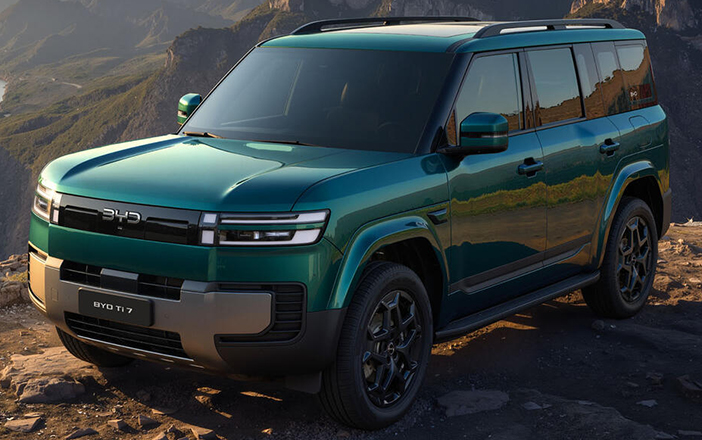
+++ BYD will add a 7-seat plug-in-hybrid SUV to its line-up later this year to challenge the big-selling Land Rover Defender. Sized between the 110 and 130 variants of the Defender, the Ti7 will be the first Europe-bound car to use the Chinese brand’s new performance-focused ‘DM-p’ powertrain. This comprises a turbocharged 1.5-litre petrol engine, 2 electric motors (1 per axle) and a 35.6 kWh lithium-iron-phosphate battery pack. Technical details for Europe-bound cars have yet to be confirmed in full, but BYD claims a 0-100 kph time of 4.8 seconds and it has an official electric-only range of 130 km. The Ti7’s chunky styling evokes classical 4x4s such as the Defender and Toyota Land Cruiser, with bluff edges and a spare wheel carrier mounted on the boot. Although it will be sold in Europe under the BYD brand, it’s effectively a larger sibling of the Denza B5 that’s also due to arrive here later this year. In their native China, both the B5 and Ti7 are sold by BYD’s upmarket, youth-focused Fangchengbao brand. Asked why the Ti7 isn’t being sold as a Denza, a spokesperson told that the differentiation is because the body-on-frame B5 was conceived as an off-roader, while the monocoque Ti7 is meant for buyers who would like rugged styling but may not need off-road capabilities. In China, the Ti7 can also be had with a battery-electric powertrain compatible with BYD’s ‘Flash’ chargers, which are capable of delivering up to 1.500 kW. +++
+++ It’s been 3 years since the FORD FIESTA went out of production, but now the supermini is set to make a triumphant return worthy of Hollywood or scripture, because it’s one of five new “rally-bred” models the brand is developing specifically for Europe. The next-generation Fiesta will be electric, which will disappoint more than a few fans of the iconic small car. However, the company says it should make up for that by combining “distinct design with Ford’s signature driving dynamics, injecting ‘race-to-road’ capabilities into the B-segment”. Hopefully that means we’re getting a new Fiesta ST, but Ford’s new product strategy is really going to lean into the firm’s proud rally heritage. Apparently the five slightly mysterious new models, all due to arrive before the end of 2029, will be “built to handle the unique challenges of Europe’s alpine passes, cobblestoned streets, and winding roads”. Ford opened the door for the Fiesta’s return late last year when it announced a new deal with Renault that gave it access to the same AmpR Small electric-car architecture that underpins the excellent Renault 5, Renault 4, Alpine A290 and Nissan Micra, plus the reborn Renault Twingo. The alliance will also allow Ford access to Renault’s battery and motor technology, granting the US brand much-needed scale in the European small-car segment. Ford will use the technology as the basis for 2 new models: the small hatchback that’ll revive the Fiesta nameplate and a small electric SUV, which will presumably replace the Puma Gen-E. Both will be designed by Ford and have unique bodies, rather than being rebadged and lightly restyled versions of the Renault models, like the new Micra. The new Ford Fiesta could arrive in showrooms as soon as 2028, because that’s when the first of the models resulting from the Renault deal are due to launch. Because it will share the Renault 5’s platform we expect the dimensions will be similar to that car’s, but the Fiesta is likely to have a sharper, more dynamic look that suits Ford’s design themes better. The new Fiesta will also have its own bespoke chassis tuning in a bid to deliver the Ford’s trademark engaging driving dynamics. The company has already used this blueprint to differentiate its Explorer and Capri from the Volkswagen ID.4, which is based on the same architecture. “We’re very confident that we can completely differentiate the customer offering”, Ford of Europe president Jim Baumbick told. “Ford will lead on the development of the design and things like the ride, steering, handling and braking to inject the uniquely Ford DNA, to support our brand positioning”. He added that the differentiated designs had already been shared with key dealers and other stakeholders to get their buy-in. Knowing plenty about the AmpR Small platform gives us a good idea of what might power a future Fiesta EV. The Renault 5, for example, is offered with a choice of 40 kWh and 52 kWh batteries; the latter boosting range to a possible 400 km on the WLTP test cycle. The bigger-battery car gets a more powerful 150 hp motor good for 0-100 kph in less than 8 seconds. The deal is all about economies of scale and getting access to a competitive platform and its manufacturing base: the new Fiesta and its electric sibling will be assembled at Renault’s ‘ElectriCity’ complex in Northern France. It’s also about moving fast: Renault is proud of having set up a brand-new R&D centre In China, which enabled it to develop the 2026 Twingo in less than 2 years. Ford will clearly benefit from the French firm’s learning, because it’s said the first vehicle from this deal will be on the market in 2028; a similar timeline to the Twingo. Jim Farley, president and CEO of the Ford, said: “The strategic partnership with Renault Group marks an important step for Ford and supports our strategy to build a highly efficient and fit-for-the future business in Europe. We will combine Renault Group’s industrial scale and EV assets with Ford’s iconic design and driving dynamics to create vehicles that are fun, capable, and distinctly Ford in spirit”. François Provost, CEO Renault Group said: “Renault Group is proud to announce a new strategic cooperation with Ford. This shows the strength of our partnership know-how and competitiveness in Europe. In the long term, combining our strengths with Ford will make us more innovative and more responsive in a fast-changing European automotive market”. Sharing the Renault Group’s EV knowhow could well allow the return of Ford’s hallowed ST badge. A Fiesta ST based on the Alpine A290 hot hatchback is a possibility, with the French car getting an uprated e-motor sending up to 220 hp to the front axle. The A290 has a thoroughly revised chassis too, with uprated brakes and a tuned suspension set-up including revised geometry and a wider track width. A revived ST would sit well with Ford’s strategy of doubling down on performance products, epitomised by cars such as the 911-chasing Mustang GTD, or the Ford Ranger Raptor pick-up with its 292 hp V6. “Look at how we’ve evolved the global portfolio: we are leaning into enthusiast products and passion products. Ford is at its best when we connect with customers at an emotional level enabling them to do things that they love to do”, Baumbick told. The deal with Renault is focused on B-segment small cars, said Jim Baumbick, where Ford is already present with the Puma Gen-E model. It’s built in Romania and powered by motors assembled in Ford’s British Halewood plant. The second EV is therefore unlikely to replace the Puma Gen-E. “I see these two vehicles as an augment to Puma”, said Baumbick. So it’s likely Ford plans to push into the affordable EV segment by launching a baby SUV paired with the Dacia Spring replacement, or reviving the Ford Ka using the Renault Twingo as a base. Ford currently partners with Volkswagen for its bigger, ‘C-segment’ cars, the Ford Explorer and Capri electric SUVs. The execution slightly differs from the Renault partnership because Ford has installed VW’s MEB platform in its Cologne plant, rather than tap into its partner’s industrial base. So don’t expect the larger of the two Ampere platforms, known as AmpR Medium, which underpins Renault’s Megane and Scenic, plus the Nissan Ariya and Alpine A390, to revive the recently axed Ford Focus as a Volkswagen ID.3 rival. And the partnership may not end at passenger cars. While still to be finalised, the 2 brands have also signed a letter of intent to collaborate on light commercial vehicles, utilising Ford’s expertise and dominance in this area. +++
+++ It seems the end is nigh for the KIA PICANTO , as bosses tell us there is simply no way to fit hybrid tech into the humble city car and that there are no plans for another generation. Ted Lee, executive vice president and head of global operations division at Kia, revealed that there’s no way of cramming the electric motors and other components for a hybrid system into the already tightly packaged Picanto. From 2035 onwards, every new car in showrooms must be fully electric. Those rules could change of course, but as it stands the pint-sized Picanto will be forced out by the end of 2034. However, Lee promised us that the little runabout will be made to meet the new Euro 7 emissions standards and Kia will apparently continue to update the Picanto for as long as possible to keep it fresh. It’s a similar strategy to what the Volkswagen Group is doing with its small petrol-powered cars, such as the Volkswagen Polo and Skoda Fabia. Whenever the Kia Picanto does leave our shores and showrooms, it will be a sad moment. It has been one of the brand’s best-selling models since it was introduced back in 2004, with more than 3 million examples sold worldwide. If you’re looking for a small urban runabout, the way to go now is clearly electric. There’s the new Renault Twingo and Volkswagen ID.Lupo arriving next year, plus Kia is working on its own cut-price, entry-level electric car that will in effect take the place of the Picanto in its line-up. All 3 models should be priced under €21.000. +++
+++ POLESTAR boss Michael Lohscheller “does not worry at all” about the brand being able to maintain its premium billing (and separation from sibling Volvo) as it eyes a huge volume uptick with expansion into more mainstream segments. The Swedish EV maker’s current line-up is weighted towards the premium end of the spectrum and inherently oriented towards lower-volume segments than those occupied by Volvo, from which it was hived off in 2017. But Polestar has plans to substantially grow its global market share and is poised to dramatically swell its sales volumes with an estate version of its 4 crossover and a compact SUV closely related to an equivalent Volvo, badged the 7. The move is part of a strategy to achieve 100.000 sales per year, up from 60.000 in 2025, in line with a push to recover from heavy losses and set the brand on a path to sustained profitability. But Lohscheller said the substantial growth ambitions and addition of more mainstream-oriented models won’t come at the expense of Polestar’s premium, sporting positioning, ensuring it remains obviously distinct from Volvo, even as it enters the same segments. Explaining that bespoke design and tuning will continue to be central to Polestar’s strategy, he said each of the brand’s upcoming cars will be obviously distinct from both competitors and the cars with which they share their platforms and technology. “We have 4 cars in the next 3 years. Polestar 5, you can’t find a more unique car than that one. Our new estate version of the Polestar 4 is also so distinct, so different; I don’t worry about any cross-shopping or cannibalisation. The Polestar 2 successor is the same thing, so unique and very, very special. And then the Polestar 7 compact SUV is super-cool; but also there we will make sure that it completely stands out. “I think our design really is good and very different. We don’t want to do cars for everybody; we want to do unique cars”. Asked if Polestar was able to continue applying bespoke dynamics to shared Geely group architectures, he said: “We put the Polestar DNA in the car, starting with design. That’s the reason we stay in Sweden; you think we like 9-month dark winters? We do it because it’s all about the Polestar DNA in terms of design, but also chassis tuning, all the suspension topics and so on”. Polestar will reveal the 4 estate in the coming months, shortly after the commercial launch of its new 5 GT flagship. Next up is the next-generation 2 saloon, which is due on sale in the first half of next year as the successor to the brand’s first series-production car, which has achieved more than 200.000 global sales since launch in 2020. Lohscheller said the aim with the new 2 is to “keep those people and give them an even better alternative”. The new Tesla Model 3 rival will be “an evolution” rather than “a revolution”, he said, and not be “a completely different car”. “We will keep the good things (the latest technology) and stay right in the sweet spot of the market and of this segment”. +++
+++ SEAT ’s product plan remains on track and its future within the Volkswagen Group is secure, despite being massively overshadowed in terms of new product by young upstart sibling Cupra. That’s the view of chief executive Markus Haupt who has re-emphasised that things are firmly on the up for the Spanish brand despite some challenges. Haupt said he is “happy” with the brand’s current performance, which included being number-1 brand in Spain in February, and that it will get new electric cars, although not for several years. “Seat has a future as a brand. With so much heritage, giving up something like that would be a nonsense”, he said. “So we need to make it happen, but in the right moment. The future for Seat beyond 2030 of course has to be electric”, continued Haupt. “The logical future for Seat would be an electric car, but with the cost situation we have now, it would be impossible to have a profitable Seat with the production costs we see on EVs”. He said once scale, time and production efficiency bring costs down, a new EV would be on the cards. “But it is nothing we need to decide this year and therefore it’s nothing we have taken a decision on, but it is a natural way”. Back in October, Seat ’s sales and marketing boss, Sven Schuwirth, identified the same difficulties around the switch to EVs. He confirmed that the Ibiza will continue and could possibly appear on an EV in the fullness of time, but that the brand’s focus for now is very much on the period before 2030. Seat’s problem in relation to its sister brand is clear. Cupra has a more premium brand position than Seat, which means it’s easier to charge more money for the newer brand’s cars. This makes EVs an easier business case for Cupra, which is why the Formentor, Born, Tavascan, Terramar and new Raval have all been launched since Seat’s last new car. Seat did facelift its Ibiza and Arona models last year, with mild-hybrid powertrains to be added in 2027. The Leon is also getting a major reskinning and hybrid power in 2028. Haupt wouldn’t be drawn on when we will next see an all-new Seat, but pledged that one will come. +++
+++ STELLANTIS has confirmed plans to begin production of a new line of “small and affordable” electric city cars in Italy from 2028. The multinational company has announced the launch of a new programme develop A-segment EVs for the European market, in accordance with the European Commission’s new E-car framework which aims to make the production of such vehicles more viable for manufacturers. Working similarly to Japan’s kei car rules, the EU’s new E-car rules will create a new category for sub-4.2 meter, EU-built EVs dubbed ‘M1E’, which will be eligible for ‘super-credits’ against manufacturers’ CO2 targets in the region. Precise requirements for the M1E category have yet to be officially detailed, but the Commission previously said it aimed to freeze regulation in the class for 10 years to give manufacturers certainty and limit the amount of ongoing investment needed. Confirming its plans to participate in the category today, Stellantis called it a “high-potential segment” that will play “a vital role in supporting the wider adoption of full-electric vehicles for convenient, everyday, city-centric mobility”. Stellantis said: “The E-car is a small, innovative, affordable and fully electric vehicle that is being developed in the true tradition of European ‘people’s mobility’, addressing the unprecedented contraction of the small affordable car segment in Europe in recent years” CEO Antonio Filosa last week cited the lack of affordable cars on the market today as “one of the major causes of the automotive industry in Europe, just because cars below €15.000 don’t exist”. He said that “affordability is possible, the project of E-car is possible” and “there is an acknowledgement that electric small cars pollute less, so they deserve special framework”. Stellantis E-cars are expected to be enter production in 2028 at the company’s Pomigliano plant in the south of Italy, which currently produces the Fiat Panda and the Alfa Romeo Tonale. It said it chose the factory (capable of building nearly 300.000 cars per year currently) on the basis of the “potential of significant production volumes” with the new E-car programme. It also highlights the site’s “long history of producing some of Europe’s most iconic and affordable cars, including the much-loved Fiat Panda” – an electric revival of which is tipped to be one of its new M1E models, alongside a similarly conceived Citroën. Autointernationaal.nl previously reported that Fiat was planning to launch a new entry-level Panda model to sit beneath the high-riding Grande Panda, riding on the STLA City platform that underpins the Fiat 500 and built at Pomigliano. Fiat boss Olivier François told he expected “the design of the replacement Panda to be a bit closer to the original Panda of the ’80s” and described it as the “baby bear” to the Grande Panda’s “mama bear”. Citroën is also working on its own plans for a spiritual revival of a legendary ‘people’s car’ for the new M1E class, channeling the ethos of the 2CV for a new entry-level EV to sit beneath the C3. Citroën boss Xavier Chardon echoed Filosa’s sentiment that the European car market was declining because of the erosion of the cheap car segment and pledged to give “buying power” back to motorists in the region, just as the 2CV did in France in the wake of World War II. “The European market is the only one that has not recovered after Covid,” Chardon said. “The United States is back, China is back, even South America is back and we are still missing 3 million people buying new cars each year in Europe. And I would say 60% of that is driven by the simple fact that you don’t have any cars any more below €15.000. “It’s quite a sad story that the average age of cars has increased by more than 2 years in the last 5 years. We are above 12 years now in average in Europe. So that’s why you need to motivate people to buy new cars and to be affordable”. Stellantis hasn’t yet confirmed, however, whether the mooted Fiat and Citroën models are among the M1E models it will build at Pomigliano; Filosa said only that the company plans to “answer the call” for more affordable cars with “exciting new models for multiple brands”. This is the latest in a string of high-profile Stellantis announcements made in the run up to its annual investor day presentation this Thursday, during which bosses will give details on the company’s future strategy. Details of the E-car programme are expected to feature, but one main focus is expected to be on the increasing importance of Stellantis’s partnerships with other car makers, which Filosa touted last week as a central pillar of its plans going forward, in all key regions. Stellantis recently expanded its partnership with Leapmotor to include the development of a new Vauxhall SUV based the Chinese firm’s EV platform and last week announced a new deal with Dongfeng to produce a pair of new Jeeps and a pair of Peugeots at its Wuhan plant in China for local and global sale. +++