
+++ BYD isn’t joining the industry’s race to deliver solid-state batteries in electric production cars, at least not yet. The Chinese giant’s executive vice president revealed that it sees existing battery technology delivering a better balance of price and low running costs in the immediate future. A number of car brands have been pushing solid-state electric car batteries as the next big thing in the quest for EV adoption. As well as being smaller and lighter than the lithium-ion units you’ll find in many current electric car models, they look set to be far safer, too. However, there’s just one problem: EV solid-state batteries are still yet to go mainstream. My hope was briefly raised when BYD applied for some new battery patents very recently. But the firm’s executive vice president struck a more cautious note. Stella Li told: “BYD is in a leading position for solid-state technology, but at this point in time our second-generation Blade battery is much better in terms of efficiency and cost. I don’t think that solid-state is ready for the mass market yet”. While they’re fundamentally the same lithium-ion units that you’ll find across the market, BYD’s Blade packs are integrated into the car’s structure. The ongoing rollout of BYD’s Flash Charging tech could also mean that solid-state batteries need to offer even greater advantages over the existing packs when they do finally arrive in production cars. Some car brands are still optimistic that they can launch solid-state battery technology within the next couple of years, including Changan which is about to begin in-vehicle testing. Other brands, such as MG, have instead launched semi-solid-state packs as an interim solution. Although the automotive world is struggling to get this tech fully off the ground, solid-state batteries can already be found within smaller devices such as medical implants. So, it’s more a case of massively sizing up as opposed to creating from scratch. For now, Nissan reckons it will have at least one fully solid-state car on the road in 2028, and we’ve already spotted a prototype BMW i7 undergoing testing. The race is on whenever BYD decides to join it, so be sure to watch this space. +++
+++ It’s easy to think that during development of a new car that engineers and designers would argue most over styling, powertrains or whether buyers want one option or another. While speaking with LEXUS ES chief engineer Kohei Chiashi during the new first-drive launch event, I learned the fiercest internal debate centered on something far less glamorous: shock absorbers. Not batteries. Not horsepower. Not giant touchscreens. Dampers. When I asked Chiashi what tuning decision created the most debate during development of the all-new ES, his answer was immediate. “We discussed shock absorbers until the very end”, he told. “We have to offer good road feel, but balance it between comfort and connection. We went back and forth with the dampers about where to set them in the final car”. That answer says a lot about Lexus’ priorities. The ES has never tried to be a sports sedan. Instead, it’s always revolved around comfort, refinement, and making long drives seem effortless. Earlier during our conversation, Chiashi described modern Lexus driving character as creating a car that responds naturally to driver inputs while ensuring that after hundreds of miles, “nobody in the car should be tired”. Naturally, suspension tuning becomes a balancing act. Too soft, and the car feels disconnected. Too firm and you start introducing fatigue, harshness, and unnecessary road impacts into the cabin. Interestingly, Chiashi also told the single biggest improvement to ride quality came from the ES’s new body structure. According to him, the more rigid platform created a stronger foundation for improvements in ride, noise isolation, and vibration control. Lexus also switched to a multi-link rear suspension setup, improving not only comfort but straight-line stability as well. Perhaps earlier in the development process, the team argued over things that couldn’t be changed late in the game. Regardless, it’s interesting to know that Lexus debated the damper tuning right up until the pre-production cars rolled off the line. +++
+++ MG is strengthening its presence in Europe with a €200 million investment to build the brand’s first production plant in continental Europe. The plant will be located in Galicia, Spain, and represents a central step in the European development strategy of the carmaker controlled by the Chinese group SAIC Motor. According to the company, the project constitutes ‘a milestone in MG’s long-term commitment to the European market’ and is part of the strategy called ‘In Europe, for Europe’, with which the brand aims to consolidate its industrial presence on the continent. The plant will come into operation in 2028 and will have a production capacity of up to 120 thousand vehicles per year. The site is set to become a strategic hub for MG’s next phase of growth and should generate over 2.000 jobs in Europe. The new industrial complex will integrate research and development, advanced manufacturing, key component supply and intelligent logistics operations. The aim is to create a fully connected industrial ecosystem capable of tracking the entire production chain. The platform will also enable the expansion of local production and sourcing, strengthening the resilience, responsiveness and agility of the European brand supply chain. Not only that. MG also intends to strengthen collaboration with European technology partners, research institutes and local suppliers to accelerate innovation in some of the areas considered most strategic for the future of the automobile. These include next-generation batteries, intelligent mobility systems and clean energy solutions. “The new European plant represents a very important step and once again testifies to the concreteness of the MG project. From 2028 we will have localised production, constant investment in research and development and a customer-focused approach to innovation, to strengthen our commitment to Europe”, said Andrea Bartolomeo, Country Manager and Vice President of SAIC Motor Italia. +++
+++ MINI has “almost finished” work on a range of significant facelifts that will herald a new era for the brand under design chief Holger Hampf. The German joined Mini from Designworks, BMW’s Californian design consultancy, in October 2024 but has yet to have an opportunity to make his mark, given how new the British marque’s range is (the Cooper and Countryman arrived in 2023 and the Aceman a year later). In a meeting with media, Hampf told that “you will see my work in an upcoming LCI” (‘Life Cycle Impulse’ being the BMW Group’s term for a major model update). Hampf said this will be an “important milestone” for the Mini brand, steered by “customer feedback from this generation”. Given the line-up is still relatively fresh, it’s likely that a restyled Cooper and Countryman will arrive late next year and a refreshed Aceman in 2028. To this end, Hampf also hinted that Mini is working on an off-road-focused variant of one of its existing models, saying: “We’ve witnessed the trend of the outdoor lifestyle and driving out of the city to spend some days in nature. Can our car do this? Certainly, so expect something in that direction”. This would most likely be based on the Countryman, given that it’s the only Mini currently available with four-wheel drive and its raised ride height would lend itself naturally to such a “lifestyle” vehicle. While Hampf’s initial focus will be on facelifts, he did confirm that work has also begun on the next entirely new generation of Minis, which are expected to arrive in the early 2030s. Of the Mini brand’s many design signatures, Hampf highlighted proportion as the most important, saying: “You can ask a Brit or a German or an Italian (you can also ask a 5-year-old) and they will recognise a Mini based on the proportions of the car, especially when it comes to the Cooper”. To that end, Hampf committed to the future of the 3-door variant, despite all rivals having abandoned this format, saying: “The three-door hatch will always be our anchor and it will always be the product that we will care for as much as possible. “You’ve seen some experimentation with the Countryman’s size and even the Cooper has grown in size, but that’s not necessarily a design decision: it’s based on pedestrian safety, sensor technology, regulations and the customer’s desire to have ADAS functionality in their cars”. “Mini has the largest portfolio in its history”, said Hampf, pointing to the 3-door and 5-door Coopers, Convertible, Countryman and Aceman. “That’s good for now. However, you see we’ve always explored how to branch out from the Cooper and offer more”. Hampf has gone through Mini’s back catalogue of concept cars to inform any new opportunities and he said he “loves things like the Urbanaut (a MPV) and the Rocketman (a city car)”, while the Superleggera (a roadster was “super-nice”. Nonetheless, “there has to be a business proposition” for any new model that Mini does decide to build, and Hampf asked of the Superleggera: “Is it only for fun?” As for the Rocketman, the 2011 vision of a Mini closer in size to the 1959 original, Hampf said: “The size discussion about Mini (growing smaller or bigger and so on) we have every day. “You have to see what’s happening in the world: as long as people prefer to buy bigger cars than smaller cars, it can be dangerous for a business to say ‘we’ve watched the micro-mobility market and there are certainly cities like Paris, Madrid or Milan where this works really well’. Quite frankly, I’m 1. 9 meter tall. Maybe this is my personal opinion, but a Mini was always good for going out to the market in the morning, driving your kids to school and going to the opera in the evening. Try to do that with some of these concepts”. Hampf added: “I can’t do things that aren’t cool. I’m not saying that going smaller is not a possibility, but it has to fit into today’s lifestyle as well”. John Cooper Works, Mini’s high-performance sub-brand, is expected to adopt more distinctive styling to further set its cars apart from regular models. Hampf said there is “air to the top” of the JCW range and drew a parallel with the differentiation between BMW’s M Competition and M performance cars, suggesting that a more extreme take on the Cooper-based JCW hot hatch is in the works. This won’t be another track-focused GP model, however, suggested Hampf: “We’ve done something right in not only thinking of the GP, which we’ve done in the past”. Hampf pointed to Mini’s recent collaboration with fashion brand Deus Ex Machina as “one experiment” regarding the evolution of JCW, with “bigger tyres and bigger spoilers”. It is possible that, given “such positive response” from the public, toned-down versions of the two Deus Ex Machina concept cars (named The Skeg and The Machina) are being primed for production. A record 25.630 JCW cars were sold last year, an increase of 59.5% compared with 2024. Mini pointed to the United Kingdom, Japan and Australia as instrumental markets. Mini CEO Jean-Philippe Parain recently told that there are “still some possibilities” to expand the JCW offering, saying that it would push the hot hatches “very strongly”. +++
+++ ROLLS-ROYCE has updated its Spectre electric coupé, giving the ‘Series II’ a longer range, a raft of new personalisation options and more power than any previous Rolls. This comes 4 years after the British luxury brand introduced its debut EV, which has since surpassed the V12-powered Ghost coupé and Phantom limo to become its second-best-seller, after the Cullinan.
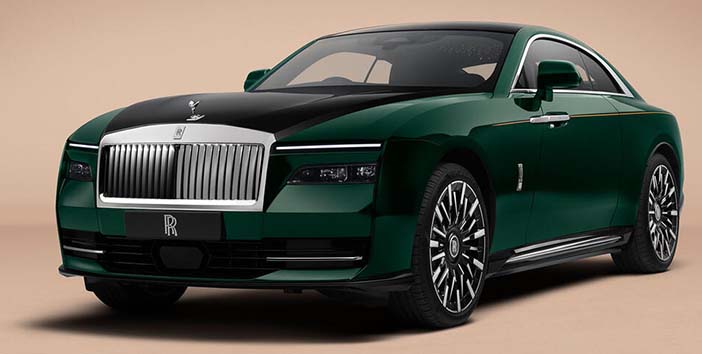
The Series II brings a host of technical advancements that should feature on Rolls’ second EV, a Cullinan-style large SUV expected in 2027. Chief among these is a new battery cell technology, coming courtesy of parent company BMW. It is said to increase the Spectre’s maximum range by 18%, from 528 to 620 Km and cut charging times by 14%. The new ‘Gen6’ cylindrical cells are the same as those fitted to the facelifted BMW i7, where they boost range and charging speeds by a similar amount by virtue of better cooling and greater energy density. Like the i7, however, the Spectre continues to use a 400V electrical architecture. Both versions of the Spectre are now more powerful. The standard dual-motor, four-wheel-drive powertrain puts out 600 hp, up from 585 hp, while the more performance-oriented Black Badge edition gains a 21 hp uplift to pump out 682 hp; as much as a Le Mans hypercar. Torque is up too: in Normal mode, the regular Series II has as much as 1.000 Nm at its disposal, while the Black Badge can call on a thumping 1.100 Nm in its Spirited mode.
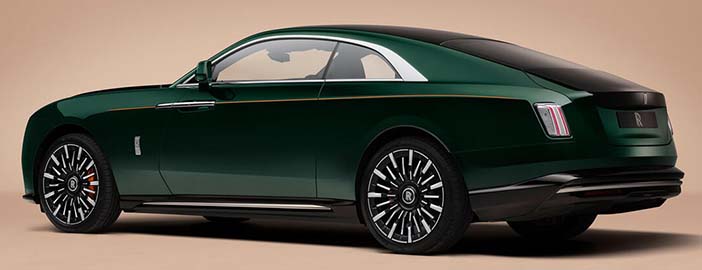
Equal focus has been placed on expanding the range of personalisation measures that Spectre buyers can apply through Rolls-Royce’s increasingly lucrative Bespoke division. As well as a new Ethereal Blue factory paint option and striking hand-finished 23 inch wheels, the Spectre can now be equipped with a “significantly expanded” range of interior trim options and an iced Black exterior package that swaps most of the chrome elements for matt black items. Rolls-Royce quotes an entry price of €400.000 for the Series II but, because so many are so intricately customised, it’s rare that 2 examples of the Spectre are the same and many cost far more than that. The average Rolls sold ends up costing more than €600.000. New for the Series II is a bamboo-based rayon upholstery embroidered with an ‘RR’ logo pattern. It can incorporate up to 2.6 million stitches and 10 miles of thread and takes up to 25 hours to put together. Buyers can have their leather seats laser-cut to reveal ‘unique artworks underneath’. This night sky motif comprises nearly 80.000 individual holes. A led dashboard display (inspired by the mist of the South Downs in Sussex) as been expanded across the car and now features 8.108 individual pixels. There’s a new clock too, influenced by ‘aviation instruments’. ‘Tiger stripe’ veneer is made using wood from non-fruiting walnut trees and eucalyptus fibres. It’s sealed with ‘a fine powder of glass flakes’ for a shimmering effect. +++
+++ Future models from the various brands that make up the STELLANTIS empire will be more differentiated despite the increasing use of common platforms and technology, according to the firm’s European boss. The firm, whose 14 brands including Alfa Romeo, Citroën and Opel, recently announced a 60 billion transformation plan that will include 110 new models. The move will involve significant cuts in spending, the use of new, shared platforms and 70% of investment going to four key ‘global’ brands: Fiat, Jeep, Peugeot and Ram. Stellantis will introduce a new architecture, STLA One, that the bulk of those new vehicles will be built on, with increasing shared technology. Despite that consolidation Emanuele Cappellano, Stellantis’s European boss, told that the plan will actually lead to greater differentiation between brands. “We really don’t want to be misunderstood when we talk about what is a global brand, what is a regional brand, which is a specialty brand”, said Cappellano. “We are not ranking the brands in terms of relevance. The point is how we can be smart in terms of capital allocation. The main difference between a global brand and the regional and specialty brands is just the timing for the first application of investment. So with the STLA One platform for the B- and C-segment, Peugeot is the global brand. That means we are going to invest first in launching a Peugeot-branded model on that new platform, new electric architecture, the STLA Brain software stack and new technology like steer-by-wire. In the meantime, we are working on the following launches on the same platform, where most of the effort, in terms of capital expenditure, is on really diversifying, the models and line-up, and not just rebadging. So you’ll have the new Peugeot first and after that you’re have a new Opel that is not a rebadged Peugeot, then an Alfa Romeo, a Jeep or whatever”. Cappellano said that the investment on each model would go on design first “because we need to change the design, body type and shape and brand attributes”, along with “all the features that are characteristic for each and every brand. “What we understood, and this is basically what is the driver of this decision, is that our brands, especially the mainstream brands, are recognised for very specific product attributes. So we need to enhance those product attributes in the future with investment for that brand”. Cappellano insisted that STLA One is an entirely new architecture and not a development of the STLA Medium that it effectively replaces, because “the only way to be competitive in BEV is to have a dedicated native EV platform”. +++
+++ Data suggests the shift from petrol to electric is gaining momentum at the dealership level in the UNITED STATES . In January of this year, 67.1% of new EV purchasers at dealerships traded in a petrol car. In April of this year, that figure had jumped to 72.1%. And it’s not just a first-time fad. Repeat EV purchase data also show an increase. Numbers for January 2026 show that 26.2% of buyers traded in an old EV for a brand-new one. That figure leaped to 35.4% in April. Worth noting: this uptick comes despite the removal of the federal $7,500 EV tax credit and several state-level incentives. So, is this a definitive trend, then? Speaking to CNBC, Ivan Drury, Senior Director of Insights at Edmunds, says it’s too early to draw a concrete conclusion, or to say whether it’s just the effect of the Middle East War and its resulting runaway fuel prices. “Oil and gas prices started rising after the U.S. and Israel attacked Iran on February 28. About three more months of high gas prices and elevated EV trade-in numbers will give a better indication of whether customers feel pinched enough at the pump to consider a switch”, says Drury. With auto prices rising across the board, whether you buy a brand-new car or a used one, the chances are you’ll be paying more for it now than you would have 6 months ago, and much more than in 2020. According to Cox Automotive, their Manheim Used Vehicle Value Index is approximately 4% higher than at the same time last year. And they’ve seen EVs leading the charge, with price increases notably higher than regular petrol-powered vehicles. “Additionally, we continue to see EV prices rising faster and holding higher than non-EVs. 3-year-old EV prices have outpaced non-EVs for 6 weeks in a row and are 11% higher than they were at the start of the year. The longer petrol prices remain elevated, the more we expect consumers to turn to fuel-efficient vehicles. “As EV lease maturities continue to increase throughout the summer, it will be critical to follow EV price trends, especially if the Middle East conflict remains unresolved”, says Jeremy Robb, Chief Economist at Cox Automotive. So, it seems that buyers are willing to pay more upfront if it means lower running costs, which EVs have offered for quite some time now. It’s no surprise to see that out of all the categories analysed by Cox Automotive, used petrol-powered SUVs and crossovers have appreciated by just 0.3% on average since last year. Given their gas-guzzling tendency and resultant tugging at pocket strings, it’s to be expected. Equally unsurprising is the fact that compact cars, a relatively fuel-efficient segment in the internal combustion engine class, saw the second-highest increase, at 7.6%. As Drury would likely agree, the data points in an interesting direction, but it’s still too early to call it a structural shift rather than a gas-price reaction. +++