
+++ The agonizing wait is finally over for the most anticipated American hybrid sports car of the decade. The iconic Bowling Green assembly plant in Kentucky has officially commenced production of the CHEVROLET CORVETTE GRANDSPORT X . According to the latest unofficial C8 production tracker updates, the very first customer vehicles slowly rolled off the factory line and into the sunlight on August 17.
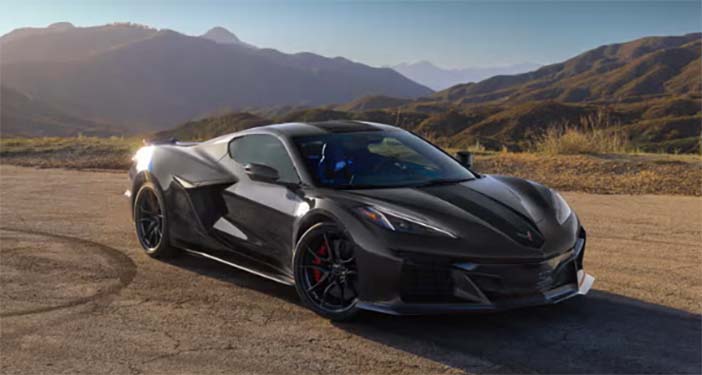
While the initial assembly rate is admittedly sluggish, mirroring the incredibly slow ramp-up phase experienced by the outgoing E-Ray, the fact that customer cars are clearing the line and entering the shipping phase is a massive win. If you have studied the stunning visual reveals recently published, you know exactly why enthusiasts are desperate for this wide-body beast to hit the streets. Higher output targets are scheduled for the coming weeks as GM prepares to handle these manufacturing complexities. Replacing the E-Ray in the Corvette range for the 2027 model year, the Grand Sport X brings a massive performance paradigm shift. It pairs an entirely new 6.7-liter LS6 small block engine, which produces 535 naturally aspirated hp on its own, with a front-mounted electric drive unit. This potent self-charging hybrid setup delivers incredible combined output. Confirming earlier estimated power figures, this all-wheel-drive monster generates 721 hp and 900 Nm. Visually and structurally, the Grand Sport X borrows the aggressive, widened stance of the C8 Z06. It acts as the perfect middle ground between the combustion-only Grand Sport and the track-destroying variants. For Americans ready to write a check, the Grand Sport X coupe starts at $109.700 before destination charges, while the drop-top convertible demands $116.700. The standard Stingray remains the entry point at $71,000. For the Dutch car market, this means €240.000-€245.000. Trim levels follow the familiar LT nomenclature rather than the LZ badges used by higher-tier track cars. The base 1LT offers Mulan leather GT1 seats and an 8-inch touchscreen. The sweet-spot 2LT adds the Performance Data Recorder, a head-up display and 14-speaker Bose audio. The top-tier 3LT brings extended leather, suede microfiber, and carbon-fiber interior accents. Buyers can also spec the Z52 track performance package for upgraded aerodynamics, brakes and suspension. The introduction of the Grand Sport and Grand Sport X completely redefines the C8 generation hierarchy, and we are already seeing the market react to this monumental shift. General Motors made a bold move by sharing the new free-breathing LS6 V8 with the Stingray but retaining the Stingray’s narrow-body design from the LT2 era. Because buyers crave that aggressive wide-body look combined with the potent new powertrain, the mid-tier model is overwhelmingly cannibalizing Stingray sales across dealerships nationwide. In my view, the Grand Sport X is the absolute sweet spot in the modern Corvette lineup. It gives you the blistering off-the-line electric torque of the old E-Ray but backs it up with a vastly superior, larger-displacement V8 engine that actually sounds like a proper American supercar. While the sluggish initial production figures are mildly concerning for those stuck on waiting lists, the sheer performance value GM is offering at just under $110,000 makes this hybrid an undeniable triumph on paper. +++
+++ Automakers from CHINA are increasingly shifting from exporting vehicles to building them in Africa, betting that rapid urbanization, a growing middle class and supportive government policies will make the continent one of the industry’s last major growth markets. It’s part of a strategy for coping with slowing demand at home and rising trade barriers in Europe and North America. Analysts say the shift could reshape Africa’s automotive industry by creating jobs, developing local supply chains and accelerating adoption of electric vehicles, although weak infrastructure and policy uncertainty remain significant obstacles. In July, Chery, China’s largest auto exporter, acquired Nissan’s former Rosslyn plant near Pretoria, South Africa, where it plans to make plug-in hybrids, battery-electric vehicles and models under its Jetour brand. The move reflects a broader strategy by Chinese automakers to manufacture closer to African consumers rather than rely solely on imports, though the trend is just getting started. Beijing Automotive Group (BAIC) has an automotive manufacturing and assembly facility in Gqeberha (Port Elizabeth), South Africa, and China’s Great Wall Motor has some localized assembly and component distribution capacity. “Africa has become known as the next frontier for the automotive market,” said Hiten Parmar, executive director of The Electric Mission, a South African non-profit promoting sustainable mobility. Analysts say South Africa, Morocco, Kenya, Ethiopia and Ghana are among the countries best positioned to attract Chinese EV investment because of their industrial capacity, supportive policies or growing electricity infrastructure. Morocco also benefits from proximity to European export markets, while Zimbabwe’s large lithium reserves could support battery supply chains. Local manufacturing could eventually lower vehicle prices by avoiding import duties while stimulating investment in charging infrastructure, component manufacturing and battery production. Africa’s first large-scale battery gigafactory is already planned in Morocco. Rapid urbanization, rising incomes and the relative affordability of Chinese brands are enabling Chinese automakers to capture markets historically dominated by European, Japanese and American giants. “Whilst African consumers have been thriving on used cars, the affordability of Asian brands is providing a wider accessibility reach for new vehicles”, Parmar said. Nick Hedley, an energy transition research analyst at Zero Carbon Analytics, said Africa’s fast-growing population and expanding middle class create a natural market for affordable electric vehicles while helping governments reduce dependence on imported fuel. “Africa is also a net importer of refined fuels, which drains foreign reserves and weighs on local currencies and budgets”, Hedley said. “Switching to local electric cars for transportation is in African countries’ national interest. As electric vehicles become more cost-competitive, their uptake will accelerate across Africa, and Chinese automakers will benefit”. The shift is also being driven by changing economics inside China. Tombo Banda, managing director of CrossBoundary Energy, said Chinese factories are producing more vehicles than the domestic market can absorb while exports face mounting barriers. “Onshoring production on the continent is a sound long-term investment”, Banda said, noting that local manufacturing helps companies navigate tariffs while positioning themselves closer to fast-growing markets. A Green Minerals Strategy adopted by the African Union aims to increase domestic processing of critical minerals. That would make more usable raw materials available locally. Ethiopia has banned imports of fossil fuel-powered vehicles and is encouraging local production by mandating lower import duties on EVs assembled domestically. South Africa has taken a different approach, using production incentives like customs duty rebates, production-linked credits, direct cash investments, and tax breaks to encourage investment in electric- and hydrogen fuelled-vehicle manufacturing. “This is becoming a notable change in approach from Asian brands, from pure imports, to considerations of assembly and manufacturing”, Parmar said. Africa is increasingly positioned to become more than just a destination for imported vehicles. “If Chinese manufacturers want access to these markets, they need to add value locally rather than simply sell into them”, Banda said. “That is what will move Africa from a sales market to a genuine manufacturing base”. South Africa already has manufacturing capacity, skilled workers and established export markets, Banda said. Purchasing facilities such as the Rosslyn plant can enable automakers to retool existing factories rather than build new ones from scratch. “Companies can pivot, or enter partnerships, far faster than anyone starting from scratch”, he said. But he cautioned that converting factories designed for internal combustion engines is complex and requires long-term certainty on taxes, tariffs and industrial policy. Stable policies are essential, since sudden changes in taxes or regulations can undermine investor confidence. Reliable infrastructure is also vital. “Without clean, reliable, affordable electricity, forget about operating EVs. Without sufficient, well-located charging, forget about functional EVs”, Banda said. +++
+++ Just a few hours ahead of the GENESIS GV90 official unveil, it looks like it was leaked. These are the first photos of the regular GV90 and GV90 Coach Door. Serving as the largest, most powerful, and most luxurious model in the brand’s line-up, the all-electric flagship turns the acclaimed Neolun concept into production reality. Spanning an imposing 528 cm in length, the GV90 directly targets heavyweights like the Mercedes-Benz EQS SUV and Lucid Gravity.
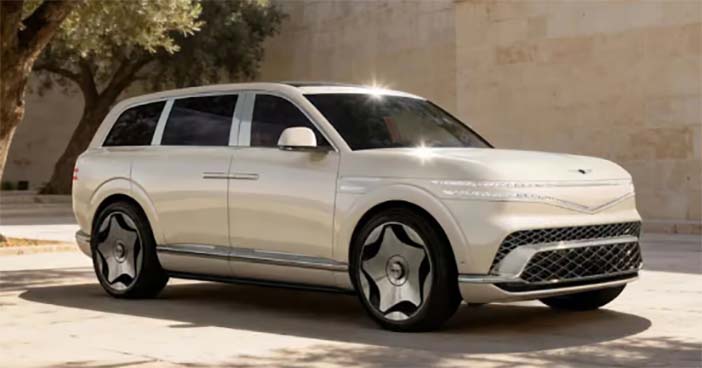
The lineup divides into 2 distinct configurations: a versatile 3-row family layout with conventional doors and the ultra-exclusive GV90 Neolun, a 4-seat lounge featuring pillarless coach doors. Both versions have dual-motor all-wheel drive generating 657 horsepower. The battery pack has 123.5 kWh capacity. Genesis estimates a range up to 500 km on a full charge. Recharges from 10% to 80% takes 22 minutes on a 350-kW DC fast charger. Height-adjustable air suspension, paired with rear-wheel steering for tight-turning agility, is standard.
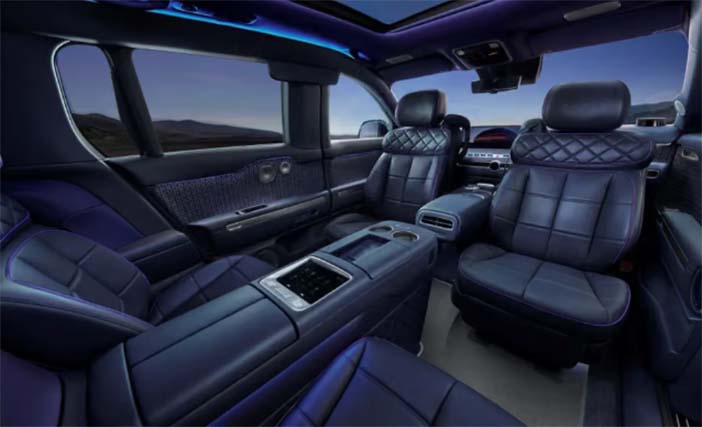
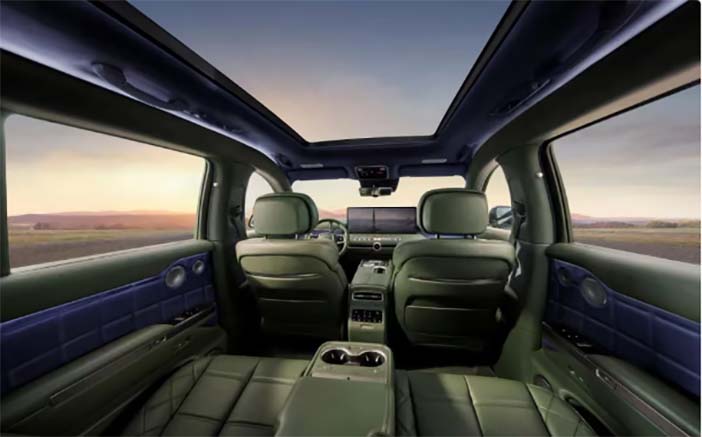
The highlight of the lineup is the ultra-luxury GV90 Neolun. Taking cues from bespoke coachbuilders, it removes the visible B-pillar to create an unobstructed entry. Power-operated rear doors slide backward before swinging outward, opening fully independently from the front doors. When parked, the front row can rotate completely to face the VIP rear chairs in a lounge configuration. Veneer real-wood flooring, wool cashmere accents and 5 mm acoustic glass throughout the cabin ensure quiet refinement. Standard 24-inch wheels fill the widened arches. Genesis eliminated the traditional start/stop button in favor of an automated entry sequence. The GV90 activates as the driver approaches; closing the door brings the drive selector toward the seat, making the vehicle ready to drive as soon as the brake pedal is pressed.
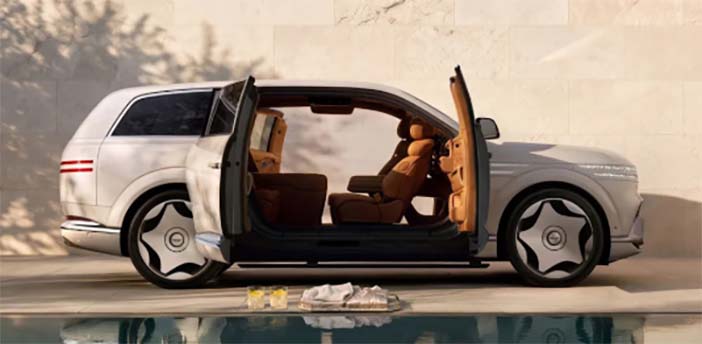
A 23.6-inch OLED screen running Pleos Connect software rises an additional 3.4 inches vertically when parked for widescreen video viewing. 16 gloss and matte exterior paint finishes paired with unique 2-tone cabin palettes, including indigo/green, brown/blue, and purple/beige. The standard GV90 (Three-Row) is expected to cost €140.000 in The Netherlands. The GV90 Neolun (Four-Seat Lounge) is expected to get a starting price around €210.000, directly targeting Mercedes-Maybach territory. An exclusive launch edition of the Neolun featuring 2-tone exterior paint, body-coloured wheels, cashmere upholstery and bespoke badges. +++
+++ HYUNDAI has applied to protect 2 new trademarks, both of which were filed in the United States and Canada. The trademarks are for the names “Hyundai N (Hybrid Hydrogen) Vision 74” and “Hyundai N74”, the latter of which is likely what a production version would be called. The name is a reference to the Hyundai Pony Coupe concept from 1974, whose design inspired that of the N Vision 74, but the powertrain proposed for the supercar concept is much more forward-thinking, with a 679 hp rear-drive hydrogen fuel cell hybrid powertrain. Combine potent power with Hyundai’s expertise in making electric vehicles exciting, and the N74 would be almost guaranteed to be fun to drive. It also looks unlike anything else on the road today, and protecting associated trademarks seems like evidence that Hyundai still has plans for the concept, despite the scarcity of hydrogen filling stations anywhere in the world. I have three theories for what Hyundai might do next. Theory number 1 is that Hyundai is imminently planning to offer a limited run of production N Vision 74 supercars. Earlier reports had suggested Hyundai was planning to produce 200 units in early 2026, and although that clearly hasn’t happened yet, Hyundai’s plans may have simply been delayed slightly, and it could still be on course to offer a limited-edition N74 before 2026 comes to a close. Exclusivity would help justify an undoubtedly high asking price, and having a decorated designer associated with the project doesn’t hurt either. Theory number 2 is that Hyundai filed 2 trademarks to muddy the waters. Perhaps it plans to launch the N Vision 74 without the hydrogen component, selling a pure EV. Perhaps it plans to wrap the concept’s styling around a more conventional combustion hybrid. Or perhaps it plans to do away with electrification altogether and thus make the supercar more appealing. The last seems the most profitable, but Hyundai likes pushing the envelope, so it is simultaneously the most unlikely, but the N74 name could work with any of these options. Finally, theory number 3 is simply that Hyundai is protecting the trademarks in one of its most important markets with an eye to launching a production N74 at some indefinite point in the future, with no imminent plans laid. Considering that the timeless retro-futuristic styling is not directly associated with any other Hyundai product and could easily get lightly revised lighting to make it more contemporary or futuristic, and considering the fact that Giorgetto Giugiaro’s rinsed-and-repeated wedge shape will always be celebrated, Hyundai could sit on this design for years to come. Perhaps once Genesis is done testing the waters at the deep end of the luxury market, Hyundai can take a shot at a supercar with its own badge on the hood. +++
+++ MERCEDES-AMG has revealed that the current-generation C-Class, which just received a mid-cycle facelift, likely won’t receive its new 4.0-liter twin-turbocharged V8, not even in C 63 guise, dashing hopes that the company’s BMW M3 competitor would finally get the engine it so desperately needs. Given that a slew of new models from AMG will get this engine, now fitted with a flat-plane crank and Euro 7 emissions-compliant, including new flagship versions of the CLE Coupe and CLE Cabriolet, many had assumed the current C-Class would follow suit. Sadly, Mercedes head of product management and global training, Klaus Rehkugler, says it probably doesn’t make financial sense to give the C-Class this engine. “We have announced that you will see a true V8-powered performance car in the form of the CLE coupe and cabrio, but most likely not in the C-Class”, he revealed. “Although the C 63 was a very popular car in several markets, including North America, Australia, Japan, China and Korea, we’re not planning a return of the V8 model. It comes down to a question of ‘can you get the amortization back given the remaining lifecycle of the current C-Class?’ and the answer is ‘probably not’ ”. This leaves the future of the current C 63 somewhat up in the air. Production of the current plug-in hybrid four-cylinder model is expected to end imminently, if it hasn’t already ended as per reports from late last year. Mercedes-AMG is said to be preparing a new C 53 using a non-hybridized engine to fill the void left behind by this model, although it obviously won’t quite match the C 63 in the performance stakes, despite having 2 more cylinders. Where does this leave the C 63? Mercedes has been building the current C-Class since 2021 and just took the wraps off a thoroughly updated model. A next-generation version, potentially arriving in late 2028, is on the agenda, and Rehkugler failed to rule out the possibility of this version eventually getting the V8. What he did say is that Mercedes should be able to keep its new V8 alive for at least another 10 years, leaving the door open for a next-generation, 8-cylinder C 63. +++
+++ TOYOTA has hinted at a new, 8th-generation Celica for the last few years. Company executives started showing their interest in 2023, and then, in late 2024, Toyota’s chief technology officer just blurted it out: “We will make the Celica”. Since then, Toyota and its executives have been quiet about the car. Dealers supposedly saw the vehicle last year, and development prototypes are already on the road. Toyota was caught testing a new rally car that further fueled speculation about the Celica’s return; the Celica raced in the World Rally Championship in the late 1980s and early 1990s to great success. I know Toyota wants to expand its GR line-up, spinning off Gazoo Racing into a separate performance brand, which will need products. It remains unclear if the new Celica is front- or mid-engine. Toyota has confirmed a new mid-engine car is in development, but it is still several years away. That likely means Toyota’s next GR product will be the new Celica Mk8. The automaker has been talking about it long enough, and it seems we are closer than ever to the car’s return. Here’s everything I know about the new Celica: Toyota will likely call its new sports car the Celica, with the automaker already trademarking the GR Celica name in certain countries. The automaker might even go as far as to call it the Celica Sport, according to some of the latest rumours. This might be the car’s official name, or a trim. Toyota first used the Celica name over half a century ago. The first-generation model, launched in 1971, was a front-engine, rear-wheel-drive coupe that would last for 7 generations. The Celica would leave the American market after the 2005 model year due to declining sales. In its last year, the coupe had a 1.8-liter four-cylinder engine that produced up to 180 horsepower in the GT-S. If the new Celica is anything like its predecessor, it will be a simple front-engine coupe. I expect the Celica to have a driver-focused cabin with a digital display and an infotainment screen on the dashboard. It should have sporty seats and paddle shifters for automatic-equipped cars. Toyota is developing 1.5-liter and 2.0-liter 4-cylinder engines, but it appears the automaker will utilize a turbocharged version of the larger one in the new Celica. The turbocharged 2.0-liter engine, called the G20E, is allegedly derived from Toyota’s 3-cylinder G16E that powers the current GR Yaris and GR Corolla. Toyota has said the new G20E could make between 400 and 450 horsepower, with a larger turbocharger capable of increasing that to more than 600 hp, which we will likely see in a race version. There’s also the possibility of electrification, with rumours suggesting the new Celica will have a hybrid powertrain capable of 500 hp. We expect manual and automatic transmission options, and all-wheel drive will be available. The automaker first announced the G20E in 2024 as part of a family of new, smaller, more efficient engines. One report alleged that the new powertrain would begin appearing in Toyota vehicles by the end of 2026, and while the automaker continues to develop the engine, it successfully tested it in competition last October. While Toyota has dropped plenty of hints that it is developing a new Celica, it has not provided any details about when it could debut. Development prototypes are already on the road, and dealers got a sneak peek at the car last June. At the time, Toyota’s vice president of product planning in North America said the sports car was in “pretty advanced development”. While nothing has been confirmed, including whether it will even go on sale in the United States, I would not be shocked if the automaker unveiled it later this year or early next year. +++
+++ VOLKSWAGEN is in the midst of undoing one of its most controversial interior-design decisions: replacing conventional buttons and knobs with touch-sensitive keys, sliders, and capacitive steering-wheel controls. Early signs are encouraging, with the ID.3 Neo bringing back more traditional buttons while eliminating the hated temperature and volume sliders, which weren’t even backlit in the early days. The ID.Polo and ID.Cross are another step in the right direction, as both have individual switches for all windows, like every car should.Now, the company has offered a surprisingly candid explanation of why it went down that road in the first place. Asked why Volkswagen, like many other automakers, believed electric cars needed radically different controls, the company essentially admitted that it was trying to predict the future without having enough customer data to know what buyers actually wanted. The reasoning, according to the company’s Head of Quality Assurance, was understandable at the time. With electric vehicles representing a fundamental change in propulsion, there was a belief that everything around them should feel equally revolutionary. In an interview, Andreas Krepp explained the thinking process: “What seems obvious to you or me today may well be viewed quite differently at a certain point in time. Then someone says, ‘People won’t want that at all in the future’. And when there’s a lack of reliable customer data, a lot of things are simply tried out. With electric vehicles. including here at our company, here was this idea: Something new is beginning (electric vehicles), so the controls must also change significantly and be particularly modern. For example, we said, “Let’s install sliders instead of traditional rotary knobs. That’s the future”. Then we learned that customers who buy an electric vehicle are primarily looking for a different type of powertrain. They don’t automatically want to buy a spaceship. To me, this is a good example of the ability to learn. We listened, took customer feedback seriously, and acted on it. Today, we weigh our options much more carefully: Where does a new user interface concept truly add value, and where is a tried-and-true, intuitive solution simply better?”. The thinking was essentially this: physical controls belong to the past, while touch-sensitive interfaces represent the future. Well, we now know how that worked out. VW eventually discovered that people buying electric cars weren’t necessarily looking for a futuristic spaceship. They wanted an electric drivetrain, but that didn’t mean they wanted to relearn how to operate basic functions such as the climate control or audio system. With the risk of pointing out the obvious, a volume knob doesn’t suddenly become obsolete because there’s an electric motor underneath the floor. The same applies to physical climate controls and conventional steering-wheel buttons. If anything, having tactile controls can make these functions easier to operate without taking your eyes off the road. Mazda begs to disagree with me on this. VW’s current leadership has repeatedly acknowledged that its previous approach frustrated customers. CEO Thomas Schäfer previously said the touch controls “definitely did a lot of damage”, while the company has gradually moved back toward tactile controls following customer feedback. The updated ID.4 coming soon is likely to have more conventional switchgear, and hopefully, the new/old approach will expand to combustion-engine cars as well. Core models like the Golf and Passat also suffer from overly simplified interiors and could use a few more analogue controls. Not just from a functionality perspective, but also because they make dashboards look more upscale, whereas a screen-heavy design comes across as cheap. +++