
+++ DREAME TECHNOLOGY entered the auto industry last year, in August 2025, and almost exactly one revolution around the sun later, the company has decided to close its automotive aspirations. It started with the Starry Sky project, which held high-profile events and launches to promote its electric hyper car that was pointed straight at Bugatti. The Nebula Next 01 Jet Edition was unveiled earlier this year, in January, and it made a bit of noise at the 2026 Consumer Electronics Show, which took place in San Francisco. It had an eye-watering spec sheet with a claimed 0-to-100 kph time of 0.9 seconds, a 450 Wh/kg solid-state battery and an advanced LiDAR system to boot. The kicker here is that all of that is coming from a company that specializes in snazzy vacuum cleaners. Dreame hired almost a thousand people to look after its car business, but over the course of the year, the company grew smaller and smaller by the day. Towards the end of it all, the company’s workforce shrunk down to just a few dozen employees. The remaining staff were members of the finance, legal and human resources departments. Towards the end of Dreame’s run in the automotive industry, the last men and women standing were tasked with processing the company’s exit and dissolution. At the height of Dreame’s run, the company was making some pretty bold claims.
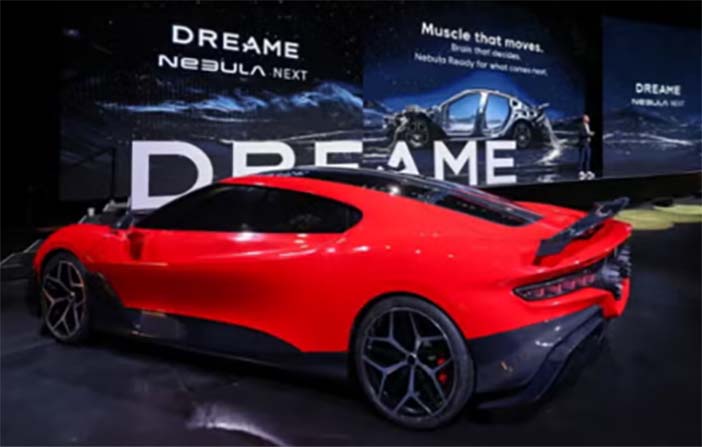
The ‘Rocket Car’ was marketed with ridiculous specs and estimates, stating that the car could achieve 100 kph from zero in 0.9 seconds, which is a few tenths away from Top Fuel drag car territory. Apart from that, the company also stated that the Dreame machine was going to be equipped with solid-state batteries, which not only had a theoretically great energy density but would also enable high output and a estimated range of 430 km. Dreame’s CEO, Yu Hao, chimed in and stated that the company will now go back to the core business units that remain profitable, which are vacuums, robot lawnmowers, 2-wheeled electric vehicles and the company’s Magic Atom brand of robots. For the record, these products suck, in a good way. While the bold claims were enough to catch people’s attention, internal sources pointed out that the project was more of a marketing and fundraising machine than an actual ‘Dreame machine’. Former employees revealed that Dreame’s Nebula Next 01, unveiled at CES 2026, was nothing more than a shell that lacked a chassis and was rolled in via a remote control. In fact, the Rocket Car model was just a purchased shell from a Shanghai-based model company, which was then modified with a chassis and accessories. Smoke and mirrors, as they would call it, but gutless after all. Aside from that, the source reports that Dreame was requiring its employees to secure funding for its projects and R&D. A former employee also came forward, stating that Dreame used high salaries to entice talent from other organizations to jump ship. In the end, these pirated employees ended up focusing on financing more than actually developing a car. This eventually led Dreame to some trouble with the local government in China, which then led to investigations surrounding the use of investment funding. +++
+++ Barely a year has passed since FERRARI rolled out the track-sharpened version of the 296, the Speciale, and word is that something more extreme is already in development. This one may go so far as to drop the standard car’s hybrid system in the name of more old-fashioned driving thrills. Throughout the first half of this year, several camouflaged prototypes of this new 296 model were snapped out and about near Ferrari’s headquarters in Maranello. Much like the 296 Challenge race car designed to compete in the automaker’s one-make series, these prototypes have been spotted wearing aggressive aero kits. The new model will wear the 296 Challenge Stradale monikrt and, like the 296 Speciale, won’t be capped at a predetermined production number. It reportedly picks up where the Challenge race car left off with dramatic bodywork, including a distinctive front fascia and a towering rear wing, and it is said to lean on the twin-turbo V6 alone for motivation, with no hybrid hardware involved. The standard 296 GTB and GTS models, as well as the Speciale, use a 3.0-liter twin-turbocharged V6 working with a rear-mounted electric motor. In the Speciale, the V6 delivers 690 hp, while the hybrid system, including the 7.45 kWh battery, boosts combined grunt to 868 hp. Ferrari abandoned the heavy hybrid setup for the 296 Challenge and is reportedly doing the same for the road car. Peak power from the V6 could be lifted from 690 hp to 720 hp and it’s speculated the 296 Challenge Stradale could have a dry weight of just 1.300 kg, or about 170 kg less than the standard road car. If true, this would give the CS an almost identical power-to-weight ratio. Obviously, the addition of all the new aero parts will make this new 296 variant even quicker on a racetrack, so it could be the perfect option for Ferrari enthusiasts looking to have the ultimate road-legal track toy. This new model could be unveiled in November. +++
+++ HYUNDAI has confirmed that it’s working on two new SUVs that’ll join its electric Ioniq range. The first will be a larger and more family-friendly model that’ll sit above the Ioniq 5, with the other slotting nicely between the Kona Electric and the Ioniq 3. Few technical details have been revealed, but the news comes as part of a wider strategy that’s been announced by the company. The announcements couldn’t have come soon enough, either, given that sister brand Kia is winning the race to electrify more of its models more quickly, with the results of that already being seen on the sales charts. Timing for both of these new models is still yet to be confirmed, but they will be part of a wave of new models due for release in the next 12-18 months. Sitting between the Ioniqs 5 and 9 will be a new family-friendly 2-row or occasional 3-row SUV. This model will sit closer to the 5 in terms of both price and size, but will have a boxier shape to offer a more versatile interior. While there has been no official information about the newcomer’s name, we suggest Ioniq 7 would best describe what we’re expecting to see. Given its size and eventual price point, this new model will include an 800V architecture that’ll keep it competitive in the fast-moving electric SUV class. It’ll offer single and dual-motor layouts, but it’s still too early to know specifics such as battery sizes and range projections, although it’ll need a range of at least 650 km to keep up with the existing competition. This will also be one of the new Hyundai models to incorporate the next generation of design and digital interfaces, including the new Pleos infotainment system and a further evolution of the design language featured on the Ioniq 3. In terms of positioning, the Ioniq 7 will be priced just above its Ioniq 5 sibling, leaving some space above for the 3-row and more premium-focused Ioniq 9. This would suggest a starting price of 60.000 euro in the Netherlands. Joining the recently revealed Ioniq 3 will be a similarly sized B-segment SUV, helping to broaden the company’s electric offerings in this massive European marketplace. Given that the Ioniq 3 will be relatively close in size, this new model (which I’ll refer to as the Ioniq 4 for now) will aim for more of a lifestyle appeal thanks to a boxier and more rugged design rather than sporty driving dynamics. The pair will share a similar interior design, with a relaxed ‘living room’ like cabin and another use of the Pleos infotainment system. Space inside is where the true differences will lie, though, because the Ioniq 4 should have more rear head and legroom, as well as a larger and more versatile boot. The powertrains will also draw from the same toolkit, so expect a similar range of battery options in 42 kWh and 61 kWh specifications, running a single front-mounted e-motor. Given its placement above the Ioniq 3, and a potential for a hot Ioniq 4 N variant, I’d suggest it’ll also be available at some point with a dual-motor option. While this might sound like it would get in the way of a new Kona Electric, it’s expected that the new generation of Kona will lose its all-electric powertrain option, sticking with a purely hybrid range of engines. Pricing for the Ioniq 4 will also need to remain competitive with a new glut of similarly sized EVs from the VW Group and Renault, suggesting a starting price of around 40.000 euro. +++
+++ 4 years after halting local manufacturing in China, Stellantis is preparing to bring the JEEP brand back to Chinese assembly lines. Under a newly announced strategic partnership, the transatlantic automaker will leverage local engineering capabilities to produce electrified vehicles. Crucially, this agreement marks the first time vehicles manufactured in China under the Jeep badge will be exported to international markets. The strategy signals a major pivot for Stellantis, which previously halted production in 2022 after local sales crashed. By returning to the country through a modernized partnership model, Stellantis aims to address its past market collapse while transforming China into a cost-effective, high-tech export hub for global distribution starting in 2027. At the core of this initiative is an 8.2 billion yuan ($1.2 billion) joint venture formed with Dongfeng Motor Group, designated as Dongfeng Stellantis Automotive Technology. Operating out of Wuhan, the entity will focus on vehicle development and marketing, while existing Dongfeng Peugeot Citroen Automobile (DPCA) facilities will handle actual manufacturing. The joint venture will launch 4 new models, comprising 2 Peugeot vehicles and 2 electrified Jeeps. Under the terms of the agreement, Dongfeng will take the lead on research and development, supplying core electrification architectures and intelligent vehicle technologies. Stellantis will contribute brand heritage, design concepts and its extensive international distribution network. CEO Antonio Filosa confirmed that these new electric SUVs and plug-in hybrid models are slated to begin rolling off assembly lines in 2027 for worldwide delivery. Dongfeng offers proven EV technical credentials to the partnership. Beyond its core passenger vehicle line-up, Dongfeng manufactures premium electric models under its Voyah brand and heavy-duty, multi-powertrain electrified off-roaders through its Mengshi marque. These existing off-road and battery-electric platforms provide the technical foundation needed to engineer robust, dual-purpose Jeep products. Jeep’s return underscores how drastically the automotive landscape in China has changed. When Jeep’s previous joint venture with GAC Group collapsed, annual sales had fallen from a 2017 peak of 203.000 units to roughly 20.000 in 2022. Western legacy automakers were caught unprepared as Chinese consumer demand rapidly shifted toward domestic new-energy vehicles, exposing severe vulnerabilities in traditional internal combustion line-ups. By relying on Dongfeng’s technological base, Stellantis is adopting a pragmatic strategy already deployed by Volkswagen, General Motors and Nissan. Partnering with a Chinese manufacturer allows legacy OEMs to accelerate EV development cycles and reduce capital expenditures. For Stellantis, using China as a high-tech export engine is not merely an attempt to regain lost market share, but an essential step toward remaining competitive in the global EV transition. +++
+++ LEXUS has already put Toyota’s GR engineering to work, starting with the LBX Morizo RR sold on several markets, and there’s little reason to think the badge stops there: a performance version of the RX is coming. The front bumper will get larger intakes borrowed from the RX 500h F Sport Performance, though they’re paired with wide fender extensions. The rear end takes the body-coloured bumper trim from that same trim level, this time with cut-outs for a pair of provisional tailpipes. The SUV here rides on covered 21-inch multi-spoke alloys that do a poor job of hiding the much larger drilled discs and red Brembo calipers behind them. Staggered Michelin Pilot Sport 4 SUV tires measure 265/40 ZR21 up front and 295/35 ZR21 at the rear. We can also expect a noticeably sportier stance, wider tracks and a lowered suspension. All of that lines up with earlier reporting from Japanese outlet Mag X, which claimed Lexus is working on a high-performance RX flagship carrying the Morizo RR badge. The hot SUV will reportedly use an AWD-capable hybrid system built around Toyota’s upcoming turbocharged 2.0-liter 4-cylinder and a pair of electric motors. Combined output is rumored at 608 hp,, which would put the Lexus RX Morizo RR in the same conversation as the BMW X5 M and the Audi RS Q8. The market launch of the Lexus RX Morizo RR is expected in 2028, although the automaker has yet to confirm any upcoming debuts. Still, recent sightings of camouflaged prototypes suggest Lexus is working on a facelifted version of the RX that could arrive next year with a larger infotainment display and mild styling updates. +++
+++ LOTUS Technology has closed the books on a deal that turns 2 companies into 1 company. As of August 21, 2026, Lotus Tech owns 100 percent of Lotus UK, the outfit behind the sports cars built at Hethel, Norfolk, and the consultancy known as Lotus Engineering. Chief executive Qingfeng Feng put it plainly: “Lotus is one brand and one strategy, and from today it is one business”. That single sentence ends decades of the British sports car maker and its Chinese-backed parent operating as separate entities with separate priorities. The transaction folds Lotus Advance Technologies, the formal name for Lotus UK, into Lotus Tech’s corporate structure. Hethel’s factory floor, where the Emira and Evija get built, now reports to the same leadership that runs Lotus Tech’s electric SUV and cross-over programs. This aligns with the Focus 2030 strategy to combine British engineering with electrified platforms. The acquisition strips out the corporate gap that had kept Hethel’s chassis work and Lotus Tech’s electric programs on parallel tracks instead of under one plan. The move also comes soon after Lotus cut jobs at its Hethel plant, underlining that integration often arrives with cost pressure even as the company talks about engineering synergy. Lotus Engineering has spent years consulting for outside automakers and Tier 1 suppliers on lightweight structures, aerodynamics and chassis dynamics, the same skills that made Lotus road cars feel distinct. With that consultancy brought fully inside Lotus Tech, those skills now point inward first. In practice, Hethel’s chassis expertise should reach electric models faster instead of staying tied up in gas-powered sports cars. Lotus has already signaled that shift by sourcing V6 and V8 engines from Renault and Geely instead of developing them at Hethel, which frees engineering capacity for electrified work. The brand has also been candid that it once bet everything on EVs being the future before moving to a mixed lineup. This reunification gives that updated plan one command structure instead of two, though it is unclear how quickly US buyers will feel the effect while one of Lotus’s electric SUVs still is not sold in America. For now, the next real test is whether the Emira’s push for more power and less weight and the promised V8 supercar hit showrooms any sooner under a single owner. +++
+++ There’s no shortage of special edition 911s in the world. This generation alone has already seen several, with the most recent one being the GT3 100 Jahre Nürburgring launched this month. Prior to that, there was the GT3 Earls Court 51 Edition, and the one before that was the Turbo S Sadu Edition, all within the span of this year so far. Now, there’s a new one coming, and it’s based on the GT3 yet again. It’ll be called the GT3 Bergsport, and it’ll make its world premiere in just a few days. The car was briefly shown earlier this month on PORSCHE ’s Austrian website but has since been taken down. But in more recent developments, the Porsche Swiss website now has a dedicated teaser page for the car. It tells us a little bit more about the car, as well as the official launch date. Porsche will show the car on September 1, 2026, and it calls the Bergsport a ‘Tribute to Alpine driving.’ The company says it’s a result of the collaboration of French, Italian, Austrian and Swiss branches. In case you haven’t noticed, those countries are Alpine nations, and possibly have some of the world’s best driving roads. It should be a fitting homage to the classic Alpine ‘Bergspyder’ hillclimb race cars from back in the day. As it’ll be based on the GT3, you can expect it to be a more focused corner carver than, say, the Turbo S. It won’t be as hardcore as an RS, but that won’t make it any less unique. Porsche already mentioned that only 100 of these cars will ever be made, but it’ll only be offered within Alpine countries, and chances are, most have already been spoken for even before the world premiere. But there is one interesting rumor about the car. Instead of the typical GT3 wing at the back, it’ll sport a ducktail spoiler. It breaks from GT3 tradition, yes, but it’s more reminiscent of the original Carrera RS models from the ’70s. It was allegedly spied a few months ago doing laps around the Nürburgring. Given Porsche’s love of making special edition models per region, one can hope for a version similar to the Bergsport. The rumoured ducktail spoiler alone makes it a very interesting version of the GT3, and no, you can’t tick it as an option in the configurator. Believe us, we tried. One thing is for sure, though. It will have collector status even before we see it. Again, just 100 of these will be made, spread across some parts of Europe. It’ll be expensive, for sure, but there’s no way these will ever depreciate. +++
+++ Small electric cars have been a tough market for car makers to make profitable, but in recent years we’ve seen the sector gather momentum and the latest brand looking to get in on the fun is VOLKSWAGEN . The new ID.Up is preparing for launch. It was shown a few years ago as the ID.Every1 concept, but I expect the production car to be named ‘ID.Up’. That runs contrary to the rumours regarding a return of the Lupo nameplate or the use of ID.1. The old Up had a long lifespan of 12 years in a single generation. It didn’t take long for it to gain electric power either with the e-Up joining the range from 2014 up until the model’s death in 2023. Judging by the ID.Every1 concept, the new ID. up looks set to continue the compact and cleanly styled approach that made the original Up so popular. At 3.880mm long, the concept is around 280 mm longer than the previous Volkswagen up!, largely because of its EV-specific architecture. Unsurprisingly, given its A-segment dimensions, the ID.Up will be the entry-point to Volkswagen’s all-electric ID range, which is steadily switching from numerical nameplates to well-known names used on combustion-engined VWs, like the new ID.Polo and what I expect to be the ID.Tiguan. Later on in 2027 we should see the world premiere of the ID.Up taking place at the Munich Motor Show in September. This reveal will also give us fresh details over Rivian’s 5 billion euro joint venture with Volkswagen to provide a next-generation electric car software with fewer control units and less wiring; similar to BMW’s sophisticated ‘superbrain’ computer in its Neue Klasse cars. Despite the car harnessing elements of the latest software and technology from Rivian’s joint venture programme, keeping production costs low for the new ID.Up will be key to ensuring it sits comfortably below the new ID. Polo. VW’s board member for sales, Martin Sander, previously told: “The ID.Every1 uses all the components from other products on the platform. It speaks to the flexibility and scalability of the platform to larger and also smaller products. We could never do the vehicle like the ID.Every1 on its own. It would not work, but we need all the components, everything we have available”. With help from economies of scale, Volkswagen is expecting to sell the ID.Up at around the 20.000-euro mark. VW’s technical development chief Kai Grunitz added: “Martin Sander came to me and said, hey, I need an entry vehicle. I want to sell it for €20.000 and I want to earn money with that”. To keep costs down, the ID.Every1 concept utilises parts from other VW EVs. Grunitz said: “It took 1.5 years to develop the concept for that vehicle. Because we started with the ID.2 all concept, and the ID.Every1 is from the front to the A-pillar pretty much the same but with a different engine”. The VW ID. up’s battery will also get a ‘dedicated chemistry’, though Volkswagen is implementing a rear axle borrowed from the Polo. Crucially, Grunitz says the baby EV will “still feel like a Volkswagen”. Even with that price point of roughly 20.000 euro, the ID.Up won’t have the small electric car market to itself when it arrives in 2027. The Renault Twingo cost less than 21.000 euro. Then there’s the Leapmotor T03 and the Citroen ë-C3 all competing for the attention of EV buyers on a budget. +++