
+++ BMW has been spied testing its new X5 M, or more specifically the new iX5 M, ahead of its reveal in 2027. In a change of strategy, the German firm’s future flagship high-performance SUV will now employ an electric powertrain in place of the previous car’s 4.4-litre twin-turbo V8. This won’t please those with a preference for internal combustion, but will almost certainly offer a mountain of extra performance. The styling of the front end will be surprisingly distinct from that of the standard iX5. In place of that car’s narrow and tall kidney grilles, this model features wider, broader units that sit on a shallower glazed front section. Expect thinner lighting, and bespoke lighting graphics, too. These will align the iX5 M more closely to the forthcoming 5 Series and facelifted M5 also due in 2027, alongside further changes to the lower bumpers and wheels. BMW hasn’t made such drastic alterations to the rest of the iX5’s body, though, as there doesn’t appear to be any bespoke body panels. A result of removing the traditional SUV-like cladding around the wheel arches on the latest X5 is that BMW hasn’t been able to easily widen the tracks or give the overall design a more aggressive stance, as has been the case on previous generations. Under the skin, however, I’m expecting more substantial changes. While I don’t have any precise details about this specific new model yet, it should share its fundamental battery capacity and performance with the standard iX5. This means it could stretch to 141 kWh, with peak charging speeds of up to 460 kW. The motors, however, will be in a different league. In place of the dual-motor arrangement of the standard car, expect the total to double to four. As we already know about the forthcoming electric M3, BMW M has been working on a unique quad-motor layout which won’t just generate more power, but promises to give drivers additional control. By being able to infinitely control drive going to each wheel, the new iX5 M won’t just be more powerful than its petrol-powered predecessor, but more agile, too. With more motors, wider tyres and a bigger emphasis on performance rather than efficiency, it’s unlikely that this new model will have quite as much range as the impressive 840 km the base iX5 is capable of. However, I’m still expecting well over 650 km; a figure that should still be well above what upcoming rivals such as AMG’s GT SUV, the Porsche Cayenne Turbo and Bentley Torcal deliver. BMW hasn’t officially confirmed a timeline for the new flagship, and with place-holder lighting, wheels and bumpers still attached, I suspect it will be a number of months before we see the finished item. But when it does arrive, potential buyers can anticipate pricing that gets underway from well over €120,000. +++
+++ HONDA is considering building a new plant in the U.S. as it seeks to expand its line-up of hybrids models from 2030, a senior executive at the Japanese carmaker said. The move follows a broader strategic pivot earlier this year, when the Tokyo-based company cancelled a trio of battery-electric models earmarked for the United States. The manufacturer plans to introduce 15 new hybrids by March 2030, primarily targeting North America. Honda, which posted its first annual loss since its founding in 1948 as a result of the strategy shift, now aims to prioritize hybrid and traditional internal combustion engine models. While Honda built its reputation on cars like the Accord (well engineered, efficient and finely attuned to what American buyers wanted), in recent years it has struggled to recapture that formula in its most important market. But its latest hybrids have proved popular with petrol-price conscious American buyers. +++
+++ There’s a lot to unpack from HYUNDAI ’s Investor Day held yesterday, which is why it didn’t feel right to just cram everything into a super-long article. The Koreans are planning a new line-up of more affordable performance cars, but there’s even more good news enthusiasts will want to hear. Hyundai has set its sights on expanding the N lineup from the 5 models it sells today to more than 7 by the end of the decade. Annual sales are projected to increase 5-fold over this period, growing from 20.000 units in 2025 to 100.000 vehicles in 2030. A new model will be crucial to the company’s estimated N boom: a rear-wheel-drive car. Without going into details, Hyundai confirms it’s working on a front-engined car based on a rear-wheel-drive platform with AWD support. It doesn’t say whether it has a combustion engine or is fully electric, but we’re tempted to say it has a petrol engine under the hood. This unnamed model is supposed to have the biggest market coverage potential (22 percent). With petrol engines still dominating the high-performance segment, it’s reasonable to expect this N model to have cylinders rather than electric motors. Well, unless it’s a plug-in hybrid, in which case it’ll have both. If anything is missing, it’s the long-rumored N Vision 74. I’ve asked Hyundai whether the wedge-shaped supercar is still happening, and I’ll update this Newsflash once I hear back. The attached infographic suggests it’ll be a large car with a starting price higher than the Ioniq 5 N and Ioniq 6 N. It’s not the only N-badged model coming soon. The ‘Entry FF’ vehicle listed in the infographic will be a small crossover, so Hyundai could be planning to bring back the Kona N. Either way, this model is supposed to increase market coverage by 5 percentage points. All told, Hyundai N wants to double its market coverage from 30 percent to more than 60 percent by 2030, thanks to an influx of new models and expanded availability in more than 40 global markets. Hyundai N also has opportunities to explore as it tries to catch up with the likes of Mercedes-AMG, BMW M and Audi Sport. It’s looking into a few whitespace products, such as an entry-level front-engined car with rear- and all-wheel drive, along with a compact EV, possibly an Ioniq 3 N. Looking at the other end of the hierarchy, there’s potential for 3 additional vehicles: a premium SUV, a premium EV and a sports car positioned as a luxury GT. However, if any of these models were to get the green light, don’t expect to see them until the next decade. The GT is the most interesting of the three, especially since it would be a Hyundai N model rather than a Genesis. +++
+++ LOTUS will also offer a V6 version of the new Esprit supercar, along with the already-confirmed hybrid V8, as part of a pledge to keep to the lightweight ethos of the brand, the company’s CEO has said. Lotus has set a target weight of 1.5 tonnes for the V8 version of the car, which is codenamed Type 135 and planned for launch in 2028, Lotus CEO Feng Qingfeng told investors on the company’s second quarter earnings call. The hybrid drivetrain will allow the company to conform to global emissions regulations “while preserving essential Lotus DNA of lightweight engineering and extreme track focus driving dynamics”, Feng said. Lotus has previously said the replacement for Emira sports car will use a V6 hybrid, but this is the first confirmation that the drivetrain will also go into the ‘Esprit’ flagship, creating a lighter weight model with a more accessible entry price. Both the V6 and V8 engines are being developed by Horse, which is jointly owned between Lotus parent Geely and Renault. Feng acknowledged the challenge off keeping the weight low in a complicated electrified drivetrain. “Achieving that target with an 800 volt architecture, a hybrid system, a V8 engine and electric motor in just is not easy”, he said. One solution will be an ultra-lightweight electric motor. “A typical 204 hp motor weighs between 75 and 95 kg. We have leveraged Formula 1 technology to bring it down to just 20 kg”, Feng said. Maximum horsepower will exceed 1.000 hp, Lotus has said. The car will be engineered with an 8-speed dual-clutch gearbox “designed to handle high torque while keeping weight to a minimum”, Feng said. The car will be a flagship model linking Lotus’s electric expertise with its strategic reversal back into combustion engines, which begins with the Eletre X plug-in hybrid version of the electric SUV due next year. “The Type 135 will fill the gap between the Emira and Evija, preserving the emotional connection Emira owners have with the Lotus mechanical handling, while leveraging V8 hybrid technology to approach the technical benchmark set by the Evija”, Feng said. The new supercar will be built alongside the Lotus Emira sports car at Hethel, in a boost for Lotus’s historical base in Norfolk. This is part of a wider plan to put ICE sports cars back at the heart of Lotus’s future after the company abandoned a plan to go all-electric by 2028. +++
+++ MATE RIMAC now runs the same production line with the loudest engine he has ever built, right next to the fastest EV he ever built. That contradiction, by his own admission, sits at the center of Bugatti’s next decade. Speaking to the press, the Bugatti Rimac CEO laid out a split in the market as cheap, mass-market cars go electric, while sports cars and up stay petrol-powered “for a very long time.” He calls it the supercar market’s Swiss watch phase. Rimac’s argument leans on his own resume. His Nevera, a fully electric hypercar, already beats many combustion-powered machines in a straight line. Yet he insists Bugatti’s next generation stays combustion-based, built around the Tourbillon’s naturally aspirated 8.3-liter V16. That hybrid powertrain delivers 1.775 horsepower in total, and Bugatti has sold every one of the 250 planned Tourbillons at a starting price around $4.1 million to $4.5 million depending on exchange rates. Rimac points to customers spending heavily on personalization, including stitching, paint and one-off details. He frames that spending as identity, not spec-chasing. “Performance is really becoming secondary”. Rimac told, arguing a $50,000 EV from China can already outrun hyper cars from a decade ago on paper alone. The watch comparison does real work here. Rimac notes that Swiss mechanical watches account for a sliver of global watch sales but capture most of the industry’s profit, and he wants Bugatti to mirror that math rather than chase volume. Rimac’s bet is that wealthy buyers are not paying millions for lap times; they are paying for hand-built mechanical drama that a screen cannot replicate. He is hardly alone in that read, as Ferrari has said petrol engines have not peaked, and Koenigsegg has made a similar case for combustion alongside EVs and synthetic fuels. Other rivals are hedging differently. Mercedes-AMG’s CEO has talked through the challenge of selling electric performance cars, while Lamborghini’s CEO has downplayed Chinese EV makers as a threat rather than a reason to abandon combustion outright. Where does that leave Bugatti a decade from now, still building V16s while everyone else electrifies? +++
+++ SUZUKI has unveiled online a prototype of its first electric minivehicle with a reference range of 310 kilometers, among the longest for electric mini vehicles. The e Sky is expected to go on sale within the current fiscal year ending next March.
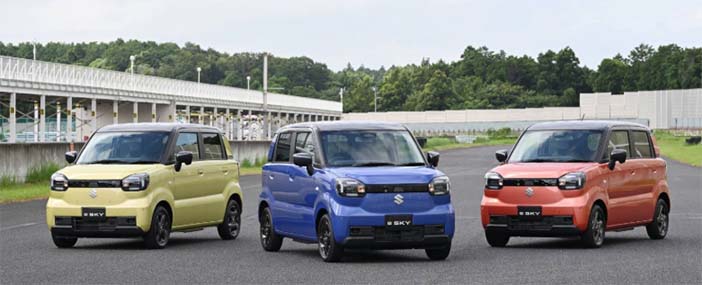
Suzuki has yet to set a price for the model but aims to make it affordable enough to encourage a shift among gasoline car owners. The automaker drew on decades of its experience developing mini vehicles, making the most of the segment’s hallmark maneouverability. It achieved the e Sky’s long range by achieving weight reduction and high energy efficiency. “We were mindful of making the vehicle easy to drive even for gasoline car users”, a Suzuki development official said, adding that the company was able to strike a balance between cost and performance. The vehicle’s navigation system recommends routes based on the remaining driving range and traffic conditions, addressing drivers’ concerns about running out of charge before reaching a charging spot. Competition in Japan’s electric minivehicle market is expected to intensify as it expands. China’s BYD launched its Racco electric minivehicle in July, while EMT, based in Yokohama, plans to enter the market in 2027. EMT was founded in 2025 by 5 Japanese and Chinese firms, including Japanese car accessory supplier Autobacs Seven and China’s Chery Automobile. Suzuki welcomed the growing competition, with a company official saying, “It is good for consumers to have more choices. We want to make a strong appeal as a company specializing in mini vehicles”, the official added. +++
+++ The covers only came off the VOLKSWAGEN ID.POLO GTI this summer, but VW is already working on a hotter Clubsport variant that’s set to loosen the reins on the new all-electric hot hatch. Set to arrive in early 2027, the ID. Polo GTI will take on a new breed of sporty superminis including the Alpine A290, Mini Cooper JCW Electric, Peugeot E-208 GTi and Opel Corsa GSE. The Clubsport will sit above all of these, however, with more power and additional driver focus, as we have become accustomed to on VW’s excellent Clubsport-badged GTI models. A big power bump should be on the way for the Clubsport for starters. While the standard ID.Polo GTI sends 226 hp and 290 Nm to its front wheels through an electric limited slip differential, Autointernationaal.nl understands that the Clubsport will get a whopping 290 hp from a revised version of the GTI’s APP290 electric motor (which will get a different name as the ‘290’ is based on torque). This should drastically lower the ID.Polo’s 6.8-second 0-100 kph time, and will also help the GTI stand out further from the most powerful 211 hp version of the regular ID.Polo, which only takes 7.1 seconds to get to 100 kph. Previous VW GTI Clubsport cars have shed up to 45 kg of weight in the name of performance. However, while we’ve been told to expect typical Clubsport tweaks for the new car, nothing as drastic as, for example, ditching the back seats (as was the case on the Mk7 Golf GTI Clubsport) has been hinted at. The ID.Polo GTI’s 52 kWh battery will surely be retained for the Clubsport, meaning that with the additional power we’re likely to see a drop off in range from the GTI’s 425 km maximum. I’ve already tested the ID.Polo GTI in prototype form and came away impressed with its sharp and direct steering, with noticeably firm suspension helping to provide balanced body control and tight handling. The GTI’s electric differential, which is shared with the Cupra Raval VZ, also helps pull the car around bends in an eager, responsive way, all boding well for this more hardcore Clubsport variant. I expect a unique set-up for the chassis, too, judging from previous Clubsport cars, with what will certainly be a stiffer tune for its DCC (Dynamic Chassis Control). The extra power and performance upgrades will inevitably bring a price premium over the upcoming ID. Polo GTI. +++