
+++ Renault and Nissan said on Monday they were in talks about the future of their ALLIANCE , including the Japanese automaker considering investing in a new electric vehicle venture by its French partner. The talks, which could prompt the biggest reset in the alliance since the 2018 arrest of longtime executive Carlos Ghosn, have included consideration of Renault selling some of its Nissan stake, 2 people with knowledge of them said. Negotiations are expected to continue ahead of a Renault investor presentation in early November, when the French carmaker is expected to give an update on its new EV unit, which is code-named “Ampere”. Renault owns about 43% of Nissan, which in turn has a 15% stake in its long-term partner. The French state also has a 15% holding in Renault. Renault and Nissan said in a joint statement that they were “engaged in trustful discussions around several initiatives” including a potential Nissan investment in the EV venture and what they called “structural improvements” in their alliance. Renault CEO Luca De Meo, who was in Japan over the weekend, and Nissan CEO Makoto Uchida have been central to talks about reshaping its terms, a person familiar with the talks said. A group of Nissan executives, including chief operating officer Ashwani Gupta, have also been involved in developing discussions in recent months, the person said. Renault is looking to win Nissan as an investor in its new EV venture, which it is setting up alongside a separate combustion engine unit, essentially splitting out the higher-growth and investment-hungry portion of its auto business. In exchange for investing in the EV venture, Nissan is looking to Renault to reduce its stake in the Japanese automaker, a person familiar with the talks said. The French dominance of the alliance has long been a point of contention for Nissan, which wants Renault to cut its stake to 15% to draw level with its own holding in Renault, the source familiar with the matter told. For Nissan, the talks could represent a chance to reset a structure that many executives at the Japanese firm have seen as unbalanced, given the way vehicle development work between the two carmakers has progressed in recent years. Nissan may consider raising funds to buy back the shares held by Renault, one person told. Seiji Sugiura, a senior analyst at Tokai Tokyo Research Institute, said he did not expect Nissan would have trouble financing a buyback on that scale. “My own guess is that Japanese investors, by something like 60-to-40, would rather have Nissan operating more as a separate company, or at least with a lower stake”, Sugiura said. “If they’re going to do this, now could be as good a time as any”. Any sale of a stake in Nissan to take Renault’s holding to 15% (which at current market prices would be worth $3.8 billion ) would not affect their continued cooperation, the source said. Nissan may need to raise funds to buy the shares back from Renault, the source added. The source said Mitsubishi, another partner in the alliance, was also considering taking a single-digit percent stake in Renault’s EV unit. At the beginning of the year, Nissan and Renault detailed plans to invest $26 billion over the next 5 years in electric car development. Nissan is set to launch the Ariya, its first EV since the pioneering Leaf, in the coming weeks. Its launch was delayed by about a year because of shortages of semiconductors, Nissan has said. +++
+++ AUDI has spent the last few years coming up with a plan to replace the current TT, and the latest update points towards electrification and even a drastic change in body style. The TT is set to be axed when production of its current generation ends in 2023, and the car will be replaced by a new style of “emotional” model that will be larger, and could well have 4 doors. The original TT stunned the car industry when it was first unveiled in 1998. But sales have dwindled in recent years, leaving some within Audi to suggest that the firm ought to leave that area of the market altogether. Audi’s board member for technical development, Oliver Hoffman, has told that the company had decided to push ahead with a change of positioning, “We want to add some very emotional cars to our portfolio, but a direct follower for the TT is not the answer”, he said. “We can’t just say we’ll do the TT in an electric way”. Audi recently teased a 4th model in its series of design concepts, to be called Activesphere and unveiled in the first quarter of 2023. The brand’s shadowy preview picture shows dramatic curves and an aggressive roofline on top of a taller body, and this could be the best hint yet that the company intends to turn its more ‘emotional offering’ into a higher-riding coupé, potentially even one with 4 doors. Hoffman has already suggested that a change of body style could be under consideration. “There was no demand for a TT when we launched it”, he said. “And this is what we want to do again: to surprise our customers”. It’s likely, in fact, that Audi is considering following rival Mercedes in amalgamating some of its more style-focused, niche offerings, in this case, the TT and the larger A5 Coupé, into a single model. This new vehicle would offer dramatic looks on top of the Volkswagen Group’s forthcoming SSP platform, which will mix the best elements from the existing MEB architecture and the more premium PPE components. A slightly higher profile will help to accommodate the car’s battery. Audi recently unveiled the TT RS iconic edition; an ultra-limited version of the TT which could well be the last hurrah for the sporty coupe. +++
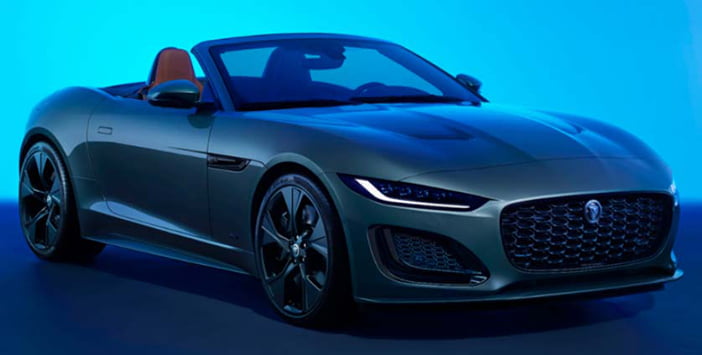
+++ The JAGUAR F-Type will bow out at the end of next year, bringing to an end 75 years of pure-combustion Jaguar sports cars; a lineage that stretches back to the record-breaking XK120. The F-Type arrived in 2013 as a replacement for the XK, and will continue into its final year with the choice of a 300 hp 4-cylinder motor or 2 supercharged V8s, one with 450 hp and the other (in the F-Type R) 575 hp. The more potent, firmed-up V8 cars will be badged ‘F-Type 75’ for the final year of production with an array of special features to set it apart from the standard car, although that will no longer be available in V8 form. This includes commemorative badging, gloss black wheels, Windsor leather performance seats and bespoke interior decorations. A unique Giola Green paint option is also available. This is similar to the Defender 75 which was unveiled last month by parent company Jaguar Land Rover. Coincidently marking 75 years of the British brand, it also gets a cosmetic reworking … and a lofty price tag when it hits showrooms next year. As with the Defender, it’s the same F-Type underneath as the one on sale today, with double wishbone suspension all around, and sticky rubber in the form of specially developed Pirelli P Zero tyres. In R spec, the 575 hp Wolverhampton-built 5,0 liter V8 engine delivers 700 Nm that, coupled with AWD as standard, helps push it to 100 kph in just 3.7 seconds. Top speed is limited to 300 kph. Deliveries of the F-Type 75 begin in January 2023. When the run is complete, Jaguar’s range will consist of the F-Pace, E-Pace, XF and XE until a trio of all-electric crossovers arrive from 2025, sitting on a new platform and priced at more than €130,000 in the Netherlands. +++
+++ Chinese electric vehicle maker NIO will only lease its cars when it launches in four European markets this year, its boss told, betting that flexibility will be a key selling point as drivers switch to the new technology. Users will be able to lease a car with a 75 kWh battery for 1.199 – 1.295 euro a month depending on the length of the subscription, which can be as short as a month. The plan is the latest unconventional move by the company, which already allows customers to rent rather than buy the battery; the most expensive part of an electric vehicle (EV). Rather than charging their cars at home, Nio owners can also drive them to a battery swapping station to have a new powerpack installed in minutes to save time. Now, as it prepares to launch in Germany, the Netherlands, Sweden and Denmark, Nio plans to operate its businesses there on a corporate leasing and subscription model, offering all 3 models available in China: the ET7, ET5 and EL7, with the latter renamed in Europe from its Chinese name of ES7 because of a branding dispute with Volkswagen’s Audi. “We will not be selling cars”, CEO William Li said in an interview at the company’s new ‘Nio House’ showroom in central Berlin, the first of 9 new members club-style venues to open for Nio fans in Europe this year. “Flexibility is the new premium”. Nio has sold just under 250.000 vehicles in China and Norway since starting production in 2018. Prices range from around 50.000 – 70.000 euro, depending on the car’s range and whether customers buy or rent the battery. It has so far operated on a make-to-order basis, creating bespoke products for customers and keeping inventory low. Nio will stick to direct sales in existing markets in part due to less attractive taxation on subscription models in Norway and restrictions around license plates in China, Li said. Nio is facing competition in China from a growing number of EV startups from Xpeng to Hozon and Leapmotor as well as larger manufacturers like China’s BYD and Tesla. In Europe, it will be chasing after Tesla and Volkswagen for the top spot on EV sales. The plan is to install at least 120 battery swapping stations in Europe by the end of next year, Li said, adding it was not so much a matter of the financial investment but of the time and bureaucracy required to get it done. The company opened its first plant to manufacture swapping stations in Hungary last month, and would consider producing batteries in the region once it reaches battery sales in Europe equivalent to around 10 gigawatt hours, Li said. “The advantage of our business separating the car from the battery is that we may reach economies of scale for the batteries faster than the cars”, Li said. “When we reach 10 gigawatt hours, we will consider localizing production”. In China, where that target has already been met, a team of around 700 people is working on in-house battery production, enabling the company to take control of its battery supply. In the meantime, Nio is seeking further partners beyond its current supplier, CATL, Li said, adding it aimed to have new partnerships secured next year. “In the long-run we believe any top company in the automotive industry will soon have in-house battery production”, Li said. Nio’s revenue grew 22% in the second quarter from a year ago while its net loss more than quadrupled to the equivalent of $410 million. It delivered just under 32,000 vehicles in September, up 29.3% year on year. Supply chain troubles in China due to Covid-19 lockdowns in August eased faster than expected, Li said. +++
+++ The revised version of the current PORSCHE 911 has been spied plenty of times from the outside during its development program. We’ve seen it in coupe, cabriolet, Turbo and even in lifted Safari guise, but this is our first look inside the latest iteration of the sports car icon. From the outside, the new 911 will look almost similar as the current model: the German brand is aiming for a subtle evolution of the current car’s looks. Likely to be designated the 992.2, the facelifted 911 will get a slightly neater grille arrangement up front and new integrated LED daytime running lights, while the rear bumper and diffuser have been redesigned to make space for a new centre-exit exhaust system. I’m also expecting some different alloy wheel designs and paint options. Due to arrive in the showrooms in 2023, the refreshed 911 will also benefit from some chassis tweaks and, perhaps most significantly, a fully digitised cabin that ditches the current model’s analogue rev-counter. Also on the cards is a jacked-up Safari model, which we’ve already caught undergoing evaluation. This high-riding machine will feature plastic body cladding to help protect the panels from scrapes when driving over rough terrain, as well as GT3-style bonnet vents. The fact that these don’t appear on our latest spied prototype suggests they’ll be a quirk of the off-road model rather than a standard fixture across the line-up. Inside, the facelifted 911 is expected to retain the same basic layout as the existing car. It’ll also benefit from Porsche’s latest PCM 6.0 infotainment system, which has just recently been updated to include Spotify music streaming, wireless Android Auto and an improved voice assistant. However, the updated sports car will move forward with a new, fully digital instrument panel, like that of the Taycan. The current model has an analogue rev-counter flanked by 2 screens, but this could be replaced with a slender curved screen that can display drive mode information, a map for navigation and a feed from the car’s night-vision system. The next 911 could also receive an improved suite of sensors for more advanced driving-assist technologies. A raft of chassis and handling improvements is also expected to give the 992.2 sharper responses when the driver takes full control. Porsche has honed the 911’s suspension and steering set-up as part of previous mid-life updates, so a returned electric power steering set-up and revised chassis settings are likely. A snappier calibration for the 8-speed PDK gearbox is also possible, although the 992.2 is unlikely to receive significant powertrain revisions. It will, however, gain a new hybrid variant. The long-awaited electrified 911 will be part of the 992.2 line-up, although this option could be added after the launch of the facelift. The electrically assisted 911 could also end up producing more power than the 641bhp 911 Turbo S and become the most potent 911 available. +++
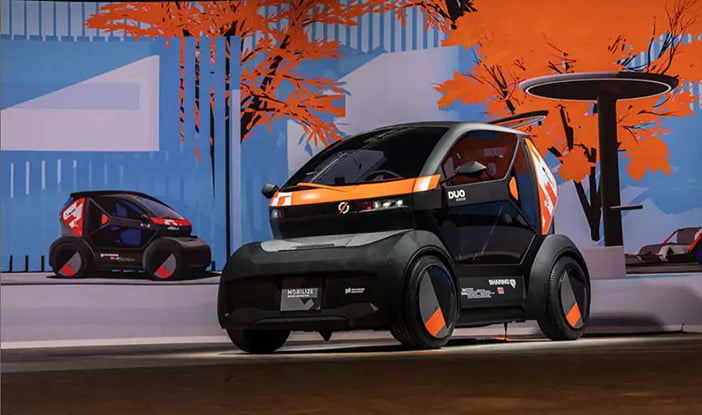
+++ The RENAULT GROUP expects its newly hived-off electric mobility venture, Mobilize, to account for a significant 30% of its total turnover by 2030, and it has unveiled a raft of new products and initiatives aimed at cementing the brand as a leading name in the field of “everything beyond automotive”. Mobilize will launch new charging stations, servicing programmes, unique zero-emission transport solutions and innovative vehicle remanufacturing programmes with a view to facilitating the mass shift away from traditional vehicle propulsion and ownership systems, and reducing the cost to the environment while doing so. Spearheading the brand’s launch on the product side is the Duo, an urban EV in the mould of the pioneering Renault Twizy. The Duo has a compact footprint and tandem seating arrangement that allows 3 of them to park side by side in one regular parking space. It also features scissor doors to minimise the space needed in car parks. Unlike the similarly conceived Citroën Ami, the 1.300 mm-wide Duo cannot be bought outright. Instead, it will be available either for a few minutes or hours at a time via a dedicated app, or for lengthier periods (upwards of 3 months) through a web-operated subscription service, which will also be used to manage servicing and upkeep. This latter service caters particularly to commercial operators in city environments, with the options of branded body panels and a 700-litre rear cargo box (in the single-seat Bento version) helping to enhance its appeal to business customers. The newly unveiled cabin is designed to be “intuitive for everybody” and, although spartan, is competitively equipped for the purposes of intensive use in busy environments. It includes a smartphone holder, USB-C charger and Bluetooth functionality, as well as over-the-air compatibility that can be used to update the operating system. For example, the speed can be capped in certain areas if limits are introduced. 2 Duo versions will be available, one limited to 45 kph to comply with less stringent L6 quadricyle regulations and another capable of 80 kph, which falls into the L7 category. Both are capable of an 140 km range and gaining 90 km of charge in 3 hours from a domestic charger. Mobilize will reveal prices closer to the late-2023 arrival date, but electric mobilities deputy director Corinne Pakey told: “We want to be affordable but competitive with a full package”, hinting at the potential for Mobilize to generate significant revenue through various platforms. With a comprehensive refurbishment program in place, Mobilize expects a usable lifespan in excess of 10 years for the Duo and says that on retirement, around 95% of the car’s components can be recycled. As the name suggests, the Solo is a single-person EV designed for low-distance urban travel, cleverly packaged to offer manoeuvrability on a par with a conventional scooter but with improved safety and comfort. Designer Patrick Lecharpy said the brief was all about “reducing the footprint on the road needed to allow one person to move around the city”. To which end, the Solo takes up far less space than even the Duo, weighs just 70-80 kg and tops out at 25 kph. Asked why Mobilize opted for a 2+1 three-wheel design, rather than a conventional 2-wheel arrangement, Lecharpy said: “We want to be as inclusive as possible, and 2 wheels isn’t for everyone”. It is closed off on only one side to save weight and steers from the rear to minimise the turning circle. Mobilize also claims the Solo will be capable of wireless charging but has yet to give any numbers detailing its range or top-up times. Charging hubs will play a fundamental role in supporting users of Mobilize EVs while introducing the brand to customers of other marques. By mid-2024, Mobilize will activate 200 self-branded fast-charging hubs at Renault dealerships across France, Belgium, Italy and Spain, before expanding into other European markets. There will be 6 chargers (100 kW) per station, which will each be sited less than 5 minutes from a motorway, be open 24/7 and provide a lounge-style waiting area. Repurposed batteries from end-of-life EVs will be on hand to provide additional energy storage, to keep charging speeds consistent at busy times, while integrated solar panels will contribute to the supply to reduce strain on the grid during peak hours. Crucially, the chargers will be compatible with all EVs, rather than just those from the Renault Group, although the firm has hinted that brand users will have access to cheaper rates. New sheltered charging devices have been conceived with a similar objective to the Solo and Duo: to facilitate urban electric motoring while exacting minimal impact on the environment. According to Mobilize, urban planners want to use the opportunity of vehicle electrification to make their cities a more pleasant place for all, not just road users. Created with street furniture designer Patrick Jouin, the Ileo chargers reflect Mobilize’s belief that “energy has to be mobile, nomadic” and, as such, can be easily moved around for the purposes of exhibitions, events and fleet management, with customers able to order as many as needed. +++
+++ Electric pick-up and SUV maker RIVIAN said Friday it is recalling almost all the vehicles it has delivered to customers in order to tighten a loose fastener that could potentially affect drivers’ ability to steer. The company, which was founded in 2009, said it is recalling about 13.000 vehicles because a fastener connecting the vehicles’ front upper-control arm and steering knuckle may not be torqued enough. The recall affects R1T pickups, R1S SUVs, and EDV commercial delivery vehicles. There have been 7 reports potentially related to the issue, but no injuries have been reported, Rivian said. “If you experience excessive noise, vibration or harshness from the front suspension, or a change in steering performance or feel, you should call immediately”, Rivian boss RJ Scaringe wrote in a letter to vehicle owners. Owners are being alerted to the problem via email from Rivian. The company, based in Irvine, California, said it will conduct the inspection via Mobile Service appointments (technician will come to you) and the fix would only take a few minutes. Rivian expects to have finished the repairs on all of the vehicles in about 30 days, with customer collaboration. Rivian is aiming to take advantage of a growing appetite among consumers and investors for electric vehicles. It is among a long line of companies, both new and old, trying to peel away market share from Tesla. It went public last year, and its market value quickly soared past that of Ford and General Motors to become the second-most valuable U.S. automaker behind Tesla. But that is no longer the case: The company’s stock is down 67% so far this year. Last month, Rivian said it was partnering with Mercedes-Benz to build a factory in Europe that will produce electric vans for both companies. Rivian shares sharply dropped Monday after the electric vehicle maker said it was acting with “urgency” in voluntarily recalling thousands of vehicles over a possible steering-related hazard. The company’s stock fell as much as 11% before paring the loss to 7%. “This is a black eye for Rivian as the company is just now starting to hit its stride on reaching its 25.000 production target for 2022 and has roughly 100.000+ reservations in hand for its SUV with clear momentum into 2023”, wrote Wedbush analyst Dan Ives on Monday, noting that the Tesla challenger has delivered 14.300 vehicles year to date. “The last thing any Rivian investor wants to see in a shaky market is a broad recall that hurts the brand and gives some lingering credibility issues to production going forward”, he said. The recall is a “speed bump” in Rivian’s growth story, Ives added in reiterating its outperform rating and $45 price target on the company. The recall shouldn’t impact Rivian’s production or delivery goals for 2022, he said. +++
+++ Shares of Ford and General Motors took a beating Monday as outlook for the industry darkened further with at least 2 Wall Street analysts predicting earnings will fall steeply next year. Profits for car companies in the UNITED STATES (and Europe) are set to drop by half next year as weakening demand leads to an oversupply of vehicles, UBS Group AG analysts led by Patrick Hummel wrote in a note on Monday. Meanwhile, RBC Capital Markets analyst Joseph Spak said 2023 estimates for the sector need to “move materially lower”. Ford shares sank 7.8% to $11.25 in New York, while GM shares dropped as much as 5.6% to $31.74. Monday’s decline adds to an already rough year for the 2 carmakers, whose shares have tumbled more than 45% so far, as investors concerned about the many challenges of the industry (including supply-chain shortages, rising costs and a cash-strapped consumer) exited the stocks. “Demand destruction is no longer a vague risk, but has started to become a reality”, UBS analysts said. They downgraded their stock ratings on Volkswagen, General Motors and Renault to neutral and cut Ford to sell. A 3-year run of “unprecedented” pricing and margins is about to end abruptly, with a glut of cars beginning to emerge as soon as 3 months from now, the analysts added. For electric-vehicle maker Tesla, whose third-quarter deliveries failed to match up to expectations, both UBS and RBC analysts struck a more benign note. UBS sees the Elon Musk-led company continuing its “aggressive” growth through cutting prices and leveraging costs, while RBC’s Spak said it is very well-positioned mid-term as the low-cost EV provider. Still, demand trends will be a key item to watch for Tesla as well, Spak added. Tesla shares were down 1.5% at $219.79. Multiple threats confront the industry, with strained consumers seeking to downgrade and growing inventories that will leave automakers unable to pass on inflationary pressures, the UBS analysts said. In September, Ford warned of how rising costs were affecting its earnings, prompting its stock to plunge. European auto stocks have surrendered their post-pandemic gains. The nearer term outlook is more positive, with the third quarter expected to be another strong one for most manufacturers, the analysts wrote. Some companies may show improved margins, with Mercedes-Benz Group among those that could increase their forecast. Volkswagen, BMW and Ford are likely to show a negative earnings trend. However, the focus will be on commentaries for the rest of the year and 2023, analysts from both UBS and RBC said. Investors are likely to overlook good news as they focus on the headwinds lying ahead for the sector, UBS analysts added. UBS favors automakers with luxury exposure, like Mercedes-Benz, due to the higher resilience of higher-income household spending, and parts suppliers with a dominant market position and pricing power, such as Autoliv and Valeo. +++