+++ Is it really 40 years since the launch of the groundbreaking third-generation Audi 100, with its drag coefficient of just 0.30? It was a big deal at the time and reflected the change in thinking following the fuel crisis of the 1970s from which the world had not long emerged. The subtle 100 certainly looked smooth compared with others of that era, but it was far from exotic and perhaps that’s what made its revolutionary AERODYNAMICS all the more interesting. It’s no secret how important that point in the timeline of the automobile has become, but today, given the massive improvements in knowledge and technology that are available, what can we expect in the future? How much can drag continue to be reduced? How will it affect the look of cars? What impact does electrification have and will it have in the future? Parasitic drag caused by the air gripping the surface of the car and trying to slow it down is fearsomely powerful, increasing by the square of the speed. Put simply, that means that doubling the speed requires 4 times the power to overcome the drag. Think, for a moment, how much effort goes into massaging the design of powertrains to extract more power, and all of a sudden the fuss made about aero makes more sense. Because electric powertrains are so much more efficient than combustion engines, the contribution of aerodynamics to a car’s overall efficiency becomes even more alarming. According to Thomas Wiegand, manager of aerodynamics R&D at Porsche, drag accounts for 30% to 40% of losses in electric cars on the WLTP drive cycle, possibly rising to 50% in the real world. In comparison, losses due to drag account for just 10% of the overall losses in combustion-engine cars. The good news is that EVs have several advantages over ICE cars in the aero department. One is that the power units generate far less heat to dispose of, and that means little or no airflow is needed through a radiator and engine bay. Another is that a lack of exhaust plumbing (and drivetrain components in some cases) means undersides are easier to make absolutely smooth. Increasing use of active aero devices, such as shutters, means that only the amount of air needed is allowed to flow over brake discs and radiators. The Porsche Taycan and Mercedes EQS are achieving drag coefficients of 0.22 and 0.20 respectively, and the Mercedes EQXX concept drives that down to an almost unbelievable 0.17. Mercedes aerodynamics engineer Stefan Kröber says the figures translate to energy consumption of 15 kWh per 100 km for the EQS, but that drops significantly to 10 kWh for the EQXX. Porsche expects cars will change shape while moving in the future, possibly by using shape memory materials. Research is also under way at the University of Stuttgart, where speakers are being used to introduce exterior surface vibrations to influence the separation behaviour of the airflow and reduce drag further. The challenge of giving drivers a safe transition from autonomous functions to manual driving goes back to the introduction of adaptive cruise control. With autonomous driving, the challenge will become much greater. Volvo is hoping its ‘contextual user interface’ will help make the switch from self-driving mode to manual smoother and safer, but exactly how drivers will interact with more advanced autonomous driving functions remains an unknown quantity. +++
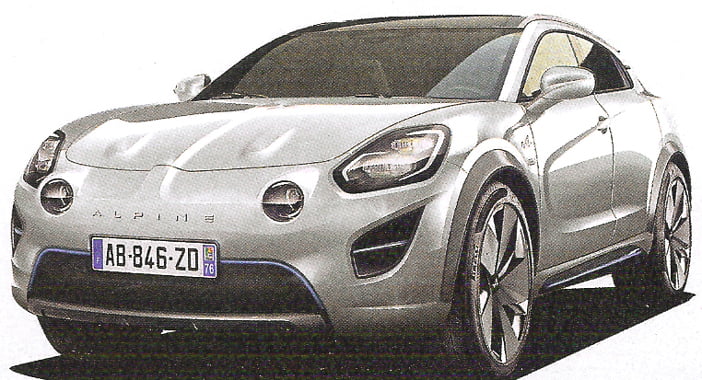
+++ The upcoming ALPINE GT X-Over, a dynamically focused and aero-optimised sporting crossover to rival the Lotus Eletre and Polestar 3, will provide Alpine with the volume-focused, practical proposition it needs to achieve substantially increased global sales. The GT X-Over will use the same CMF-EV architecture that underpins the Renault Mégane E-Tech Electric and the larger Nissan Ariya. It is likely that the Alpine’s lofty power figure and keen dynamics will come courtesy of a second motor on the rear axle, mirroring the range-topping e-4orce version of the Nissan, while the front wheels will be driven by the 220 hp unit used by the Mégane. Speaking at the Paris motor show last month, Alpine head designer Antony Villain made it clear the brand will not abandon its sporting credentials in the pursuit of high-volume sales. “If we keep the driving experience, the elegance, the sportiness and the stance of the car, it’s not a problem”, he said. A test mule spotted wearing the body of a Dacia Duster, Alpine’s sibling brand, has already hinted at a strong emphasis on cornering agility. Spy shots show it with large-diameter sports wheels pushed right to the corners of the architecture, giving a long wheelbase and as wide a track as possible. “I think there are a lot of other manufacturers that explore ways of staying true to their DNA”, added Villain. “I think it is possible, and there are a lot of customers who really want this kind of car”. As with other performance-focused brands tapping into higher volumes with larger, heavier models, Alpine will look to ensure that the spirit of its flagship model is carried over to its first SUV. While the Alpine A110 is obviously a modern reinterpretation of the 1963 original, with its distinctive quad-light front end and shapely aluminium curves, the GT X-Over promises a step-change in Alpine’s approach to car design. “You will see a lot of links with the A110”, said Villain, but he added that all-new cars give “more freedom to explore”. Aerodynamic efficiency will play a key role in shaping the new SUV, with a view to optimising straight-line pace while improving both downforce in corners and efficiency. An official teaser of the car reveals a dramatic, coupé-style curved roofline, swollen rear haunches and a low, sloping bonnet. Engineers at Alpine’s Formula 1 headquarters in Oxfordshire have worked with the Paris-based road car team to improve airflow (with a claimed 25 km range boost as a result) and Alpine CEO Laurent Rossi said there is also scope for technology transfer on the battery management side. Alpine’s simultaneous focus on race and road car development was showcased recently by the radical Alpenglow single-seater concept. While ostensibly showcasing the French outfit’s plan to bring hydrogen-combustion technology to the fore, the car also previewed several features and cues that will be common to upcoming production cars. Active aerodynamics, for example, could help mitigate the GT X-Over’s kerb weight (likely to exceed 2.500 kg), and it will nod to the brand’s motorsport activities with a similarly LMP1-inspired steering wheel and a driver-focused cockpit. More precise details about the GT X-Over’s performance potential and technical make-up will remain under wraps until an expected reveal in 2024, but Renault has confirmed it will add a new 272 hp EV motor to its ranks in the coming years. That, if combined with the smaller 220 hp unit in a twin-motor, 4WD set-up, could see the SUV arrive with nearly 500 hp. If it uses the same 87 kWh battery as the CMF-EV based Ariya and drops some of its weight, an official range in excess of 500 km is well within reach. +++
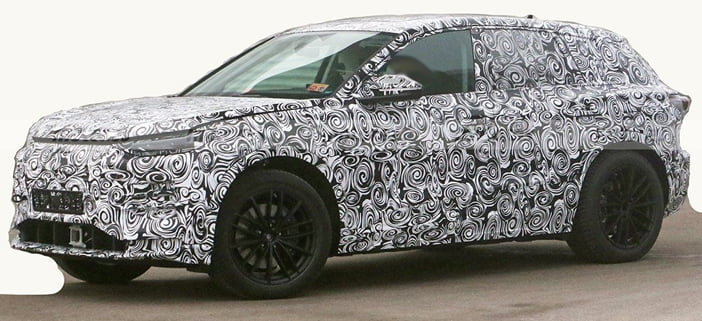
+++ One of the most anticipated future AUDI models is the fully electric Q6 e-Tron. Unrelated to the ICE-powered Audi Q6 that is already available in China, the Q6 e-Tron will be a sporty and premium SUV that shares its underpinnings with the upcoming Porsche Macan EV featuring the latest advancements in terms of technology and driving dynamics. Besides the numerous shots of camouflaged prototypes we have seen over the past couple of years, our spy photographers have caught Audi’s next SUV with an undisguised front end leaving little to the imagination. The Q6 e-Tron will feature split headlights at the front, similar to the A6 e-Tron sedan. The upper units will sport matrix LED graphics for a high-tech look, at least in some trims. Similarly to the smaller Q4 e-Tron, the grille will be covered and painted in silver, but the bumper intakes will still be functional. From the profile, the Q6 e-Tron will look more dynamic than your average SUV thanks to the sculpted body lines and sporty proportions. The tail will be typical of the German brand with aggressive-looking horizontally mounted LED taillights. Besides the traditional SUV bodystyle, Audi will also launch the Q6 e-Tron Sportback coupe-SUV with a sloping roofline and an integrated spoiler. As with most Audi models these days, a high performance-focused RS variant with an even sportier bodykit will join the range at a later date. Inside, spy shots have revealed a different layout to the current Audi range. The dashboard is dominated by a large portrait-orientation infotainment touchscreen combined with a digital instrument cluster. The multifunctional flat-bottom four-spoke steering wheel features Audi’s new and simpler emblem, while the center console has fewer buttons than ever before. Unlike the more mainstream Q4 e-Tron which is based on the VW Group’s MEB architecture and the larger Q8 e-Tron flagship that sits on an updated version of the aging MLB Evo, the Q6 e-Tron will ride on the more sophisticated Premium Platform Electric (PPE). Those same underpinnings will be shared with the upcoming Audi A6 e-Tron and the Porsche Macan EV. The PPE is compatible with single (RWD) or dual electric motors (AWD), and a battery with a capacity of up to 100 kWh. Audi is keeping its cards close to its chest in terms of the available power outputs. However, it has been confirmed that the Porsche Macan EV will produce up to 612 hp and 1.000 Nm of torque from dual electric motors. Audi could use the same setup for the performance flagship of the Q6 e-Tron range bearing the RS badge, in combination with a sporty chassis setup. Lesser variants could be offered with the dual electric motors from the A6 e-tron concept which produced a more sensible 477 hp and 800 Nm of torque. As for the range, the A6 e-Tron sedan was said to be able to travel up to 700 km in concept form. A more limited range is a safer bet for the less aerodynamic SUV, placing it closer to rivals including the Mercedes-Benz EQE SUV and the BMW iX. The Audi Q6 e-tron was initially expected to arrive before the end of 2022. However, its premiere could be pushed back, though hopefully, it will debut before the mechanically-related Porsche Macan EV which has been delayed for 2024. Starting in 2026, Audi will only unveil fully electric models before becoming an EV-only brand in 2033. +++
+++ The AUDI R8 is nearing the end of the line. As a swan song to the storied nameplate, the German marque has launched the final V10 GT. However, those who want to get a hold of the final R8 but don’t prefer a fixed roof will be disappointed. The model’s Technical Project Manager, Nils Fischer, confirmed that a Spyder variant for the R8 GT won’t be happening. When asked the reason behind this move, Fischer confirmed that it was simply because there isn’t enough production volume left. Of note, the Audi R8 GT will have its production through 2023 only, which means that it will not return in 2024. Those who seek to buy this V10 supercar will have to do so within a year. While the arrival of a drop-top R8 GT was already ruled out in the coupe’s release in October, this confirmation from Fischer has completely shut the door for the Spyder hopefuls. The R8 V10 GT will have limited production, with only 333 units to be produced. This mirrors the numbers of its first namesake back in 2010, albeit that one also came with 333 R8 GT Spyder units. The final R8 V10 packs 612 hp and 550 Nm of torque, routed to the rear wheels via a newly developed 7-speed, dual-clutch transmission that’s claimed to deliver gear changes quicker than before. This could be the final Audi R8 that’s running on ICE as the next one is said to be powered with electric motors while using a Porsche platform and coming in 2025. Fischer, however, confirmed to Carbuzz that the future of the R8 is yet to be determined. +++
+++ GENERAL MOTORS is one of the automakers that have the most ambitious EV strategies. The manufacturer wants to beat Tesla in its own game by the middle of the decade but apparently, that doesn’t mean GM will abandon the internal combustion engine. In fact, a company executive currently confirmed the ICE is here to stay for the years to come and GM will continue to rely on its services. GM president Mark Reuss recently gave an interview ahead of the company’s investor day presentation in New York. He told General Motors is not ready to leave the traditional mainstream segments where models with combustion power are still dominating sales by a wide margin. “The ICE age is not over”, Reuss told Fox Business. “We’re not going to abandon our internal combustion engine segments. We’ve got truck leadership with GMC and Chevrolet. We’ve got it across our midsize trucks, our full-size trucks, and then beyond”. If you’ve been following the automotive industry more closely in the last few years, you won’t be very surprised by Reuss’ statement. More and more automakers are strengthening their combustion-powered portfolios to keep earning money and start investing in electric vehicles. In GM’s case, the company wants to pour around $35 billion into EV and autonomous technologies by the middle of the decade. In February this year, the automaker’s CEO Mary Barra declared General Motors had plans to deliver about 400.000 electric vehicles in North America through 2023 and up to 1 million EVs in the region through 2025. However, the rapidly changing automotive industry forced GM to change its forecast, and during the Q3 2022 earnings call on October 25, Barra changed the timeline to the first half of 2024 (or 6 months later than initially planned) for the first goal. In the new interview, Reuss commented on when he expects the investments in the EV sector to start bringing fresh money and that year is 2025. “Then we begin to make money on EVs and the margin structure becomes very good”. +++
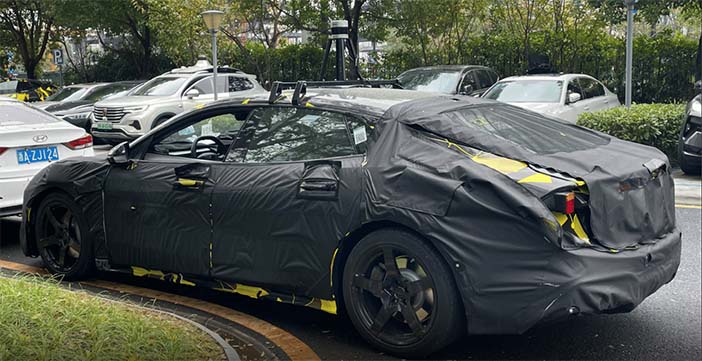
+++ The LOTUS ENVYA , also known as Type 133, is a new upcoming EV in a Lotus lineup. It is a sedan that stands on the modified Geely’s SEA platform. It was spied in China during road tests. Let’s get to know it better. First, we will remind you that in 2017, Lotus became owned by Geely. Then, Lotus Technology was founded by Geely in Wuhan. It develops all Lotus’ electric vehicles. The development of the last petrol-powered sports cars remains in the United Kingdom. But after the current generation, there won’t be any new ones. So all actual development will be in China only. The first Lotus EV developed by Lotus Technology is the Eletre. This SUV stands on the EPA (Electric Premium Architecture) that is based on Geely’s SEA. As for the powertrain, it has up to 918 horses and 600 km of WLTP range. It was launched in China in October. And now Lotus Technology works on a one more exciting vehicle, and it is the Lotus Envya sedan. Recently, a pair of Lotus Envya sedans was spied in China during road tests. And now, a more fresh shot has leaked online. It is wrapped with a heavy camouflage, but we still can see its exterior features. It has got an aerodynamic shape with a slope roofline. So it looks like the Envya isn’t just a simple sedan, but a sedan-coupe. Its taillight unit is unfinished, but it will probably stay in line with the Lotus Eletre. We can also see that it has got pop-out door handles, and an oddly tall camera pod on the roof. The wheels of the Envya are R20. As for the interior, we can see that it also stays in line with the Eletre. It has the same steering wheel and a thin instrument panel. We should also mention a visualization of the Lotus Envya, made by one enthusiast. Its exterior is close to the Eletre. Specs of the Lotus Envya are unknown, but Chinese media speculate that its powertrain will be similar to the Eletre. So the entry-level Envya will be equipped with two electric motors for 612 hp and 710 Nm. As for the top trim level, it will have 3 electric motors for 918 horses and 985 Nm. Anyway, it will hit the market in 2023, so we will soon get to know it better. We will keep an eye on it, so stay tuned! +++
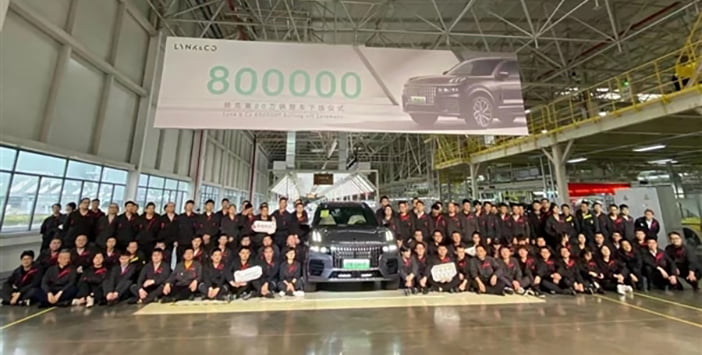
+++ The 800,000th vehicle from LYNK & CO , which happens to be a 09 EM-P model, has rolled off the production line. Established in 2017, Lynk & Co was jointly created by Geely and Volvo, and its first model was the Lynk & Co 01. Since then, the automaker has expanded its product line adding 8 other models. Its lineup includes a compact SUV, compact hatchback, crossover, sedan, coupe SUV, 7-seater, and even an electric scooter. Lynk & Co’s models are mostly sporty/performance cars targeted at a younger audience. By 2021, the company had sold a cumulative 220.500 units. However, in 2022, sales slowed down, with only 77.000 copies sold in the first half of the year. From January to September, the automaker sold 123.500 units, and a further 16.439 copies in October, representing a 24% drop in sales year-on-year. In a bid to improve sales figures, the automaker introduced its flagship SUV, the Lynk & Co 09, a six-seater midsized SUV, which many have compared to the Volvo XC90. Even with the 09, sales have not improved much. One factor affecting the brand’s sales might be its use of the 3-cylinder engine, which isn’t exactly a bestseller in China. However, the Lynk & Co 03 has done considerably well in the market. Currently, it is also introducing 4-cylinder engines in its ICE models, while the 3-cylinder engines are used in its hybrid models. Lynk & Co launches at least 2 models yearly, and despite the temporary drop in sales, the automaker has outlined an electrification plan. By 2024, Lynk & Co says EVs will make up 60% of its lineup, and the automaker plans to fully electrify its lineup by 2025. Unlike other automakers, Lynk & Co uses a direct-to-consumer sales model, ditching the traditional dealership model. With this, buyer order and customize their car directly, either online or at a retail shop. +++
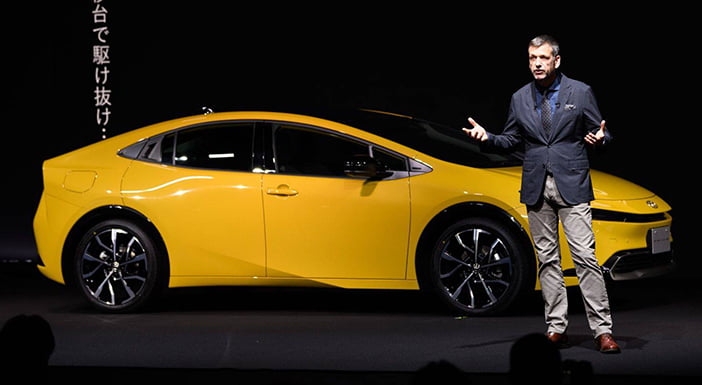
+++ TOYOTA took the wraps off the latest iteration of the Prius, the hybrid vehicle that that paved the way for electric cars more than 2 decades ago. The fifth generation of the car, with bigger wheels and a sportier design, offers 3 different hybrid powertrain options and will go on sale starting this winter, the carmaker said at an event in Tokyo on Wednesday. Pricing for the new model wasn’t disclosed, although Toyota stressed it would be “affordable for everybody”. The world’s No. 1 automaker pioneered mass-market hybrid vehicles with the debut of the Prius in 1997, and contends that the technology still has a long way to go. It’s a bet on the longevity of the brand and technology at a time when Tesla and other upstarts have seized the narrative to say that the era of electric vehicles has already arrived, even though they still only make up about 6% of total global car sales. “It’s a car to be driven by all people, not just the few”. Simon Humphries, Toyota’s senior general manager of design, said at the unveiling. “That’s its greatest strength and reason for its existence, and it’s the reason why the Prius brand should not be lost”. The new Prius will have a 1.8-liter and 2.0-liter engine hybrid powertrain options, which combines a combustion engine, electric motor and battery to deliver better fuel economy and acceleration. There’s also a 2.0-liter plug-in hybrid system that boosts power and range. A lower chassis, swept body and shark-like nose, in addition to black exterior accents and dark interior tones, are all aimed at giving the Prius an edgier look, a departure from the wedge-shaped and gray interiors seen in prior models. Toyota mainly focused on 2 areas for the new Prius, according to Satoki Oya, a deputy chief engineer at Toyota who worked on the Prius. One is the design and the other is drivability, he said. “This is meant to showcase Toyota’s most advanced technology”, said Bloomberg Intelligence analyst Tatsuo Yoshida. Toyota has sold 4.75 million Priuses to date, while Tesla only just passed the 3 million mark for cumulative production of all its vehicles. After peaking in 2010, when more than 500.000 units were sold worldwide, there’s been a gradual slide, with customers buying almost 86.000 Priuses last year. Even though Prius sales have tapered off, hybrid technology is now spread across Toyota’s product line, including the Lexus brand. Other Toyota hybrids, such as the RAV4, do even more volume. “The reason why Prius sales have declined isn’t because hybrids aren’t selling well,” Yoshida said. “It’s because there are other hybrid options, so it is no longer necessary to buy a Prius”. +++