
+++ ASTON MARTIN will launch a new, ultra-exclusive model this year as part of the British car maker’s 110th-anniversary celebrations, which will run throughout 2023. Described by the Gaydon-based firm as “a new, strictly limited, exclusive Aston Martin model”, the car will be officially unveiled later this year. Aston Martin has remained tight-lipped about the model, withholding its name, performance statistics and what shape it will take. It could come from its bespoke Q division, following the launch of the Aston Martin DBR22 last year. It’s likely the model will appear at one of the year’s most significant motoring events, though. Aston Martin has confirmed its anniversary celebrations will “take centre stage” at the Formula 1 British Grand Prix, Goodwood Festival of Speed and abroad at Pebble Beach. The firm will begin the launch of its next generation of sports cars this year while also saying farewell to the Aston Martin DBS with a high-powered, range-topping swansong. The Aston Martin Vantage and Aston Martin DB11 are expected to receive major overhauls this year, with engine, gearbox, suspension and interior revisions in the pipeline. Aston Martin’s 110th anniversary marks a number of milestones. It’s the 75th year of the DB nameplate, 60 years since the Aston Martin DB5 and 20 years since the firm relocated to its Gaydon headquarters. “In 1913, Lionel Martin and Robert Bamford came together with a shared vision of racing cars and using learnings from the racetrack to push the boundaries of automotive innovation”, said Amedeo Felisa, who was appointed Aston Martin CEO in May last year following the departure of Tobias Moers. “110 years and little over 110.000 cars later, that spirit continues. Our 110th year promises to be just as exciting as our first, as we turn a new chapter in Aston Martin history with the launch of our next generation of sports cars and the reveal of an extraordinary special model later this year that will celebrate this unique milestone”. +++
+++ Testing of the first purely electric BMW sports car is under way, with engineers working to preserve the distinctive dynamic character of an M car in the post-combustion era. BMW revealed the first images of a mysterious EV prototype last year, giving few details but confirming that it was powered by a pioneering quad-motor, four-wheel drive system capable of “extremely precise” power delivery “within milliseconds”. Speaking exclusively with the press following the recent unveiling of the new M2 Coupé, which is in line to receive similar technology in its next generation, M CEO Frank van Meel hinted that 4WD performance EVs will take the lead from the F90-generation BMW M5 xDrive saloon. That model was controversial on its reveal for adopting a powered front axle but now regarded as one of the best-handling sports saloons of its time. “The secret behind that”, he said, “is that you have a central controller, or a central logic that controls everything: the rear differential but also the front-to-rear differential and the DCS (Dynamic Stability Control) system”. Having one system that manages these relationships is crucial because “if you have four systems that try to co-operate, the car drives like a car with 4 systems that like to co-operate”. BMW calls this ECU the ‘Hand of God’. It has developed it for deployment on various M cars since it first appeared on the i8 as a means of balancing the output of its petrol and electric powerplants and allowing for advanced torque vectoring to improve handling. “If you go a step further and look at electric cars with four electric motors, like we have in our very early development car, then of course you can still use the same logic to control the car that drives like an M”, said van Meel. “So it gives you even more possibilities”. He highlighted that a powered front axle also allows for greater recuperation of energy under deceleration; potentially a huge boon for electric motorsport. Details of exactly how an electric M car will be marked out from its standard counterparts remain secret, but the top-rung iX M60 and upcoming i7 M70 already have outputs in the region of 600 hp and rapid off-the-mark acceleration, so van Meel’s engineers will be working hard to cultivate a distinct dynamic character for its new family of sports cars. Intriguingly, the quad-motor prototype that BMW showed last year is a mash-up of several models from the line-up (it has a BMW 4 Series Gran Coupé bodyshell and BMW M3 front and rear ends, most notably). This suggests the modifications M has in mind will be so extensive as to necessitate the launch of a highly bespoke model, rather than a relatively lightly reworked i4 or i7, for example. Fruition could be some way off, however, with van Meel saying it needed “a very early start on the development, because it takes years to get everything ready”. It’s possible that this technology could find its way into an EV successor to each current M car, which raises the intriguing proposition of a quad-motor, compact coupé in the vein of today’s M2; a model that stands to benefit most obviously from the compact footprint, low centre of gravity and even weight distribution afforded by such a powertrain. Van Meel hinted that such a car is on the cards, telling that M “will try to also offer in the future cars in this price range”, referring to the M2’s starting price as the gateway to the M line-up. Given that the second-generation M2 (M’s final pure-combustion car) is only just on its way to dealerships, an EV successor would no doubt be several years off, but the model’s critical and commercial success means BMW is unlikely to retire it after only 2 iterations. +++
+++ The 7th generation BMW 5 SERIES will bow out after seven years in 2023, and the German car maker has now confirmed that the model’s all-electric counterpart will also go on sale this year. Set to radically transform the model both technologically and stylistically, the new BMW i5 forms a major part of BMW’s transition to a maker of electric cars. In the firm’s 2023 sales report released this week, BMW said it hoped 15% of its sales in 2023 would come from electric vehicles. “The clear focus will be on continuing to ramp up electromobility. The next milestone for 2023 is for 15% of our total sales to come from fully electric vehicles”, said BMW sales chief Pieter Nota. “With the launch of the i5 later this year, we are taking another important step on the road to electrifying our model line-up”. BMW’s 5 Series, which was first launched back in 1972, has been on sale in its current, 7th-generation guise since 2017. The latest car follows the arrival of the latest X3 and 4 Series, and will be offered with a choice of pure-combustion, hybrid and full-electric powertrains in line with BMW’s ambition to sell seven million plug-in hybrid and pure-electric vehicles by the end of 2030. The i5, though, will be marked out from the 5 Series in the usual BMW EV style, featuring a blanked-off grille, bespoke wheel designs and, based on subtle differences between 2 recently spotted prototypes, a bespoke rear-end design. The EV is highly likely to mirror the line-up of the new i4, which means potentially a choice of rear- and four-wheel drive, with outputs ranging from 340 hp in an entry-level i5 eDrive40 to 542 hp in a twin-motor M50 xDrive model. The i4’s 80.7 kWh battery pack, said to be 30% more power dense than the smaller i3’s 42.2 kWh item, is also likely to feature, providing a WLTP range of around 560 km at the top end. The BMW Group will offer 12 fully electric vehicles globally by the time the new 5 Series goes on sale this year, including EV versions of the X1 and 7 Series. An all-electric version of the 3 Series is also in development as a sibling model to the i4. In terms of design, the new 8th generation 5 Series brings a sharper front-end design and a more rakish roofline than the current model. It will sit atop an evolved version of the modular Cluster Architecture (CLAR) used by all current BMW models apart from the 1 Series, 2 Series Gran Coupé and 2 Series Active Tourer. Compatible with pure-combustion, mild-hybrid, plug-in hybrid and fully electric powertrains, as well as both rear- and all-wheel drive layouts, this platform underpins BMW’s strategy of portfolio diversification in the run-up to going all-electric. The 5 Series will be one of the last all-new BMW models launched before the company begins the ‘third phase’ of its electric transition in 2025. This new era, termed ‘Neue Klasse’ in reference to the mould-breaking saloon cars that catapulted BMW into the mainstream in the 1960s and 1970s, will usher in new-generation EV powertrains, heighten BMW’s focus on supply chain sustainability and introduce an all-new software platform with the aim of providing “a completely novel user experience”. Codenamed G60, the new 5 Series could be updated during its life cycle to keep pace with Munich’s new-era line-up. However, when the car is launched in 2023, BMW’s ‘Power of Choice’ strategy will still be in operation (a follow-up to the initial ‘Project i’ program under which the i8 and i3 were launched), whereby each model in the line-up is offered with combustion, hybrid and electric powertrains. To that end, it is set to largely retain the current car’s turbo-only 4- and 6-cylinder petrol and diesel motors, as well as an expanded choice of plug-in hybrid systems centred on a 2.0-litre or 3.0-litre petrol combustion unit. Less certain is the survival of the 4.4-litre V8-powered M550i xDrive to occupy the gap between the 540i and top-rung BMW M5. Its twin-turbo N63 petrol engine dates back to the first-generation BMW X6, launched in 2008. This will make the unit 15 years old when the Mk8 5 Series arrives, so it will not be a strong candidate for expensive modifications to be made compliant with new Euro 7 emissions regulations. One possibility for the M550i’s successor is an uprated version of the 545e PHEV’s 4-wheeldrive powertrain, which comprises a 3.0-litre straight06 and a 109 hp gearbox-mounted electric motor for a combined 394 hp and 600 Nm. BMW has previously said CLAR-based PHEVs could accommodate electric motors with up to 204 hp, which hints at the potential for a circa-500 hp hybrid to sit beneath the M5. The M5 itself has been widely tipped to match its arch-rival, the Mercedes-AMG E63, in adopting plug-in power for its next iteration but with a petrol unit of larger capacity than AMG’s electrified turbo-4. BMW development boss Klaus Fröhlich has previously said there will not be any fully electric M cars until 2025. “Until then, we will have normally aspirated, turbo and ‘powered’ PHEV applications that deliver what we want to achieve”, he said, suggesting pure-electric powertrains and platforms remain too heavy to match the dynamic performance of today’s M cars. An M5 PHEV could use the electrified set-up tipped to appear in the upcoming XM performance SUV, which has been reported to mate the M division’s ‘S63’ twin-turbo V8 with a 200bhp electric motor for a combined output in the region of 750 hp. In the M5, that would almost certainly prove a significant enough boost (around 136 hp) to offset the weight penalty of a hybrid powertrain. It would also provide BMW with a contender to rival the forthcoming PHEV variant of the Mercedes-AMG GT 4-Door Coupé, which will pack around 800 hp, hit 100 kph from rest in less than 3.0 seconds and have a top speed above 320 kph. If the M5 does adopt such a set-up, it still leaves room at the top of the 5 Series line-up for an even more powerful fully electric performance variant based on the new i5. The CLAR platform can house up to 3 electric motors (2 on the rear axle and 1 at the front) with a combined power output of 800 hp. That would make even a far heavier ‘i5 M’ capable of outstripping the current, 625 hp M5 Competition in a straight line. Fröhlich also anticipates that an EV’s easily configurable traction control system means agility and responsiveness could be on a par. “The control can be 100% faster than on an M4 today, so it is easy to have a more responsive car”, he said. “If you want a drift mode that slips to 5 or 10 degrees (even 45) then it is easy”. However, it remains to be seen if BMW would offer a road car this potent. The Porsche Taycan Turbo S has a maximum output of 760 hp (even then only for a few seconds) and is one of the fastest-accelerating cars on sale today. +++
+++ The first ever electrified edition of the CHEVROLET CORVETTE , called the E-Ray Hybrid, will arrive on 17 January. Chevrolet has published a video of a production-ready car undergoing cold-weather testing, dubbed over with a mixture of V8 grumbles and electrified whines. This suggests its anticipated hybrid powerplant will be based around the hallowed 6.2-litre petrol engine and offer electric-only running over a certain distance. In an earlier teaser video showing a camouflaged prototype, the front wheels were seen spinning before the rears, confirming a four-wheel-drive set-up. Announced in this latest teaser is a new Stealth mode, which will likely switch the drivetrain from hybrid power to electric power for towns and cities. Stopping power will come from carbon-ceramic brakes, currently only available on the high-performance Chevrolet Corvette ZO6. Late last year, the car was leaked on Chevrolet’s online configurator, with buyers able to spec a range of colours not currently available on the Corvette, from Riptide Blue to Cacti, along with the option of all-blue interior leather. Chevrolet is yet to reveal exactly what powers the Corvette E-Ray Hybrid, but I expect it will feature broadly the same 495 hp 6.2-litre V8 as the current car, with a boost provided by the accompanying electric motor. As part of its 4-wheel drive set-up, I suspect the V8 will power the rear wheels, with electric power delivered to the front wheels by 2 electric motors. This would technically make it, in Stealth mode, the first ever front-wheeldrive Corvette. Last year, General Motors CEO Mark Reuss confirmed the first electrified Corvette would be launched in 2023, with a later pure-electric version built on GM’s Ultium platform, thus sharing underpinnings with the GMC Hummer and Cadillac Lyriq SUVs. The new versions of the Corvette will join the standard coupé and convertible models, fitted with a 495bhp naturally aspirated 6.2-litre V8, as well as the new track-focused Corvette ZO6, which features a 680 hp 5.5-litre V8. +++
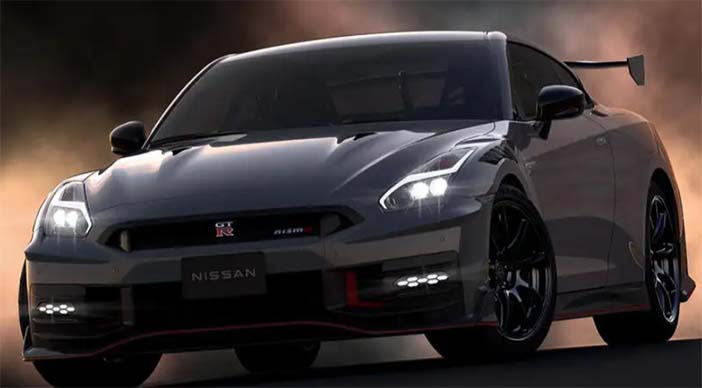
+++ The NISSAN GT-R has gained the most powerful production GT-R ever built as 1 of 2 special-edition models, along with some mild styling tweaks for 2023. Revealed on stage at the Tokyo motor show by Nissan COO Ashwani Gupta, the new GT-R looks largely similar to the previous car, save for a new front grille design. Key changes have been made under the bonnet and there are adjustments to the brakes and transmission, as well as moves to reduce noise and vibration and to improve ride comfort. 2 new trim levels, T-Spec and Nismo, have been added to the GT-R range, bringing the total number of specifications to 8. All cars are driven by the same 3.8-litre twin-turbocharged V6 engine, with an output of 570 hp and 620 Nm of torque in standard guise. However, range-topping Nismo cars produce 600 hp and 550 Nm. Nissan says the first new addition, T-spec, has been inspired by “trend and traction”, with improved grip, specially tuned suspension and carbon brakes all contributing to bolstered driving dynamics. A second addition is the new GT-R Nismo, which features technologies drawn from motorsport and racing. Aerodynamics have been improved with some modifications to the GT-R’s front end and there are carbon fibre intakes, a carbon fibre bonnet and sleeker wheel arches. Rear downforce is enhanced by a stronger rear wing, derived from Nissan’s GT500 race cars. Additional carbon fibre added at the back helps to enable a 13% increase to rear downforce. All cars feature 4-wheeldrive, a GR6 dual-clutch transmission and specially designed Recaro sports seats. The firm has also modified the GT-R’s exhaust note to adhere to stringent sound regulations. Under the skin, Nissan says, the GT-R Nismo benefits from weight-balanced engine parts, including a new crankshaft, piston rings and connecting rods. The new GT-R will go on sale in Japan in spring this year before the more powerful Nismo versions join later in the summer. It’s unlikely we’ll see it in Dutch showrooms, though. In March last year, Nissan announced the sports car, famously nicknamed ‘Godzilla’, would be removed from sale in Europe due to strict new noise regulations. The GT-R had been on sale for 13 years on the continent. However, there is a slim chance we could see it on our shores, given the firm has adjusted the exhaust note. +++
+++ PORSCHE is close to a radical reinvention as it prepares to electrify its entire lineup, with 4 new models (Macan, Cayenne, Boxster and Cayman) arriving from 2024. These EVs, released along with petrol equivalents, feed into Porsche’s goal of 50% of its sales having electrified powertrains by 2025, with 80% being pure-electric by 2030. However, making EVs is counterproductive if their manufacture incurs damage to the environment, so Porsche now has another target: to make its entire supply chain CO2-neutral by 2030. Here’s how it’s leading the charge to net zero. 1) Using new forms of energy: Porsche’s energy strategy comprises 2 key tenets: exploiting only sustainable energy sources and reducing how much it uses. The former has meant a switch to renewables at the Stuttgart factory, which has slashed its annual CO2 output by 90.500 ton. Using biogas has been less transformative but has reduced CO2 by a further 42,300 ton. Changes inside the factories are more novel: regenerative braking has been added to the autonomous guided vehicles carrying parts on the factory floor, boosting their efficiency. 2) The old-school approach: Porsche’s environmental drive is not a response to cultural trends over the past decade but has been in motion since the turn of the millennium. When an old military test facility near Leipzig was chosen to house a new factory for Cayenne production in 1999, the company gave itself 3 years for construction. The base had been used since the days of the German Empire, and to break ground the firm first had to clear almost a century of old munitions. At this point an ‘old-school’ approach to conservation was set in motion, explained Porsche environmental and energy management boss Anke Höller. Some 326 acres of the 740-acre facility were designated as an “ecological compensation area” to help offset the environmental impact of the factory; a novel concept at the time. Today, the zone houses Exmoor ponies, Heck cattle and 50 honey bee colonies, and it attracts 138 bird species. The facility is also used to educate the next generation. Children aged seven and up are offered safari tours around the factory grounds. “It’s important that we teach children how to engage with nature and the environment in a responsible and sustainable way from an early age”, said Thomas Schmidt, former Saxon state minister of the environment and agriculture. 3) Removing plastic from products: The final pillar in Porsche’s net-zero strategy is collaboration with parts and logistics partners. Recycling, for example, has benefited from work with suppliers to remove as much plastic as possible from their products, which are often shipped without. And where plastic is strictly necessary, coloured plastics are banned because they cannot be recycled. “You always need partners”, explained Höller, as she emphasised that Porsche can only do so much alone. Porsche’s war on plastic extends even to the trolleys used to ferry components around shop floors. The company has switched to carts built exclusively from chipboard and cardboard. 4) Minimising water pollutants: Such measures have already had a significant impact: Porsche’s Leipzig, Weissach and Zuffenhausen facilities are now CO2-neutral on balance. But times are changing, and CO2 is no longer the only metric by which Porsche measures its environmental footprint. “Water is the gold of the future”, said Höller, as she explained that Porsche is now working to minimise the release of pollutants and toxins into its waste water. Whether that turns out to be a visionary move (or just another string to its bow) only time will tell. Due in 2024, the Macan-E will arrive as the “sportiest car in its segment”, with a dual-motor set-up producing 610 hp and 1.000 Nm. Codenamed K1, expect the BMW iX rival in the latter half of the decade. It will get highperformance motors and a high-silicon-content battery. An electric Cayenne will land in 2025 alongside the current petrol-powered model. Range is tipped to beat the 600 km miles of the Mercedes EQS SUV. The 718 duo will adopt a bespoke electric sports car platform that mimics current mid-engined characteristics. Launch is expected in 2026. +++
+++ SKODA has confirmed it will launch the heavily updated 4th generation of its Superb in 2023, with a range of powertrain options and an estate bodystyle available. Predominantly ICE-powered, the new Superb will directly rival the Peugeot 508 and play a major role in maintaining and advancing the Czech firm’s market share, which took a hit based on 2022 sales figures. Last year, the model sold 60.800 examples worldwide, representing a drop of 8% on the previous year. As part of the firm’s rapid advance towards electrification, it unveiled a plan to guide its transition that includes investing €5.6 billion in e-mobility, including three new electric cars by 2026; a flagship SUV, a city car and an electric alternative to the Karoq. However, in the lead-up to the 2030 ICE ban, it will continue to update its existing combustion models, with a next-generation Kodiaq also confirmed for launched this year. By this time, the firm estimates ICE cars will still account for 30% of its total sales. Given that the Czech car shares many of its underpinnings with Volkswagen’s Passat, I expect the latest Superb to broadly follow the same path, meaning the 2023 Superb will be based on Volkswagen’s latest ICE car platform: MQB Evo. As such, I suspect powertrain options to be similair to the current VW crop: a mix of pure-ICE and electrified options in 2- and 4-wheel drive configurations, in line with Skoda’s ploy to cater to a larger range of buyers and strengthen its position in the premium executive segment. A mixture of petrol and diesel engines are available with the current Superb, with 1.5-litre and 2.0-litre turbocharged petrol engines and 1.6-litre and 2.0-litre diesel engines. The next generation electrified plug-in hybrid uses a 1.5-litre petrol 4-pot. Whether these powertrains will drive the new car remain to be seen because details remain scarce. However, given Skoda’s aim of catering to a large bracket of customers, this line-up will bring about the sort of cost-efficiency needed to achieve that goal. Production is tipped to take place on a new line in Czechia, although this hasn’t yet been officially confirmed. +++
+++ VOLKSWAGEN will reveal a GTX performance version of the Volkswagen ID.Buzz later this year. This will crown the electric MPV line-up, which will soon also expand to include a longer-wheelbase version and a California camper van. Speaking at a 2023 Car of the Year event, Volkswagen R&D boss Kai Gruenitz gave more details on how the firm will expand the ID Buzz range beyond the initial 5-seat MPV and Cargo van. “The GTX will be a cool high-performance version, with 340 hp, a dedicated interior, new exterior colours and some additional features”, he said. It will use the dual-motor, 4-wheel drive system shared with other versions of the Volkswagen ID range of EVs, including the 2023 Volkswagen ID.7 saloon. Wolfsburg is also considering launching a non-GTX four-wheel-drive version of the ID.Buzz. Gruenitz also detailed the long-wheelbase version of the ID.Buzz that’s coming this summer, offering far greater seating flexibility than the five-seater. The launch model has only a standard 3-seat bench across the back that splits 60/40 and can’t be removed. The long-wheelbase version will be 25cm longer than the standard car and feature 7 seats. “It will have 3 rows and 7 seats, and you can pull them all out of the back”, said Gruenitz. “It will also have captain chairs that turn around”. When asked for an update on the development of the California version, Gruenitz said: “There will be a camper version. The first concept is being worked on now. It’s interesting what’s possible and what would be cool and usable”. Autointernationaal.nl understands this model is likely to be introduced in 2025. +++