
+++ NISSAN on Tuesday unveiled a new electric SUV at the Shanghai auto show as it highlighted its commitment to the Chinese market. “We are bringing more electrified models, such as Ariya, e-Power Sylphy and e-Power X-Trail. We are also planning to launch an EV designed specifically for the Chinese market”, said Ashwani Gupta, Nissan’s chief operating officer, speaking at the show. China has long been a key market for Nissan, but like other global automakers it faces increasing pressure and the threat of declining market share from the rise of home-grown auto companies. Gupta said the new vehicle, called the Arizon, will offer a virtual personal assistant, dubbed Eporo, and feature a low centre of gravity while lacking structural pillars, a move the company says enhances the car’s spacious interior. “Going forward, software-defined vehicles will continue to redefine vehicles, making cars a more and more integrated part of our digital lifestyle”, Gupta said. Once a pioneer in the global electric vehicle market with the Leaf, Nissan has long since ceded dominance to Tesla and has struggled in China against BYD, the country’s biggest EV player. Nissan’s latest electric offering, the Ariya, has been hampered by problems at its high-tech production line, media reported last month, slowing delivery of a car that was designed to put the Japanese automaker on the road to a comeback. The Ariya is supposed to be the first of 19 new battery EVs that Nissan has said it plans to roll out by 2030. S&P Global Ratings recently cut Nissan’s debt rating to junk status, saying margins and sales volumes were unlikely to improve as quickly as previously expected. +++
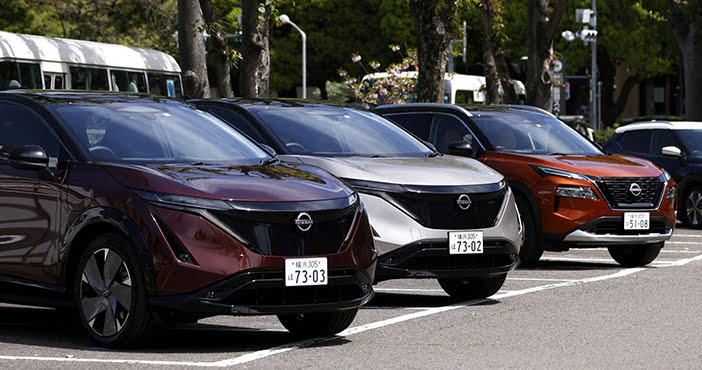
+++ NISSAN is developing growth plans in areas such as software and electric vehicles independent of Renault as the automakers work to finalize terms of a sharply limited alliance, said 7 people with knowledge of the matter. Japan’s third-biggest automaker by sales is seeking a partner outside the auto industry to develop software that connects vehicles to cloud-based services, 2 people involved in discussions said, without elaborating on candidates. That would address a relative weakness for Nissan as it tries to make cars “smarter and more connected”, one of the people said. It is also working on an expanded strategy for all-battery and plug-in EVs for North American and Asian markets that will be for Nissan alone, they said. The revelations come as the alliance oversight board met this week to discuss a rebalance that will see Renault cut its stake in Nissan to 15% from 43% (matching the size of Nissan’s stake in Renault) and Nissan gain reciprocal voting rights. Under the deal, to be finalized by mid-year, Nissan will also invest in the French automaker’s new Ampere EV business. Imbalance had long riled Nissan executives who complained Renault did not pay its fair share of costs for innovation and development. Nissan’s emerging strategy reflects a belief within the automaker that the 23-year-old alliance has run its course for many of the biggest challenges it faces, the people said. While Nissan sees continued savings in shared parts procurement with Renault, it has no plan to provide engineering support to Ampere, said two of the people, who all asked not to be identified because talks between the pair are ongoing. It also has no plan to provide its e-Power hybrid technology to a gasoline powertrain-focused joint venture Renault has with China’s Zhejiang Geely Holding Group and Saudi Aramco Base Oil, 2 of the people said. Such go-it-alone thinking is shaping a longer-term plan that could be announced by year-end focusing on improved operational performance, electrification and software allowing self-driving and other “connected car” features, one of the people said. “Even if Renault gets something from Nissan, benefits moving in the other direction are hard”, a second person with knowledge of Nissan’s stance said. “The restrictions from Renault are gone, and we can move freely”. In a joint statement to Reuters, Nissan and Renault said they were working toward final partnership terms that would make them more competitive. They said they planned to detail already-announced cooperative projects for India and Latin America. “The new structure enables faster and more flexible decision making”, the pair said in the statement. They said, without elaborating, investing in Ampere would strengthen Nissan in Europe and “accelerate new business”. Nissan will invest and provide technology for the venture but will limit its operational involvement, one of the people said. If Ampere developed technology of interest for Europe, Nissan would look to buy it separately, the person said. The stance marks a hard stop for the vision of Carlos Ghosn, who formerly headed both Renault and Nissan and pushed deeper integration over the objections of some Nissan executives. Ghosn was arrested in 2018 in Tokyo on charges of financial misconduct. He said his detention was part of a plot by Nissan executives to block a merger. He fled to Lebanon in late 2019 while awaiting trial and has since been living as a fugitive. In rebalancing talks, Nissan has pushed for protection of its technology to limit any downside from continued partnership, people involved have said. Among technology Nissan wants to protect is its work on solid-state lithium-ion battery-making and its e-Power electric hybrid powertrain, the people said. Some executives said the alliance talks’ best outcome would have been a “zero percent, zero percent” equity tie-up; a goal they knew was unreachable but floated to drive home the point that Nissan needed to move on its own, the people said. +++
+++ PANASONIC , a Japanese battery supplier to electric vehicle maker Tesla Inc, said on Sunday that it is considering building a battery plant in Oklahoma, its third in the United States. “Panasonic has entered into an agreement with the State of Oklahoma that defines the eligibility and terms of the incentives under Oklahoma’s LEAD Act”, the company told in an email, referring to an incentive package the state has established to attract major companies to its MidAmerica Industrial Park in Pryor. “There are no other specific decisions that have been made by the Company. We will share more information as it is available”, the statement said. Panasonic’s decision to consider Oklahoma, which was reported earlier by Kyodo news agency, comes amid surging sales for electric vehicles, and other EV makers besides longtime customer Tesla are looking to the Japanese conglomerate as a possible battery supplier. Panasonic is in talks with other Stellantis and BMW about building a new EV plant in North America, the Wall Street journal reported this month. The Japanese company in July rejected Oklahoma as the site for its second EV battery plant, picking Kansas instead to make batteries for Tesla. State officials there said that investment of up to $4 billion will create up to 4.000 jobs. +++
+++ In SOUTH KOREA , cars have overtaken semiconductors for the first time in nine years to become the country’s most profitable export although the overall trade balance remains in the red. According to the Korea International Trade Association on Monday, cars posted a trade surplus of $7.92 billion in the first w months of this year, rising to $10.5 billion if automotive parts are included. Semiconductors, which ranked at the top from 2017 to 2022, fell to 8th place with a surplus of $1.9 billion. Korea’s automobile trade surplus increased 37.2 percent on-year in January and February. Analysts said rising car prices at Hyundai and Kia, which account for 88 percent of Korea’s total car exports, played a major role. The average sales price of their cars surpassed W50 million for the first time last year and a strong U.S. dollar helped increase exports in money terms. The Korean auto giants sold more value-added vehicles like SUVs and hybrid and electric cars and Genesis premium cars. Another factor was improved performance in North America and Europe. Korea’s car exports rose 22 percent in the first 2 months to 421.668 cars, soaring 41 percent in North America and 18 percent in the European Union. Hyundai-Kia took 4th place in car sales in the U.S. in the 4th quarter of last year to beat Stellantis. In the first quarter this year, their sales in North America rose another 18.5 percent on-year to 382.354 vehicles to rank 4th after GM, Toyota and Ford. Although sales of Korean electric cars slowed after they were excluded from U.S. tax breaks, sales of compact SUVs and sedans increased 20 to 40 percent there, and U.S. sales of Genesis surged 17.5 percent. Hyundai-Kia’s sales in Europe rose 1.1 percent to 162.835 cars, and around 10.000 of those were electric. General Motors Korea and Renault Korea, which export most of their cars, also fared well. GM Korea started manufacturing the Trax compact SUV at its Changwon plant in February, and it became hugely popular in North America, with exports totaling 20.000 vehicles until last month. GM Korea’s exports totaled 709.386 vehicles including the Trailblazer in the first quarter, which is 1.5 times more than a year ago. Renault Korea is also boosting exports to Europe centering on the XM3 compact SUV (Arkana). Shipments rose 14.5 percent on-year in the first quarter to 25.846 vehicles. The outlook for this year remains bright as the supply crunch due to a shortage in automotive chips is being dealt with. Hyundai’s global order backlog still hovers at around 600.000, although it has fallen from 1 million a year ago. But there are signs of slowdown in global demand amid interest rate hikes. +++
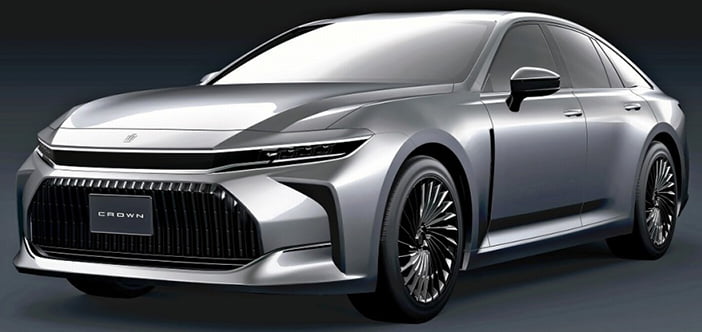
+++ TOYOTA plans to launch a hydrogen-powered fuel cell version for the new Crown Sedan in autumn, its second fuel cell passenger car after the Mirai, the automaker said. Toyota’s 16th generation Crown vehicle has 4 models: Crossover, Sport, Sedan and Estate. The Crossover is a hybrid vehicle with a new style that is a mix of a sedan and sport-utility vehicle. It was launched in September. The Sedan will have both hybrid and fuel cell versions. The Sport is an SUV. Toyota plans to launch a hybrid version in autumn and a plug-in hybrid type around winter. The company plans to launch in 2024 a hybrid and plug-in hybrid for the Estate, which is a combination of a wagon and SUV. Prices will be announced later. +++
+++ In the UNITED STATES , many Americans aren’t yet sold on going electric for their next cars, a new poll shows, with high prices and too few charging stations the main deterrents. About 4 in 10 adults are at least somewhat likely to switch, but the history-making shift from the country’s century-plus love affair with gas-driven vehicles still has a ways to travel. The poll by The Associated Press-NORC Center for Public Affairs Research and the Energy Policy Institute at the University of Chicago shows that the Biden administration’s plans to dramatically raise U.S. EV sales could run into resistance from consumers. Only 8% of U.S. adults say they or someone in their household owns or leases an electric vehicle, and just 8% say their household has a plug-in hybrid vehicle. Even with tax credits of up to $7.500 to buy a new EV, it could be difficult to persuade drivers to ditch their gas-burning cars and trucks for vehicles without tailpipe emissions. Auto companies are investing billions in factories and battery technology in an effort to speed up the switch to EVs to cut pollution and fight climate change. Under a greenhouse gas emissions proposal from the Environmental Protection Agency, about two-thirds of all new vehicle sales could have to be EVs by 2032. President Joe Biden has set a goal that up to half of all new vehicle sales be electric by 2030 to cut emissions and fight climate change. But only 19% of U.S. adults say it’s “very” or “extremely” likely they would purchase an electric vehicle the next time they buy a car, according to the poll, and 22% say it’s somewhat likely. About half (47%) say it’s not likely they would go electric. 6 in 10 said the high cost is a major reason they wouldn’t and about a quarter cited it as a minor reason. Only 16% said the high cost would not be a factor in rejecting the EV. New electric vehicles now cost an average of more than $58.000, according to Kelley Blue Book, a price that’s beyond the reach of many U.S. households (the average vehicle sold in the U.S. costs just under $46,000). Tax credits approved under last year’s Inflation Reduction Act are designed to bring EV prices down and attract more buyers. But new rules proposed by the U.S. Treasury Department could result in fewer electric vehicles qualifying for a full $7,500 federal tax credit later. Many vehicles will only be eligible for half the full credit, $3.750, an amount that may not be enough to entice them away from less-costly gasoline-powered vehicles. About 3-quarters say too few charging stations is a reason they wouldn’t go electric, including half who call it a major reason. Two-thirds cite a preference for gasoline vehicles as a major or minor reason they won’t go electric. “I’m an internal combustion engine kind of guy”, said Robert Piascik, 65, a musician who lives in Westerville, Ohio, a Columbus suburb. “I can’t see myself spending a premium to buy something that I don’t like as much as the lower-priced option”. Although he has nothing against EVs and would consider buying one as the technology improves and prices fall, Piascik said the shorter traveling range, lack of places to charge and long refueling times would make it harder for him to go on trips. In his BMW 3-Series, all he has to do is pull into a gas station and fill up in minutes, Piascik said. “The early adopters have to put up with a lack of infrastructure”, he said. Biden has set a goal of 500.000 EV charging stations nationwide, and $5 billion from the 2021 infrastructure law has been set aside to install or upgrade chargers along 75.000 miles (120.000 kilometers) of highway from coast to coast. Electric car giant Tesla will, for the first time, make some of its charging stations available to all U.S. electric vehicles by the end of next year, under a plan announced in February by the White House. The plan to open the nation’s largest and most reliable charging network to all drivers is a potential game-changer in promoting EV use, experts say. High prices and a lack of available chargers are cited by at least half of Democrats and Republicans as main reasons for not buying an EV, but there’s a partisan divide in how Americans view electric vehicles. About half of Republicans, 54%, say a preference for gasoline-powered vehicles is a major reason for not buying an EV, while only 29% of Democrats say that. James Rogers of Sacramento, California, a Democrat who voted for Biden, calls climate change an urgent problem, and he supports Biden’s overall approach. Still, he does not own an EV and isn’t planning to buy one, saying the price must come down and the charging infrastructure upgraded. Even with a tax credit that could put the average price for a new EV close to $50.000, “it’s too much” money, said Rogers, 62, a retired customer service representative. He’s willing to pay as much as $42,000 for an EV and hopes the market will soon drive prices down, Rogers said. In an encouraging finding for EV proponents, the poll shows 55% of adults under 30 say they are at least somewhat likely they will get an electric vehicle next time, as do 49% of adults ages 30 to 44, compared with just 31% of those 45 and older. And people in the U.S. do see the benefits to an EV. Saving money on gasoline is the main factor cited by those who want to buy an EV, with about three-quarters of U.S. adults calling it a major or minor reason. Making an impact on climate change is another big reason many would buy an EV, with 35% saying that reducing their personal impact on the climate is a major reason and 31% saying it’s a minor reason. +++
+++ VOLKSWAGEN ’s EV sales in China decreased by 38% in the first quarter of 2023 compared to last year. According to data released by the China Passenger Car Association (CPCA), the Volkswagen brand sold 16.611 EVs in China during this period. This is a significant decrease from the 27.101 units sold in in the first quarter of 2022 and a 56% decrease from the 38,437 units sold in the last quarter of 2022. In China, the ID.4 and ID.6 electric SUVs are manufactured by both SAIC and FAW companies. FAW makes ID.4 Crozz and ID.6 Crozz versions while SAIC produces ID.4 X and ID.6 X. They differ not only by manufacturer, but they also have some differences in styling and color schemes. The ID.3 model is manufactured only by SAIC, while FAW will produce the upcoming ID.7 there. In terms of sales by model, ID.3 sold 5.767 units, ID.4 Crozz sold 4.432 units, ID.4 X sold 3.518 units, ID.6 Crozz sold 2.079 units, and ID.6 X sold 815 units in the first quarter of 2023. In terms of sales by manufacturer, FAW-Volkswagen sold there 6.511 units while SAIC-Volkswagen sold 10,100 units. One of the reasons cited for the decline in Volkswagen’s EV sales in China is the recent abolishment of EV subsidies starting from January 2023. This policy change, combined with a large-scale price war among major manufacturers and the launch of numerous new EV products, has significantly impacted Volkswagen’s EV sales. It should be noted that Volkswagen is not the only automaker facing challenges in the Chinese EV market. As we previously reported, overall new car sales in China have declined by 13% in the first quarter of 2023 compared to last year. In this period, Volkswagen sold 442.203 in China, while in the first quarter of 2022, it sold 511.778, a year-on-year decrease of 13%, the same as the overall market decline. Volkswagen slashed prices of the ID. series in China in March. FAW-Volkswagen announced a price cut of 40.000 RMB ($5,800) on its ID. lineup. And SAIC-Volkswagen followed with a 30.000 RMB ($4,350) price cut. +++