+++ BMW will overhaul its decades-old naming system when it begins rolling out a range of cars inspired by the 2023 Neue Klasse concept, according to a recent report. Core nameplates like 3 Series will remain, but SUV shoppers will need to become familiar with new badges. Citing trademark applications filed in Europe and anonymous company insiders, the shift is fueled by BMW’s plan to continue selling combustion-, electricity- and possibly hydrogen-powered variants of the same model in the foreseeable future. The first Neue Klasse-based model will replace the current-generation X3. Gasoline-powered models will get a naming structure that consists of “X3” followed by 2 numbers, while electric models will follow the same system but receive the “i” prefix. For example, if you’re in the market for a gasoline-powered X3 you might be able to choose from the X320, the X330 or the X340 model. If you’d prefer an EV, your choices could include the iX320, the iX330 and the iX340. Note that we’re using these names purely to illustrate the rumored new system; none have been confirmed for production. For context, the current-generation X3 range includes the X3 sDrive30i, the X3 xDrive30i, the X3 M40i and the X3 M, while the battery-powered model sold in some overseas markets goes by the name iX3. The naming structure of sedans and wagons will evolve as well, though BMW allegedly has smaller changes in store. Using the 3 Series as an example, the gasoline-burning variants will ditch the “i” (which originally denoted a fuel-injected engine) and switch to a 3-number system. For example, you might find a 320, a 330 and a 340 if you visit a BMW showroom in the second half of the 2020s. The same goes for the 5 Series and the 7 Series (e.g., 530, 550, 740 and 760). Electric sedans and wagons will receive the same “i” prefix as their high-riding counterparts, so you might see an i330 or an i550 on the BMW website. As it stands, the recently-unveiled electric 5 Series is called i5. Keep in mind that none of this is official. BMW hasn’t commented on the report, and it hasn’t announced plans to overhaul its naming structure. If the rumor is accurate, more details about the Munich-based brand’s new naming system will emerge in the coming years. +++
+++ The moose test has become one of the most fascinating exercises in the automotive industry, as much for its relevance to real-world driving, as for its surprising results. The latest notable performance doesn’t come from a disaster, it comes from the BMW XM performing surprisingly well. You may argue that a BMW managing the moose test well is not a surprising result. After all, the brand fancies itself as the “ultimate driving machine”. But when that particular BMW is an enormous, plug-in hybrid SUV that weighs more than 2.800 kg, it makes more sense that expectations were low. And on the first run, it looks like this might turn into an unmitigated disaster for the big M-branded SUV. To be sure, the XM simply can’t manage to perform the test at 77 km/h. However, it does go through the moose test at 74 km/h. Moreover, the driver is complimentary about the driving characteristics, saying that when the XM loses traction, it does so gently and progressively. In addition, while it displays both oversteer and understeer, it does neither to an alarming level. “All in all, the reactions of this one were not very different from those described in other attempts: a small body roll, clean and relatively fast movements, and a high feeling of security”, the host declares. “I have to admit that with respect to the first impression I had after the first attempt, I was wrong, I said that it was going to be more difficult for me to get it between the cones, but the truth is, it was quite easy”. More impressive still was the XM’s performance through the slaloms. Agile and confident, it manages to complete the test in 22.9 seconds, which makes it faster than a Audi RS 3 Sportback. While that compact car has less power than the XM, it is also significantly smaller and lighter, making this a pretty good result for BMW. +++
+++ CHINA ’s car industry is booming, and local brands are making bank at home, while also working hard on a plan to steal customers from Western brands in other countries. But a new study suggests simply trying to increase the number of cars it exports to regions like Europe won’t be enough to overcome a perception barrier that will limit sales growth in the West. And according to Jato, it’s predominantly developed Western countries that have a beef with Chinese cars. While Chinese buyers no longer see Western imports as superior, and those in many price-sensitive developing countries seem to have no problem switching their allegiance to Chinese brands, which can be 36 percent cheaper than a Toyota, Western consumers and governments in developed countries tend to see Chinese cars in a negative light. 10 or 15 years ago that negativity might have stemmed from the (largely correct) belief that Chinese cars were of lower quality and less advanced than the vehicles offered by familiar Western brands. But these days those gripes don’t hold up to scrutiny. Instead, much of the negative sentiment expressed today can be attributed to a desire to protect local industries and jobs, something that recently led the EU to investigate whether Chinese imports should be slapped with tariffs. So what’s a Chinese automaker with dreams of global domination to do? Jato’s senior analyst, Felipe Munoz, holds up SAIC-owned MG as a shining example of how Chinese brands can break through to win Western hearts. Most obviously, while MG’s cars are designed and built in China using Chinese technology, they wear the badge of a Western brand that most Europeans will have heard of. And its mix of traditional sedans aimed at Chinese consumers and well-priced compact SUVs and hatchbacks created with international buyers in mind has also helped its sales rocket. MG shifted just 75.000 cars in 2015, but did 450.000 in 2022. Lotus and Volvo are now also owned by Chinese companies and Jato says it’s quite possible that other Western carmakers might be bought up to help China gain recognition and trust in export markets. It also says to expect tech and charging infrastructure collaborations between Chinese and Western brands in the West. +++
+++ Automakers and politicians love to tell us how much they care about the planet and cleaning up the air we breathe, but behind the scenes, it’s a different story. Senior execs like Stellantis boss Carlos Tavares have railed against strict new EURO 7 EMISSIONS regulations and now it looks like the EU member states might force those rules to be rewritten in a much milder form. On the same day that British Prime Minister Rishi Sunak announced the United Kingdom was pushing back its 2030 ban on ICE vehicle sales to 2035, EU countries are debating a compromise draft for tailpipe targets that would relax emissions limits and monitoring requirements and delay the introduction of the new measures that were meant to come into force in 2025 for cars and 2027 for vans. Carmakers claim the cost of engineering vehicles to meet the targets proposed last November would result in higher prices for consumers, particularly on smaller, cheaper, low-margin cars bought by people who can least afford to pay more. They also say that since sales of ICE cars will be banned in the bloc by 2035, automakers would be better off putting their energy and investment into ramping up EV programs in readiness, rather than getting sidetracked with interim targets that will only deliver marginal benefits. Now Spain, who currently holds the EU presidency, has presented a draft that is said to call for Euro 7 to be watered down, to the extent that it will demand no change in emissions limits versus Euro 6, even for diesel cars. Spain was keen to present the new draft next week, but is still waiting for other European countries to agree to the suggested new targets. 8 countries, including France and Italy, sent a joint paper to other EU members in May of this year calling for the Euro 7 regulations to be scrapped altogether. Though any climbdown will leave environmental campaigners disappointed, it could be good news for enthusiasts. VW’s decision to drop the manual transmission option from the Golf GTI was taken to help the automaker meet Euro 7 standards, but it conceded that it might reverse the decision if the draft rules were eased before becoming law. +++
+++ Sales of the Tesla Model Y remain strong throughout EUROPE , so much so that it is on track to be the continent’s best-selling new vehicle for the fifth month this year. Preliminary sales data from Dataforce indicates that Tesla sold a total of 19.725 Model Ys across Europe in August. This represents a significant 189% increase over the 6,817 units that were sold in August last year and is significantly more than the number sold in July 2023 where it was the 17th best-seller in Europe. Strong demand for the Model Y throughout 2023 means that it is the best-selling new car in Europe through the first 8 months of the year. In fact, some 151.191 units have been sold in Europe from January through August, positioning the Model Y slightly above the Dacia Sandero with 148.080 units sold and the Volkswagen T-Roc in third place with 138.302 units finding new homes. Sales of the Tesla have soared 198.3% across Europe throughout the course of 2023, easily out-pacing the Sandero and T-Roc which have enjoyed sales increases of 19.2% and 20.7% respectively. New car sales across the board in Europe are proving strong this year. In fact, the Peugeot 208 was the only car among the 17 best-sellers to report a decline in sales volumes in 2023, dropping by 6.7%. By comparison, sales of the Renault Clio have jumped 57.7% to 123.134, Volkswagen Tiguan sales are up 33.6% to 113.150 units, Skoda Octavia sales have soared 59.7% to 99.706 and sales of the Toyota Yaris Cross are 38.1% higher, reaching 110.446 sales. Various other models have also experienced a significant increase in demand this year. For example, sales of the Volkswagen ID.4 have jumped 82.7% from 29.811 to 54.479 while sales of the Dacia Jogger are also up 79.6% from 30.640 to 55.038. It is expected that sales of the Tesla Model Y will jump even higher this month as the firm usually enjoys its strongest sales in the final month of each financial quarter. +++
+++ MERCEDES is using advanced technologies at its factories in Germany, Hungary and China to prepare them for the production of Mercedes Modular Architecture (MMA) based models from the middle of the decade. The carmaker is also using Nvidia’s Omniverse system to create digital twins of its factories. The car manufacturer describes its efforts as the ‘Digital First’ approach and is already using its MO360 digital production ecosystem at 30 plants worldwide. This system uses real-time data to connect all of these factories and provides Mercedes-Benz with the flexibility to produce electric, hybrid, and combustion vehicles on the same factory line. The firm’s factory in Rastatt, Germany is also making good use of its digital twin technology. By using Nvidia’s Omniverse technology, Mercedes-Benz has been able to create a production facility in the virtual world, allowing it to determine the exact positioning of machines, supply routes, and production lines to prepare for the production of MMA-based models, recently previewed with the Concept CLA. This technology also allows Mercedes-Benz to ramp up production significantly faster and it will use the virtual ramp-up in Rastatt as a blueprint for its global production network. Mercedes-Benz is investing hundreds of millions of euros in its Rastatt plant to ready it for MMA production. Not only does the use of a digital twin help it to double the speed for converting or constructing an assembly hall but it also improves the quality of the processes and allows it to detect errors at an earlier stage. Artificial intelligence (AI) is also being used in Rastatt. The technology has helped to boost efficiency in the painting process and also contributed to 20% savings when used to monitor sub-processes, rather than a conventional programmable logic controller. “Digitalization will enable a whole new era of efficiency for the automotive industry”, vice president of Omniverse and simulation technology at Nvidia, Reb Lebaredian, said. “Using Nvidia Omniverse and AI, Mercedes-Benz is building a connected, digital-first approach to optimize its manufacturing processes, ultimately reducing construction time and production costs”. +++
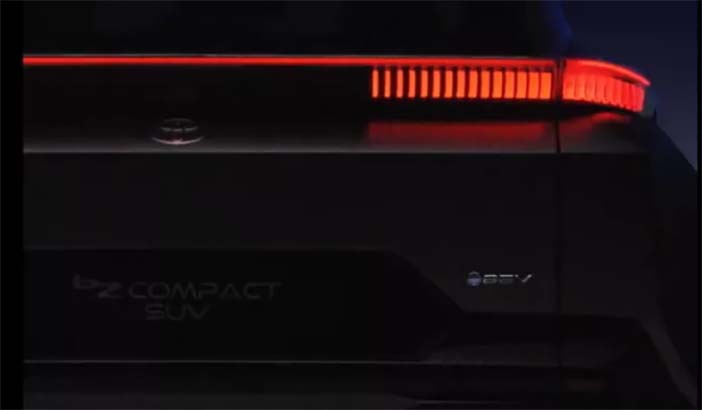
+++ TOYOTA is desperately trying to shake its history of lobbying for climate-denying politicians and resisting electric vehicles, to convince investors that it’s now all-in on EVs. In a new social media post, the Japanese carmaker has revealed that a blue badge on the back of its next electric crossover will show that it values “the happiness of people living on earth”. Toyota’s latest teaser video shows the rear end of the BZ compact SUV, as a nod to its upcoming electric SUV. Identified by its license plate, the BZ Compact SUV concept was first unveiled in November 2022. As the camera zooms in on its ‘BEV’ badge, we can also see that it is joined by a blue circle badge that was first seen on the Prius. The badge is then singled out, and around it images of clean water, children running through fields, forests with beams of light, and other feel-good imagery can be seen. In the post accompanying the teaser, the brand writes “This badge from the Prius conveys the message that we value the happiness of people living on earth and want to pass it on to the next generation”. For its part, the BZ Compact SUV concept debuted as a “nod to the near future” and it is rumored that the production version will be called the BZ3X. One of several bZ models Toyota is planning in the coming years, the concept is a little larger than the Corolla Cross and a little smaller than the RAV4. The upcoming electric SUV is aggressively styled by the Toyota ED2 center in France and bears some similarities to the C-HR Prologue that was designed at the same studio. Inside, it gets a curved infotainment screen and a cabin filled with plant-based or recycled materials. So far, the automaker has not revealed any details about what will power the production version of the BZ Compact SUV, but the BZ4X gets up to 217 hp and up to 461 km per the WLTP. However, in China, Toyota revealed the BZ3 sedan, which is based on the same platform as the BZ4X. Its smaller stature (and the more generous Chinese test cycle) mean that it gets more than 500 km of estimated range. Meanwhile, the automaker is planning a next-generation battery technology that promises to offer up to 800 km of range by 2026. Just the next in a series of new electric vehicles Toyota is planning to unveil by 2026, Toyota hopes to sell millions of EVs per year by that point. +++