
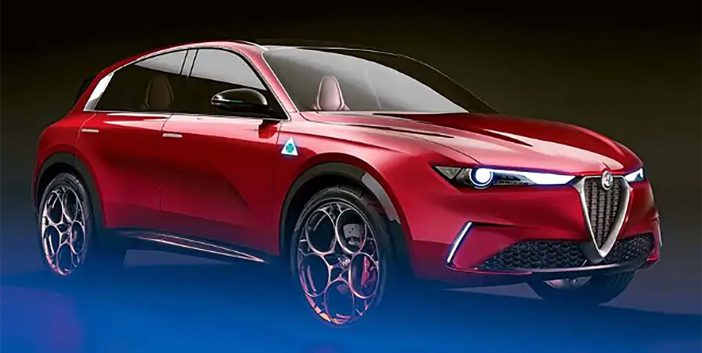
+++ In an X-Files television episode called “Teliko,” the show changed its usual tagline during the title sequence from “The truth is out there” to “Deceive, Inveigle, Obfuscate”, Both taglines would apply to the mystery around the name of ALFA ROMEO ‘ s coming B segment SUV. For the longest while, based on information from unnamed sources, the urban runabout twinned with Europe’s Jeep Avenger was expected to be named the Brennero, honoring Italy’s Brennero Pass (Brenner Pas). Then automaker design head Alejandro Mesonero-Romanos said: “This name is ruled out. The model name is now decided. it will be Italian and it will be beautiful. But more than that, I cannot say for now”. But here is the news: the decided, Italian, beautiful name is Brennero after all. That’s what I get from an automaker post on X bearing the caption, “Maybe we’ve known it all along” and a 15-second animation flashing four GPS coordinates. One coordinate picks out Alfa Romeo’s history museum, the Museo Storico, another the Balocco Proving Grounds, another the Stelvio Pass, and finally, the Brennero Pass. Speculation has gathered around a few hard points. The Brennero sits on the CMP/e-CMP platform utilized by the Avenger, the Fiat 600(e), the Peugeot (E-)2008 and the Opel Mokka (Electric). In electric form, it fits the Avenger’s 54 kWh battery and front axle e-motor making the same 156 horsepower and 260 Nm, and will likely get around the same 400 km on a charge on the WLTP cycle. As the new entry-level offering beneath the Tonale, if the Brennero adopts Avenger dimensions, the Brennero will be about 40 cm shorter than the Tonale, its roof about 8 cm lower. More speculative speculation supposes there could be a dual-motor all-wheel-drive Brennero evolved from the drivetrain in the Avenger 4×4 Concept. And assuming the Alfa offers a mild hybrid powertrain like the Avenger, there are a couple of possibilities like the 1.2-liter petrol engine with 136 hp from the Avenger. Alfa Romeo CEO Jean-Philippe Imparato said of the model, “You will see that it will be an Alfa Romeo. We are spending time on designing that car with the same spirit. And the drivability of the car, the performance of that car, will be driven by the tuning that we do on the Tonale”. He delayed the Tonale after deciding it needed more time in the development oven. However, after the Tonale was finally revealed, it turned out to be a disappointing car and not up to the usual Alfa Romeo standard. So don’t expect to much. Drivers could welcome a subcompact early next year. +++
+++ The rise of inexpensive Chinese ELECTRIC VEHICLES has upped the pressure on legacy automakers who have turned to suppliers (from battery materials makers to chipmakers) to squeeze out costs and develop affordable EVs quicker than previously planned. “Automakers are really now only turning to affordable vehicles, knowing they’ve got to or they will lose out to Chinese manufacturers” said Andy Palmer, chairman of U.K. startup Brill Power, which has developed hardware and software to boost EV battery management system performance. Palmer, formerly Aston Martin’s CEO, said Brill Power’s products could boost EV range by 60 percent and enable smaller batteries. The battery is an EV’s most costly component. Fears of slowing demand because EVs are expensive has increased urgency to reduce costs. That urgency can be seen everywhere. Renault said last month it plans 40% cost reductions for its EVs to reach price parity with fossil-fuel models. Stellantis is building a European plant with China’s CATL to make cheaper LFP batteries and recently unveiled the Citroen ë-C3, which starts at 24.790 euro in the Netherlands. Volkswagen and Tesla are developing 25.000-euro EVs. Vincent Pluvinage, CEO of Palo Alto, California-based OneD Battery Sciences, said that on his recent visits with European automaker customers, every meeting started with the same refrain: ” ‘Reducing costs is now more important than anything else’ “. OneD adds silicon nanowires to graphite EV battery anode material to boost range and cut charging time, saving $281 (nearly 50%) versus using graphite alone for a 100 kWh EV battery. This can reduce EV battery weight by 20% for the same range, Pluvinage said. General Motors is a OneD investor and customer. OneD has developed a manufacturing process on relatively inexpensive machinery used in the solar panel industry, as Pluvinage said automakers dislike complex, costly new processes. OneD’s first test plant will open early next year. Hodenhagen, Germany-based Veekim has developed an EV motor with magnets using a form of ferrite, or iron powder, instead of rare earths, which five automakers and suppliers are testing for affordable EV projects. Legacy automakers want to cut rare earths use because China dominates mining and processing. Veekim CEO Peter Siegle said using cheaper ferrite and low-cost processes (including 3D-printed copper wiring) can cut an EV motor’s price by 20%. Motors can cost more than 500 euros. It is not just startups seeking EV cost reductions. Chip maker NXP is working with automakers to reduce the amount of electronic control units (or mini-computers) in EVs, which can number between 200 and 300, said Allan McAuslin, director of vehicle control and electrification. Siemens has developed software simulation called digital twins to halve expensive EV development time. European automakers are reacting to the arrival of lower-cost EVs from China, whose makers are planning even cheaper models. BYD’s Dolphin, for instance, starts in the Netherlands at 29.990 euro, nearly 30% below the starting price for the Volkswagen ID.3. But U.S. automakers, somewhat protected from Chinese EV imports by subsidies in the Inflation Reduction Act, also seek more affordable EVs. General Motors said it has saved billions partly by developing a more inexpensive battery pack with LFP batteries for its revamped Bolt EV, which will launch in 2025, 2 years earlier than planned. Ford said it will cut costs partly through a 50% increase in “in-sourcing” of parts like batteries and inverters. Premium automakers want lower costs for EVs, too. Michigan-based Our Next Energy (ONE) is developing an Ares battery pack with cheaper LFP technology that should give automakers the same electric driving range for half the price and a Gemini pack for customers including BMW that offers extended range and should cost $75/kWh compared with an average today of $130/kWh, CEO Mujeeb Ijaz said. Suppliers said automakers particularly like less expensive parts that also reduce production costs. San Carlos, California-based CelLink has developed a laminate sheet to replace wire harnesses (labor-intensive to make and install) that can be installed by robots. CelLink raised $250 million from investors last year and in May announced a $362 million U.S. government loan for its Texas factory. Since opening that plant, said CEO Kevin Coakley, “We’ve gotten some form of a purchase order from basically every major automaker that’s come through there”. Israeli startup Addionics has developed porous, three-dimensional copper and aluminium electrode battery materials that look like sheer silk scarves when held up to the light and use far less material, including 60% less copper. Those electrodes provide faster charging and boost EV range by 30%, CEO Moshiel Biton said. But automakers are more interested in projected savings of up to $7.50 per kWh. “What we hear from carmakers today is, ‘We don’t need longer range, we want lower costs’ “, Biton said. +++
+++ EURO NCAP has said the increasing popularity of SUVs presents a “safety concern” and that its own safety rules aren’t to blame for the increasing size and weight of modern cars. The Belgium-based safety organisation has published safety ratings for 11 new cars in its final round of testing for 2023, 7 of which were SUVs: the Mercedes-Benz EQE SUV, Kia EV9, Vinfast VF8, Xpeng G9, BYD Tang, BYD Seal-U and the Honda ZR-V. It also tested the BMW 5-series, Volkswagen ID.7, Smart #3 and Hyundai Kona Electric; the latter 2 of which are crossovers. The majority of the SUVs tested were awarded five stars, but Euro NCAP suggested the trend towards “heavier, more powerful, and taller cars” risks the safety of other drivers and said they’re more damaging to the environment than smaller, lighter cars. Euro NCAP secretary general Michiel van Ratingen said: “For years, Euro NCAP was accused of pushing up the weight of cars. It was thought that additional safety features meant extra mass. That was never really the case, and the increase in vehicle weight we see nowadays is certainly not safety-related. It’s down to consumer preference for larger vehicles and to electrification, with ever bigger batteries being used to quell consumers’ range anxiety”. Van Ratingen later went on to explain how this trend “helps neither safety nor the environment”, with safety concerns emerging from a collision scenario or when “vulnerable road users” are involved. Despite the concerns, the latest crop of SUVs performed well in NCAP’s tests. The top-ranking Mercedes EQE SUV scored well for its safety assistance technology but was let down by its central airbag system. The larger Kia EV9 was awarded five stars due to its coverage of child safety equipment. Also achieving the target result was the Smart #3, however it was noted that both passengers in the front seats made contact during a crash and the car wasn’t equipped with child presence detection; a system that triggers a warning to the driver if a child has been left unbuckled in their seat. Another crossover on test was the second-generation Hyundai Kona Electric, which Euro NCAP said was a “real disappointment” and “lucky to avoid 3 stars”. Its crash avoidance and driver assistance systems were lacking and didn’t represent enough of an improvement over the previous Kona. Also falling short of the 5-star mark was the Honda ZR-V. Despite being the lightest car on test, at 1.589kg, it scored 4 stars. Cars from both China and (for the first time) Vietnam also featured. The BYD Tang, BYD Seal-U and Xpeng G9 were awarded 5 stars, with the G9 lacking only in pedestrian head protection and abdominal protection for smaller occupants. The Vietnamese Vinfast VF8 achieved 4 stars, being marked down for a “lack of robustness” in its seatbelts. Of the executive saloons on test, the Volkswagen ID.7 and BMW 5-series, both “comfortably” scored 5 stars, with the ID 7 achieving 95% for adult protection, “one of the year’s best overall scores”. The BMW matched the ID.7 in overall performance but didn’t score as highly for passenger protection in frontal impacts. +++
+++ MG will comprehensively upgrade its combustion car line-up during the first half of 2024 before launching a new electric SUV and updated versions of all its current EVs, the general manager of its business unit, Lu Jiajun, has revealed. Speaking at a recent event, Lu said the mg brand experiences solid growth in the sales of EVs in key export markets, with models such as the ZS and ‘4’. The electric ‘5’ estate and ZS are tipped to switch onto MG parent company SAIC’s new Modular Scalable Platform (MSP), as already used by the 4, for their second generations. The highlight of the brand’s centenary year, though, will be the unveiling of an electric SUV conceived as a new flagship. Positioned as the successor to the Marvel R, it will also be based on the MSP architecture, which can accommodate various battery capacities of up to 150 kWh and facilitate battery swapping. Speaking about the new electric SUV, Lu said: “The appearance of this car is great and the price will make it competitive”. Marvel R’s replacement will be “a completely different car” and suggested it will be priced at around €52.000 in the Netherlands. MG is also readying a “big upgrade” to the interior of the 4, according to Lu. This is due to be launched during the second half of 2024, only around 2 years after the car arrived in Europe. +++
+++ The next-generation electric-only NISSAN Qashqai will be designed, engineered and built in Britain, and the company is aiming for it to be priced the same as the current combustion-engined version. The hugely popular machine helped spark the trend for family crossovers when the first generation launched in 2006 mixing practicality with edgy styling. The third-generation model launched in 2021, and was the best-selling vehicle in the United Kingdom last year. The new model will be styled at Nissan’s UK design studio in London, and will take inspiration from the Hyper Urban concept that was recently shown at the Tokyo motor show. The bold, angular exterior styling of that concept will be retained for the production model, although the radical interior is set to be toned down. The Qashqai is currently offered with petrol and hybrid powertrains, but the next-generation version (due in 2027) will only be offered as an electric car. Despite that, Nissan boss Makato Uchida said launching the fourth-generation model at a price equal to the outgoing ICE version was “what we are aiming for, and what our ambition is”. The Qashqai range currently starts at 35.440 euro in the Netherlands. Uchida admitted achieving price parity between ICE and EV machines was a challenge, adding: “At one side we talk about scale and how to support that, and on the other side we need supply chains to be established. We are at the stage of considering how we are going to make EVs balanced on price with ICE. It’s a challenging discussion, because the regulations in each country are not moving at the same pace”. The Qashqai is currently built at Nissan’s Sunderland plant and the firm recently confirmed investment of up to 2,3 billion euro for its electric successor to be manufactured there alongside the next-generation electric-only Juke and the successor to the Leaf. That 2,3 billion euro total funding includes direct investment from Nissan in its UK operations of up to 1,4 billion euro, which includes styling work on the cars at Nissan’s design studio in London, development and prototyping at the Nissan Technical Centre in Cranfield, as well as the cost of retooling and preparing the Sunderland plant for the new platform and bodies. Nissan has yet to reveal many technical details of the new Qashqai, although it will sit on the Renault-Nissan-Mitsubishi Alliance CMF-E/F platform, a bespoke electric architecture designed for C- and D-segment cars. It is already used for the Renault Mégane and Renault Scénic, and will also underpin the next-generation Juke and Leaf. Battery packs for the new Qashqai will be built in Sunderland, with Nissan partner AESC planning to build a third battery gigafactory at the site. Nissan and AESC are currently focused on lithium-iron-phosphate (LFP) battery chemistry. One key focus for the next Qashqai will be on maximizing efficiency. Despite the sharp, angular styling of the Hyper Urban David Moss, Nissan’s European research and development chief, told that the firm has “paid a lot more attention to aerodynamics” than with previous models in a bid to maximise efficiency”. Nissan is aiming to only sell electric cars in Europe from 2030 onwards, while the European Unio will ban the sale of all new non-zero emission cars in 2035. +++
+++ STELLANTIS said it will temporarily cut one shift at its Detroit assembly plant that builds SUVs for Jeep, citing California emissions regulations. The automaker, which employs 4.600 at the plant that builds the Grand Cherokee, said it will drop to 2 shifts from 3 shifts at its Detroit Assembly Mack plant and reduce production by an unspecified amount. The move, it said, was “in part because of the need to manage sales of the vehicles they produce to comply with California emissions regulations that are measured on a state-by-state basis”. Stellantis said it is seeking to void a 2019 California emissions deal in which rival carmakers agreed to voluntarily cut emissions beyond levels stipulated by the then-Trump administration. Separately, the automaker also said its Toledo, Ohio, assembly plant that builds the Jeep Wrangler will move from an alternative work schedule to a traditional 2-shift operation. Both moves will result in job losses but the company did not have a precise figure. Stellantis said the shift will allow the Detroit plant to improve performance “in the event that a change in the regulations or marketplace allows for an increase in volume”. The company is warning more than 3.600 employees of potential job impacts, citing an abundance of caution, but did not have a precise total of jobs impacted. Stellantis has been limiting shipments of gasoline-powered vehicles to dealers in states that have adopted California’s emissions rules and in some cases gas-powered vehicles were shipped to those states only for sold orders, once customers ordered such vehicles. Stellantis has also at times limited sales of plug-in EVs to states adopting California rules and shipped only sold order vehicles to other states. Ford, Honda, Volkswagen and BMW struck a voluntary agreement with California on reducing vehicle emissions, and Volvo, owned by China’s Geely, joined soon afterward. Stellantis has since sought to join but been rebuffed. Stellantis said the agreement allows participating automakers to comply based on national sales, while it and other firms are measured by sales in the 14 states following the California rules, which hinders it from selling electric models in other states. In May, CARB asked the Environmental Protection Agency for approval for its rules adopted in August 2022 that would allow the state to ban the sale of gasoline-only powered vehicles by 2035 and require at least 80% electric-only models by then. The EPA has not yet opened the request for public comment. +++
+++ Elon Musk is already looking forward to the next addition to TESLA ’s growing fleet of vehicles. The CEO told that the long-awaited €33.000 Tesla is nearing reality in an interview following the Cybertruck’s launch party. Musk said his company is “quite advanced” in its work on the affordable Tesla, and that he is reviewing production plans weekly. “The revolution in manufacturing that will be represented by that car will blow people’s minds”, Musk said. “It is not like any car production line that anyone’s ever seen”. Musk has teased a sub-€40.000 Tesla since 2020. At the time, he said the more attainable price point could be achieved by halving battery and cell manufacturing costs. He told Munro that the new vehicle is currently slated for the Texas Gigafactory, where the Cybertruck is currently produced, with a secondary assembly line at the company’s planned plant in Mexico. The U.S. electric vehicle market has undergone some serious changes in the last 12 months, with the shopping base for these vehicles changing over from wealthy early adopters to more practical buyers looking to switch from gas to electric power. That has elevated the need for more affordable options in the EV space, creating a gulf between where EV demand actually stands and which EVs are available to purchase today. Many car companies have responded to this change in demand by pulling back production plans while dealers lather on discounts to move these cars off their lots. Tesla had led the way in a segment-wide dip in average EV prices this year, setting off a price war that has caused headaches for Ford and Stellantis as these companies get their grand electric vehicle plans off the ground. Adding more affordable options will only make it harder for Detroit car companies and other legacy automakers to compete with Tesla, especially since these companies still aren’t turning a profit on their electric cars. If the reaction to Cybertruck’s pricing is any indication, Tesla itself is not safe from the changes in price sensitivity in the EV segment. Pricing for the Cybertruck was finally released last week, with the cheapest option (not available until 2025) starting at almost $61,000; $20,000 more expensive than Musk originally promised. While these prices are in line with where EV truck prices stand right now, some order holders told they were counting on a more affordable option with the Cybertruck. +++
+++ After a bumper month for premium brands in October, we’ve returned to seeing more familiar faces at the top of the best-selling cars list in the UNITED KINGDOM for November with the Ford Puma, Nissan Qashqai and Vauxhall Corsa leading the way. The UK’s best-selling car of November was once again the Ford Puma, which extended its lead over last year’s best-seller, the Nissan Qashqai (with the British-built Japanese crossover still having a decent month in third). Splitting the 2 in November was the Vauxhall Corsa, which sits third overall in 2023. After an impressive October as the month’s second best-selling car, the Mmini continued its good form with 4th in November; enough to bump it up 1 place for the year to 7th. Mid-sized SUVs were the flavour of the month with the Ford Kuga, Kia Sportage and MG HS also appearing in November’s top 10 and then the Volkswagen Golf and Audi A3 showcasing their everlasting appeal, despite facelift variants of the 2 premium hatchbacks coming soon. It didn’t feature in the top 10 for last month but in 2023 the Tesla Model Y remains the country’s best-selling electric car. The overall outlook for the UK car industry looks positive in 2023. The year-to-date figure of 1.761.962 cars sold is 18.6 percent up on 2022 and while some people might be tightening their purse strings ahead of winter in light of high cost of living and heating costs, almost 3.000 more cars were sold in November compared to October. Those figures don’t tell the full story however. Fleet has overtaken private sales and now accounts for a whopping 53.8 per cent of the market in 2023. Private sales have grown in 2022, but only by 1 percent for the year so far. BEV (battery electric vehicle) sales in November dropped steeply with a 17.1 percent decrease compared to 2022, although BEV registrations are up 27.5 percent for 2023 so far. Pure-electric car sales have larger market share this year as expected but only by 1.2 percent. Plug-in hybrid cars have risen massively in popularity recently with a 60.5 per cent increase in October and 55.8 per cent in November. Petrol car sales are up in 2023 by 12.5 percent and diesel, as expected, is down by 15.7 percent; both have a smaller share of the market in 2023. The UK’s new car sales market increased 9.5% year on year in November, with the number of cars leaving showrooms almost matching pre-pandemic figures. According to the Society of Motor Manufacturers and Traders (SMMT), 156.525 new cars were registered last month. That was the market’s best November performance for 4 years, standing at just 96 units (0.1%) below November 2019. +++