
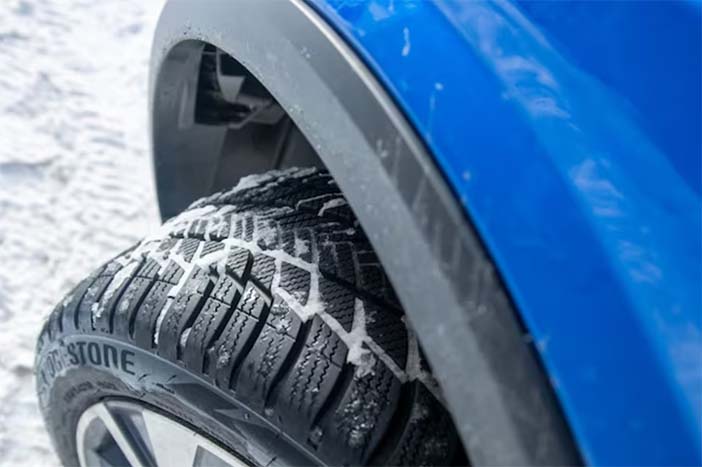
+++ HYUNDAI has come up with a solution to get rid of traditional snow chains and the hassle that comes with mounting them. It’s called a shape memory alloy snow chain and replicates the functionality at the touch of a button. How does it work? The newly developed wheel and tyre assembly has built-in radial grooves at regular intervals. There are shape memory alloys inserted into these channels, making the assembly look like a pizza. When an electrical signal is received, the shape memory alloy modules protrude to behave like a snow chain. The elements sticking out of the rubber form a “J” shape to improve grip on a slippery surface during wintertime. When not in use, the shape memory alloy resides within the wheel in the shape of an “L” that doesn’t touch the road surface. Inevitably, the tyre will be worn down to the point where those alloys will always make contact with the road surface. That’s when the tyre will have to be replaced. Hyundai mentions it has applied for a patent at home in South Korea as well as in United States. Meanwhile, it already has plans to further develop the technology. If everything goes according to plan, Hyundai and Kia will consider putting shape memory alloy snow chains into mass production. However, one question arises. How much would it cost? We’re not just talking about how expensive the tyre is going to be. Replacing the wheel isn’t going to be cheap either considering the shape memory alloy starts near the centre of the wheel. It pops out from the tyre after the electrical signal is received. It’s obviously more convenient this way since all you must do is touch a button on the infotainment system instead of mounting a traditional snow chain. You press it again after you’re done using the snow chains, without having to store them in the boot of the car. It’s hard to say how many people would fork out the money for this technology, should it reach production. +++
+++ Amid the e-mails and letters I get from readers, the cost of new cars is a recurring theme. They (like so many other things) are getting more and more expensive. As much as all costs have risen in recent years, cars now come with more and more kit as standard (some demanded by consumers, some by legislators) and then there’s the added cost of electrification. There’s also the march of mainstream brands and newcomers towards the premium end of the market, where the margins (and profits) are much greater. Becoming premium is not the work of a moment, though. Plenty of brands have tried and failed, while others continue the struggle. Infiniti is one that has been and gone, while Genesis is rapidly heading towards a plan B in Europe because plan A clearly hasn’t worked. LEXUS is a fine example of playing the long game, though. From its origins in the corner of Toyota dealers back in the nineties to a real premium player today, it’s been a long, tough road to be considered among the established elite car brands of the world. I spent some time recently with Pascal Ruch, boss of Lexus in Europe, as his brand is pushing for sizeable expansion across Europe. At one end of the scale, the firm has striking concepts like the LF-ZC, which Ruch showed me around and explained how its battery tech (with 1.000 km of range), Direct4 all-wheel drive system, steer-by-wire and innovative structure will be key to Lexus’s differentiation in the second half of this decade; just a few years from now. At the other end is the crucial LBX small SUV that’s set to boost Lexus sales, but provide a big challenge for what has been the brand’s biggest selling point: its customer service. Ruch is aware of the challenge that growth poses to a network that’s already slipped from the lofty position it made its own at the top of client satisfaction surveys. But it’s a position he wants back. I like the Lexus difference. It’s a brand that’s never wanted to be BMW (unlike others), taking a different path to premium. And it’s all the better for it. +++
+++ More and more cars are catching the downsizing bug due to stringent emissions regulations. These increasingly stricter laws are forcing automakers to cut the cylinder count and add a hybrid component. The latest MERCEDES-AMG C 63 is the most eloquent example since it has eschewed its brawny 4.0-litre V8 in favour of a small 2.0-litre 4-cylinder. There had been some rumours about Affalterbach’s plan to install a bigger engine, but that’s not going to happen. In an interview, AMG boss Michael Schiebe admitted people have been asking why the V8 has been dropped from the BMW M3 competitor. The man in charge of Mercedes’ performance division explains: “We want to be very, very progressive when it comes to technology. And we are convinced of the hybridisation concept, there we will stay with the 4 cylinder”. He went on to admit AMG can’t persuade each and every V8 fan to buy the new 2.0-litre model. Seeing the glass half full, Schiebe says the plug-in hybrid C 63 has lured in buyers who otherwise wouldn’t have been interested in the sports saloon. Mercedes has also launched a C 63 Estate. The 2-door variants of the C-Class and E-Class (coupe and convertible) are being replaced by the new CLE, which recently gained an inline-6 for the “53” models. Should there be a “63,” that one too is likely to have a 3.0-litre engine. If you’re in the “there’s no replacement for displacement” crowd, Mercedes still has got you covered. That said, I reckon the V8’s demise would’ve been more bearable had AMG given the C63 that inline-6 engine. Going forward, you’ll have to get a CLE Coupe/Convertible to have more than 4 cylinders under the bonnet. Should you want 4 doors and extra cylinders, chances are the next E 63 will also rock an inline-6 but the larger saloon/estate is also expected to get a charging port. Spy shots have suggested it’ll utilise a plug-in hybrid setup. Its nemesis, the BMW M5, will also be a PHEV, but the Bavarian monster is going to retain the beefy V8 engine for one more generation. Better yet, the M5 Touring is coming back. +++
+++ Following hot on the heels of the second-generation MERCEDES-AMG GT 63 (S E-Performance) comes the softer and less expensive 53 model. The overall design of the 53 won’t differ too much from the 63, although look closely and you’ll notice some key changes denoting this car’s less aggressive approach. The front end will get its own bumper layout with smaller air intakes to the sides and a new style of Mercedes’ ‘Panamerica’ grille. I’ve already seen the split 5-spoke 20-inch wheels this test car is using on the new SL 43, which now shares the same platform as the AMG GT. Given the snowy conditions here, they’re unsurprisingly shod in Michelin winter tyres. Behind the front wheel we see a small air vent that looks closer to the one on the SL than the vertical opening of the AMG GT 63. To the rear we can see the diffuser here for the first time: it’s similar to the 63’s but does without the lower extension. To the side the snow is conveniently acting as a camouflage for where the rear wheel ducts would be, although previous spy shots suggest these won’t be carried over from the 63. The most obvious indication this is a lesser-powered 53 are the quad-tip exhausts with rounded ends rather than the 63’s square design. There’s only one filler flap on the body, suggesting this is no plug-in hybrid. In terms of power we expect the 53 will get a version of the straight-6 found in the new CLE 53. It’s a mild-hybrid turbocharged 6-cylinder petrol and in the AMG GT 53 we should see 469 hp and 700 Nm of torque; enough for a 0-100 kph time of 3.9 seconds and a top speed of 290 kph. Power will be sent to all four wheels using Mercedes’ 4Matic system that’s driven through a 9-speed automatic transmission. The GT 63 comes with adaptive dampers, rear-axle steering and an electric limited-slip differential, plus a hydraulic anti-roll bar system that can control the car’s ride height. We’ll have to wait and see how much of this car’s technical wizardry makes it over to the 53, but it’s likely you’ll be able to add some of this kit as an optional extra. The 53 should arrive in the showrooms in 2024. +++
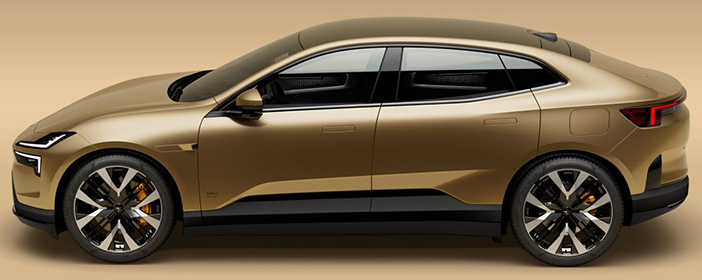
+++ The POLESTAR 4 has won the Car Design News ‘Production Car Design of the Year’ award for 2023, one of the industry’s most auspicious design prizes. Announced at the Car Design News Peoples Awards, it was joined by 2 other main automotive categories including Concept Car Design of the Year and a Lifetime Achievement award. The Car Design News awards are different from most design awards, as they are selected by a panel of 16 leading designers from the world’s most famous studios. This year, the panel included names such as Massimo Frascella, design director of Jaguar Land Rover, and Lisa Reeves, head of interior design at Volvo, who worked with the esteemed panel in selecting the winners on peer merit. The Polestar claimed its prize at the head of a 10-car shortlist, pipping the highly commended Kia EV9, Volvo EX30 and Jeep Avenger to top spot. Also of note were the four Chinese models in the top-10 list, leaving only 3 European manufacturers in contention. James McLachlan, editor of Car Design News, said of Polestar’s win; “the 4 was a clear favorite of fellow designer judges, receiving the highest number of first place votes (8) in the Production Car Design of the Year award category. Concept Car Design of the Year was awarded to the Dacia Manifesto Concept, a particularly impressive result considering it’s the brand’s first ever concept car, headlining a comprehensive design revolution of its road-going models. The concept shortlist also included the Citroen Oli and Mercedes Vision One-Eleven, and in contrast to the production car class, saw eight of the 10 shortlisted models from European brands, with the remaining two from the USA. Ed Welburn, the first head of General Motors Design was awarded the Lifetime Achievement Award. Guy Bird, editor of Car Design Review X, said of Welburn’s accolade: “Ed is a truly special winner of our 10th Lifetime Achievement Award. He became the first African-American to work in General Motors’ design department and throughout his 44-year career at GM broke through ceiling after ceiling”. +++
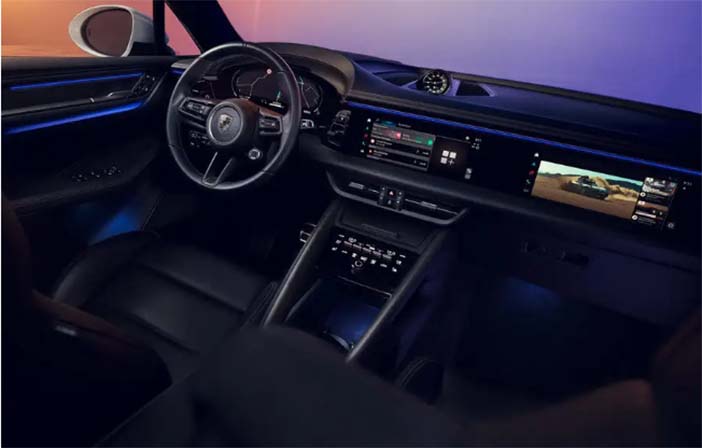
+++ Full interior details of PORSCHE ’s ambitious new electric Macan have been revealed ahead of the car’s full debut. Like with the new Panamera, the yet-to-be-fully-named electric Macan borrows the Driver Experience control concept first shown in the Taycan. This means physical driving controls are grouped together, rather than being behind different menus on a touchscreen. There are three screens in total. The first is a 12.6-inch driver’s display behind the steering wheel, which now houses in-built navigation with Apple Maps via Apple CarPlay and Google Maps with Android Auto. Drivers will also be able to control Porsche’s first head-up display with augmented reality tech via the screen too. The system uses environmental data and the position of the car along with cameras to run a live feed to the driver so it can display real time information. For example, navigation arrows are displayed in the correct turn lane lane. This also supports the functions of some driver assistance systems, such as activated Adaptive Cruise Control, where the selected distance to the vehicle in front is virtually laid over the road in a carpet of dots. Warnings from the driver assistance systems can also be displayed in the AR area. The central display is a 10.9 inch touchscreen complete with Porsche’s latest tech, while there’s also an optional 10.9 inch passenger display. The passenger can adjust settings for infotainment or navigation, browse through media or stream video on apps such as TikTok, although they will be viewing videos filmed in portrait on a landscape screen. This is even possible while the car is being driven thanks to special film technology that prevents the driver from seeing the display. Driving games, much like in Teslas, can be played while the car is charging. But unlike with a Tesla, you don’t use the steering wheel to control the virtual car.
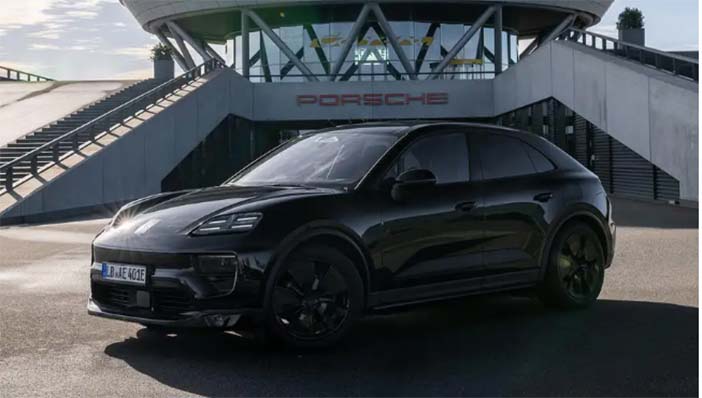
Deliveries of the E-Macan, which will share its PPE architecture with the similarly sized Audi Q6 e-Tron, are scheduled for 2024. It was originally planned for 2023, but was delayed by development difficulties at Cariad, the Volkswagen Group’s software division. The SUV shows off a slightly different design from the combustion car it will be sold alongside, which itself received a facelift last year (and a technical boost this year) that distinguishes the pair. Key changes have resulted in a more angular face, replacing the current Macan’s blockier design. This also gives the headlights a sharper shape, more in line with those of the bigger Porsche Cayenne, and the front daytime light bars have been replaced by 2 sets of twin circular lights. A close relationship to the Cayenne is also apparent at the rear, where the E-Macan swaps the previously bulbous design for a more angular one. Antoon Janssen, Porsche powertrain manager for the Macan line, told that he intends for the Macan EV to be the sportiest car in its class. As such, it receives a pair of permanently excited electric motors (1 per axle) similar to those used in the Porsche Taycan. However, these have been heavily reworked to boost power density and efficiency, featuring a new ‘double V’ magnet arrangement and switching from a silicon semiconductor to silicon-carbide. The latter reduces switching losses (effectively power leakage) in the motors’ pulse inverters. These improvements yield power outputs of up to 610 hp, with more than 1.000 Nm of torque, sent to all 4 wheels. The firm has not commented on whether an ‘overboost’ function (as offered on the Taycan Turbo S to temporarily raise power and torque to 760 hp and 1.050 Nm) will also be available on the Macan EV. Rear-wheel drive is also possible on the PPE platform, said Janssen, although this will initially be used only to decouple the front motor when cruising to reduce rolling resistance (and conserve energy). Dynamics have also been a point of emphasis for the E-Macan. Model chassis manager Dominik Hartmann confirmed that it will have a “performance rear axle”, with the motor mounted as far back as possible. This gives a weight distribution of 48 % at the front and 52 % at the rear, to maximise traction. For reference, the Taycan’s mass is divided 49:51 front to rear. Porsche also confirmed that the tyre widths will be more staggered than on the current Macan (the existing GTS variant uses 265 mm wide rubber up front, but 295 mm wide tyres at the rear) to accommodate the rearward weight bias and further improve grip. The Macan EV will also be the first model to receive Porsche’s two-valve dampers, which are said to enhance ride comfort because they enable independent adjustment via the Porsche Active Suspension Management (PASM) system. This will also lower the suspension at certain speeds to improve the car’s aerodynamic profile and reduce energy consumption. To improve manoeuvrability, the steering angle has been increased by 15% over the petrol car, and rear-wheel steering up to 5.0 degrees (below 80 kph) has been added. The most expensive versions of the Macan EV will also get an electronic locking differential mounted at the rear axle, designed to improve its front-rear torque-vectoring capabilities. All variants will receive a 100kWh lithium ion battery, which, Porsche stated, is the optimum size for minimizing journey times. The company has offered no range prediction, but an optional 93 kWh battery gives the lower Taycan enough power for 500 km per charge. The PPE platform’s 800 Volt architecture allows maximum charging rates exceeding 270 kW. However, trick hardware and software developments mean that the battery can respond to 400 Volt chargers by splitting the single 800 Volt battery into 2 halves. This boosts charging speeds, said Janssen, although he did not confirm how significant this impact was. Janssen also confirmed that the PPE platform could be extended to fit more battery modules. The Macan uses 12 prismatic cells. This implies that the eventual Porsche Cayenne EV (which is tipped to also use the PPE platform) could have an even greater battery capacity in order to compete with the Mercedes-Benz EQS SUV. Nonetheless, the long-term goal for Porsche’s road-going cars is to reduce the size of the batteries, according to Florian Modlinger, the firm’s Formula E boss. This “must be the target”, he said, although he acknowledged that this “will take longer” than in motorsport. The E-Macan is the next model in an assault of Porsche EVs due over the next few years, which include the 718 Boxster EV (2025), the electric Cayenne (2025) and the Panamera EV (2026). Later this decade, a new electric SUV, known to be a seven-seater codenamed the K1, will arrive. It is thought this model will be Porsche’s most expensive car and represent a complete styling revolution for the marque. Porsche aims for electric vehicles to account for 50% of its global sales in 2025, and 80% by 2030. +++
+++ The profitability of electric vehicles is a big talking point nowadays, and for good reason. Automakers that haven’t managed to turn a profit on their EV models yet are struggling at the moment, with many announcing a slowdown in the implementation of their electrification plans in recent months. Basically, pretty much everyone outside Tesla is struggling to make their EV operations profitable, but it looks like STELLANTIS is also on the right path. Chief Carlos Tavares said that the automaker is “in the black” on electric vehicles in the United States and Europe. Speaking at a Goldman Sachs conference, Tavares said automakers need to be “super sharp on cost” to achieve good profits on EVs. At the same time, he noted that carmakers have to attract middle-class consumers, and they can only do that by offering EVs that are affordable to buy and profitable to make. The only way to make that happen is to reduce cost, and Tavares said Stellantis is “reasonably good” at that. “The fact that we try continuously to levelize the margins between BEVs and ICE is not new. We have been working on that for several years now, and I would say that we are achieving results”, Tavares said. “The first thing is that we are in the black, both in the U.S. and in Europe. Our margins on electrified vehicles are in the black. That’s a good thing. We are closing the gap against ICE faster in Europe than in U.S. because we started sooner, but we are achieving results and we see that all of this is going to be exciting”. Selling EVs profitably in Europe and the U.S. is an important development for Stellantis at a time when most automakers are faced with mounting losses from their EV operations. The fact that Stellantis is more advanced building EVs profitably in Europe is obvious in the sales charts, where the Franco-Italo-American carmaker is “fighting head-on” with Tesla, according to Tavares. Stellantis recently overtook Tesla as Europe’s No. 2 EV seller behind Volkswagen Group, CFO Natalie Knight said. Tavares noted that the forthcoming Citroën ë-C3, which starts at €24.790 in the Netherlands, will be a profitable vehicle despite the low price for an EV. The small electric car is built on the company’s low-cost “smart car” platform. Stellantis aims to sell more than 75 battery-electric models worldwide by 2030, of which more than 25 in the United States. The automaker is currently absent from the American EV market, with zero fully electric models on sale in its home region. However, it said it would launch five BEVs in the near future: the Ram ProMaster van (by end of 2023), the Fiat 500e (early 2024), the Ram 1500 REV (Q4 2024), the Jeep Recon, the Jeep Wagoneer S, and the Dodge Charger Daytona SRT muscle car, with the last three expected sometime in 2024. +++
+++ The Vietnamese VINFAST VF8 , which is trying to get a piece of the electric vehicle market in Europe, got 4 out of 5 stars in Euro NCAP’s latest crash tests. It’s the first time a major safety organisation put the electric crossover through its paces. Immediately, it’s evident that the VinFast VF8 didn’t get the maximum 5-star rating, putting it one step below its major competitors, including the Tesla Model Y. And while it’s true that the VF8 got its score based on Euro NCAP’s updated and tougher 2023 testing protocol, while the Model Y was tested using last year’s procedure, the small print reveals that the Vietnamese crossover isn’t as safe as its American rival. According to Euro NCAP, the VinFast VF8 got a safety score of 76% for adult occupants, 89% for child occupants, 77% for vulnerable road users, and 79% percent for its safety assist systems. By comparison, the Model Y got 97% for the protection of adult occupants, 87% for children, 82% for pedestrians, and 98% for its safety systems. But figures don’t tell the whole story. In the complete safety report for the VinFast VF8, the European organisation notes that the electric SUV provides good protection of the knees and femurs of both the driver and front passenger in the front impact scenario, but structures in the dashboard were considered to pose a risk of injury to occupants of different sizes and those sitting in different positions. Furthermore, the driver’s knee airbag deployed in a way that “provided no protection to the inboard leg, attracting a further penalty”, while the analysis of the deformable barrier test after the crash “revealed that the VF8 would be a somewhat aggressive impact partner in a frontal collision”. Protection of the chest was also rated as marginal for both the driver and rear-seat passenger after the full-width rigid barrier test. In the side barrier test, dummy readings showed good protection of all critical body parts, but the side curtain airbag deployed incorrectly, getting trapped on the interior trim. In the child occupant protection category, the VF8 scored the maximum points, providing good protection to all critical body parts in both the frontal offset and side barrier tests, Euro NCAP noted. In the safety assist category, the Vinfast VF8 performed almost flawlessly. The auto brake function worked as advertised in all but one scenario: when approaching a car head-on. The lane support system is also good, correcting the vehicle’s path when drifting out of the lane and intervening in more critical situations. This year, Euro NCAP updated its safety testing protocol to include new systems in child presence detection, specifications for vehicle submergence, and the latest technologies that detect–and respond–to motorcyclists and vulnerable road users. The first cars to achieve the maximum rating of five stars under the new procedure were the Nio ET5 and EL7. +++