
+++ BENTLEY said Monday it achieved an all-time high sales record in the South Korean market last year, making it the leading market in the Asia-Pacific region and the fifth largest globally for the second year running. Bentley Motors Korea accelerated its sales trajectory in the domestic market for the third year in a row, with 810 units sold in 2023, surpassing the sales milestones of 506 units in 2021 and 775 in 2022, according to data from the Korea Automobile Importers & Distributors Association. The sales breakdown for Bentley Korea included 349 Flying Spurs, 203 Bentaygas, and 258 Continental GTs. Global sales leaders were the United States with 3.679 units, followed by China (including Hong Kong and Macao) at 3.010, the United Kingdom at 1.249 and Germany at 989. The Korean market’s growth aligns with the overall trend in the Asia-Pacific region, which posted a 4 percent year-over-year increase in sales, totaling 2.121 units. Bentley Motors Korea attributes its success to the popularity of derivative models like the sporty luxurious and customizable Mulliner, and comfort-focused Azure. These variants accounted for 82 percent of Bentley’s Korean sales last year. The Flying Spur, Bentley’s premier grand touring luxury sedan, has performed particularly well in the Korean market, and its cumulative domestic sales surpassed 2.000 units last year. Bentley Korea also expanded its local offering with the launch of a new luxury SUV, the new Bentley Bentayga EWB, last December. SUVs accounted for 44 percent of Bentley’s global sales last year. Despite a global sales decrease of about 11 percent from the record-breaking year of 2022, Bentley’s sales figures for 2023 still represented the third-highest in the company’s history at 13.560 units. +++
+++ Safety scandal-hit DAIHATSU , Toyota’s small car manufacturing unit, says it is recalling a total of 322.740 mini vehicles in Japan due to a faulty door locking system. The defect was uncovered during Daihatsu’s review of its vehicle safety testing, prompted by a conclusion from a third-party panel set up by the company that revealed decades-long safety test rigging. The carmaker will replace the door parts of the Cast and Pixis Joy models produced between August 2015 and June 2023 to address the defect that could prevent the doors from unlocking in the event of an accident. The latter model is sold under the Toyota brand. The vehicle test fraud scandal led Daihatsu to halt all vehicle shipments at home and abroad. However, it resumed operations in Indonesia and Malaysia several days later, citing approval from local authorities. The maker of small vehicles has halted production at all four of its domestic vehicle assembly plants but is considering resuming production of commercial vehicles at its Kyoto factory. +++
+++ HONDA expects sales in the United States to hit 1.4 million vehicles this year for the first time in 3 years, fueled mostly by demand for its hybrid-powered models. The Japanese automaker aims to grow sales 10% in 2024, including as many as 1.3 million Honda brand vehicles and some 150.000 upscale Acura cars and SUVs, according to Mamadou Diallo, the top sales executive at Honda’s U.S. subsidiary. Honda’s sales in the U.S. soared 33% last year to 1.3 million vehicles, with one-quarter of that total coming from hybrid models, including versions of its best-selling CR-V and Accord. That followed a slump in 2022, when Honda sold fewer than 1 million vehicles for the first time in 25 years. A Honda spokesman said the dip was due to supply and logistics issues that challenged the entire industry. “We ended 2023 strong and we’re continuing to take that momentum into 2024”, Diallo told reporters at a media briefing, adding the company expects to overcome headwinds such as vehicle affordability and higher interest rates. “We anticipate continued growth but at a more modest pace”. Diallo said the more normalized growth this year comes after Honda’s fully restored post-pandemic production levels finally have caught up with pent-up demand. But he said the company plans to keep “balanced inventories and days supply” so as not to flood the market. Initial deliveries of 2 new all-electric vehicles, the Honda Prologue and Acura ZDX, are on track for early this year, Diallo said. The pair of vehicles are being manufactured at a General Motors plant that neither company has identified publicly. GM has faced a series of production and software issues with its EV that have forced it to delay deliveries to buyers. “We’re feeling confident that we’ll be able to meet our targets with these new products”, Diallo said. “We’re confident that some of the software issues will be addressed”. +++
+++ The HYUNDAI MOTOR GROUP has clinched three accolades at the 2024 What Car’s Car of the Year Awards (2024 What Car Awards), an event hosted by the British automotive publication What Car? . The Hyundai Motor Group revealed on January 21 that the Hyundai Kona Electric, along with Kia models Sportage, EV6, EV9 and Genesis GV70, secured victories at the 2024 What Car Awards. Esteemed as Europe’s most prestigious automotive accolade, the What Car Awards were inaugurated in 1978. Now in its 47th year, the awards recognize the top vehicles in various categories, including the overall Car of the Year. The Kona Electric earned the title of ‘Best Small Electric Sports Utility Vehicle (SUV) for Families,’ while the Sportage was acclaimed as ‘Family SUV of the Year.’ The EV6 and EV9 garnered titles as the ‘Family Electric SUV of the Year’ and ‘Best 7-Passenger Electric Vehicle’, respectively. The Genesis GV70 was lauded for having the ‘Best Family SUV Interior’. The Kona Electric was commended for its spacious rear seating, setting a benchmark in its class for practicality. The Sportage, retaining its title as ‘Family SUV of the Year’ for the second consecutive year, was praised for its interior design, driving dynamics, and value for money. The EV6, previously crowned ‘Car of the Year’ at the 2022 What Car Awards, was recognized for its considerable range per charge. The EV9, last year’s ‘Most Anticipated Car,’ earned plaudits for its cutting-edge infotainment systems. Meanwhile, the GV70 was distinguished in the Interior category, celebrated for features like its Nappa leather seats and an electronically controlled transmission with a rotary steering wheel. +++
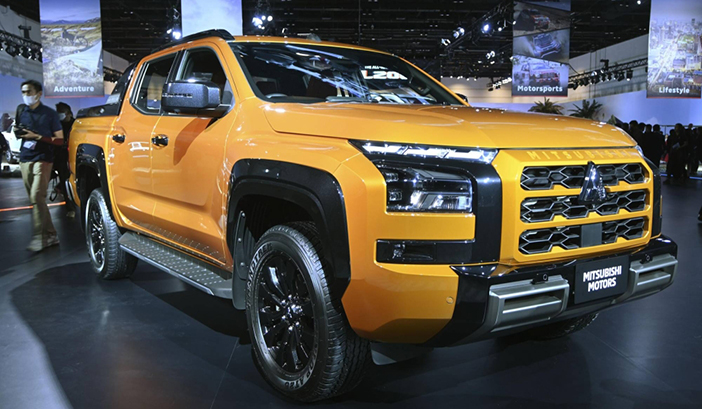
+++ As the popularity of lifestyle vehicles rises in JAPAN , domestic automakers are introducing overseas-made models to offer more options to domestic consumers looking for cars suitable for camping and skiing. Mitsubishi will sell the newest iteration of the Triton pickup truck in Japan starting February 15, bringing back the model, popular in Southeast Asia, to the country after a 12-year hiatus. The latest model of the four-wheel drive vehicle (photo), equipped with a high-power diesel engine, newly developed suspension and 7 different driving modes, is produced in Thailand, where the company unveiled it in July. The automaker stopped selling the model in 2011 at home amid shrinking demand but has decided to revive it after people grew interested during the Covid-19 pandemic in vehicles that came in handy for outdoor activities, it said. “We are targeting those who want to own a car that is a little different”, said Yoshiki Masuda, Mitsubishi’s chief product specialist. “We hope to revitalize the domestic pickup truck market”. Honda will launch its newest India-made SUV, the WR-V, in Japan in its first introduction to the home market of cars made in the subcontinent. The compact SUV, boasting large luggage room and spacious backseats, is priced at ¥2.09 million. The new model will add to the company’s domestic SUV lineup (the Vezel / HR-V and ZR-V) and target young people who are purchasing SUVs for the first time, the company said. The popularity of SUVs and pickup trucks has been on the rise in Japan since even before the pandemic on the back of the increasing popularity of outdoor activities, with Toyota bringing its pickup truck Hilux back into its domestic lineup in 2017 after a 13-year break. +++
+++ A SUV for 15.000 euro is indeed a powerful selling point. This price appeal has allowed the brand to offset doubts associated with the MG brand or prejudices related to its Chinese ownership despite its British origins. The car itself has an aesthetically pleasing appeal and offers useful features for its price, which have together contributed to its rapid success. The MG ZS topped the Spanish market charts in December 2023 with 2.563 units sold. The Renault Clio came in second place with 2.360 units sold, followed by the Dacia Sandero (2.289 units), Hyundai Tucson (2.087 units) and Toyota Corolla (1.829 units). Analysis from the Spanish market indicates priority given to price by customers over brand sentiment. Notably, no models from Seat or Cupra made it to the top-10, and the only model from the Volkswagen Group to make the list was the T-Roc, coming in 6th with 1.774 units sold. It remains to be seen whether the MG brand will replicate this impressive performance in other European countries. Nonetheless, the Spanish market results suggest that the much-touted factors of tradition and brand trust may be overemphasized. Evidently, crafting an appealing offer is key. +++
+++ TOYOTA announced Monday that fraudulent performance tests for engine emissions were also conducted on its diesel engines. The fraud also extended to industrial vehicle engines used in construction machinery. The Land, Infrastructure, Transport and Tourism Ministry has decided to conduct on-site inspections at the Toyota Group company’s plant in Hekinan, Aichi Prefecture. Toyota has decided to suspend worldwide shipments of 10 models (including the Hiace, Land Cruiser, and Hilux) that are equipped with the affected engines. Toyota Industries announced last March that it had engaged in fraudulent activities such as replacing data in performance tests of forklift truck engines. The company has suspended domestic shipments of forklift trucks equipped with these engines, and the transport ministry revoked the type certification of two models of engines manufactured by the company. Toyota Industries was founded in 1926 to manufacture and sell the Type G automatic loom invented by Sakichi Toyoda, the founder of the Toyota Group. The company now manufactures machinery, including engines, electronic devices and industrial vehicles such as forklifts, in addition to automobile vehicles. +++
+++ In a recent media communication conference, VOLKSWAGEN GROUP China (which includes its partnerships with SAIC and FAW) officially unveiled its ambitious goals for 2030. Despite facing challenges in the domestic market environment in 2023, the automaker reported a 1.6% year-on-year growth, delivering 3.236 million vehicles in China and placing second best in sales. EV sales have been Volkswagen’s Achilles heel. In 2023, VW sold around 155.500 ID-series electric cars. For comparison, Chinese GAC Aion sold over 480.000 cars, Tesla sold over 600.000 vehicles in China, Li Auto delivered over 370.000 and even Nio (a high-end EV brand) sold nearly 160.000 units. In stark contrast, Volkswagen ID.7 sales in November received only 300 orders 72 hours after the pre-sales started. Looking ahead to 2024, Volkswagen Group says it is committed to accelerating its transformation and maintaining its leadership in the era of intelligent connected vehicles. As part of its strategy, Volkswagen plans to offer 30 locally-produced fuel and hybrid models by 2027, intensifying its push towards electric vehicles. By 2030, the company aims to provide a minimum of 30 pure electric models in the Chinese market. The recently updated ID.3 and ID.4 are examples of its electric goals. Furthermore, in order to further bolster its efforts, Volkswagen Group is harnassing other Chinese manufacturer’s tech and plans to use Xpeng’s E/E architecture to produce 2 electric models for the Chinese market in 2026. In addition to its electric ambitions, the Volkswagen Group intends to strengthen its position in the internal combustion engine (ICE) market. The company plans to upgrade its major ICE products with advanced technologies in the coming years. The Volkswagen Group is set to integrate innovative technologies into its products, introducing driving assistance features, intelligent cockpits, new in-car navigation systems, and AI-powered assistants tailored for the Chinese market. This move aims to enhance the overall intelligence of their products. The Volkswagen Group will continue to expand its lineup of ICE vehicles, gradually transitioning towards new energy sources by advancing hybrid technologies. Volkswagen’s strategy in China encompasses a comprehensive approach that includes both electrification and enhancement of traditional combustion engine products. The company’s commitment to innovation and adaptation to the evolving automotive landscape highlights its determination to play a leading role in the Chinese market’s future. +++