
+++ The long-awaited replacement for the BUGATTI Chiron will be revealed next month, packing well over 1.000 hp from a hybrid system that’s based around a naturally aspirated V16 engine. The company recently revealed the shape and layout of the engine, but Bugatti-Rimac CEO Mate Rimac has now given new details. While keeping most cards close to his chest, he revealed that the colossal engine will go without forced induction, unlike its W16 predecessor, which inhaled through 4 turbochargers. The engine itself, he added, will measure a whopping 1-metre long in its own right: 400 mm longer than the 4-bank unit from the Chiron. Despite that, though (and the integration of a substantial electric drivetrain element), the car will be a similar shape to its predecessor, Rimac said: “The exterior is an evolution. You can still see the very distinct Bugatti design”. Certainly, spy shots circulating the internet in recent weeks indicate that it will have a familiar silhouette, but be somewhat lower and sleeker than the Chiron it replaces. Mate Rimac, despite being best known for his pioneering work creating electric hypercars and supplying battery tech to a number of global car manufacturers, said he was a driving force behind bringing the V16 to fruition. Before his firm took over Bugatti from the Volkswagen Group, he said: “The business plan was to make an electric coupé-SUV type of thing”. “Management was saying the next car has to be electric”, he added, acknowledging that a rebadged and restyled version of the Rimac Nevera would have theoretically made a logical electric replacement for the Chiron. But maintaining differentiation between the 2 hypercar brands, while honoring the heritage of Bugatti, was essential. Mate Rimac said: “You could very easily and convincingly make a Bugatti out of the Nevera (just make a different design and call it a day), but I thought that was absolutely wrong for the brand. “Luckily, I won that argument 3 years ago when electrification was all the rage, which it isn’t any more”. Rimac was referring to the perceived decline in demand for electric hypercars, acknowledging that his firm has still not sold all 150 Neveras. In addition, Rimac said, any Bugatti powerplant should be “as emotional as possible”. Referencing founder Ettore Bugatti’s famous slogan, he said: “You can achieve the power figures we have with the V16 from a very highly turbocharged V8, but we wanted to have it very emotional. It has to feel special, because ‘if it is comparable, it is no longer Bugatti’ “. As for that power figure, while refusing to be drawn into giving a specific number, he suggested the next Bugatti will have comfortably more than 1.000 hp. Given the size of the engine and the introduction of a hybrid element, it seems likely the new car will comfortably eclipse the W16’s 1.600 hp maximum. It will be the first production car in decades to use such an engine, the last having been the ultra-rare Cizeta-Moroder V16T in 1991. Bugatti has not given any more details about the engine, such as its capacity, but various reports say it is 8.3 litres in capacity, and has been developed by Cosworth, though neither Bugatti nor the British firm have confirmed these details. The firm describes its first hybrid powertrain as “incomparable in every detail, it is a pure embodiment of Bugatti’s DNA, created not just for the present, or even the future, but ‘Pour l’éternité’ “: for eternity. Previously, it was thought that Bugatti would downsize its engine in light of the potential electric power boost provided by a hybrid drivetrain, and the need to accommodate a battery and electric motors, but clearly the firm has found a means to stay true its 16-cylinder lineage as it embraces electrification. The firm had already told that the new powertrain would be “unlike anything else on sale” but had stopped short of revealing any technical details. The design of the car itself was signed off early last year, with designer Achim Anscheidt, who stepped down as Bugatti’s design chief recently, telling that it will “bring forward” Bugatti into a new era while retaining signature cues such as the horseshoe grille and crescent-shaped belt line. His replacement, Frank Heyl, promised the new car will be “even more amazing” than the Chiron. “It’s going to be amazing, proportionally, technologically, in terms of innovation, in terms of unexpectedness. It’s going to blow people out of the water completely, and it’s a true joy to work on this”. It is not yet confirmed whether the hybrid drivetrain will allow for engine-off running, or whether the 2 propulsion systems will work in tandem for maximum power output. +++
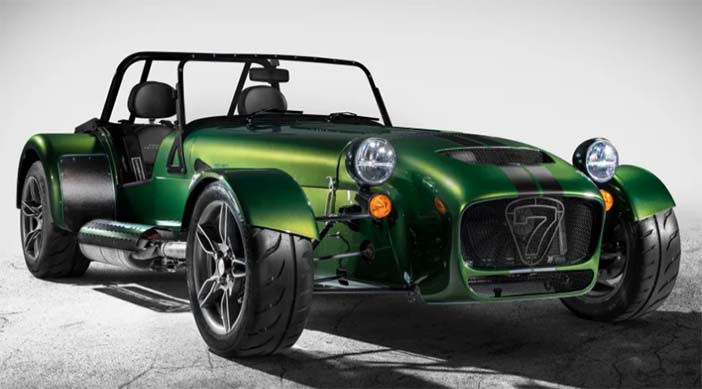
+++ CATERHAM has announced the end of the line for its naturally-aspirated offerings in Europe with the new Seven 485 Final Edition. The limited edition model will be split up into 85 units: 60 of the 485 Final Editions and 25 in 485 CSR Final Edition guise. Exclusive to the Final Edition models are the new satin black stripes which sit on a selection of 5 paint finishes: Golden Saffron, Viper Blue, Volcano Red, Verdes Emes and Viola Parsifae. There’s a fully-carpeted interior, carbon dashboard and seats featuring a ‘Sports Hex’ pattern with Alcantara upholstery. A unique numbered plaque inside is bespoke to each car. The supercharged Seven 620 is the fastest Caterham you can buy in the United Kingdom, but the European range-topper is no slouch. The 485 Final Edition gets a 2-litre 4-cylinder from Ford with 225 hp and 204 Nm of torque and a lofty rev limit of 8.500 rpm, resulting in a 4.1-seconds 0-100 kph time and 223 kph top speed. Those figures are unchanged for the 485 CSR Final Edition, which is only offered with the large chassis and inboard suspension raising the weight from 560 kg to 605 kg. If you wish to take your Final Edition to the track, there’s an option to fit ‘Cup’ dampers, a roll cage, a fire extinguisher and even an uprated brake master cylinder. While the Final Edition starts at 67,495 euros (Dutch taxes not included), it will be one of the most exclusive Caterhams ever made. There will be an additional 10 right-hand drive models made, but these are destined for the Japanese market. +++
+++ The successor to the LAMBORGHINI Huracán will be launched in August, swapping its trademark naturally aspirated V10 for a plug-in hybrid powertrain. That powertrain will be based around a new V8 that has been engineered in-house, rather than taken wholesale from sibling firm Audi. When it arrives in August (a date confirmed by Lamborghini’s head of sales and marketing Federico Foschini), the supercar will complete the Italian firm’s all-electrified model line-up, joining the flagship V12 PHEV Revuelto and just-launched Lamborghini Urus SE. The move to PHEV for the Huracán successor is because “the package itself it’s much better than a normal ICE car”, Foschini said, adding: “There are characteristics that you cannot achieve if you don’t have an electric motor, such as active torque vectoring; it gives you the opportunity to leverage even more on the potential of the engine”. Visually, the new supercar will be clearly related to the flagship launched earlier this year. It will have a dramatic silhouette that adheres to head of design Mitja Borkert’s ‘spaceship’ ethos, as well as a raft of cues that have become Lamborghini hallmarks, including a gaping hexagonal exhaust, Y-shaped led light designs and prominent air channels throughout the body to boost downforce. The basic principles of the ‘mono fuselage’ carbonfibre monocoque introduced with the Revuelto are also expected to be carried over. However, the abundance of expensive composites used in the flagship supercar’s structure are unlikely to be shared by the junior model. Instead, it’s set to use cheaper aluminium where possible, without incurring a major penalty to rigidity, in line with its more entry-level billing. The rear subframe is already aluminium on the Revuelto, but the front end could follow suit on the junior supercar, for instance. This philosophy of reserving exotic materials for key structural elements would match that used for the Huracán and Audi R8. They featured a carbonfibre ‘backbone’ (the central tunnel and rear bulkhead) but used mostly aluminium elsewhere. The platform will also be shortened to visually distinguish the new car from the 4.947 mm-long Revuelto. For reference, the run-out Huracán Tecnica is 4.567 mm long. The move to the mono fuselage chassis also enables the electrification of the Huracán successor. Lamborghini hasn’t yet said whether the junior supercar’s V8 is related to the Urus’s 4.0-litre twin-turbo arrangement. However, given the need to cultivate a highly distinct character and offer a markedly different driving experience, it’s likely that the Huracán successor’s engine will be a highly bespoke proposition, irrespective of its fundamental specification. Lamborghini called on Oxford-based specialist Yasa to supply its slimline axial flux electric motors for the Revuelto, in the interests of saving weight and boosting power efficiency, and this format could be reprised for the smaller supercar. However, it remains to be seen whether the Huracán’s successor will also feature 2 motors on the front axle, plus a third integrated in the gearbox, as in the 1.001 hp Revuelto. It’s also unclear whether Lamborghini still plans to offer rear- and four-wheel-drive variants. The motors will be fed by a small, lightweight battery (possibly the same 3.8 kWh pack used by the Revuelto) situated in the same central spine of the chassis and giving an electric-only range of about 15 km. More important than the slight gains in homologated fuel economy and emissions will be the dynamic benefits of such a set-up. The Revuelto deploys its three motors to great effect: torque vectoring at the nose helps to neutralize the supercar’s handling, while the rear motor masks the effects of the highly strung V12 bogging down at low revs. The ability to ‘torque fill’ in this way has prompted speculation that the Huracán successor’s engine will be biased towards high revs. This would make it similar in character to the Revuelto’s naturally aspirated V12, which doesn’t deliver its full 825 hp until a screaming 9.250 rpm. Lamborghini will build the Huracán successor on the same production line as the Revuelto. It will be the first time that the brand has built both of its supercars in series on the same line, facilitated no doubt by the sharing of major architectural and electrical components. +++
+++ LUCID ’s new Gravity SUV is expected later this year, but earlier this year, the automaker filed trademark applications for what is expected to be a smaller, much more affordable electric SUV: the Earth. It is scheduled to land in 2026, behind the Gravity. 3 model names popped up in the United States Patent and Trademark Office application: Earth, Lucid Earth and Earth Dream Edition. Lucid reportedly plans to start production in 2026, and it should land as the company’s least expensive model. Sized similarly to the Tesla Model Y, it will also feature a competitive price, with the cost of entry expected to slide in under the €70,000 mark in the Netherlands. Lucid’s CEO also confirmed the vehicle during the automaker’s first-quarter earnings call, though the Earth name wasn’t known until the trademark application was discovered. Peter Rawlinson said the midsize model would be priced “around €65.000” and noted that the company would chase “unrivaled levels of efficiency” to deliver the range numbers Lucid customers expect. The Earth could be a make-or-break model for the automaker, and two years is plenty of time for its better-funded competitors to make updates. The Model Y is overdue for a refresh, though recent layoffs and upheaval at Tesla could throw a wrench into the gears and slow things down. Though it has major backing from the Saudi Arabian government, Lucid’s fortunes are anything but set in stone. The company’s first-quarter deliveries were up from the same period in 2023, but its projection of 9,000 units for this year is around 25% short of analysts’ expectations. Rawlinson said he is confident that the upcoming Gravity will help boost volume, but the automaker has reported significant losses per unit delivered, making it unclear how Lucid could achieve profitability without a sustained effort to reduce its supply chain and production costs. +++
+++ The 3 Hybrid+ kicks off a big year for MG , with at least 4 other new models arriving in the next 12 months. And that’s on top of the all-new small electric 2 hatchback that’s likely to come by the end of 2025. Prices have been announced for the Cyberster electric roadster. MG’s most powerful production car ever will cost about €65.000 in the Netherlands, with the top-spec dual-motor GT coming in at a around €75.000. That car will arrive in the coming months, quickly followed by a new HS mid-size SUV. Initially available as a plug-in hybrid ahead of a regular hybrid coming early next year, the PHEV in particular is being tipped for big things. “We’re going to disrupt the market with that car”, MG’s head of product and planning, David Allison, told. It will have a larger battery than any competitor, with an official electric-only range of around 110 km possible. Late this year, MG will also replace its big-selling ZS. MG is developing a SUV using the MG4’s underpinnings and giving the EV its own style. Development on the HS and ZS cars are currently running out of MG’s British engineering site at Longbridge, working on tailoring the technology and safety systems for the European market. The MG 2 will be one of a new breed of affordable small electric cars, rivalling the Dacia Spring and Citroen ë-C3, as well as the Volkswagen ID.1. “It feels like the natural place for EVs to go, particularly from an affordability point of view”, said Allison. +++
+++ TESLA spent around $2 million on lidar, a technology used in EVs that Elon Musk has previously referred to as a “fool’s errand” and that any carmakers relying on it are “doomed”. But according to a recent earnings report from lidar manufacturer Luminar, Tesla was its largest customer last quarter and “comprised more than 10%” of its revenue during the period. That’s about $2 million, given that Luminar’s reported quarterly revenue was $21 million. Lidar stands for light detection and ranging, and it uses light pulses to measure distance and create a 3D image of its surroundings. It’s often used in EVs, specifically in self-driving and Advanced Driver-Assistance Systems, to help detect a vehicle’s surroundings. Tesla’s purchase of the technology is notable considering the CEO has repeatedly slammed lidar in favor of cameras. “It’s like having a whole bunch of expensive appendices”, Musk said at Tesla’s “Autonomy Day” event in 2019. “Like one appendix is bad, well how about a whole bunch of them? That’s ridiculous. You’ll see”. “Humans drive with eyes & biological neural nets, so makes sense that cameras & silicon neural nets are only way to achieve generalized solution to self-driving”, Musk said in an October 2021 tweet. Musk most recently reiterated his stance on lidar during Tesla’s quarterly earnings call. The CEO said Tesla EVs only rely on camera-based vision systems for driver-assist features. “No lidars, no radars, ultrasonic. Nothing”, Musk said. Musk has also said that he doesn’t hate lidar, he just opposes its use in electric vehicles. The Tesla CEO said he personally ran a project at SpaceX to create lidar sensors to help navigation. For now, it’s unclear how Tesla is using the technology, or if it will eventually make its way back into the company’s vehicles. In 2021, a photo of a Model Y with lidar sensors affixed to its roof circulated around the internet. That same year, Tesla reportedly entered a partnership with Luminar for testing and development. Tesla has autonomous testing units in a number of cities around the country as it seeks to refine its Full-Self-Driving system. The company’s self-driving Autopilot feature has also caught the eye of regulators in the past. Last year, Tesla recalled over 2 million vehicles after regulators said its Autopilot system didn’t protect enough against drivers misusing it. Last month, the National Highway Traffic Safety Administration said it was looking into whether the recall had enough of an impact after a fatal crash involved a driver who said he was using autopilot. The US Department of Justice has also reportedly been investigating Tesla since 2022 over potential wire and securities fraud related to Elon Musk’s past comments about Autopilot and its abilities. +++
+++ VOLKSWAGEN will retire its GTX branding for sporting EVs to make way for its first electric GTI and R models. The GTX badge was first used for warmed-up, range-topping versions of the ID.4 and ID.5 in 2021, and has since been extended across the wider ID family, with more potent GTX versions of the ID.3, ID.7 and ID.Buzz revealed in recent weeks. Initially, the GTX badge was set to be reserved exclusively for twin-motor, performance-oriented EVs, but the hot new ID.3 GTX remains powered by only a single motor at the rear. But despite the GTX line-up having been significantly expanded of late, Volkswagen CEO Thomas Schäfer has confirmed the branding will be phased out as Volkswagen ramps up to electrify the GTI and R performance brands. “GTX is the performance brand of the MEB platform, but we’ll work our way back to GTI and R in the next products going forward”, he told. Volkswagen revealed the ID.GTI concept last year as preview of an electric successor to the Golf GTI hot hatch, which is due on sale in early 2027. It is not yet known whether the badge will be rolled out to other electric Volkswagens. Since it was introduced in 1976, it has been used for only the Golf and Polo. Schäfer said Volkswagen is still shaping the future of the GTI brand internally, but emphasized the importance of staying true to its roots. “The question is: how do we position GTI? GTI is traditionally front-wheel drive”. Volkswagen has yet to give any clues to what an electric R car could look like, but has confirmed that R will become an electric-only performance brand by 2030. Schäfer said it will still be used “for four-wheeldrive performance” cars, as it has been for the past 2 decades. The brand has previously suggested an R version of the Mk9 electric Golf is likely to arrive around 2029. GTI and R, he emphasized, will have “clear genes going forward”. The move means Volkswagen is unlikely to launch any more GTX models, but there is no plan to rebadge any of the current cars. “With the current products, this is what it is, but future products will go back to a clear portfolio”, Schäfer said. +++