
+++ The AUDI Q7 is the oldest model in the firm’s line-up, so it’s ripe for a replacement and spies have caught it testing ahead of an expected release next year, giving us a better look at the upcoming SUV. The Q7 was Audi’s first SUV when it launched in 2006. However, the brand was pretty late to the segment, when you consider its all-wheel-drive heritage and the fact that Volkswagen Group siblings such as the Porsche Cayenne and Volkswagen Touareg went on sale a couple of years earlier. The current, second-generation Q7 gained an update in January of 2024, although that wasn’t a mid-life facelift (that happened in 2020). This year saw a series of mild tweaks to keep the Q7 looking fresh alongside the newly revised Touareg and the Q7’s coupe-SUV alternative, the Q8. The Q7 is Audi’s largest SUV and it will adopt the same design details seen on many of Audi’s newer internal-combustion-engined models: a new shape to the grille, separate headlight clusters, and a bold, upright front end. The overall body shape is similar to the current Q7’s but the rear window looks a little less raked for a taller side profile; possibly a deliberate move to distance the Q7 from the sleeker Q8. At the front we can see a thin upper headlight cluster, which incorporates the indicators and a chunkier lower light. The large grille we’ve become accustomed to seeing on Audi SUVs appears wider than the current car’s, and the lower grille features a radar sensor in the middle. Down the side of this test car we can see the door handles have transformed into little winglets on the window line; similar to the ones you’d find on a Ford Mustang Mach-E. There are still some contrasting elements over where the traditional handles would be, however, so we’ll wait and see what design Audi has decided to go with here. The previous Q7 test car caught by our spies featured new diamond-cut wheels, but this model has black alloys, marking this out as the hot SQ7 model. We’re yet to see inside the next Q7, but it should use the latest technology from the VW Group. I expect a massive 14.5-inch touchscreen coupled with a 10.9-inch display for the passenger and Audi’s latest Virtual Cockpit; essentially the same set-up as in the new Q6 e-tron. Given that the VW Group is spending big on its new PPE architecture for electric cars (which Audi will make use of for the Q6 e-Tron and A6 e-Tron) but the new Q7 will use the PPC (Premium Platform Combustion) architecture. We’ll have to wait and see what engines the new Q7 will come with, but a selection of petrol V6s is likely, considering that Audi previously claimed its final cars using those fuels will launch by 2026. A plug-in hybrid edition is available as part of the current Q7 line-up and I expect it’ll be offered with the new model. +++
+++ BYD makes more EVs than anyone, and it makes them for less money than most Western automakers can comprehend. But there is a cost, and it’s being paid by the workers in its supply chains, according to a new report investigating human rights risks in the EV industry. Amnesty International’s Recharge for Rights study ranked 13 automakers according to how they address human rights risks in their mineral supply chains. BYD came bottom with a score of just 11 out of a potential 90 points, with Mitsubishi not far behind on 13 points. Hyundai (21), Geely and Nissan (22 apiece) came out looking like bad guys but Tesla (49) and top-rated Mercedes (51) performed far better. Not that even Benz’s score was enough to please the Amnesty investigators, who suggest that only a total of 68 points or more shows an adequate commitment to human rights issues. Although EVs don’t produce tailpipe emissions, their batteries need huge quantities of minerals like lithium, nickel, and cobalt. And while many of us are aware of the environmental damage caused by mining lithium, Amnesty International says the cobalt mining industry is ripe for the abuse of workers, some of whom in countries like the Democratic Republic of Congo, which generates 25 percent of the world’s supply, are children. BYD was marked down for refusing to reveal the name of the smelter, refiner, and mine that supply its minerals, but Geely, Hyundai, Mitsubishi and General Motors were all guilty of a lack of transparency. In contrast, the best-rated brands were able to provide supply-chain mapping. Here is the full list of car brands and their human rights score (out of 90): Mercedes 51, Tesla 49, Stellantis 42, Volkswagen 41, BMW 41, Ford 41, General Motors 32, Renault 27, Nissan 22, Geely 22, Hyundai 21, Mitsubishi 13 and BYD 11. “As the global transition to electric vehicles gains momentum, drives global competition and allows for huge profit, Amnesty International is calling on all car makers to improve their human rights due diligence efforts and bring them in line with international human rights standards,” said the organization’s Agnès Callamard. The need for automakers to prove the origins of their batteries’ minerals to be eligible for EV credits has improved transparency, Wired notes. And there are steep fines (and market access restrictions) awaiting companies who flout rules governing supply chain welfare contained in the Corporate Sustainability Due Diligence Directive that came into force in Europe this summer. But Callamard believes there’s more to be done. “Those lagging behind need to work harder and faster to show that human rights isn’t just a fluff phrase, but an issue they take seriously,” she says. “It’s time to shift gears and ensure electric vehicles don’t leave behind a legacy of human rights abuses; instead, the industry must drive a just energy future that leaves no one behind”. +++
+++ It’s hard to believe GENERAL MOTORS boss Mary Barra has been leading the automaker for nearly 11 years now, at least for veteran industry watchers who witnessed the revolving door of CEOs atop this company less than 20 years ago. Today, GM is about as stable as a global automaker can be (relative to the environment in which it competes). This week, Barra was honoured as the 2024 All-Stars Industry Leader of the Year. She earned it. It’s hard to find a significant metric showing GM is doing worse this year than last: The stock price as of last week’s close was up 62 percent year to date. • Net income improved 12 percent to $8.9 billion through the first 9 months. This despite significantly higher North American labour costs stemming from new contracts with the UAW in the U.S. and Unifor in Canada. GM has raised its earnings guidance 3 times this year. It’s an unscientific statistic that speaks to quality, but GM’s 31 U.S. recalls filed with NHTSA this year are half that of its Detroit rivals, Stellantis and Ford, which each have issued 62 callbacks so far in 2024. BMW has recorded 34 recalls. GM improved its supplier relations score, according to Plante Moran’s annual automaker-supplier working relations index study. Of course, Barra and GM didn’t have a perfect year. The November 15 layoff of about 1.000 employees was poorly handled and badly timed. But CEOs don’t win popularity contests by adhering to their fiduciary responsibilities to shareholders. Still, given GM’s overall performance this year versus many of its competitors, Barra is the clear winner of this award. +++
+++ JAGUAR has managed to do something they haven’t done in years: get people to notice them. However, last week’s rebrand has gone over like a lead balloon in some circles. As part of their Copy Nothing campaign, Jaguar introduced a new brand identity, visual language, and signature. The company also decided to embrace exuberant colours, which were prominently featured in an odd promotional video that was more art/fashion show than car commercial. Needless to say, everyone’s been talking about it and that’s exactly what Jaguar wanted. However, there’s also been tons of hate and claims the automaker has gone “woke”. Jaguar is now trying to put out those fires as BBC News is reporting the company is asking fans to trust them and “reserve judgment” until their plan is fully presented. A spokesperson went on to tell: “We had to break rules and do something that would get us to cut thru” the noise. Those sentiments were echoed by Jaguar Managing Director Rawdon Glover, who told that they’ve seen “vile hatred” in response to the campaign. He added the company isn’t trying to be political and their message was lost in a “blaze of intolerance”. Glover went on to say: “We need to re-establish our brand and at a completely different price point, so we need to act differently.” The campaign was part of this and they purposely wanted to “move away from traditional automotive stereotypes”. Regardless of what you think about the campaign, it’s gotten people talking. In less than a week, the video has been viewed nearly 2.1 million times on YouTube and 163.7 million times on X, which was aided by Elon Musk tweeting about it. That is undoubtedly a win for the automaker and they’re hoping the attention stays on them until December 2 when they unveil their highly anticipated Design Vision concept. It previews their new era as an electric ultra-luxury brand, which will reportedly begin in earnest in 2026. +++

+++ Following the pandemic, the automotive market boomed to high demand as inventory levels tumbled the opposite way due to the shortage of semiconductors pertinent for vehicles to function. Fast forward to now, and it’s possible to find dealers with full lots with units to sell. At the same time, EV demand has plummeted and carmakers are backtracking commitments to EVs in favor of hybrids and plug-in hybrids because having a gasoline backup doesn’t hurt anybody. This ultimately comes down to buying costs and charging infrastructure. It also means rental companies tend to play with fire despite no guaranteed returns. In 2021, Hertz famously spent $4.2 billion for 100.000 Tesla units so it could offer an electric option in its fleet. Now it’s trying to offload them for cheap. However, it seems EVs aren’t the only cars not immune to heavy depreciation. Perhaps surprisingly to no one, MASERATI values have been affected too. Through Hertz, the Grecale is losing money faster than Bitcoin investors. A 2024 GT model carries a base MSRP of $69,900 so imagine our surprise when used examples are showing up on the Hertz classifieds with a $30,000 discount. Yep, a 2024 Maserati Grecale GT is on sale right now for $40,227. The mileage? Just 4.060 on the odometer. No damage is mentioned and the vehicle history report reveals no accidents. And it’s not alone. There are a number of Grecales for sale right now, with a lot of them showing less than 10.000 miles. These are basically brand-new cars with titles that do not appear to be lemons. So what’s going on here? One answer may lie with the manufacturer, whose reputation is not great when it comes to reliability. However, a quick glance through the Autotrader classifieds of near-new Grecales that have been certified pre-owned through Maserati dealers shows them to carry a selling price in the $50.000 range. So it might reflect the blowback Hertz faced for buying too many Teslas and hurting the company’s value. This is all pure speculation. I’ve reached out to the representative for insight and as of this writing, they have yet to reply. If I hear back, this Newsflash will be updated accordingly. The Maserati Grecale is the latest model to wear the trident badge. It is a compact crossover designed to compete against the likes of the BMW X3 and Porsche Macan. The GT trim utilizes a 2.0-liter turbocharged-4 with mild hybrid assist that’s connected to an 8-speed automatic transmission. This delivers power to all 4 corners through an all-wheel-drive system. Let’s leave this on a positive note: you have the chance to nab a Maserati for the price of a top-end Toyota RAV4. Hertz shows Grecales listed with low miles in different US states so it’s always a good idea to clarify warranty information before purchasing, as coverage on a used vehicle may reflect differently depending on the state. There’s also the risk that these were abused to a greater extent as rentals than what you may typically find on a used car so it’s a good idea to drive it yourself to ensure that’s not the case. To be fair, these are advisable steps to approach any pre-owned vehicle, not just reflected on a specific brand like Maserati. +++
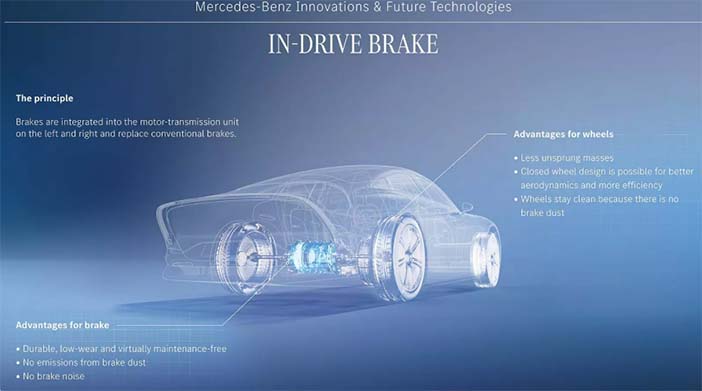
+++ MERCEDES is looking to reimagine how mechanical brakes work on electric vehicles and has developed a system that shifts the brakes in-board, reducing unsprung mass along with other benefits. Engineers from the German carmaker say that the regenerative braking systems of EVs can handle 98% of braking scenarios, meaning mechanical brakes are only necessary in emergencies when maximum braking force is required. With this in mind, engineers have developed a system where the actual brakes are located inside the motor transmission unit. By moving the brakes in-board, up to 90 kilo unnecessary weight from the corners of a vehicle could be shifted more centrally, improving handling. It would also allow for fully-enclosed wheels to be used, boosting aerodynamics and improving range. These new-age brakes work slightly differently than normal ones. A circular brake pad is mated to the driveshaft and 2 discs would clamp against it. Small trays could then be implemented to catch all the brake dust. As the brakes are fully enclosed within the motor unit, they would get very hot, with Mercedes-Benz potentially using water cooling to solve this problem. The system wouldn’t only work on dual-motor EVs with drive units at the front and rear axles. Mercedes says it would mount the brakes to the center of the front axle for EVs that only send power through the rear wheels. Engineers believe the in-board brakes can last the lifetime of a vehicle, meaning they won’t need to be serviced or replaced. While Mercedes-Benz continues to develop and test the system, it has yet to confirm its production intentions. Should the system prove up to the task of lasting the lifetime of an EV, then it would be a no-brainer to introduce it for the brand’s future EVs. +++
+++ PORSCHE is preparing for a world that buys fewer of its cars, especially its electric cars, but is hoping to keep its position as a profit powerhouse by selling more higher priced models. The Volkswagen Group brand has long been a key cash generator for the wider group thanks to high profit margins particularly on its 911 sports car and its SUVs. However in the three months to the end of September the brands’ stellar operating margins slipped to 11 percent, down from 17 percent the quarter before. Profits tumbled to below a billion at 974 million euros in the quarter for the first time in at least 10 quarters. +++
+++ The next stage of VOLKSWAGEN ’s electrified reinvention is gearing up with the imminent unveiling of its first battery-powered supermini. This new model – previewed by the ID.2all Concept (and potentially to be named alongside a future ID.Golf as the ID.Polo) represents a step change for the company. It heralds not only a reformed electric architecture, but also a new design language and lower price points that VW is relying on to re-establish its position as Europe’s biggest and most profitable mainstream manufacturer. There’s a lot at stake for VW, but the future ID.Polo is promising big things, not least the introduction of a 25,000 euro starting price (27.500 euro in the Netherlands). It’ll achieve this through a variety of means, not least a simplified platform called MEB Entry, but should also prove profitable; a crucial aspect for the survival of VW in the electrified age. The new platform’s development is being done in collaboration between Volkswagen and its sister brand Cupra, whose Spanish plants will build not only the Raval (which will be the first to put into production in mid-2025), but all MEB Entry models, including future Skoda and Volkswagen SUVs . Beyond just offering a low-cost supermini, the ID.Polo will also be the first all-electric car to offer a GTI edition, which has already been previewed with another concept. But the future VW ID.Polo will have a tough crowd to compete with, including a range of new rivals such as the Renault 5, Fiat Grande Panda and Citroen ë-C3. There’s also a brand-new set of Stellantis rivals on their way in the coming years. These include a new Peugeot E-208 and Opel Corsa Electric, which will sit on their own refreshed platform. The great news is that we already have a very clear idea of what to expect with the new ID.Polo thanks to the ID.2all concept that was revealed in 2023. As well as revealing the all-new exterior design language overseen by new design chief Andreas Mindt, it also gives a clear indication of the brand’s future interior and interface design. These 2 elements have been at the top of the list for VW to reinvent after less than favourable reaction to the first ID models. First and foremost, the production car will likely retain the concept’s pair of screens on the dash: a 10.9-inch screen for the driver and a 12.9-inch infotainment screen. On the concept, you can choose between eras of Volkswagen cars as themes for the displays; a Vintage setting is designed to mimic the dash of an old Golf, Classic mode apes the readouts of the original Beetle, and a Modern mode reflects the latest thinking for the ID.2. But the bigger change is the move away from controls within touch panels or screens, and a return to physical controls for key elements like volume and cabin temperature. On the ID.2all concept these are mounted below the central display. The steering wheel also does away with touch sliders; they’re replaced by rotating thumbwheels and just 4 regular buttons. And in another small but significant move away from the ID.3’s interface, there are 4 electric-window controls for the driver (instead of just a pair and a front/rear selector). The gear selector has been moved to a stalk mounted on the steering column; a move already seen on VW’s latest MEB models, while between the front seats, there’s a dial controller that’s said to be for switching between the drive modes. The concept’s boot capacity is 440 litres; nearly 60 litres up on the ID.3 and more than 100 litres larger than many Polos, rising to 1.330 litres when the rear seats are folded down. The boot floor has an adjustable height and there’s also a novel 50-litre storage area beneath the second row; VW says that while this lockable compartment has been conceived to house the charging cables, it could also be ideal for items like laptops, allowing them to be charged while they are stored. The MEB Entry project is an offshoot from the MEB platform that delivered the likes of the Volkswagen ID.3 and Skoda Enyaq, but it’s designed from the outset to support smaller, cheaper vehicles. As such, it switches layout from rear to front-wheel drive and makes use of a less complex torsion-beam rear suspension to boost practicality and keep a lid on costs. The new concept is said to have been created in less than two months, under the guidance of VW’s design boss, Andreas Mindt, who only joined the brand earlier this year. The former Audi and Bentley man has created a much cleaner, simpler-looking vehicle than the futuristic (more visionary) ID.Life, which was canned by VW’s latest brand boss Thomas Schäfer within days of him starting in the position. Even though the ID.2all won’t go on sale for 2 more years, VW has taken the unusual step of confirming several of its key technical details. The concept’s single front-mounted motor produces 225 hp; enough, the firm says, for a 0-100 kph time of around 7 seconds. The battery pack will come in 2 sizes: 38 and 56 kWh, but the chemistry involved is as yet unknown. VW says that it expects a WLTP range figure of around 450 km for the larger pack, and that DC charging will take the battery pack from 10 to 80 percent of its capacity in around 20 minutes, thanks to a 125 kW peak charging capacity. Given that there are 2 battery options, these figures will almost certainly relate to models fitted with the larger pack. The front end and profile could easily pass for those of VW’s conventionally powered supermini, although there’s a single strong crease running along the flanks, and the rear door handles are hidden beyond the side windows. There’s also a fresh interpretation of the signature C-pillar from the Golf, too; this alone is a strong hint that the concept may not carry the ID. badge in production form. In contrast to many recent offerings, the ID.2all doesn’t make overt statements that it lacks a combustion engine. Mindt describes the new concept as “an homage to the Beetle, Golf and Polo” that encompasses what VW calls its key values, stability and likeability. And sure enough, the ID.2all looks pretty detached from any of the ID models that we’ve already seen; certainly much more conventional than the ID.3. It’s 4.050 mm long and has a wheelbase of 2.600 mm, so a couple of centimetres shorter than the current Polo overall, but with 5 centimetres more between the front and rear axles. VW is being open about its fresh push into more affordable EVs. It says that within a year of the ID.2 all going into production, the new model will be joined by a similarly sized all-electric SUV, already previewed by the ID.2all SUV concept that will make a full public debut at the Munich motor show in 2025. Beyond these cars, VW has also confirmed that it is working to deliver an even cheaper EV with a proposed price of less than 20.000 euro (22.000 in the Netherlands). That’s believed to be a project being led by Skoda engineers, but it’s unlikely to bring vehicles to market until 2027 at the earliest. +++
+++ Not long after VOLVO abandoned its plans to go all-electric by 2030, the Swedish car manufacturer is said to be developing a new plug-in hybrid SUV that it will sell exclusively in China. This new model, currently codenamed V446, is tipped to be based on the CMA 2 platform and should use the same EM-P PHEV technology found in Lynk & Co models like the 07 sedan and the 08 SUV. In the 08, this system consists of a 1.5-liter turbocharged four-cylinder engine and either a single 215 hp electric motor or a dual-motor system consisting of 215 hp and 209 hp motors. Lynk & Co also offers the 08 with 21 kWh and 39.6 kWh battery packs. It’s not just the powertrain that will be sourced from another model within the Geely Group. The new PHEV will feature the same Flyme Auto in-car software from Meizu that’s used by a slew of Lynk & Co, Galaxy and Polestar models. However, Volvo is insisting on making some changes to this software to make it “feel more like a Volvo.”. Leading the research and development for the new model is Volvo’s Chinese team, and the SUV is said to include very little involvement from the brand’s Swedish R&D team. As the vehicle will be sold exclusively in China, it comes as no surprise that it will be built locally. The V446 won’t be the first Volvo model developed with the Chinese market in mind. 12 months ago, Volvo lifted the veil on the all-electric EM90 MPV and is initially selling it exclusively in China, although it could be offered in other markets moving forward. The EM90 shares its platform with another vehicle from the Geely group, namely the Zeekr 009. While few details about the Volvo V446 have been confirmed, production of it will reportedly start in early 2025. If that’s the case, then we expect to learn more about it in the not-too-distant future. +++