
+++ AUTOMAKER STOCKS fell Thursday after Reuters reported Trump is planning to propose Congress kill a $7,500 consumer tax credit for electric cars (this despite his new right-hand man being Tesla co-founder Elon Musk) as part of a promised attack on efforts to cut fossil fuel use. Rivian shares slid 11% and Ford and General Motors pared earlier gains. Tesla fell nearly 5%, though Reuters says Musk doesn’t mind because killing the credit will damage his rivals. The credit is a signature element of president Joe Biden’s Inflation Reduction Act, which poured billions of dollars into supporting the green transition and on-shoring EV manufacturing. A repeal (which would have to be passed by Congress) would complicate the already bumpy transition away from gas-burning cars. Automakers have pared back plans around EVs this year: Ford scrapped an electric SUV with 7 seats and GM is overhauling its battery plans … on consumer demand for hybrids instead. +++
+++ The CAR OF THE YEAR SHORTLIST for 2025 is dominated by small electric cars. Among the 7 shortlisted models are the Alfa Romeo Junior, the Citroën ë-C3, the Hyundai Inster and the Renault 5 E-Tech. The shortlist is completed by the Cupra Terramar, the Dacia Duster and the Kia EV3. The winner will be announced at the Brussels motor show on 10 January. The 7 cars were selected by 60 jurors from 23 countries. There were 42 eligible candidate cars on the longlist; all launched in 2024. Hyundai’s new city car is the smallest car on the list, while the 5 (nominated jointly with the Alpine A290) and ë-C3 (ditto with the petrol C3) are B-segment hatchbacks. The Junior is a cross-over that’s offered in both electric and hybrid forms and is closely related to 2023’s Car of the Year, the Jeep Renegade. The EV3 is the latest electric Kia to make the shortlist. The Kia EV6 won the 2022 Car of the Year award and the Kia EV9 came fourth last year. As for the non-electric models, the Terramar is a hybrid SUV that’s closely related to the Volkswagen Tiguan and competes in a new market for the fast-growing Cupra brand. Remarkably, the Duster is the first Dacia to ever make the Car of the Year shortlist. The 2024 Car of the Year was the Renault Scénic E-Tech. The BMW 5 Series and Peugeot 3008 completed the podium. To qualify for Car of the Year, cars must be all-new. Facelifts are not permitted, nor are derivatives allowed. Car of the Year statutes dictate that: “The main criteria on which a car should be judged are the following: general design, comfort, safety, economy, handling and general roadworthiness, performance, functionality, general environmental requirements, driver satisfaction and price. Technical innovation and value for money are major factors”. +++
+++ The new November 2024 new-car safety tests published by EURO NCAP award the maximum 5-star rating to the Cupra Tavascan and the new MG HS, with the Ford Tourneo Courier achieving only 3 stars. The same round of tests and evaluations also assigned scores to cars that are derived from other cars already tested or that only change in engine. Thus Euro NCAP awarded 5 stars to the Ford Capri, Renault Rafale and Omoda 5 EV, leaving the Mitsubishi ASX at 4 stars. But let’s go in (alphabetical) order and find out the scores of the 3 cars tested for the first time by Euro NCAP this month. The Cupra Tavascan, the new electric SUV with a sporty layout and Chinese production, deserves 5 stars thanks to its excellent 89% adult protection. The new Cupra’s child protection is also good at 86 percent, while the 80 percent for the safety of vulnerable road users (pedestrians and cyclists) is also thanks to the automatic front bonnet lift system in the event of impact. The safety rating for driver assistance systems is also high, earning 79 percent. The Ford Tourneo Courier stops at 3 stars in the Euro NCAP test and the reason is mainly in the 62 percent safety rating in adult occupant protection. In particular it is the poor protection for the head of the female dummy in the back seat during frontal impact that lowers the average. The good 80 percent for child protection on Ford’s new multi-purpose car is matched by 81 percent for pedestrian and cyclist protection, while the 54 percent awarded to safety systems is due to the not always precise behaviour of the automatic emergency braking. The second-generation MG HS earns 5 stars in the Euro NCAP tests with an excellent 90 percent for adult occupant safety. The 85 percent safety rating for on-board child protection is also good. The 83 percent protection of pedestrians and cyclists is among the highest in the 2024 tests and the 74 percent for safety assistants is also good. +++
+++ The Roma only arrived back in 2020, but FERRARI has already removed its entry-level grand tourer from sale … and replacing it will be this new front-engined coupé that has been caught testing for the first time. The successor looks fairly similar to the outgoing car, and I suspect it will be a heavy update of the Roma, similar to the mid-engined F8 Tributo and its 488 predecessor. While technical details are yet to be revealed, its position as the starting point in Ferrari’s range should be retained, meaning it will once again rival the likes of the Porsche 911 GT3 Touring, Aston Martin Vantage and Mercedes-AMG GT. A long, low, sloping bonnet, heavily raked windscreen, imposing wheel arches and a wide rear are all hallmarks of a front-engined Ferrari, but elements such as the grille, headlights and rear lights are all likely to change for this new car. 20-inch alloy wheels feature on this prototype, and they’re the same ones that were available on the Roma. Lurking behind are massive brake discs accompanied by some suitably large calipers. The heavy camouflage extends to the rear, where we can see a quad-exhaust system seemingly unchanged from the Roma’s. The interior is likely to undergo an update, too, although it’s difficult to see how the 3-screen layout will be amended without significant changes to the dash. Whether or not the next Roma takes inspiration from Ferrari’s latest GT car, the 12Cilindri, remains to be seen. A 3.9-litre turbocharged V8 powered the outgoing Roma with 612 hp and 760 Nm. I expect a boost in performance for the latest car, but it’s not yet clear if that will result in a downsizing of the V8 to a hybridised V6 to align with Ferrari’s target of 80 percent electric and hybrid sales by 2030. Given that the Roma was the second best-selling Ferrari globally in its final full year on sale, we wouldn’t be surprised to see some form of electrification arrive on its successor. +++
+++ FORD today generated more bad news about its ongoing quality troubles following its agreement with NHTSA to pay up to $165 million in fines for violating recall regulations. While it’s the second-highest NHTSA fine of all time, $45 million of that goes toward Ford making investments that will improve its safety compliance infrastructure. Ford has to build a multimodal imaging test lab that focuses on low-voltage electronics and invest in a VIN traceability system to track components. Ford has led the U.S. auto industry in recalls for the last 3 years and remains tied with Stellantis in U.S. recalls so far this year with 58 callbacks, according to NHTSA data. But the real surprise in these NHTSA statistics? BMW is third with 31 recalls. +++
+++ HYUNDAI has named chief operating officer Jose Muñoz as its new global CEO. He will take the reins on 1 January from Jaehoon Chang, who has been promoted to vice chair of the company’s automotive division. Born in Spain, Muñoz will be the first non-Korean to lead Hyundai Motor Company since it was founded in 1967. Joining Hyundai in 2019, Muñoz was appointed global chief operating officer of Hyundai, with a second role as the president and CEO of Hyundai and luxury brand Genesis in the US. In 2022, he was called up to the board of directors and that role expanded across Europe, India, the Middle East and Africa. Hyundai hails Muñoz as a primary driver of its “profitability-focused sales structure” through his efforts to optimise volume and manage margins. Under his stewardship, Hyundai and Genesis achieved record sales, market share growth and financial performance in the North American market. Muñoz previously served in various high-ranking positions in a 15-year career with Nissan, where “he achieved significant profit growth and record sales”, according to Hyundai. Muñoz’s appointment as CEO comes as Hyundai’s global electrification strategy picks up pace, with the new Ioniq 9 flagship scheduled to break cover next week as one of more than 20 electric cars it plans to launch by 2030. Progressing Hyundai’s hydrogen propulsion ambitions will be another prevailing priority for Muñoz, in line with the company’s push to offer a diversified global powertrain offering that meets different demands in different regions. Under Muñoz, Hyundai will continue to invest in hydrogen as an alternative energy solution (in passenger car, commercial vehicle and industrial contexts) and will expand its global offering of fuel cell vehicles, with a new Nexo due in the near future with a design evolved from the bold Initium concept. Muñoz said: “It’s an honour to serve Hyundai, our employees, customers, dealers and other stakeholders in this new role. Thank you to our executive chair Euisun Chung and vice chair Jaehoon Chang for your trust. “Succeeding in this challenging industry requires excellence throughout the value chain, from design and engineering, to manufacturing, sales and service, along with a talented team that’s able to deliver every step of the way. I’m excited and motivated by the challenge ahead and want to continue Hyundai’s growth trajectory and laser-focus on exceeding customer expectations. It truly is a great time to be with Hyundai”. Outgoing CEO Jaehoon Chang praised Muñoz as a “proven leader with vast global experience” and said he is well placed “to lead Hyundai as competitiveness and business uncertainty increases”. +++

+++ VOLKSWAGEN and Rivian have been collaborating for some time and are gradually intensifying the relationship. Now they are officially launching a joint venture to work together on increasingly modern and efficient electric cars. Oliver Blume, CEO of Volkswagen, said the partnership is designed to enable the German group and the American start-up to bring the best possible technical solutions to their battery-powered cars quickly and at a lower cost. Specifically, Volkswagen will leverage Rivian’s IT and electronics expertise to create software-defined electric cars: next-generation vehicles that will want to stand out from the competition precisely because they are so technologically advanced. Volkswagen had already announced in June that it would invest $5 billion in the joint venture with Rivian, now it is announced that the total size of the deal is $5.8 billion, or around £4.6 billion, which will be paid out by 2027. The name of the new company has also been announced: Rivian and VW Group Technology, which will see 50-50 equal participation of the founders. The new models, which will be jointly designed, will cover all relevant market segments, including compact cars and citycars. The new JV will be led by Rivian’s chief software engineer Wassym Bensaid and Carsten Helbing from the Volkswagen Group. Initially, the design teams will work in a centre in Palo Alto, California. Then three more locations in North America and Europe will be added. By combining Rivian’s software expertise and VW’s enormous production capacity, the JV plans to reduce development costs and accelerate the deployment of new technologies, including advanced autonomous driving. Rivian CEO RJ Scaringe said that this joint venture “marks an important step forward in helping the world transition to electric vehicles” and added that the company is ‘excited to see Rivian’s technology integrated into other brands’ vehicles’. +++
+++ There’s big news in the WORLD RANKINGS for cars sold in the third quarter of 2024: China has placed 2 of its many carmakers in the top-10. But let’s proceed in order, between July and September, global markets sold around 22 million units, down 2.7%, and while Europe, the US and most emerging markets fell on hard times, China continued to gain ground thanks to its ambitious and aggressive carmakers.
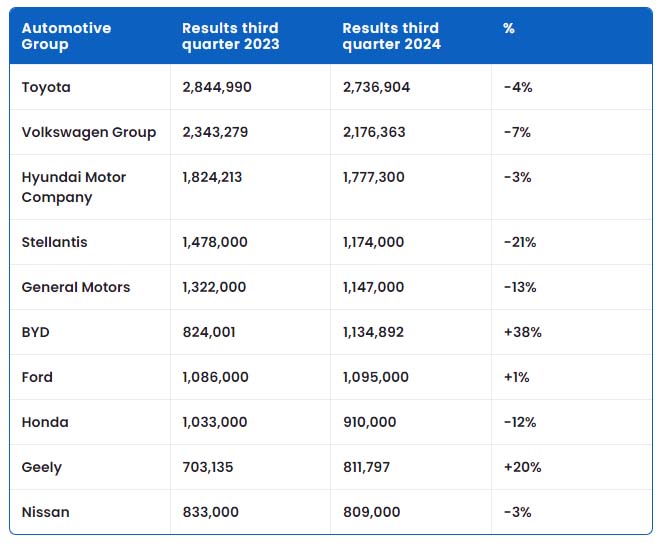
According to official data published by the world’s carmakers, Toyota remained at the top of the world rankings in the third quarter with 2.74 million units (a market share of almost 13%), but declined by 3.8% year-on-year in the third quarter of 2023, due to demand problems in China. The second, third, fourth and fifth places also remain occupied by the “usual” manufacturers. The Volkswagen group retained second place with 2.18 million units, down 7.1%. The Hyundai Motor Company (including Kia) remained third with 1.78 million units, down 2.6%. Both companies were affected by demand trends in China, where consumers continue to prefer local brands. Finally, the Top 5 is completed by Stellantis and General Motors, which both recorded double-digit declines. In particular, Stellantis recorded the biggest year-on-year decline among the world’s top 20 OEMs, as it faces significant demand problems in North America and Europe, its 2 main markets, and growing competition from Chinese brands in South America. In the third quarter of 2024, BYD occupied sixth place with 1.13 million units sold, representing impressive growth of 38%. The group continues to increase its market share at home and abroad thanks to its extensive product range, which includes all-electric and plug-in hybrid models. In terms of electric car volumes, BYD was only 19,500 units behind Tesla in the third quarter. In fact, BYD’s volumes in the third quarter were so high that they were very close to those recorded by Stellantis (1.17 million) and GM (1.15 million). The Chinese manufacturer was only 12.108 units behind GM and almost 40.000 units behind Ford. If it continues to perform well, it could overtake Honda, Ford and probably GM by the end of 2025. The other surprise was to see the Geely group (including Volvo and Polestar) in the Top 10. With 811,800 units sold, it was able to overtake Nissan and oust Suzuki from the ranking. Geely is making great strides with its latest Chinese brands, such as Zeekr, Lynk & Co and Geely Galaxy, and is also the only Chinese manufacturer present in the United States with its Volvo and Polestar brands. For the first time, carmakers of Chinese origin sold more cars than European manufacturers. According to the data, the former sold a total of 5.07 million units, an increase of 10%, while the latter saw their volumes fall by 11% to 4.99 million units. This means that the global market share of Chinese OEMs rose from 20.8% in the third quarter of 2023 to 23.6% the following year, in contrast to the loss of market share suffered by Japanese, European, American and Korean manufacturers. +++