
+++ There is now a date: 2025. Two new car factories will come into operation in Hungary next year: one by BYD and the other one by BMW. “Optimism for next year’s economic policy is supported by current developments, as the new plants will start production in the second half of next year”, Prime Minister Viktor Orbán, Gergely Gulyas said. Indeed, the Hungarian government expects the country’s economy to grow by 3.4 percent in 2025, driven also by the production of electric cars and batteries. An important estimate, given that the Hungarian economy entered a technical recession in the third quarter (-0.7 per cent compared to the previous 3 months). Let’s start with BYD, which began selling imported electric vehicles in Europe in 2022 and has opened 250 sales outlets in 19 European countries. The Chinese giant, which in record time (just 29 years since its founding) has climbed the global carmaker rankings, moved well ahead of its competitors by deciding to open a car factory in Europe as early as last year. Production on the Old Continent will help the company avoid a price increase, as BYD has to pay a 17 percent tax on the all-electric cars it exports to Europe from China, in addition to an existing 10 percent duty. The factory under construction in Seghedino could have a volume of 200.000 cars per year, both BEVs and PHEVs. And BYD is already thinking about a second European production site. BMW’s Debrecen factory will build its new generation of long-range, fast-charging battery electric cars on the Neue Klasse platform. Prime minister Viktor Orbán has also promoted the opening of Chinese battery production plants in Hungary. In the same city, CATL is building a huge £6.1 billion battery plant that will supply several manufacturers, including BMW and Mercedes. It will have a production capacity of 100 gigawatt-hours, enough to power more than 1 million cars. +++
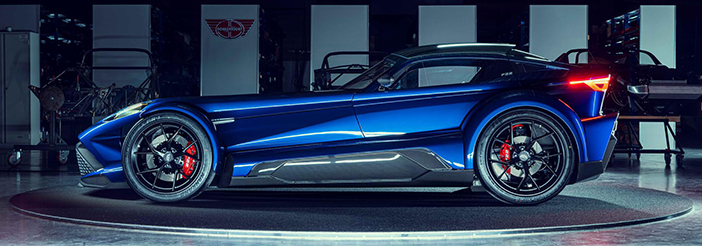
+++ We hear little about DONKERVOORT . The Dutch niche brand was founded in 1978 and has produced a replica of the Lotus Seven since its inception. In 2011, it launched the D8 GTO, a custom-built car based on Audi’s 2.5-litre 5-cylinder turbocharged engine. This engine transformed an already fast Donkervoort into a supercar that sprints from 0 to 100 kph in just 2.8 seconds, reaching a top speed of 270 kph. Initially, the D8 GTO delivered 375 hp of power and at the end of 2022, the F22 arrived with the same power unit and an output of 500 hp. While all F22 owners have finalised their specs, the last 5 Audi-powered Donkervoort cars appear on the scene. The F22 Final Five is a 2-seater butterfly-door coupe/roadster with removable carbon-fibre roof panels with reinforcement bars. It is 4.03 metres long, 1.91 metres wide, and 1.105 metres high, with a wheelbase of 2.42 metres. The boot offers 298 litres. Lighter than the F22 (it weighs 712 kg vs 750 kg), it has, as anticipated, even more captivating performance, held at bay by ultra-light carbo-ceramic disc brakes. The car will be the final Donkervoort with Audi’s 5-cylinder turbo engine. For its future products, the brand will source different engines. The Donkervoort F22, of which 75 were produced, cost €245.000, excluding taxes. The list price for the F22 Final Five starts at €315.000 (in European markets, including preparation costs, excluding taxes and running costs). All units have been sold, though. +++
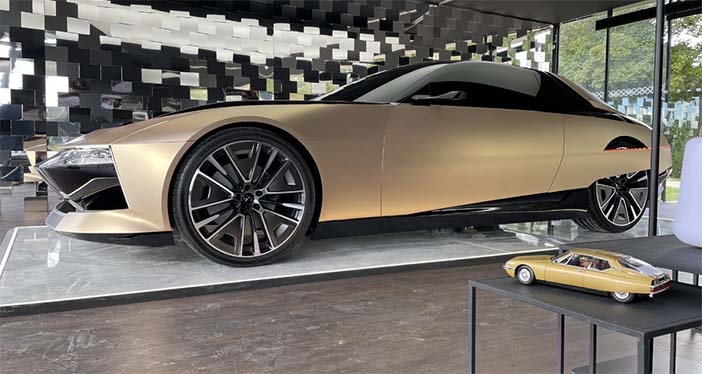
+++ DS is looking for ways to bring the fantastic SM Tribute coupé study into series production. Although the concept car, which was only shown in September, is very radical in its design language, existing series parts from another brand in the Stellantis Group were used for it. We are talking about Maserati. In this case, that fits like a glove, because the great role model, the Citroën SM (built between 1970 and 1975), did exactly the same thing. More than 50 years ago, it combined a Maserati platform and a 6-cylinder engine from the Trident with a French body and the trademark hydraulic chassis. Now, DS is looking for ways to bring the concept into small series production. This was revealed to TopGear by Thierry Metroz, head of design at the French car manufacturer. According to the report, the car could be produced in very small numbers by an external coachbuilder. The Maserati Granturismo would serve as the basis. The SM Tribute already uses the windscreen of the Italian GT. Metroz reveals that both Stellantis boss Carlos Tavares and DS boss Olivier Francois are behind the idea, provided that the car could make some money. This has long been a major issue in relation to the luxury brands of Stellantis. Maserati and DS, in particular, are regarded as money-burning machines and are under critical scrutiny within the group. Could projects such as a desirable, extremely high-priced SM small series with Maserati technology be a way to make these brands more profitable? The question is whether DS currently has the image to charge the right prices, even with an unquestionably beautiful car like this one. And we are talking about more than hefty asking prices here. When asked whether a possible production car would have an electric or combustion engine, Metroz said that you wouldn’t want an electric car if you were buying a car for a million euros. The power source would therefore probably be Maserati’s own Nettuno V6, a 3.0-litre biturbo with at least 530 hp. The original SM from the seventies was a front-wheel drive car, but for its revival, DS might rely on all-wheel drive. +++
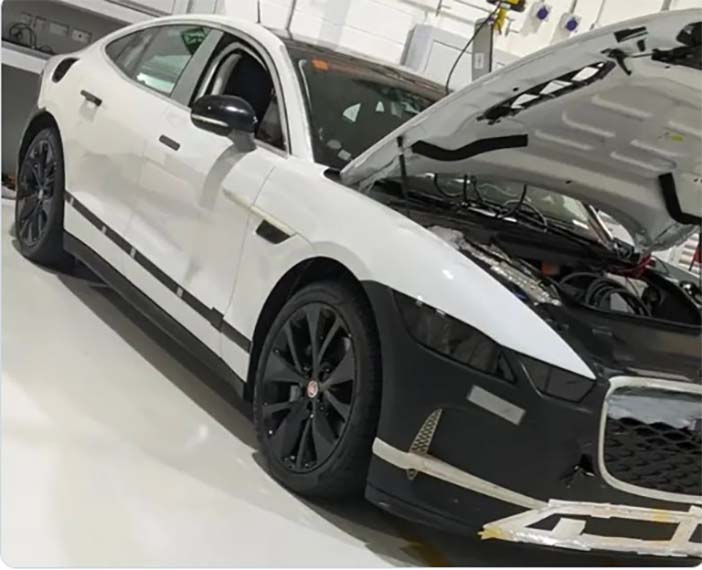
+++ Pictures have surfaced of an almost production-ready version of JAGUAR ’s electric XJ, the car that was tipped to lead the brand’s electric reinvention before it was scrapped in 2021. The electric XJ was first previewed by the brand in 2019 and was spotted several times road testing in the advanced stages of its development. But Jaguar called time on the model just two years later “following a thorough technology review against the exponential change in the automotive industry” because the car “does not fit with our vision for a reimaged Jaguar brand”. Jaguar never released official pictures of the car. The brand has since pushed back its previous 2025 target to go EV-only by a year, and the concept that will set the tone for its complete electric rebirth will be revealed in just a matter of weeks. Now, just as Jaguar gears up to unveil that brand-redefining concept, pictures of the scrapped XJ EV have been leaked, showing the model for the first time without camouflage. These images reveal the XJ EV would have taken heavy design inspiration, especially at the front of the car, from the Jaguar I-Pace (so far, the only EV the brand has launched) while retaining the XJ’s saloon body shape. This shape is similar to the electric GT; a car that will launch the brand’s transformation in 2026 and something that has previously been dubbed an indirect replacement for the axed XJ. Official pictures of the striking new 4-door in prototype guise were released last week and show that Jaguar’s €120.000 Porsche Taycan rival will be a complete departure from recognisable Jaguar styling hallmarks, with straight-edged proportions and a long bonnet. It is the first of 3 upcoming electric Jaguars due to arrive by the end of the decade atop a new brand-specific, EV-only platform called JEA. The other 2 cars are a large luxury saloon and an SUV. Before its new era begins, Jaguar has stopped producing the XE, XF and F-Type in Castle Bromwich, and production of the E-Pace and I-Pace will come to an end at Magna’s factory in Austria by the end of the year. Just the F-Pace will remain in production through 2025 for certain markets, but not for the United Kingdom. +++
+++ Previewed by concepts revealed last year, KGM (formerly known as SsangYong) is gearing up to launch fresh production models in 2025 that will be ‘powered by toughness’ and embody ‘our spirit through robust architecture’, according to the Korean brand. First up will be the all-electric 0100 truck.
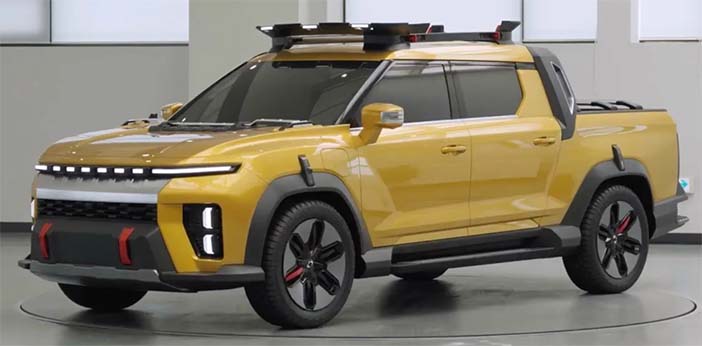
KGM says it will provide a mid-size pick-up ‘for urban drivers’. The 0100 will tackle the Maxus T90 EV and upcoming all-electric versions of Isuzu D-Max and Ford Ranger. The 0100 was initially revealed at the Seoul Motorshow in 2023, showcasing KGM’s new exterior design language. There’s a segmented lightbar at the front, body cladding to protect from rocks and undergrowth, some faux winch hooks, roof bars, beefy handles on the rear pillars and a ‘Torres’ script stamped on the bootlid. The reason for the ‘Torres’ insignia is because the 0100 shares the same underpinnings as the all-electric Torres EVX. The LFP ‘blade’ battery taken from Chinese giant BYD has a capacity of 73 kWh in the Torres EVX, which allows for 460 km of range. However, the pick-up will have an 80 kWh set-up, feasibly allowing for 500 km of range. KGM claims the truck will feature vehicle-to-load capacity, so owners can power electrical appliances or worksite tools.
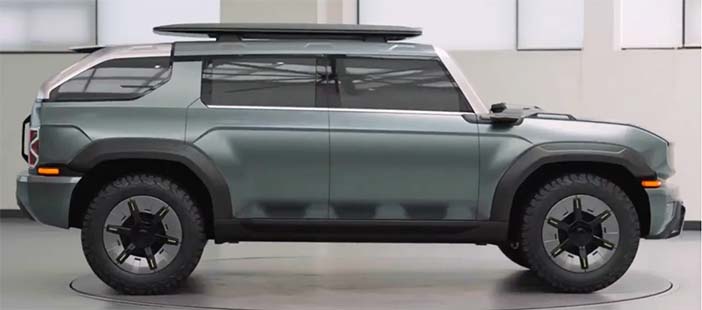
With a design that apes the second-generation Korando, the KR10 comes with traditional off-road SUV styling cues, such as plenty of wheelarch cladding, a boxy profile and even a faux spare wheel outline on the bootlid. KGM says it ‘inherits the heritage of the Korando’, which is especially prevalent at the front thanks to round LED headlights and an upright, five-slat grille. Technical details are yet to be confirmed for the KR10, but expect it to use an adaption of the Torres EVX battery and drivetrain.
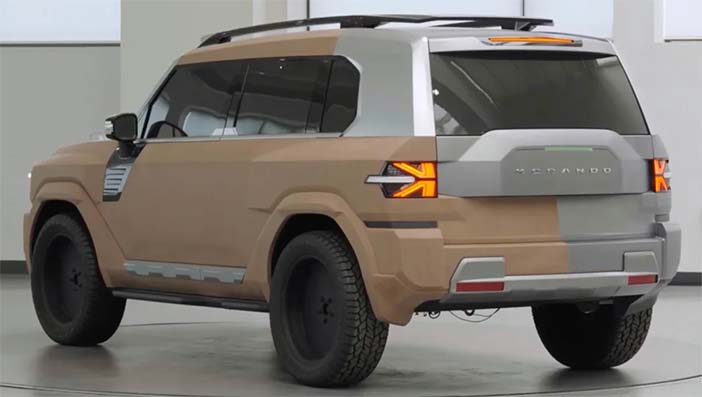
Something even more off-road focused is the F100 concept. This is ‘the most avant-garde’ of all of KGM’s 3 concepts and we suspect it’ll be pitched as an alternative to the upcoming Kia EV5 and Jeep Recon. Again, it’ll use a battery from BYD so it should be pretty competitive on range – despite having incredibly un-aerodynamic proportions. +++
+++ Tesla and Elon Musk have long promised a $25,000 electric vehicle, but that idea has now been largely abandoned, with the EV maker’s boss recently dismissing it as pointless. Now, LUCID boss Peter Rawlinson has (also) made it clear that his company isn’t interested in pursuing that price point either, though he still acknowledges there’s potential in the low-cost EV segment. Rawlinson explained the challenges of budget EVs, stating, “That market is notorious because you get into mass manufacture—terrible, low margins… To install the manufacturing base for millions of these units makes little sense to me”. But Rawlinson does see the opportunity for other brands to build a $25,000 EV and even do so while still benefiting Lucid. “This is where our licensing opportunity comes to play. As a tech company licensing out tech so that other OEs can benefit from that and they could put such a vehicle in place. They have a more installed manufacturing base”. No doubt, other OEMs have a larger production infrastructure when compared to Lucid. The fledgling EV company will sell fewer cars this year than supercar manufacturer Lamborghini, a far cry from the kind of figures it’ll need to do to be a long-term sustainable brand of its own merit. Offering its own tech through licensing deals could prove to be the solution for Lucid. But here’s the rub: not every manufacturer is going to rush to license Lucid’s technology. Many already have their own strategies in motion, particularly in the lower-cost EV segment. Ford, for instance, is reportedly fielding a Skunkworks-style team dedicated to developing a $25,000 electric car. Rivian, on the other hand, probably won’t be aiming that low in terms of cost but it appears poised to launch a $45,000 R2 platform and we still don’t know what kind of price the R3X will have. Either way, it appears that more affordable EVs are coming, we only have to wait and see if anyone will use Lucid tech to hit the market. +++
+++ STELLANTIS is “on track” to launch its first STLA Small-based car in 2026, with the platform to underpin vehicles made specifically for the European market, boss Carlos Tavares has confirmed. The platform itself will be unveiled between late 2025 and early 2026, he told reporters. It will be crucial in underpinning the group’s next generation of small cars ranging from the A-segment to the C-segment, with power drawn from either hybrid or electric set-ups. For EVs, it will be offered with batteries of between 37 kWh and 82 kWh capacity. It will also allow for a range of motors and power outputs, starting from around 95 hp. Figures released by Stellantis suggest that the platform can be used for cars as small as 3,600 mm long and 1.700 mm wide. It will replace the CMP/e-CMP platform used today by cars including the Peugeot 208, Peugeot 2008, Opel Corsa, Opel Mokka and more. It has yet to be confirmed which model will be the first to sit on that new platform, but Tavares told that the scheduled production date of 2026 remains “on track”. “I believe that we will be presenting this STLA Small platform, most probably in late 2025 or early 2026 depending on the first application vehicle, which is now in the preparation phase,” he said. “And as you see from the first three, we are on track, and we are delivering those platforms at the appropriate timing, which is connected to the date at which we make the first applications”. He added: “Of course, when we’ll come to STLA Small, we’ll talk about the compact cars, most of them aiming at the European market, as you may imagine. STLA Small will be the final next-generation platform unveiled by the automotive giant, sitting above Smart Car (which underpins the new Citroën C3) and below STLA Medium (Peugeot 3008), STLA Large (upcoming Jeep Wagoneer S) and STLA Frame, the latter unveiled today primarily for the US market. +++