
+++ BYD was the 6th-largest automaker in the third quarter of this year, selling more new vehicles than Ford for the first time in its history. It may even end the year having sold over 4 million vehicles and could overtake Ford for the entire 2024. During the July-September period, BYD sold 1.13 million vehicles, representing a 38% increase from the same period last year and making it the most successful quarter ever for the brand. Ford sold approximately 40.000 fewer vehicles over the same period, slipping from the 6th-largest car manufacturer to 7th. Ford was holding on to a narrow lead for the January-September period, having delivered 3.3 million vehicles globally, slightly ahead of the 3.25 billion shipped by BYD. BYD is not the only Chinese company giving traditional legacy automakers something to worry about. Sales at Geely jumped 14% through the third quarter after it delivered 820.000 vehicles. That placed it ahead of Nissan and behind Honda in 9th position. China’s third-largest car manufacturer, Chery, also rose to 12th in the ranking, reporting a 27% rise in sales to 550.000 units. Sales of many brands from Japan, Europe and the US fell last quarter. For example, Toyota’s sales dropped 4% to 2.73 million, although it still holds a commanding lead over the VW Group which reported a 7% decline in sales to 2.17 million cars. The Hyundai Motor Group retained its position in third, but its sales also fell, down 3% to 1.77 million units. Things were even worse at Stellantis as its sales plummeted by 20% to 1.14 million. A surge in sales for brands like BYD is boosting their financials, too. During the third quarter, the carmaker posted revenues of 201 billion yuan, the equivalent of $27.6 billion, higher than Tesla at $25.2 billion. +++
+++ Forget the furore. Remove from your mind, if you can, the past 2 weeks’ noise about Living Vivid and Breaking Moulds. Concentrate instead on the JAGUAR TYPE 00 (Zero Zero), the long-promised concept coupé that introduces an entirely new design style to the 90-year-old marque and sets the tone for its all-EV range that will hit showrooms from 2026.
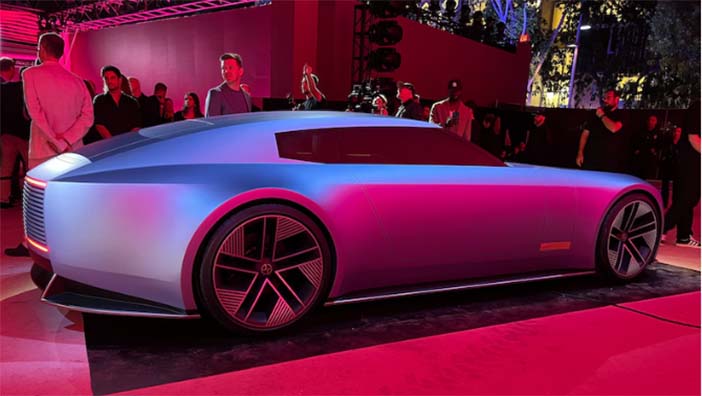
The concept car is a 2-door fixed-head coupé, a body type we’re told will not be built. But it has perhaps been artfully chosen because it loosely echoes the layout of the 1961 Jaguar E-Type, the car nearly everyone cites as the leader of a previous great leap forward in Jaguar design. Company insiders say the concept coupé’s size, proportions and, above all, its design style are all “very close” to the brand’s first next-generation production car: a blocky Porsche Taycan-rivalling super-GT that was pictured testing earlier this month. This will be the first of 3 models to be launched within about a year between them on the new purpose-designed JEA architecture. That platform will, Jaguar estimates, offer as much as 700 km of range and the ability to add 320 km with 15 minutes of charge. This would suggest power being drawn from a battery in excess of 100 kWh, but Jaguar has yet to confirm a pack size. This concept, revealed at the Miami Art Week, is the product of an exhaustive process that led designers to produce 13 full-size models on the way, and its maturity shows. All were avant-garde, according to design chief Gerry McGovern. “Anything iterative would not have taken us where we wanted to go”, he said. Its name, which reprises the word ‘Type’ used for so many great Jaguars, also suggests that future nomenclature won’t stray too far from the past. Although the Type 00 is a 2-door car with forward-hinged dihedral doors and built on a shorter-than-production wheelbase, it tells us plenty about the forthcoming saloon. We already know this is a low, lithe car in the old Jaguar mould, with a raked roof, a long wheelbase and a uniquely long bonnet. It’s also one of a new wave of cars that ditches a heavy and fundamentally useless rear window and uses twin side cameras, and a digital rear-view mirror like that offered in its Defender cousin. The Type 00’s shape is defined by long, confident lines that spell out beautiful, opulent proportions, according to its maker. The modernist surfaces are starkly simple, almost flat in places, but they incorporate sleek compound curves where needed. The overall effect is boldness, a key aim of the designers, yet the surfacing and sparse details carry impressions of sophistication and restraint, as befits a Jaguar selling in the €140.000 bracket, more than twice the price of an outgoing-generation Jaguar. The glasshouse stresses the theme of lowness. The Type 00 has a fairly high waist and a flattish roof with a ‘fast’ rear panel (without window) that gives it almost a chop-top look. In that one way, it faintly resembles one previous Jaguar: the XJS. The car has a bluff front with no ‘proper’ grille, using Jaguar’s new 16-bar Strike Through design device as frontal embellishment. The same device is used again atop the long bonnet and it even flows through the raked windscreen to become a fascia-topped feature. The massive 23 inch alloys also use the same multi-line Strike Through as part of their own design. Inside, it is a stunning, cream-coloured compartment for two that shuns leather in favour of modern, sustainable textiles such as Kvadrat (already popular in production Defenders and Range Rovers). It features a pair of elegantly designed bucket seats, constructed in a way that avoids visible stitching (as in the Defender Octa). There’s also a surface called Travertine Stone on the centre console (a genuine stone veneer) and a brass spine runs along the length of the cabin. The concept’s controls and instruments are comprehensive, rethought but minimised in what has become a very JLR way. “Just as on the outside, deployable technologies are a hallmark of the interior”, said interior design chief Tom Holden. This is shown by 2 rearview screens (“that glide silently and theatrically”), which save the Type 00 from having untidy exterior rear-vision mirrors. The door releases are in the roof console next to a long panoramic roof. And instead of choosing your driving mode from a switch, you drop a brass token into a slot in the centre console. Some of it is beautiful, some features are gimmicky and, unlike with the exterior, it’s far from clear how influential the Type 00’s cabin will be on the 2026 production car. Overwhelmingly, the Type 00 fulfils its mission to be “a copy of nothing”, to employ once again that grievously overused quote from Jaguar founder Sir William Lyons. It also brings a new logic to the much-discussed rebranding elements: the Device Mark, the Strike Through, the Maker’s Mark (the new ‘leaper’ and simpler ‘JR’ medallion). The new ‘jaGuar’ script looks okay on the car, despite its middle capital letter, and the Strike Through provides interesting detail for the car’s frontal surface (where traditionally a grille would be) while also giving the rear body panel an unmistakable ‘new Jaguar’ identity. The new brass leaper provides detail on each of the car’s front flanks and the ‘JR’ medallions are used as wheel centres. It all comes together far better than many critics might have imagined a few weeks ago. In most ways, the Type 00’s design collides head on with the proportions of the outgoing I-Pace, Jaguar’s first full EV that was launched only 6 years ago and whose creators took pains to emphasise their car’s forward-control layout (and consequent short nose) and to brand it an SUV. This allowed it a sleek but high-riding shape with plenty of space for the battery below the cabin floor. We have yet to discover how the new-generation Jaguars will accommodate their batteries while retaining their low-slung stance. The lowness of the Type 00 and the similarly low-riding production models to come promise a relatively small frontal area (despite a very upright, bluff front) as a way of delivering decent aerodynamic performance. But good aero is not the only priority, it seems. Jaguar managing director Rawdon Glover said it was a key objective from the project’s earliest days to resist (for concept and production models) the arch-conventional, somewhat hackneyed use of high-riding, forward-control shapes that had “spent too long in the wind tunnel” and been adopted by many current EVs as a way of delivering Jaguar’s avowed “fearless creativity” of design. Though everyone at JLR takes pains to credit the whole 600-strong JLR design group for work on this project, the influence of McGovern, JLR’s chief creative officer whose success with highly profitable Range Rover models has underpinned the 4-year-old Reimagine plan, is clear. The idea to “think Range Rover” at Jaguar has driven the adoption of its reductive, modernist approach to the new cars. While promoting something “very different”, McGovern sympathises with the plight of his design predecessors at Jaguar, pointing out that the company’s product objectives 10 years ago simply wouldn’t have allowed this bold approach. “Back then, the company thought very differently”, he said, “and was aiming at very different competitors”. The target was to grab sales from BMW and Audi with good but mainstream premium models like the XE and XF saloons and the E-Pace and F-Pace SUVs. In the past months, all of those cars, as well as the I-Pace have been ditched. Understandably, none of Jaguar’s bigwigs wants to get into a discussion about the size of the risk they’re taking with Jaguar, though most admit there is one. JLR CEO Adrian Mardell takes a determined tone by insisting that “there will be no success for JLR without Jaguar”. That’s probably just in case any of us thought JLR people could have a happier life at Gaydon by shutting Jaguar, selling the name to a Chinese company and concentrating on making super-successful Range Rovers for a living. While the reinvention risks alienating some of Jaguar’s traditional customers, the firm seems determined it will win over a new clientele of car lovers with €140.000 to spend. With its completely new products, this Gaydon team wants to live up to Enzo Ferrari’s age-old quote about their predecessors’ E-Type being the most beautiful car in the world. Glover, who has spent a year telling people how excited he is by the size of the challenge ahead, cites copious research to back his view of the people who will buy a new-generation Jaguar. “First and foremost”, he said, “they’ll be independently minded. They’ll have an appreciation of design and will be looking for exclusivity. We expect them to be young and wealthy, connected and more likely to live urban lives. They’ll be cash rich and time poor, so every aspect of their journey with us will need to be effortless”. In the light of today’s EV slowdown, does he have fears for Jaguar’s acceptance? Not really, it seems. It’s all a matter of timing. Jaguar is talking about models that will be in their prime in 2030, he explains, not 2024. “Besides, our product will be game-changing”, he said. “Up to 700 km of range, and in excess of 320 km of charge possible in 15 minutes. That makes it fundamentally different from what’s on the market today”. Jaguar’s next-generation line-up will be spearheaded by a Porsche Taycan-rivalling super-GT, the design of which has been clearly previewed by the Type 00 concept. Arriving in 2026 as the first all-new Jaguar since 2018’s I-Pace, the EV was shown in official testing images released last month to bear a striking resemblance to the concept, especially its long bonnet, low nose and square proportions. Differences with the production car come in the form of an extra set of doors and rear seats. Although the GT’s back end has yet to be seen, the concept’s lack of a rear window indicates this will make it into production. This striking 4-door GT is the first of three upcoming electric cars due to arrive by the end of the decade atop a new brand-specific, EV-only platform called JEA. The other two are thought to be a Bentley Bentayga-style SUV and a luxury saloon to rival the Mercedes S-Class. +++
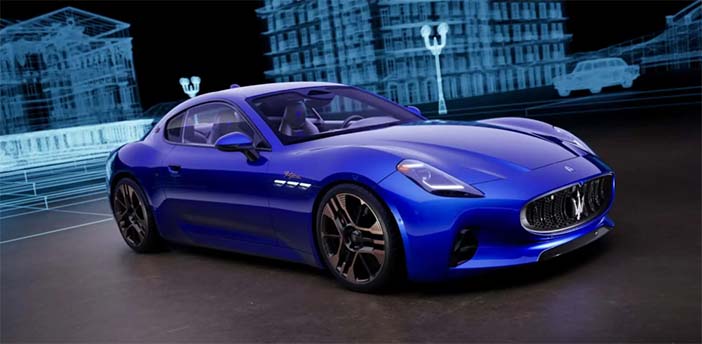
+++ 2024 is the year of MASERATI ’s 110th anniversary celebrations. It is a very important anniversary in the automotive world, which the company has chosen to celebrate with a special series of GranTurismo. Called the 110th Anniversary, it is based on the Folgore version and is available in 110 customisable examples in two opposing colour combinations. To create the special 110th Anniversary version of the GranTurismo, the Modenese engineers started from the Folgore version which, in 2 configurations of 55 examples each, has been enriched with two special body colours, Rame Folgore and Blu Inchiostro, combined with dedicated finishes, special wheels with “black and copper” details and, respectively, interiors in Econyl denim or black with copper or blue stitching. But that’s not all. For the special edition model, the House of the Trident has also created a new celebratory logo, which sees the Trident followed by the numerals “110”, with special slanted lettering, positioned on the car’s C-pillar. The new GranTurismo 110 Anniversario will be presented to the Modenese Trident’s most affluent clients during the Trident Experience, a 2-day event organised by the company to celebrate the important anniversary together with its most passionate guests and clients. The company has not yet released the prices of each of the 110 examples of the special GranTurismo. What is certain, however, is that to get one you will have to hurry. +++
+++ After a brutal six months, NISSAN is edging towards a financial precipice of the type that prompted its 1999 rescue by Renault. The Japanese firm is reportedly scouting for an investment partner to bolster it financially. Honda has been named by a source speaking to the Financial Times as a possible buyer for shares being sold by Renault. Nissan has hit the financial skids during a 6 months in which it was forced to offer substantial discounts to move metal in its key markets of the US and China. As a result, times are extremely tough at Nissan these days. CEO Makoto Uchida recently declared that the company is in “emergency mode”. Sharing the stage with him during that very announcement was CFO Stephen Ma. Now, it seems like Ma is about to leave the brand or, at the very least, step down from his role. For context, a little less than 2 years ago, Ashwani Gupta stepped down from his position as Nissan’s chief operating officer. As part of this “emergency mode”, Uchida outlined a series of painful cost-cutting measures aimed at keeping the automaker afloat. Around 9.000 employees will lose their jobs, while executives, including Uchida himself, have agreed to voluntary pay cuts. Adding to the turmoil, Nissan has announced it will slash U.S. production by 17%. That move comes as the brand sees a huge drop in production worldwide. According to Nissan’s own data, production is down everywhere except in Mexico, where the automaker has managed to maintain growth. Despite that bright spot, global sales remain flat, offering little relief to the struggling automaker. Will Nissan be able to turn the ship around in 2025? It’ll need to, according to 1 unnamed source who told that Nissan had 12 to 14 months to survive; an ominous deadline looming over the company’s efforts. To survive, among other things, Nissan needs to catch as much of the hybrid wave as it still can in the USA, where it has lagged behind competitors in electrification. But reducing production to save costs could further limit its ability to meet market demand, creating yet another challenge for the automaker. If Ma does step down, the person to fill his shoes will no doubt have a gargantuan task ahead of them in navigating Nissan’s financial recovery. With the clock ticking and drastic measures underway, the coming months will be pivotal for Nissan’s future. Whether the automaker can right the ship or sink under mounting pressures remains to be seen. +++
+++ The new-generation electric PORSCHE 718 Boxster and Cayman will feature motorsport-honed braking and handling to ensure they offer a “real sports car feeling”, according to the firm’s technical chief. The new 2-seaters will be built alongside the existing combustion engined versions at Porsche’s Zuffenhausen factory and were due to be launched in 2025. But with Porsche recently pushing back its electrification plans, reports claimed the electric 718 Boxster and Cayman could be delayed and the life cycle of their ICE siblings extended. However, prototypes of the Boxster Electric drop-top and Cayman Electric coupé have been spied testing regularly in recent months, suggesting they are on track for a debut next year. These test mules show how close the pair will be to the existing combustion versions in their size, styling and philosophy; even though they will be based on a new bespoke electric sports car platform. That architecture, first hinted at with the Mission R concept in 2021, will be designed around a battery ‘core’: instead of siting the batteries under the floor as in most EVs, they will be mounted in a pack located behind the driver, in a similar position to the combustion engine in the existing 718 models. A requisite of that design is to minimise the size of the battery to optimise the packaging benefits, which in turn puts a key focus on efficiency and energy regeneration. In a wide-ranging exclusive interview, Porsche R&D chief Michael Steiner detailed how learnings from the company’s title-winning Formula E programme will directly influence the forthcoming 718 Boxster and Cayman EVs. Highlighting that “motorsport has always been within our brand core”, Steiner said the key to its success in Formula E has been that it is “an efficiency formula”. This is because Formula E teams have the freedom to develop their own powertrains but are required to use spec batteries, which puts an emphasis on making the most use of that power. “Importantly, on-the-road e-mobility is also an efficiency formula, because when you save on energy, you can win in weight, win in range or win in material cost”, said Steiner. “There’s a wide variety of things we can do with better efficiency”. Crucially, Steiner noted that efficiency isn’t just related to the design of the motor but also puts a focus on software and braking, and in the case of the latter, merging the regeneration systems with the traditional brakes. Unlike some rivals, Porsche’s existing electric models such as the Taycan and Macan Electric offer only limited regeneration control and Steiner said: “Our strategy is not one pedal drive”. He added: “ If you ask any race driver, none would choose a one-pedal system because you should have control of recuperation and braking on the same pedal as seamlessly as possible. In cornering, if you don’t have the right feeling on the pedal, you don’t have trust in the stability of the car. You don’t see it by watching the cars, but if you ask drivers, you feel the difference on the brake pedal”. Steiner said this brake feel (a key element of Porsche’s trademark handling) is “what makes a car superior”. He said: “Fast straight-line acceleration could be done by more or less anybody. But the brake pedal, the feel on the brakes and good handling in corners, that’s something we’ve learned in Formula E. We still see room for improvement on the road, including with efficiency”. Steiner added that the emphasis on integrated braking is about “physics” because it is always more efficient to use the car ’s kinetic energy to slow it , with the aim of avoiding the use of the brake discs as much as possible. He said: “With a one-pedal system, you sometimes start to regenerate earlier than you should do, so you’re already decelerating when the brake discs kick in , so as a driver, you have no influence at all”. By contrast, “if you have all the braking on the brake pedal, then you as the driver can do the modulation you need and also feel the reaction of the Tarmac, steering and things like that”, he said. “So you can control the car with the brakes as well as the throttle and, in our view, this is superior to a system that does something you can’t control”. While the 718 twins will feature integrated regen and braking systems, there will be a focus, as in Formula E, on maximising the amount of energy recaptured to optimise efficiency. That, in turn, will allow the cars to be fitted with smaller batteries, aiding packaging and reducing the cost and, most crucially, weight. That ties in with Porsche’s e-core platform, which features the battery behind the seats. Steiner said: “ It’s putting the centre of gravity as close to the driver as possible so the car around them is really flexible and agile. Then you can really handle and control the car nicely and it’s really well balanced. “You sit close to the road, so it’s a huge advantage over [a platform where]you sit on top of the battery. It ’s a real sports car feeling”. Steiner said he has driven a prototype Boxster EV and “it’s really great” in 2 specific respects. The first is that “you are close to the centre of gravity of the car, so the handling is great”. The second is the experience of driving an electric drop-top. “Driving with the roof down in a quiet way (it’s not silent, but there’s no engine noise) through the landscape, hearing and smelling everything, is a new experience”, he said. “In addition to the experience of electric driving, it ’s something new just to drive with the roof down”. Asked if someone would recognise the lineage from a combustion Boxster to the EV, Steiner said: “Even with the best technology you could have in an ICE, the electric car will be faster. The big disadvantage is weight, but we’ve done a lot to keep that in control. Weight-wise, you should not expect a package with weight in the area of a four-door car: we’re significantly better. This car, with really sharp steering and good braking, will be a package worth waiting for”. +++
+++ VOLKSWAGEN ’s workers across 9 vehicle and parts plants Germany have decided to go out on warning strikes starting Monday, as tensions rise between unions and the German car manufacturer that’s planning to close plants, cut wages, and initiate large layoffs. The strikes come amid escalating tensions between labour unions and the automaker, which is reportedly planning to shut down facilities, reduce wages, and implement significant layoffs. These warning strikes typically last from a few hours and come after the IG Metall union was unable to reach an agreement with VW on cost cuts. In late November, the union proposed €1.5 billion in cost savings, which would include forgoing bonuses for 2025 and 2026. It also proposed using money from wage increases to create a fund that would finance temporarily reduced working hours for parts of the business facing overcapacity issues. “The Group’s finances are not yet in the red, like they were in crises in the 1970s and 1990s”, union chief negotiator Thorsten Gröger said. “We can see room to take action and make investments to correct the expensive mistakes of the past”. He also warned that, if they can’t come to an agreement, “this will be the toughest wage dispute Volkswagen has ever seen”. In response to the union’s proposal, VW said that “although there may also be positive effects in the short term, the measures will not lead to any sustainable financial relief for the company in the coming years”. A VW source added these measures would simply buy the company time which it doesn’t have. VW is seeking 10% wage cuts across the board, believing this will allow it to significantly cut costs and boost profitability, helping it to better rival cheaper competition from China. It’s also possible that factories in Germany could be closed for the first time in VW’s history. A drop in demand across Europe and China, as well as poor management decisions and high costs, are among the factors that have led to VW’s woes. The company does not expect pre-pandemic demand to return, meaning it now has excess production capacity. Representatives from IG Metall and VW are scheduled to meet on December 9 for the next round of negotiations. If a deal isn’t reached, 24-hour strikes could be initiated, or the union may decide to trigger “unlimited strikes” that could last longer. In an interview with Bild last month, VW Group CEO Oliver Blume was very honest about the tense situation at the Wolfsburg-based car manufacturer. He blamed “decades of structural problems” for the lack of competitiveness, including high labour costs as one of the main reasons. Mass redundancies, salary cuts, and plant closures are intended to help get the figures back on track, but VW apparently also sees potential for optimisation in other areas. Head of Development Kai Grünitz has a plan how the company can cut costs. This includes shortening the development time for new models to just 30 to 36 months. And for new vehicles that utilise an existing platform, it should be even quicker. If VW were to stick to the previous modus operandi, which envisaged four to five years for the development of a new car before market launch, the model would already be obsolete by the time it rolled into the dealership, according to Grünitz. Development is also to be accelerated by carrying out fewer road tests on real roads. Volkswagen has already reduced the number of prototypes built by 40 percent by 2024. Now you may (justifiably) be concerned that the quality of the vehicles could suffer massively as a result of this measure, but this is not the case, emphasises Grünitz. More virtual tests and test bench runs are being carried out to compensate for the reduction in physical tests. “We can now go through the entire development chain with a digital prototype. This shortens the development process and reduces costs without sacrificing test depth”. Another point: Volkswagen wants to avoid cramming more and more functions into its cars that the customer doesn’t even notice in the end, let alone use. Grünitz explains that priorities have changed here, in favour of features that bring real benefits instead of functions that are simply there for the sake of being there. However, the head of development did not say exactly which functions these are. The aim is to listen to what the customer really wants instead of simply throwing things at the wall and then seeing what sticks. VW has already cancelled plans to build a new plant in which it should be possible to produce a car in just 10 hours. Nevertheless, a new goal is to “radically shorten” production times in existing plants by installing new and more advanced tools. Closer cooperation with suppliers should also increase efficiency. Will these measures save thousands of jobs and avoid plant closures? It is still too early to say. But VW employees have reasons to worry. The industrial union is gathering pace this week with strikes at all German plants. The car manufacturer’s management has indicated that it will have to close three plants and cut salaries by ten per cent in order to maintain competitiveness amid stagnating sales figures, which are partly due to the Chinese electric car offensive. +++