
+++ ASTON MARTIN will rapidly expand its hybrid line-up and increase the number of model variants it offers in the coming years, according to new boss Adrian Hallmark, and it will launch its first electric vehicle before the end of this decade. Former Bentley boss Hallmark took over as CEO of the sports car firm in September last year and has been working on a revised strategy for the coming decade. Hallmark said he had been tempted into joining Aston Martin because it was “an amazing brand” with “great potential, great shareholders and investment for the future, and a product portfolio we have never had before and couldn’t have dreamed of”. The dramatic growth in the number of luxury car buyers in recent years has expanded Aston’s market potential, he said, and the key to its future success is that “the plan has got to be boring and stable. You can create the excitement around you, but you don’t create excitement by ripping the plan up every five minutes”. Hallmark had been in his previous role at Bentley since 2018, and said he “loved” working for the company. But he added: “This opportunity came alone, and the chance to be the first person in 112 years to make it sustainably profitable, when I believe there is a way to do so, was irresistible”. Speaking to a select group of reporters, Hallmark said he is confident he can achieve that target “because we’ve got the playbook, not just from Bentley but all the luxury players that are out there. “In the last 10 to 15 years, the market has totally changed, and so have the prospects for luxury car markers. If you go back 10 or 20 years, the number of people that would buy products in our price bracket was a fraction of that it is today. Both the number and average wealth of luxury buyers has increased fourfold, so the market for luxury has exponentially increased, and the opportunities for companies like Aston Martin have matched that”. Hallmark said he was also attracted to Aston Martin by the investment made in the firm since it was taken over by a consortium led by Lawrence Stroll 4 years ago. He added: “There’s no way in my old world, with any of the brands I’ve worked directly or indirectly for in the last 25 years, they would have tried a product offensive like Aston Martin did over the last 18 months with the launch of the DB12, Vantage, Vanquish, Valkyrie, Valhalla and several specials. It almost worked, but not every car was perfect day one, and there’s been delays, but the ambition and the spend is all genuine. It’s not any difficulties we’ve had, and not because of lack of money. This is a genuine endeavour and the commitment to make a high-potential company a high-performance one is there”. Previous Aston management touted plans to use plug-in hybrid powertrains as a ‘transitional’ technology on the firm’s path to electrification. The forthcoming mid-engined Valhalla will be Aston’s first plug-in hybrid model, but the firm has a partnership to use PHEV technology developed by Mercedes-AMG for other models. Hallmark said the electrification pathway is “not as clear-cut as 3 years ago, but the general direction is absolutely towards electrification. Our commitment is towards carbon-neutral or net zero. But to get there we will double down and add incremental products in the hybrid space before we get to full electric”. Nevertheless, Hallmark insisted Aston’s first EV will arrive “in this decade, but we’ll add hybrid derivatives as well, through to 2035”. Previous management had set a date of 2027 for the first EV but Hallmark said he had questioned that even before starting his role and he refused to be drawn on a specific date. He added that “we have all the prerequisites defined, and some of them developed” for the first EV models. Aston Martin has a deal to use US EV firm Lucid’s electric motor, battery control systems and inverters for its EVs. Asked whether the first EV will be a new model or a variant of an existing one, Hallmark said: “For a company of our size, you have to either replace an existing nameplate and take the brave pill, or create the niche and do an incremental model as the first one. We haven’t fully decided. The original plan was to go with an incremental model, but we’re looking to other options”. The approach is about being “flexible” over the next 10 years, said Hallmark, adding: “The key message will be to be flexible and have multiple options that fit with legislative and customer requirements over that period”. Hallmark said he expects combustion models “with some form of electrification” to account for the bulk of sales until 2030, with the firm eventually becoming “full electric some time between 2035 and 2040”. He said: “We’re not resisting. We’re just taking account of legislation and trying to manage through a period of high risk for a small company. We can’t afford to do engines, hybrids and electric cars and just see which ones work and then turn off the factories of the others”. Hallmark joined Aston shortly after one of the biggest product offensives in its history, including the new DB12, Vantage and Vanquish, along with the Valkyrie hypercar. Hallmark said he had “never seen as much ambition in 18 months”. He acknowledged that the rollout of those models hadn’t been as smooth as anticipated due to that compressed cycle and he hinted that, EV aside, further new model lines won’t arrive until after 2030. Instead, the focus will be on maximising the potential of the brand’s existing models. Hallmark said Aston Martin’s limited provision of model variants means it risks existing buyers going elsewhere. He cited the example of Porsche, which offers numerous variants of the Vantage-rivalling 911. “At the moment, customers buy a Vantage, DB12 or DBX and keep it for 2 years or so, which is the average ownership cycle in the luxury segment”, said Hallmark. “So in 2 years’ time, there’s got to be a reason to buy a better Vantage, and then 2 years after that an even better Vantage. We’ve never had the intensity of life-cycle innovation that we need, and if our competition are doing it and we’re not, we’ll never be as successful as we could”. This approach will include substantially expanding the list of high-end options, after Aston found that some rivals were offering close to 200 more options and extras than it was. While he said not all those were relevant to a performance brand, he said Aston had identified around 100 options that could be added to its range (“titanium exhaust, carbon wheels, high-end audio and so on”) to add further value. Hallmark said: “If we can add those and have normal levels of uptake, the per-year improvement in our bottom line, and more importantly the fit in meeting customer needs, is massive”. As part of its luxury push to rival Ferrari, Aston Martin has moved into the mid-engined supercar sphere in recent years, with the Adrian Newey-designed Valkyrie and the upcoming Valhalla. Newey now works for Aston’s F1 team, and while Hallmark didn’t rule out an eventual Valkyrie successor, he said developing that sort of boundary-pushing model is “a once in a seven- or 10-year cycle” project. He added: “Not many car companies can afford, financially or emotionally, to do a car that is so far ahead of themselves and everybody else every year. It would kill you”. He was non-committal on a Valhalla successor, suggesting its platform can’t be used for a lower-priced version. “If I look at the second half of this 10-year period, this is all about the acceleration of the launch of BEVs and the redefinition of the core portfolio”, he said. “There’s no question that if we want to be a high-performance sports car brand as well as what would be in the past, then mid-engine is attractive. Valhalla is too sophisticated a platform in totality to make an affordable mid-engine car, so it would mean a completely new platform, and we haven’t defined that yet. It’s not off the cards, but it’s not defined”. Hallmark also cited the profitability of ultra-limited-run specials in the luxury market and said both the Valhalla and front-engined Vanquish will be used “as the basis to do a couple of specials”, but he added: “We’re not going to go specials crazy in terms of overdoing it, because there is a finite market for these cars as well”. He hinted that those specials will “not just have a different roof” from their base car, but will be “a completely different concept, but using the core technologies from those two”. Hallmark is confident the DBX will eventually succeed, despite lower than expected sales so far. He compared it to Bentley’s struggles with the Bentayga in the first few years after its launch and said there is still work to do on raising awareness of the model. “In 2018 the Bentayga was seen as a failure that was selling 3.500 to 4.000 cars per year, but there was a little facelift and a lot of communication and it was selling nearly 8.000 in 2023”, said Hallmark. “Not everybody knows we’ve got a DBX. If you go to America and look at the awareness of the brand and then the products, only around 40% of luxury buyers know we even do an SUV. We launched the DBX during Covid, and we’ve got a problem in that it was launched in a strange way. We had a position for the car we’ve subsequently changed, and we changed the pricing as well. But I fundamentally believe that if 52% of the luxury segment is SUV, then we need an SUV. The DBX hasn’t done everything it needs to do yet. Watch this space in the next 3 years. We’re going to attack through the life cycle, and give people reasons to come back or come to us. We want to keep the strength we have with 2-door cars and boost the exotic nature of the Valhalla. We will keep that sports car, supercar, hypercar story moving nicely, but we can and will make the SUV work because it’s a brilliant car”. Late last year, Hallmark scaled back Aston Martin’s planned 2024 production output by 1.000 units to around 6.000 units and it lags behind rivals, such as Ferrari, that produce closer to 13.000 cars annually. Asked about Aston’s goals, Hallmark said: “Look at the Luca di Montezemolo period at Ferrari: there was this repeated rule they would never go above 7.000 cars, and look how much money they made on 7.000 cars. We’ve never made that much money, and I’m not saying our limit is 7.000 cars, but we don’t need 13.000 cars to be a great company. What we need is the right margins, the right volume of cars and the right cost base. What you’ll see in the next period is volume, no question, but you’ll also see us addressing the productivity and cost structure of the company”. +++
+++ FORD has said it is developing range-extender EVs to make electrified motoring more affordable in larger segments, having suffered a global dip in EV sales last year. CEO Jim Farley confirmed that the company is developing both SUV and pick-up platforms designed for range-extender EVs (RExs), without giving a date for launch. REx vehicles differ from plug-in hybrids in that the combustion engine is not connected to the wheels but is linked to a generator that drives the electric motor or recharges the battery. Farley referenced interviews with owners of RExs built by Li Auto, which has carved out a substantial market in the premium SUV arena in China based on the technology. “We were really impressed that the customers thought of these vehicles as EVs”, Farley said on the company’s earnings call. “They do not think of them as hybrids or plug-in hybrids. They use 95% of the kilometres as electric and they plug them in every night”. Sales of Ford’s EVs fell 9% globally in 2024 to 105.000 units despite the launch of the Explorer and Capri in Europe last year, company figures show. Meanwhile, revenue generated by Ford’s Model E division, which is responsible for EVs, fell 35% because it was forced offer discounts, especially for the Mustang Mach-E and the F-150 Lightning pick-up in the US market. Model E lost $5.08 billion last year as it spent more than it earned developing new models. Farley admitted that retail customers of larger vehicles in the US were still reluctant to go electric, even before the election of EV-sceptic Donald Trump as president. “The economics are unresolvable”, Farley said. “These vehicles have worse aerodynamics and they’re very heavy, which means very large and expensive batteries”. A shift to RExs in these segments would help drive down prices, Farley argued. “For the customer, you’re able to buy an electric vehicle that’s fully comparable to an ICE vehicle in terms of cost”, he said. “Because there’s no transmission, no gears, no driveline, there’s no duplicate axles, there’s no duplicate powertrain, the incremental investment of fitting that combustion engine is very minimal to the customer”. Stellantis truck division Ram will launch a REx version of its full-size pick-up this year, which is claimed to offer an electric driving range of 560 km from a 168 kWh battery pack. The 1500 Ramcharger also comes with a 3.6-litre V6 engine to power the generator for a total output of 680 hp, Ram said. No price has been revealed. Ram has reportedly axed a pure-electric version of the pick-up. Currently, the only REx model available to European buyers is the Mazda MX-30 R-EV, which packages a 17.8 kWh battery pack with an 830cc rotary engine. Stellantis’s Leapmotor brand has said it will sell the new REx version of the C10. The mid-size SUV is powered by 218 hp electric motor on the front axle and is fitted with a 28.4 kWh battery. A petrol motor is linked to a generator that both recharges the battery and drives the electric motor. The powertrain offers up to 950 km of combined range while emitting just 10 g/km of CO2, Leapmotor claims. Lotus, meanwhile, has also said it is developing ‘Hyper Hybrid’ REx versions of its current electric cars and they are expected to arrive from around 2026. The move is a pivot from its original strategy to go EV only. Farley said Ford was committed to its ‘skunkworks’ project of developing a low-cost EV platform despite the likely ending of incentives for EV sales and manufacturing in the US under the Trump administration. “This capability of making money in high-volume EVs is going to be a global capability”, he said. ”It’s strategically important for us”. +++
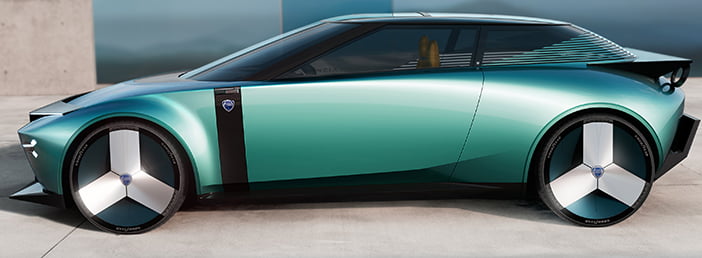
+++ Among the cars that made Italy great after the Second World War, the LANCIA FULVIA undoubtedly deserves a place of honour. Produced from 1963 to 1976 and a rival to the Alfa Romeo Giulia, it never had a successor, except for the Fulvia Coupé Concept, a prototype presented in 2003 and which has remained so. High production costs, uncertain commercial success and the desire to concentrate on other models led to its demise. History, however, reminds us that the past is always ready to return, and so could the Lancia Fulvia. The first clue comes from the European Patent Office, where Stellantis registered the name Fulvia at the end of January. It is definitely not certain that a new car could be born out of a simple registration. We have come across such situations on several occasions, sometimes arising from the desire to protect a particular name that is particularly significant for a brand, in order to prevent it being used by others. It must be said, however, that the plan announced by Lancia ends in 2029, the year of the new Delta’s debut. From then on, we know nothing, and the Stellantis designers may have got their hands on it. Just a thought. Especially since, with a new CEO yet to be appointed (Carlos Tavares’ successor is due to arrive by June 2025) it would be risky to commit a business plan to paper. The fact remains that Stellantis has now taken the Fulvia name, perhaps to be used for a compact hatchback positioned below the new Gamma, planned for 2026, also this car can also be called Delta. Or, harder still, on a small sports coupé. The latter option is much riskier because, although the car would be very attractive, it would belong to a niche segment and would certainly not sell in large numbers. The Alfa Romeo 33 Stradale shows that historic names can be used to create unique objects, such as the Biscione coupé, of which there are only 33 examples, with a price starting at €2 million. A fascinating model for a very limited number of customers, created to celebrate the DNA and history of Alfa Romeo. And what if Lancia did the same with a hypothetical Fulvia? Let’s be clear that this is just speculation on our part, but this kind of action can have a major impact on the perception of a brand. Especially one like Lancia, which is returning to Europe with the new Ypsilon after years spent exclusively within Italian borders. The mechanics and technology of the Maserati MC20, the technical basis of the 33 Stradale, are there. Why not add a design inspired by the Fulvia Coupé HF, with some ingredients from the Pu+Ra HPE? +++
+++ STELLANTIS ‘ search for a new CEO continues, with the aim of appointing one by the end of June 2025. The guessing game continues apace, but nothing official has been leaked. In the meantime, however, the group is continuing its reorganisation work in the post-Tavares era by changing the key men at the helm of its brands. Following the return of Tim Kuniskis, former number one at Dodge and now at the helm of RAM, 3 other brands are preparing for a change of CEO: DS, Jeep and Peugeot. And not only that. Let’s go in order: the first change at the top concerns DS, which will have Xavier Peugeot as its new CEO in place of Olivier François, who will remain at the head of Fiat. Staying in France, Peugeot’s leadership will also change from Linda Jackson to Alain Favey, while across the Atlantic, Jeep will have as its new number one Bob Broderdorf, for whom he was already in charge of the North American market. Changes for brands with different philosophies and positioning, with DS leading a new life that began with the presentation of the flagship No. 8, and Jeep struggling in the United States and preparing for the launch of the new Compass, while also thinking about the successor to the Renegade. Finally, Anne Abboud is in charge of Stellantis Pro One’s commercial vehicle unit. The changes do not stop there, because Stellantis is not just about cars. On the contrary. Among the new appointments is Ned Curic, who will take charge of all the group’s software activities, which will be integrated “into a single product development and technology organisation to streamline the process of bringing innovative products and services to market for all brands in all markets where the company is present”. Software is now a key market for car manufacturers and (as Volkswagen’s (negative) experience with Cariad teaches us) getting an infotainment system and user experience wrong can jeopardise a model’s sales. Also in the name of simplification, Stellantis has decided to create a centralised marketing office headed by Olivier Francois, while Antonio Filosa (Stellantis’ current operations manager in America) will also take charge of the quality department. As mentioned above, all this is happening while Stellantis is still looking for a replacement for Carlos Tavares, who announced at the beginning of December 2024 his intention to step down as CEO. +++
+++ TESLA has a problem. The American company is no longer selling, either in Europe or in the US. Or rather, it is still selling a lot, but much less than in the past. The figures for January 2025 do not leave much room for interpretation. There are several factors behind this slump. Anticipated at the shareholders’ meeting at the end of last month and now confirmed by the first figures of the new year, the reasons lie first and foremost in the behaviour of Elon Musk, who has disappointed both Americans with his support for Donald Trump and Europeans who have not liked the various interventions of the brand’s CEO in the politics of the Old Continent. But there is more. One of the reasons is the low availability of cars in stock. As every year, the company pushes sales in the last quarter in order to close the accounts with a better result. But this inevitably has an impact on the start of the new year, when stocks are low. Then there is the ‘Juniper effect’. The Tesla Model Y, the brand’s best-seller, has just been relaunched with a 2025 model year that is quite different from its predecessor. The new Model Y has recently gone on sale in China and is now available in Europe and the US, but only in the Launch Edition. The fact that the full range is not yet available means that many potential buyers are waiting for further versions. This is why sales are slowing down. But what have all these reasons led to? Let’s have a look. If 2024 ended badly, 2025 started even worse. On the old continent, there was a 50% drop compared to January 2024. The decline affected key markets such as those in Scandinavia (Sweden -44%; Norway -38%), where electric car registrations grew by double digits. Negative figures were recorded in Spain, where registrations fell from 1.094 to 269 (-75.4%), and in France (from 3.118 to 1.141, -63.4%), but Tesla also fared badly in the Netherlands (from 1.610 to 926, -42%) and Denmark (from 763 to 451, -40.9%). In Italy, the figures are smaller, but the decline was also -13.4%. In Europe as a whole, we have reached an uncomfortable -47.7%. To explain Tesla’s current situation, you can also look at what is happening in California, the largest electric car market in the United States. For years, Elon Musk and Co. dominated the market with ever-increasing numbers. But in 2024 they will see a decline. And while zero-emission car registrations are up 1.2%, Tesla’s are down 11.6%, with almost 27.000 fewer electric vehicles delivered. Without Tesla, the Californian market is up 20%, and while the brand still leads with a 52.5% share, it’s hard to ignore that it was over 60% in 2023. +++
+++ In the UNITED KINGDOM , electric car sales climbed 42% year on year in January. The top-10 bestselling new cars for 2025 so far are, according to registration data, 1. Kia Sportage – 3.476 units, 2. Nissan Qashqai – 3.421, 3. Vauxhall Corsa – 3.379, 4. Volkswagen Golf – 2.614, 5. Peugeot 3008 – 2.567, 6. Peugeot 2008 – 2.478, 7. Ford Puma – 2.332, 8. Nissan Juke – 2.320, 9. MG HS – 2.148 and 10. MG ZS – 2.107 units. +++
+++ VOLVO reported a decline in fourth-quarter operating profit and predicted a turbulent 2025 with challenging market conditions. The automaker said it didn’t expect the market to grow at the same rate as in previous years and that increased competition, particularly from China, would likely mean price cuts across the sector. “As a result, it will be challenging to reach the volumes and profitability level we achieved in 2024”, CEO Jim Rowan said in a statement. The company did, however, repeat a forecast for a core operating profit margin of 7 to 8 percent. Rowan also said Volvo thinks it already has an answer if the Trump administration increases tariffs on vehicles imported into the U.S. from Europe: the automaker’s factory near Charleston, South Carolina. “The biggest benefit is that we have the building and we have spare capacity in that building, so that takes away a lot of the lead time” to add models, Rowan told. A key advantage of the plant: It’s capable of making cars underpinned by both the first and second generations of Volvo’s Scalable Product Architecture. +++
+++ The first prototype of the new VOLVO EX60 , the firm’s first model to sit on an advanced new highly scalable platform, will begin on-road testing this year ahead of is production launch in 2026. The new model will be key for Volvo’s electric switch as the EV equivalent of the hugely popular XC60, which has long been its bestseller. The EX60 will be the first model to sit on the SPA3 platform, which is effectively a successor to the platform used for the EX90 and forthcoming ES90, but scalable to allow for cars both smaller and larger than Volvo’s current line-up. As with those models, the EX60 will be designed around an advanced software stack, giving it the ability to accept over-the-air updates and other extras. Volvo confirmed the first EX60 test vehicle would be built and driven this year during its latest financial results presentation. Bosses had previously described the model as a “huge boost” in Volvo’s electriciation journey, given that it would serve as the electric sister model to its bestseller. Tech chief Anders Bell described the SPA3 platform as being “100% electric and 100% Volvo”, rather than a shared Geely group platform, such as the SEA platform used for the EX30. “Because it’s 100% electric, we’ve been able to remove all the old constraints of the combustion engine”, said Bell. “We very much took a first-principles approach to it. You will see the highest level of supremely well-integrated technology coming together in these products”. The EX60 is likely to broadly match the dimensions of the XC60 (pictured below) and will doubtless take styling cues from the EX30 and EX90. Bell said the SPA3 is “a big step from a mechanical perspective, but from a software electronics perspective, it’s a straight evolution”. He added: “All the work we’re putting into the EX90 will go directly into the SPA3 cars as well. It’s basically the same software stack. SPA3 is designed from the beginning to be much more scalable, in size and price point and across regions, but also scalable in volume. It’s designed for scale in every dimension: when it comes to size, my job is to make sure that the company has optionality. We are designing the SPA3 to be scalable from B to F segments, to make sure that we have flexibility and that we can launch the products that markets decide they want when they want it”. Since all future new Volvo models will share the same basic tech stack, Bell added that it will allow for more focused and rapid development. “Because it’s all one technology stack, there’s no repeat of work”, he said. “It’s the same software stack, same basic electrical architecture. Yes, it’s scalable in size, price and capabilities, but it’s not spreading our products in different ecosystems. Everything we do gets married to the Volvo connected car cloud. If you look at successful tech companies, they’re all single tech stack companies where all their products are interlinked. Apple is a good example: hardware, software, telephones, laptops, they’re basically all interconnected with the same software. That’s one example of where we need to be converging as a technology company going forward. Our focal point is safety, sustainability and creating this fantastic customer experience, all wrapped in this Scandinavian design, on one tech stack”. As previously reported, the EX60 will also be the first Volvo designed to benefit from megacasting; a technology set to be introduced with the SPA3 that allows for entire sections of a car to be created as a single part rather than multiple elements. That, along with other changes and the more modular nature of the SPA3, will lower production costs. +++