
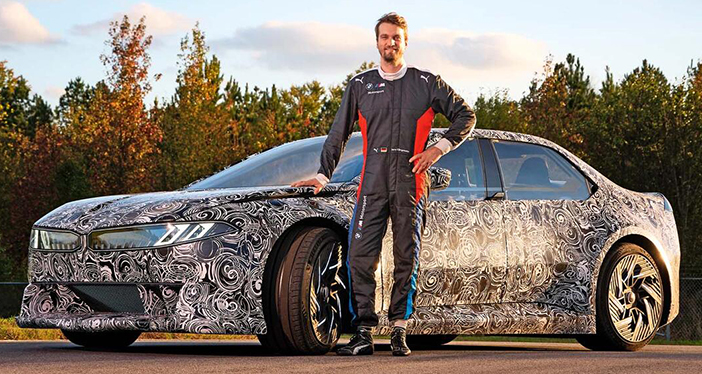
+++ The radical BMW VISION DRIVING EXPERIENCE is a quad-motor, high-performance test vehicle that is being used to hone the advanced technology that will power its next-generation of Neue Klasse electric vehicles, including a forthcoming M3. While the powertrain layout, featuring 4 high-power motors mounted on each axle, has clear parallels to plans for the next-generation M3, BMW insists the Vision Driving Experience serves a wider purpose as a rolling test rig. Because the focus is on vehicle development, BMW has not given a power output for the machine. Other radical elements included the fitment of 5 fans designed to suck it to the ground and, a new addition for the Shanghai motor show, a see-in-the-dark livery which BMW says “underscores the innovativeness of the car”. However, the key focus of the Vision Driving Experience is to be a high-performance machine that can be used to push development of the ‘Heart of Joy’, the new black box computer system that will combine the drivetrain and driving dynamics systems in all future Neue Klasse models. That system will first be seen in the next-generation iX3 that is set to be revealed later this year, and on the next-generation 3 Series saloon that will follow soon afterwards. Frank Weber, BMW’s development boss, said that the Heart of Joy system “enables us to take driving pleasure not just to the next level, but another one beyond that”, adding that the system would offer efficient dynamics squared. Autointernationaal.nl was given access to the Vision Driving Experience for a ride in the car, and to talk to the engineers who have developed it. “The engineers won’t even tell me how much power this has”, says development driver Jens Klingmann, as he casually hurls the BMW Vision Driving Experience into a corner fast enough for the tyres to howl in protest. “But it’s a lot”. Given that my insides are still churning from the hit of acceleration at the start, he didn’t really need to say that last bit. The Vision Driving Experience is, indeed, a lot. It’s a lot of car, with a lot of motors, a lot of fans (we will get to those) and a lot of performance. And it has a lot of significance for the ongoing development of BMW’s Neue Klasse cars, of which the iX3 will arrive this year. This isn’t just your average prototype, then. But at heart that’s basically what it is: a quad-motor, high-power EV test mule styled on the next-generation 3-series, which has been pounding around various test facilities during recent months. 4 motors and a ridiculous power output? That sounds quite a lot like the forthcoming first electric M3, doesn’t it? Except BMW insists the Vision Driving Experience (let’s call it the VDE for short) isn’t a test mule for the next M3. Instead, the firm describes it as a one-off test rig on wheels, a moving laboratory used to hone technology being developed for all future Neue Klasse models in an extreme environment. The development work being done with it is as relevant to the next single-motor, entry-level iX3 as it will be to whatever M division’s engineers concoct for their electric offerings. Perhaps because of the development work for which it has been created, until now the VDE has been cloaked in secrecy, and we’re not just talking about its camouflage wrap. But the fact that BMW recently strapped me (thankfully tightly) into the passenger seat for a short (but very fast) ride shows that Munich now wants to showcase exactly why it has been created. Although Klingmann’s inability (or perhaps refusal) to share its power output indicates that the veil of secrecy isn’t fully lifted. What BMW has confirmed is that the VDE is powered by 4 electric motors (one for each wheel). There isn’t an official power output, but you can probably guess it’s pretty high. BMW hasn’t given any performance stats, either, but after my ride in it, I would say the 0-100 kph time can be described as ‘brisk’. Beyond the 4 motors, the other thing we have been told about are those fans. 5 of them, in fact. BMW calls them impellers, and they serve to literally suck the car to the ground. Each fan requires 50kW of energy to run, but combined they add around 1.000 kg of downforce without creating any drag, in turn allowing Klingmann to push even harder in corners. All of that torque and downforce is really there to develop one small but very significant black box full of computer chips and loaded with software. That would be BMW’s new Heart of Joy, the unusually named hardware and software stack that will unify the computer systems that run the powertrain and driving dynamics systems on future EVs into a single unit. It’s the first time BMW has unified those systems, and the firm claims the system has been developed entirely in-house. “The Heart of Joy will run all the key driving functions of the car”, says driving dynamics expert Christian Thalmeier. “But to develop those, we need to push the technology. Even production cars with only 1 electric motor will gain advantages from the work we’re doing on a car with 4 motors”. It might seem like overkill to build a super powerful, fan-laden hack just to test a computer processing unit, but the idea is that if the Heart of Joy can handle anything the VDE can throw at it in the real world, it can handle pretty much anything. So how does it work? Traditionally, the powertrain and driving dynamics systems have been separate units. The powertrain system takes the inputs from your foot on the accelerator and sends that as a request to the powertrain, whether a combustion engine or a single or pair of electric motors. Meanwhile, a separate driving dynamics unit receives inputs from the steering wheel and brakes, along with any other data the car’s sensors might get from the external environment. Those two systems run in parallel, so there’s a small but potentially significant lag when they need to send data to each other, and there are limitations on how closely they can operate together. The Heart of Joy unites those systems into a single unit that receives all those inputs in the same place, processes them simultaneously and then sends the information to up to four motors along with the brakes, steering and so on. BMW says it allows for communication that’s up to 10 times faster than that used on cars that were on sale in 2021. That’s a big boost when trying to precisely modulate power and braking to best fit the conditions. But there are other benefits too. On most current EVs, friction braking is controlled by the driving dynamics unit while regeneration through the motors is the responsibility of the powertrain system. That’s why you can sometimes feel an imbalance if you’re slowing using the regen and then need to apply the brakes. “When recuperation is only done by the powertrain, you can’t use the whole potential of it”, says Thalmeier. “You need the driving dynamics system to work out how to enlarge the recuperation”. He cites the example of a rear biased car (yes, future BMW electric cars will still be rear-driven or rear-biased) cornering at speed. “When there’s a load change, you can only put a certain amount of longitudinal force on the tyres before the car becomes unstable”, he says. “So to keep the car balanced, you have to take away either lateral or longitudinal force. Because you’re cornering and you can’t remove the lateral force, you have to reduce the recuperation to keep the car stable. But that’s not what we want: we want to add stability by recuperation. Now, though, we’re so quick at taking data from the sensors on the car about yaw rate, lateral and longitudinal acceleration and how stable the car is that we can change things. If it’s still stable, we can do a bit of recuperation, and when it gets unstable, it will be quickly reduced”. There’s another benefit: the Heart of Joy can take your braking inputs and work out the most efficient way of stopping the car, which in most cases will be via the motor. That increases the use of regen, which BMW claims makes the car up to 25 percent more efficient. Not a huge amount but a useful gain given that most drivers don’t know whether it’s the brakes or the motor slowing their car. The Heart of Joy won’t just help when you’re slowing down your BMW, though: it will help you go faster. Again, a combustion car has a single power source, so systems such as variable 4-wheeldrive or torque vectoring have to go through various mechanical systems to divide up that power. But the new system can take power from one, two, three or four motors and continuously adjust where it’s sent to, keeping the car better balanced and more stable. Besides simply adding raw power, Thalmeier says adding motors will make a big difference to future Neue Klasse models. “We’re influencing the driving dynamics”, he adds. “If you think of 3 electric motors with 1 on the front axle and 2 on the rear, you can help steer with the rear axle by making one wheel faster and the other slower. So you can make the car agile purely through running the electric motors at different speeds. Any existing actuator or rear-wheel steering system isn’t as quick as our new electric motors will be”. Which brings us back to the passenger seat of the VDE, with Klingmann laughing as he jams the throttle and sends the machine down the straight of the BMW Spartanburg Performance Centre test track at something approaching warp speed. It’s actually surprisingly comfortable inside, with comfy sports seats and a working version of BMW’s new iDrive system on the dashboard. Even in its test hacks, Munich does premium well. But can you feel the Heart of Joy at work? Being honest, no, not really, but that’s in part because on a cold day in South Carolina tyre grip is limited and Klingmann confesses the road-legal rubber is the limiting factor. But as my innards slowly settle once I’ve escaped the passenger seat, the performance of the Vision Driving Experience (and the systems underpinning it) is clear. The closest comparison I can make is with a passenger ride in an electric rallycross supercar. Impressive, then. And it certainly whets the appetite for the potential of a quad-motor electric M3. The BMW Vision Driving Experience’s 5 impeller fans are the car’s undoubted party piece, as demonstrated when its engineers fired them up for a demonstration when it was back in the garage. For a comparison of how loud they are, imagine standing underneath the wing of an Airbus A380 when the pilot presses the start button. Essentially, they serve to stick the car to the ground, adding grip without creating aerodynamic downforce. But could they ever reach production? “You won’t see anything like this in a production car”, says Thalmeier. “It’s just too expensive. They are just for the system on this car. If you have a lot of downforce and then you add a lot of torque, it makes it very hard to accelerate. What we’re interested in with this car is how to deal with the acceleration in the software. It’s purely a development tool. It’s not even a driving dynamics tool; it’s just another thing that makes it faster for us to develop functions”. +++
+++ HYUNDAI has developed a new hybrid powertrain. The setup pairs a turbocharged 2.5-liter 4-cylinder engine with dual electric motors, integrated into a 6-speed automatic transmission, to produce a total of 333 horsepower and 460 Nm of torque. Interestingly, Hyundai plans to launch a rear-wheel-drive variant of the 2.5-liter hybrid in 2026. Meanwhile, the company’s luxury arm, Genesis, is also entering the hybrid space, but only select “key models” will receive electrified powertrains. While no specific vehicles have been confirmed, we can likely rule out the G70, as Hyundai’s global product officer Marc Choi has hinted at a focus on larger, higher-margin vehicles. Compared to the outgoing gas engine, the new petrolengine is 2.9 percent more efficient. Once you factor in the hybrid components, fuel efficiency improves by an impressive 45 percent over the standard non-hybrid engine. Power also climbs significantly, with a 19 percent jump. For the cheaper cars, Hyundai is developing a second hybrid system using a 1.6-liter turbocharged engine. It boosts efficiency by 4 percent and increases torque slightly, from 367 Nm to 380 Nm. While no models were named, I believe the likely candidate is the Tucson, as the current hybrid version produces the mentioned lower torque figure. The Hyundai Motor Group’s hybrid range will span everything from compact to large vehicles, including entries in the luxury segment under Genesis. Combined system output will vary from the low-100 hp range to the mid-300 hp range. The dual-motor hybrid setup divides tasks: One of them takes care of starting, battery energy generation and energy deployment, while the other handles propulsion and regenerative braking. +++
+++ LEAPMOTOR has confirmed the name of its forthcoming sub-€35.000 family hatchback at the 2025 Shanghai Motor Show. The B05 will be based on the recently revealed B10 SUV, and could offer up to 640 km of range. The B05 will use the same components, including its battery and rear-mounted electric motor, although capacities and power outputs haven’t been confirmed. Leapmotor senior VP Li Cao told me the firm’s new range of B-badged models is “born for the youth”, with the company specifically targeting a younger audience compared to that of its existing cars. During Leapmotor’s press conference on the opening morning of the Shanghai show, a silhouette of the new family car flashed up on a screen behind the stage. The outline showed a fairly conventional hatchback shape (not dissimilar in proportion to something like a Peugeot 308. Inside, a twin-screen layout is likely, possibly including a 14.6-inch central display. We’ll need to wait until early 2026 before we first set eyes on the production-ready B05. Company founder Jiangming Zhu also revealed the names of the final 2 models set to complete Leapmotor’s European line-up in due course. The A10 small SUV and A05 supermini won’t be ready until later in 2026, though the Nissan Juke and Micra rivals are considered core to the maker’s success in Europe. It remains unclear if Leapmotor will offer any of them with the range-extender powertrain that it has just introduced to the C10, with bosses suggesting it’s gauging market reaction to the technology. The A10 will be positioned as a rival to the Jeep Avenger. That car will then spawn its own low-riding hatchback sibling, called the A05. This entry-level model, which could be priced below €23.000, will go up against the Fiat Grande Panda, the Citroën ë-C3 and the Skoda Epiq. Leapmotor’s model range expansion comes off the back of rapid growth for the 10-year-old brand, both in its home market and internationally. Leapmotor says that within 13 days of launching the B10, it had shipped more than 8.000 examples, of which more than 95% were specified in the mid-range trim or higher. It now has nearly 1.500 retail sites worldwide and was the 11th most popular EV brand globally last year. In 2025, it aims to move up to 9th position, then to 7th in 2026, ultimately aiming to become one of the world’s top-5 EV brands. +++
+++ LOTUS has warned that heavy cost savings are on the way as it battles “global trade uncertainties”, despite the brand nearly doubling its sales over the past year. The brand recorded 12.134 sales during the 2024 financial year (June 2024 to April 2025), up 74% from 6.970 in the previous financial year. However, it recorded just $29 million in gross profit, down from $102 million the year before. This leaves it with just a 3% gross profit margin, down from 15%. Chief financial officer Daxue Wang blamed this on the impact of worldwide tariffs and further “global trade uncertainties”. +++
+++ The Honda – NISSAN merger may be dead, but that hasn’t stopped collaboration talks between the 2 brands. North America senior vice-president and chief planning officer, Ponz Pandikuthira, revealed discussions between Honda and Nissan are still ongoing. He even brought up the possibility of platform sharing for the next-generation NSX and GT-R. “Can we do a next-generation NSX and GT-R off the same platform, make the NSX authentic to what it stands for and make a GT-R authentic to what it stands for? So they are not clones?” Pandikuthira asked rhetorically: “Can you co-develop 2 cars like that? I think we can”. This theory isn’t just hopes and dreams, either. Honda confirmed last year that an “NSX-type” electric sports car would be put into production. Nissan, meanwhile, told me at the New York Auto Show that the GT-R would make a return. Other reports suggest the car will go on sale in 3 to 5 years, as a hybrid. “Authenticity matters”, Pandikuthira told. “A Honda NSX had a very different origin of what that car was. Super lightweight, all aluminium”. He went on to describe the NSX as “super precise, lightweight, aerospace execution, whereas a GT-R is a brute, but a sophisticated brute”. Pandikuthira was keen to point out that while merger talks have faded, the “strategic partnership” between Honda and Nissan, ratified back in August 2024, is alive and well. Ivan Espinosa, one of Nissan’s leads during the merger negotiations, is now the company’s CEO. He “never stopped talking with Honda”, according to Pandikuthira. “We need collaboration”, he told. “We’re going to need partnerships to deliver vehicles. I think partnerships are going to be a key part of our future”. Pandikuthira made sure to clarify this wasn’t a confirmation the GT-R and the NSX are being co-developed, but rather a belief that “it can be done”, Considering the success of Toyota and Subaru’s co-developed GR86 platform, I’m inclined to agree. If shared platforms get us more sports cars, I’m all for it. +++
+++ The new 7th generation SUBARU Outback is different to all its ancestors, firstly because what was once an off-road-ready estate car has been transformed into an SUV, but also because this is the first iteration that won’t be sold in Europe. Why? Especially for a brand that prides itself on extremely high customer retention, and having a loyal customer base that will buy multiple iterations of long-serving models over many years, this sounds as a strange decision. But Subaru’s general manager for Europe David Dello Stritto informed me that the new Outback would be “simply unsellable in Europe” due to the amount of CO2 it will produce and resulting high taxes, which left the brand with no other choice. The company hasn’t revealed the emissions figure for new Outback yet, however it’s powered by the same naturally-aspirated 2.5-litre boxer engine found in the previous generation, which produces around 200 g/km of CO2. No form of hybrid assistance has been added to the engines either for the new model. The latest Subaru Forester does have a mild-hybrid setup, but still emits 183 g/km of CO2. For context, a rival Hyundai Tucson Hybrid produces between 130 g/km and 148 g/km, as does the closely related Kia Sportage Hybrid. Stritto explained that the current Forester, priced between €68.995 and €75.995 in the Netherlands, is just unsaleable and the Outback would be the same”. Ultimately, as Stritto put it, “Yes, we know that introducing a new Outback would allow us to keep more customers, but in the end, they won’t be able to afford it”. Instead of offering the new Outback in Europe, we’re getting the all-new Trailseeker which follows a similar same formula, and is even a similar boxy shape, but gets around the emissions issue because it’s all-electric. Stritto admitted: “Our customers are telling us we didn’t ask for electrification. But they’re starting to get up okay with it, and they’re starting to get used to the idea. It surprised me, the way e-Boxer was adopted, and it was adopted much quicker than I expected”. The Trailseeker is due to go on sale in Europe by the middle of 2026, potentially wearing a different name. A similar thing happened with Subaru’s other midsize SUV that in Europe was called the XV, and Crosstrek in other markets. If for whatever reason Subaru does decide to rename the Trailseeker, one alternative we floated was simply calling it the ‘E-Outback’ or ‘Outback EV’, to make it as familiar as possible to that legion of loyal customers we mentioned earlier. Stritto didn’t object to it, and responded with: “It could be”. +++
+++ Remember when TESLA had the bestselling vehicle in the world? Now, the beleaguered brand can’t fend off Volkswagen’s fleet of EVs in Europe. A new report from Jato Dynamics took a close look at new-vehicle registrations in Europe through the first quarter of 2025, and found some surprising information. As of March 31, a total of 65.679 new electric VWs were registered. That’s an astounding year-over-year jump of 157 percent. Meanwhile at Tesla, new registrations fell 38 percent, landing at 53.237. Ouch. It’s worth noting that the data here is registrations, rather than sales. Tesla doesn’t report sales by region, and it’s always possible (albeit unlikely) that someone could buy a new car and not register it, for some reason. However, registration data provides a good window into the sales world, and with a difference of over 12.000 new-vehicle registrations, it’s safe to assume Volkswagen is kicking Tesla’s butt right now. In Europe, anyway. Unlike Tesla, Volkswagen lists vehicle sales by region, and the automaker’s figures support Jato Dynamics’ data. The automaker reported Group EV sales were up 112 percent through the first quarter of 2025. “Our products are being well received and show that the Volkswagen Group is on the right track”, said Marco Schubert, Member of the VW Group’s executive committee for sales. “We increased our all-electric deliveries worldwide by around 60 percent in the first quarter. In Europe in particular, we were able to significantly expand our leading position in this segment with a doubling of deliveries”. VW states the ID.4 and ID.5 are its best-selling EVs across all brands in the Group, accounting for 43.700 global sales through the first quarter. The ID.3 is next at 28.100, followed by the Audi Q4 e-Tron at 22.800 and the Skoda Enyaq at 20.200. As for other VW-specific models, the ID.7 sold 19.100 units and the ID.Buzz logged 12.700 sales. What is driving the decline at Tesla? In case you’ve been living under a rock, the company is facing global backlash over Elon Musk’s political involvement with US President Donald Trump. Tesla dealerships have been the target of protesters while Tesla owners have come under fire for simply being seen in the cars. And with big tariffs now in effect for a multitude of products imported from Europe (including cars) it seems the only way to stem the tide is for Musk to abandon Washington and start running his company again. Even then, the damage could be too severe to fix. +++
+++ It was previously understood that the forthcoming, second-generation VOLKSWAGEN T-Roc would be the maker’s final internal combustion-engined (ICE) car. But stagnating EV demand means the company is now investigating the feasibility of bringing range-extender tech to the European market, allowing petrol-powered VWs to be sold well into the next decade. Speaking at the 2025 Shanghai Motor Show, Volkswagen’s board member for sales and marketing, Martin Sander, told that the company was investing in range-extending hybrid systems, and that he saw it as a “ladder” to electric cars. When asked whether the T-Roc was still set to be VW’s final ICE car, Sander replied: “What is a combustion engine? Here in China we’re going to have range extenders with possibly 250-300km of electric range, and the combustion engine on board is basically a generator to charge the battery. “I think you will see combustion engines in our vehicles for a long period of time that have a different purpose”, he told. “We believe that in Europe there will be room for a range extender on the way to a fully battery electric vehicle”. Kai Grunitz Volkswagen’s board member for technical development insisted that there were no weight or packaging compromises to be made, either: “No, range extenders are not as heavy as a fully battery electric vehicles; if you take a look at our ID.7, we’ve got over 80 kWh batteries, and having a range extender would mean that you can reduce the battery to 30 kWh. Here in China, we’re putting the petrol engine at the front”, Grunitz told. “But you could do it in a different way. It depends on the customer’s demands. You need the same amount of space as in a plug-in hybrid, so it’s not a huge difference”. It isn’t clear at this stage which model might utilise the range-extender tech, but it’s likely the company would focus on larger vehicles and those currently less suited to being pure-electric. This could give models like the Touareg a stay of execution, giving them a longer zero-emission range and the possibility of vastly improved efficiency, providing the user plugs them in. +++