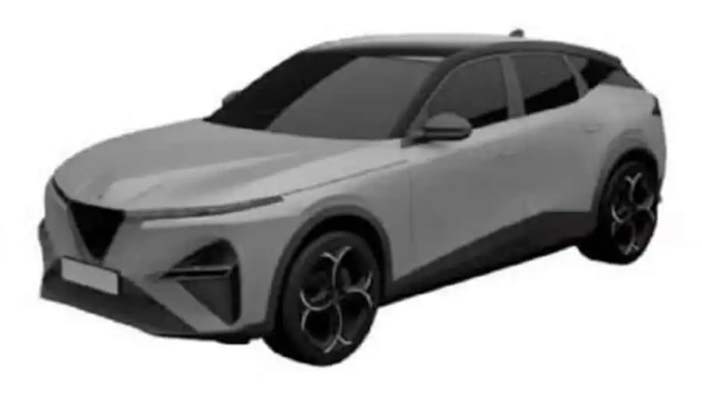
+++ The Stelvio is getting up there in years, having been around for nearly a decade. Nevertheless, ALFA ROMEO ’s first SUV remains a desirable car and one of the most exciting to drive in this challenging segment. However, a second generation is becoming increasingly necessary since the high-riding model can’t avoid electrification for much longer. An official reveal is happening later this year. Meanwhile, we already know how it’s going to look. Fully revealing images of the Stelvio’s exterior design have emerged through the trademark office. The styling is in line with the camouflaged prototype we saw last month, revealing a complete overhaul compared to the outgoing model. The absence of visible exhaust tips strongly indicates we’re dealing with the purely electric version, but Alfa Romeo has confirmed there will be cheaper petrol flavours, too. If it weren’t for the proprietary front grille (scudetto), I would’ve had a hard time identifying this SUV as an Alfa Romeo. Ok, the wheels also have a familiar design, but everything else is a stark departure from what we’ve come to expect from the Torino-based automaker. Take, for example, those slim upper daytime running lights, which wouldn’t look out of place on a BMW iX. A separate set of led elements “hidden” in the bumper will serve as the main headlights, à la X7 or XM. A closer look at the profile hints at a significant jump in size over the current Stelvio. Alfa Romeo must’ve trademarked a higher-end version judging by the two-tone look with a black roof. Flush door handles are all the rage these days since they help streamline airflow for better aerodynamic efficiency. The quarter glass now sits aft of the rear doors, and we think there’s a battery pack hanging from the underbody. Moving to the back, the taillights have an odd shape, starting as ovals on the fenders and meeting on the tailgate where they form a triangle. Alfa Romeo is putting the rear wiper in the usual place instead of tucking it away underneath the roof spoiler like some other automakers are doing these days, including Land Rover and Hyundai. The tailgate appears to be perfectly square, and we think we see a sunroof. It’s worth noting that future models always look worse in grainy images from the patent bureau compared to the real thing. Be that as it may, Alfa Romeo is certainly playing it less safe with the Stelvio’s design for the second generation. The luxury SUV looks far more daring than its predecessor, trading some of the Italian elegance for polarizing details such as the split lights. We’re beginning to wonder whether the new Giulia will look like a Stelvio without the high heels. Alfa Romeo has said it’ll abandon the sedan body style in favour of something different, with reports stating it would be a 5-door fastback. Before the Giulia debuts in 2026, its SUV counterpart will break cover later this year. Both will sit on the STLA Large platform, therefore abandoning their pricey Giorgio bones from the FCA-PSA era. While today’s Stelvio is 469 cm long, the new architecture has been conceived for vehicles between 477 and 513 cm. It would explain why we’re getting the impression the future model will be visibly larger. Although the temptation would be to think the Stelvio and Giulia Quadrifoglio will borrow the Dodge Charger’s Hurricane inline-6, Alfa Romeo promised in late 2023 it would keep its own twin-turbo, 2.9-liter V6. Former CEO Jean-Philippe Imparato mentioned watered-down Euro 7 regulations would allow the company to retain its proprietary engine. It’ll be interesting to see whether Stellantis is keeping both this engine and Maserati’s Nettuno V6, with which it actually shares some components. We’re in for a long wait since the new Stelvio is unlikely to get the four-leaf clover treatment from day one. +++
+++ We’re less than a month away from the world debut of the all-new ALPINE A390 on 27 May, as the French performance brand prepares to take on the Porsche Macan Electric with an electric five-seat ‘Sport Fastback’ that it’s promising can deliver the “agility and driving pleasure” of its exceptional featherweight sports car, the A110.
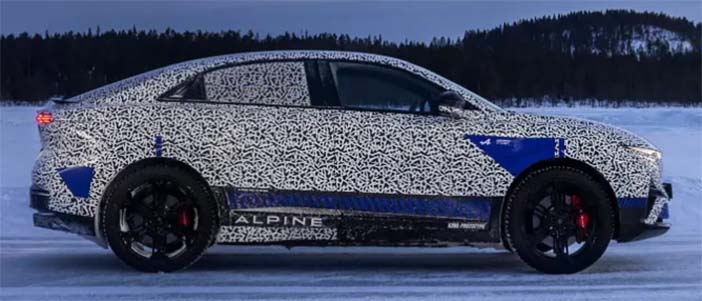
Alpine is also quite boldly calling the A390 a “true 5-seater sports car” and says it’s working to ensure that the electric SUV can deliver the level of performance and sharpness customers will expect from the brand, which until now has focused on sports cars and hot hatches. But while we’ve been told the A390 will be quicker than the hardcore A110 R (meaning it’ll do 0-100 kph in well under 4 seconds) Alpine also wants that performance to be accessible and progressive to adapt to the skill of the driver, as well as repeatable. The A390 will be available with a tri-motor powertrain (using 1 motor on the front axle and 2 at the rear) that could deliver up to 600 hp, plus all-wheel-drive traction and active torque vectoring to boost agility through the corners. A less potent dual-motor version will be offered as well, I’ve been told. Alpine has just about wrapped up testing on the A390, which has been taking place in all sorts of conditions, including the freezing cold of Lapland, in the north of Sweden and more recently at Michelin’s Ladoux facility in France for wet-weather testing. The 2 French firms have actually been working together to develop specific tyres for the A390: 20-inch Pilot Sport EVs will be the standard choice and are designed to balance performance, refinement and range, while more performance-focused 21-inch Pilot Sport 4S rubber will be available too. Alpine has also been refining the A390’s 5 drive modes, with its Track setting “dedicated to more sporting endeavour”, which is an eloquent way of saying ‘giving it the beans’. Plus the ‘Alpine Drive Sound’ system will deliver 2 unique soundtracks to enhance the driving experience, but without trying to replicate the exhaust note of the A110’s petrol engine. The A390 will sit on the AmpR Medium platform (previously known as CMF-EV); the bespoke EV architecture also used by the Renault Scenic and Nissan Ariya. But as well as adding the new tri-motor set-up, Alpine will be making numerous chassis tweaks, not least a wider track and larger brakes. Alpine is calling the A390 a Sport Fastback rather than an SUV and it’s not hard to see why, given the incredibly athletic silhouette and quite brutish design previewed by the A390_ß concept shown last year. This was very close to the production car’s styling, as we can see from these official pictures of a prototype cutting a rug on the ice. At the front, the A390 will sport a full-width lightbar that connects 2 clusters of triangular lights. The brand calls the lighting signature ‘Cosmic Dust’, because it’s supposed to evoke a comet passing through our atmosphere, and the same feature has also been used for the taillights. Meanwhile the sharply pointed nose gets Alpine lettering, just like the concept. Elsewhere, blades sculpted into the bonnet are designed to improve airflow over the top of the car, and its ‘micro-perforated’ grille should guide air towards the intakes on either side of the bumper to create a curtain of air along the sides. Alpine has confirmed the A390 will measure 4.615 mm long, 1.885 mm wide and 1.532 mm tall, making it smaller than the Porsche Macan Electric. Instead, the A390 is much closer in size to the Cupra Tavascan, Ford Capri and Kia EV6, but it should provide plenty of space for passengers and luggage alike.
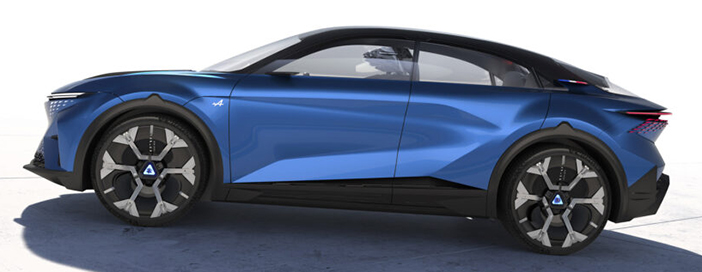
I assume the road-going A390 will feature a very toned-down version of the concept’s interior, but we do know it’ll include a Nappa leather-wrapped steering wheel. This is inspired by the ones on Alpine’s Formula 1 cars, with buttons to switch drive modes, plus others for ‘Overtake’ (OV) and ‘Recharge’ (RCH). Presumably the first provides a short boost of extra power, while the other adjusts the regenerative braking system. As with Alpine’s other models, the A390 follows a simple naming convention of the letter A followed by 3 numbers. The first digit refers to the coupe-SUV’s size, compared with the Alpine A290 hot hatch, for instance, while 90 denotes this is one of the brand’s more versatile, everyday models. The A390 will be the next addition to Alpine’s ‘dream garage’ of 7 brand-new pure-electric cars that it’s hoping to complete by 2030, and has just started to become a reality following the launch of the A290. 2 more SUVs are scheduled to be launched in 2027 and 2028, the largest of which should rival the Porsche Cayenne. Also on the way is the next iteration of the Alpine A110 sports car, which will be followed by a roadster version and a 4-seat sports coupé that will bring back the Alpine A310 name from the seventies and eighties. +++
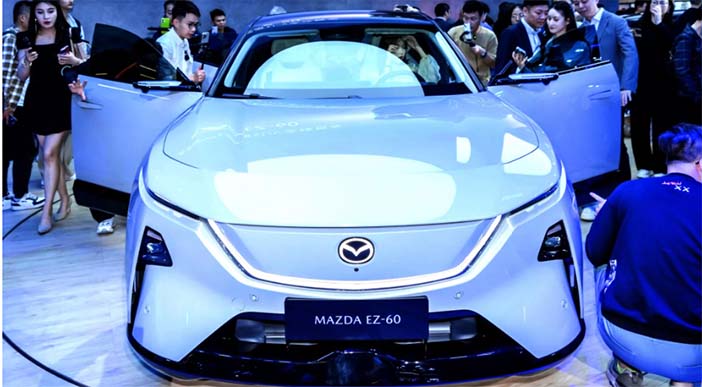
+++ MAZDA ’s new electric SUV proves an instant hit in China. Especially, the REV version of the EZ-60 is selling like hot cakes, with over 10.000 pre-orders within the first 2 days of its unveiling. The new Mazda shares its platform with the Deepal S07 from Changan. However, one shouldn’t mistake pre-orders for actual sales. For starters, shoppers are in no way obligated to follow through with purchasing the car. Additionally, pre-orders can be placed for just 10 yuan, the equivalent of just $1.40. Not all people who did will go through and buy it, but that’s the norm in the industry anyway; only the percentage varies in each case. Even though Mazda borrows a Chinese platform, but the EZ-60 looks every bit like a Mazda should. That is important because it will not be limited to China. In other markets, including Europe and possibly Australia, it will be sold as the CX-6e. The range-extender version of the EZ-60 presented at the Shanghai Auto Show has a 1.5-liter naturally aspirated 4-cylinder that acts as a generator for the 31.7 kWh battery, which drives a 255 hp electric motor at the rear axle. As mentioned, Mazda has yet to reveal specifications of the all-electric version, and it’ll be interesting to see how buyers react to that one. +++
+++ Where would Western luxury automakers be today without the Chinese market? Prestige brands have been riding the gravy train for years, but all good things must come to an end. The rise of domestic automakers has severely impacted demand for international brands; ask PORSCHE . Its sales in China slipped by 28 percent in 2024 to 79.283 cars. The first quarter of this year has been even worse, with demand plummeting by 42 percent to 9.471 units. Porsche’s downfall isn’t because the 911 suddenly became undesirable. The real issue stems from an inability to fend off Chinese competition in the EV segment. Xiaomi and others sell much cheaper electric cars, some of which boast more power than a Taycan or a Macan. Zuffenhausen is fully aware of the problem, and rather than retaliating with price cuts or new, more affordable models, it might just call it quits. Porsche CEO Oliver Blume admitted the company might stop selling EVs in China in the foreseeable future: “We will see in the next 2 to 3 years whether Porsche exists as an electric brand here”. The head honcho, who also runs the Volkswagen Group, acknowledged that Porsche’s electric vehicle sales in China are “relatively low”. The top brass made it crystal clear that Porsche has no intention of chasing volume and will maintain prices at a level “appropriate for Porsche”. Consequently, the new Cayenne, coming later this year, won’t be cheap, and neither will the electric 718 successor due to arrive after the big SUV. Blume doesn’t view Xiaomi, with its 1.548 hp SU7 Ultra, as a direct competitor, arguing that it’s a cheaper EV that can’t match the driving ability of a Porsche. Xiaomi’s Taycan fighter costs 529.900 yuan (nearly $73,000) in China, while a base 402 hp Taycan starts at a much steeper 918.000 yuan ($126.000). Unlike BMW, Mercedes, Audi and even Jaguar, Porsche has not invested in China-specific models. Global players have poured money into long-wheelbase sedans and SUVs to enhance legroom for rear passengers. Audi recently went a step further by launching the confusingly named AUDI (written in capital letters) as a purely electric sub-brand. Fun fact: VW’s Jetta is also a separate brand there. Speaking of VW, it’s planning to launch 20 plug-in hybrids and electric cars in China by the end of 2027, but there’s seemingly nothing on the horizon from Porsche regarding localized products. That new petrol crossover to replace the old Macan would make sense, but it’s not expected until closer to the decade’s end. Other traditional luxury automakers have adapted in order to maintain their market share. Relevant examples include posh minivans like the Lexus LM and Volvo EM90. However, with Chinese brands having easier access to raw materials and benefiting from lower labour costs, it is becoming increasingly difficult for international players to compete. Beating them on their own turf seems impossible now. Some automakers have come to grips with the new, harsh reality, deciding instead to strengthen local alliances. As the saying goes: “If you can’t beat ‘em, join ‘em”. +++
+++ STELLANTIS has announced plans to demonstrate solid-state batteries in 2026 after a successful ‘breakthrough’ validation of the technology. The parent company of major car brands such as Opel, Peugeot, Citroen and Fiat invested 75 million dollars in US-based solid-state battery specialist Factorial Energy back in 2021. Since then, the pair have worked towards a five-year goal of introducing solid-state batteries into electric vehicles. “Reaching this level of performance reflects the strengths of our collaboration with Factorial”, said Ned Curic, Stellantis Chief Engineering and Technology Officer. “This breakthrough puts us at the forefront of the solid-state revolution. We continue working together to bring us closer to lighter, more efficient batteries that reduce costs for our customers”. Unlike the lithium-ion batteries that conventional EVs currently use, solid-state batteries have a capacity for higher energy density, essentially resulting in more range and quicker charging speeds. Tesla’s latest 4680 battery technology, for example, has an energy density of 244Wh/kg; Stellantis’ solid-state demonstrator’s density stood at 375Wh/kg after completing 600 charging cycles. Stellantis claims a 15 to 90 percent top-up will take 18 minutes. The solid-state cells should also weigh less than comparable lithium-ion batteries and will also deliver a higher power output, with Stellantis noting their ability to support “greater performance demands in electric vehicles”. The battery can perform in temperatures ranging from -30 degrees to 45 degrees Celsius. While Stellantis says its latest validation “marks a significant step forward on the path to bringing next-generation electric vehicle batteries to market”, it is not committing to a date when we might see production-ready solid-state battery-powered vehicles. However, it does intend to build a demonstration fleet with Factorial next year for “assessment of performance in real-world driving conditions”. While we’ll see road tests of solid-state battery vehicles in the next 18 months, Stellantis’ latest STLA platform (which was only introduced in 2023) isn’t expected to be compatible with the new technology. +++
+++ VOLKSWAGEN is preparing a second facelift for the 5-year-old ID.3 as part of efforts to keep the electric hatchback fresh until it is replaced by the electric Golf in 2028. Set to be launched in 2026, the upgraded ID.3 is planned to adopt a bolder front-end design and higher-quality interior trims among other changes, according to sources with knowledge of Volkswagen’s future model plans. News of the facelift to the ID.3 comes as Volkswagen prepares to kick off pilot production of the smaller ID.2 and its sister model, the Cupra Raval, at Seat’s Martorell plant in Spain. With the ID.2 and Raval poised to grab the limelight, Volkswagen is moving quickly to ensure the ID.3 does not get left behind. It is the second facelift for the ID.3 since its debut in 2020, but this time around the changes run deeper than those made in 2023. A complete redesign of the front end is claimed to provide it with a fresh face, heavily influenced by the ID.2all and ID.GTI Concept models. Volkswagen design boss Andreas Mindt says he wants the company’s new electric models to look more inviting in a step away from the more clinical designs of earlier ID-badged efforts. Additionally, the roof and tailgate of the ID.3 will be painted in body colour in a move aimed at lowering the car’s visual centre of gravity and giving it a squatter, more sporting stance. The changes inside are even more significant: the facelifted ID.3 borrows its dashboard design, with buttons and switches, from the ID.2, ditching the divisive touch-sensitive sliders and touch control in the process. A redesigned steering wheel and higher-quality materials for the doors and trim complete the transformation. Details of any drivetrain changes remain under wraps, though the ID.3 is expected to receive any new developments planned for the ID.2 as part of Volkswagen’s efforts to further increase its overall efficiency. +++
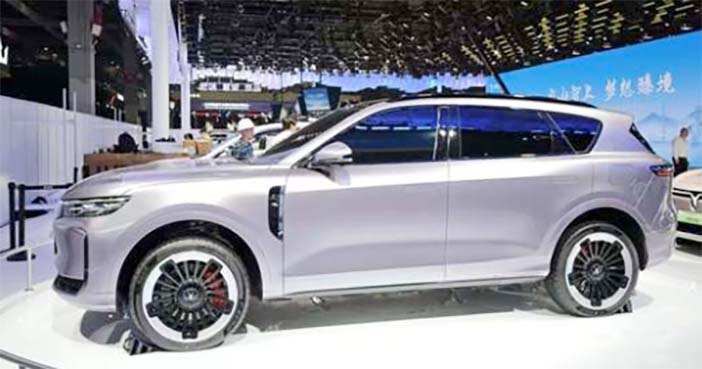
+++ The all-new VOYAH FREE+ officially debuted at the 2025 Shanghai Auto Show, representing a comprehensive upgrade rather than a mere facelift of Voyah’s flagship Free. The model has already garnered over 100.000 customers since its initial launch. The Voyah Free+ embraces a “City Light and Shadow Aesthetics” design language, balancing family practicality with individual style. The exterior features a cleaner, more unified body colour scheme complemented by new 21-inch dynamic wheels and increased ground clearance, giving the vehicle a more luxurious and substantial presence. Dimensionally, the Free+ has grown slightly, measuring 4.915×1.960×1.660mm in l/w/h with a wheelbase of 2.960mm. Compared to its predecessor, the length and width have each increased by 10 mm, while height has increased by 15 mm, offering more spacious passenger accommodations. The most significant upgrades come from technology. The Free+ will be among the first vehicles to feature Huawei’s ADS 4 advanced driver assistance system paired with HarmonyOS Cockpit 5. This system supports highway NOA (Navigation on Autopilot), automatic lane changes, and vehicle avoidance, enhanced by a laser radar and multi-sensor fusion solution for improved safety. The vehicle’s chassis has also been upgraded with an EDC “Magic Carpet” suspension system offering five customised driving modes. This new suspension can anticipate road conditions, providing dynamic performance and improved comfort during travel. Inside, the Free+ offers premium features including an onboard refrigerator, customised pressure-relief seats, and an entertainment display screen. The cabin also features an immersive surround sound system, creating a more luxurious and comfortable environment. The Free+ continues to use a 1.5T range extender coupled with dual electric motors. The system delivers a combined power output of 483 hp and 720 Nm of torque, enabling acceleration from 0 to 100km/h in 4.4 seconds. For enhanced safety, the battery has been changed from ternary lithium to lithium iron phosphate, with a pure electric range estimated at 150 km. The vehicle will launch in the coming months, though specific pricing details have not yet been announced. +++