
+++ For the first time, Chinese electric vehicle giant BYD outsold Tesla in Europe, signaling a dramatic shift in the region’s EV landscape. According to new data from JATO Dynamics, BYD sold 7.231 fully electric vehicles across 28 European countries in April, edging out Tesla by just 66 units. But analysts say the significance goes far beyond the numbers. “It’s a watershed moment for Europe’s car market”, said Felipe Munoz, an analyst at JATO. European consumers appear increasingly open to Chinese-made EVs, drawn by their lower prices, even after the European Union imposed tariffs last year to shield domestic automakers. Tesla’s once-dominant position in Europe is faltering. The company’s EV sales dropped a steep 49% compared to April of last year, falling to 11th place for the month. Just a year ago, Tesla ranked second in quarterly EV sales, behind Germany’s Volkswagen. Now, it’s struggling in major markets like Germany and the United Kingdom, where April sales hit 2-year lows. Tesla began selling in Europe more than a decade ago and opened its Berlin Gigafactory in 2022. But recent political backlash tied to CEO Elon Musk, who has poured millions into supporting president Trump and taken a controversial advisory role in Washington, may be accelerating the brand’s decline abroad. BYD, short for “Build Your Dreams”, has aggressively scaled up its European operations. It started selling in Norway and the Netherlands in 2022 and is now building factories in Hungary and Turkey. The Hungarian plant will help BYD avoid EU tariffs, while also serving as the automaker’s European headquarters, expected to create 2.000 jobs. April sales tell a story of momentum: BYD’s electric car sales surged 170% year-over-year. If you include its plug-in hybrids, sales grew more than 300%, surpassing brands like Fiat, Dacia and Seat in some key countries. Despite BYD’s gains and Tesla’s slide, Europe’s top EV seller last month was Volkswagen, which notched over 23.500 new electric car registrations. That figure represents a nearly 60% year-over-year increase; proof that local brands still carry weight, even as global competition intensifies. But the trend lines are clear. BYD’s swift ascent in Europe, in the face of trade restrictions and growing geopolitical tensions, signals that Chinese automakers are here to stay and may soon reshape the European auto industry as we know it. +++
+++ In recent years, loyal and passionate enthusiasts who dwell on forums, comment sections, and social media platforms have been very vocal about the changes that automakers enact on their beloved vehicles. Fans feel unrestrained to express their emotions and opinions when it comes to decisions that they consider as controversial. No other phenomenon is just as apparent as the vocal internet enthusiast backlash surrounding the revamped MERCEDES-AMG C 63 S E-PERFORMANCE , which swapped the 4-liter biturbo V8 for a 2-liter 4-cylinder turbocharged engine with a performance-oriented plug-in hybrid system. Though it makes earth-shattering 671 hp and 1.000 Nm of torque, numbers on paper could only go so far. In a new interview, Mercedes-AMG CEO Michael Shiebe addressed the response associated with the decision to replace the C 63’s brashly loud twin-turbo V8 powerplant for a turbo-hybrid 4-banger in the new model. “We probably could have better explained the technology to our customers. There are pure V8 fans, and it’s hard to convince them of this 4-cylinder hybrid technology”, Schiebe told, adding, “It’s my job to do a constant review of our portfolio. I’m pretty confident that we will fullfill our customers’ dreams in the next 2 to 3 years”. The latest statement from the Mercedes-AMG CEO reflects similar ones in past interviews. In a July 2024 interview, Shiebe noted that some customers “take time to really be excited for the technology” and that “it’s important to be open-minded when it comes to technology”. Additionally, in an April 2025 interview, he admitted that some of AMG’s very loyal customers “struggle[d]a bit with the concept”, and that it “lost some customers who are just into V8s”. However, he felt confident that the doubt would melt away behind the wheel. “We jumped far ahead with this technology, but we should have explained the technology more to our salespeople and customers”, the AMG boss told Car. “We will continue to do that and further improve. There is a German saying, ‘You never have a second chance at a first impression.’ Maybe we missed out on the first impression, but if you have the opportunity, I’m sure you will be convinced of the technology”. In the same interview, Shiebe noted that AMG’s future cars will be distinctively AMG. When asked about how its future EVs would distinguish themselves among the line-up, he noted that “There won’t be such a difference between them, because all these cars need to be an AMG first and then an petrol car or electric vehicle second. When you buy an AMG, you buy the performance, the emotion”. He also added that making AMG’s offerings visually different than mainstream Mercedes-Benz models is as important as ever, noting that its buyers “love the distinctive AMG look and the differentiation it brings. Our future cars will be more expressive in that dimension. If you look into the future, I would say you can expect cars that will be more visually differentiated: AMG will be doubling down on design; our design language will be more expressive”. +++
+++ The forthcoming POLESTAR 7 , the brand’s first mass-market model, is set to be a far bigger seller than any of its current line-up but will retain the premium billing and dynamic credentials of those cars. The Europe-made, Europe-focused crossover is being primed as the catalyst behind a significant growth in sales for the Swedish car maker. Polestar has not yet said whether it will use its own architecture for the 7 or adapt a platform from the wider Geely group, as it has done with each of its current models. Either way, CEO Michael Lohscheller was keen to emphasise the firm’s commitment to ensuring the new 7 looks, drives and feels like an authentic Polestar. Asked if he had any concerns about a more mainstream model diluting Polestar’s premium positioning, Lohscheller said: “No, because we’ll make sure we get the Polestar DNA right into it. That’s the key task of our R&D teams: to make sure that Polestar DNA, in terms of chassis tuning, behaviour, look and feel, comes in, and it behaves totally like a Polestar”. Citing the stark differences between the Polestar 3 and the closely related Volvo EX90 as an example of how 2 cars that share a platform can still be obviously differentiated models, Lohscheller said: “If you take the Polestar 3 and the EX90, I would argue it’s executed very well. The Volvo is comfort and safety, nice and easy for the commute; the Polestar is a performance car: you feel it in how it drives. The suspension is different, the chassis tuning is different”. The comparison suggests that while the Polestar 7 might be similar in size and closely related to sibling models from Volvo, Zeekr or Lotus, for example, it will be engineered to have a markedly distinct dynamic character that’s in line with Polestar’s sporting billing. The 7 will also be distinguished by an evolved design language that Lohscheller says will be rolled out to all Polestar models to make them “more confident” and better show off their performance potential. “Design is of the highest importance”, he added. “The 7 needs to have a very compelling design, obviously in the Polestar style. Maybe a bit more confidence going forward and the performance element is also super important”. Lohscheller also said a defining tenet of this new treatment (as being defined by new head of design Philipp Römers) will be making the cars “less minimalistic”. But he stressed that the brand will not seek to completely overhaul its styling cues, so the 7 will be recognisable as a sibling of the 2, 3 and 4. “I wouldn’t say different”, Lohscheller said of the new look. “Design is always evolving. It will develop, especially with a new head of design, but I would say we’ll keep the basics in terms of Scandinavian design, but I want to have a bit more confidence”. Lohscheller stopped short of confirming whether this new design approach means the Polestar line-up will be available in a broader and brighter spread of colour options than those currently offered. Polestar has already announced the 7 will be built in Europe; Lohscheller said a precise location will be confirmed in the coming weeks. Volvo’s Ghent factory in Belgium is one candidate, but that will soon be supplemented by a new Volvo plant in Slovakia, which could also accommodate some Polestar production. +++
+++ PORSCHE has reportedly instructed its dealers to suspend sales of used first-generation (pre-2025) Taycan. It involves 135 cars that require a fix for a battery issue. But the Taycan’s problems are perhaps deeper as the performance EV faces broader market challenges. As a used car it just isn’t going well with the buying public. Prices have been tumbling and stocks piling up. Used Taycans are experiencing significant depreciation, with values dropping by nearly 50% within 12 months for some models. In contrast, a Panamera dropped 34%. In the U.S., similar trends are evident. A new Taycan depreciates just over 61% after 5 years, while a new Panamera depreciates just under 48% in the same period. The pre-2025 Taycan also suffered from a range disadvantage compared to the Tesla Model S. That changed with the 2025 model, which brought a major boost in both range and efficiency, making it the version most buyers now prefer. +++
+++ Japan has an incredibly strong local car market, and while most of the new cars sold there are built locally, the country does import thousands of vehicles every year. Contrary to what most people think, including some policy officials from the Trump administration, Japan has maintained a zero-tariff policy on imported vehicles since 1978. But here’s another surprise that might actually throw you off: in April, it was actually a Japanese brand that imported more vehicles than any other carmaker. Wrap your head around that one. The company in question is SUZUKI . While it’s one of the nation’s most recognized brands, it actually manufactures several models in India and then ships them back to Japan. One of the standout imports is the five-door Jimny Nomade, which is proving to be particularly popular. In April, Suzuki imported 3.990 vehicles into Japan, surpassing the 3.202 units imported by Mercedes-Benz and the 2.575 vehicles imported by BMW. As you can tell, the Jimny Nomade is largely responsible for this surge. Suzuki received roughly 50.000 orders for the 5-door from Japan in just 4 days, despite the carmaker having only forecast monthly sales of 1.200 units. In addition to starting Indian exports of the 5-door Jimny to Japan in April, Suzuki also imports the Fronx from India. Suzuki believes the Fronx can be a hugely important global model for it and plans to sell it in more than 70 countries. Suzuki has set ambitious goals for its Indian operations, aiming to ramp up annual production there to 4 million units by 2031. To make that happen, the company plans to invest $8.3 billion in its Indian production facilities. With this expanded capacity, Suzuki hopes to solidify India as a critical hub for global markets, including Japan, Europe and Africa. This isn’t the only Japanese carmaker importing vehicles into its home market. Between January and April, Honda imported 16.720 vehicles into Japan. Many of these were for the WR-V compact SUV, which it builds in India. In total, 35.269 vehicles from Japanese brands were imported into Japan during the first four months of the year, representing a 33% year-on-year increase. It’s clear that while Japan’s domestic market remains strong, its automakers are increasingly looking beyond their borders to stay competitive. +++
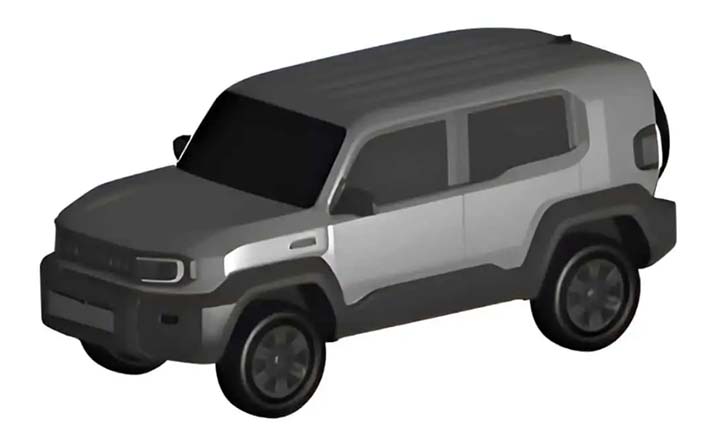
+++ It’s been almost 2 years since TOYOTA teased the shadowy silhouette of a small, boxy SUV during the Land Cruiser 250’s debut. There have since been a handful of hints that the automaker is still developing that smaller off-roader, but now we potentially have our best look yet. This might be the new Toyota FJ Cruiser. The lone design image comes from a filing at the patent office in the Philippines. Toyota filed for the patent way back in January 2024, but the local press only recently stumbled upon the design. It looks very similar to the shadowy silhouette teased in 2023. The rear looks awkward from the provided angle, and the D-pillar appears massive compared to the rest of the vehicle, which would create equally huge blind spots. The rear bumper cladding also looks a bit too chunky at the back, but it does seem to have a spare tire mounted on the liftgate, alluding to its ruggedness. The vehicle looks plain in these patent images, admittedly, likely representing the base version. There are no fog lights and no roof racks. The wheels also look quite small for something supposedly suited for Moab. But the teaser (that we lightened in Photoshop) shows an appealing-looking addition to the Toyota line-up nonetheless. Shortly after Toyota teased its small off-roader, the automaker filed a trademark for the Land Cruiser FJ name. There’s still a lot of mystery surrounding the vehicle, which is likely to borrow styling cues from the Compact Cruiser EV concept. However, a report suggested the SUV would feature gasoline and hybrid engines instead. All these hints will hopefully add up to something incredible. We don’t doubt there’s a market for a smaller off-roader with some of the kit and capability of the larger Land Cruiser. +++
+++ The TOYOTA SUPRA is on its way out — again. Production of the fifth-generation GR Supra, co-developed with BMW and built in Austria alongside the Z4, is set to end by spring 2026. Toyota has already announced a Final Edition for the 2026 model year, signalling the end of this chapter, but the Supra nameplate isn’t being retired. Not yet. In recent interviews, Toyota executives confirmed that while the Supra will go on hiatus, it’s expected to return. “It would be logical that we would have a next-generation Supra”, said Cooper Ericksen, senior vice president of product planning and strategy for Toyota Motor North America. “But when and how is still not clear”. What is clear is that the gap between Supra generations won’t be as long as last time. Fans will recall the 2 decade stretch between the legendary 4th generation Supra and its modern GR-branded reboot in 2019. Ericksen insists that Toyota’s goal is to shorten that downtime significantly, though he didn’t offer a concrete timeline. Cost is a major factor. New global regulations, particularly around emissions and safety, are pushing automakers to either invest heavily in updates or start from scratch. For Toyota, refreshing the Supra isn’t feasible without a full overhaul. “It needs to be a new house”, Ericksen said. “When we can get the new house built is the question”. Toyota hasn’t officially greenlit a successor, but the intention is there. Whether the next Supra will be built in partnership, as the current one was with BMW, or like the GR86 with Subaru BRZ, remains undecided. David Christ, general manager of Toyota’s U.S. division, said he’d love to be involved in planning a new Supra, but admitted the decision lies with Toyota’s global leadership in Japan. There’s also the issue of prioritization. Toyota is currently overhauling its core lineup, including the recently revealed RAV4, which debuts a new electric platform, multimedia suite, and safety tech. With more than 30 Toyota and Lexus models in the U.S. alone, the company’s resources are stretched. +++