
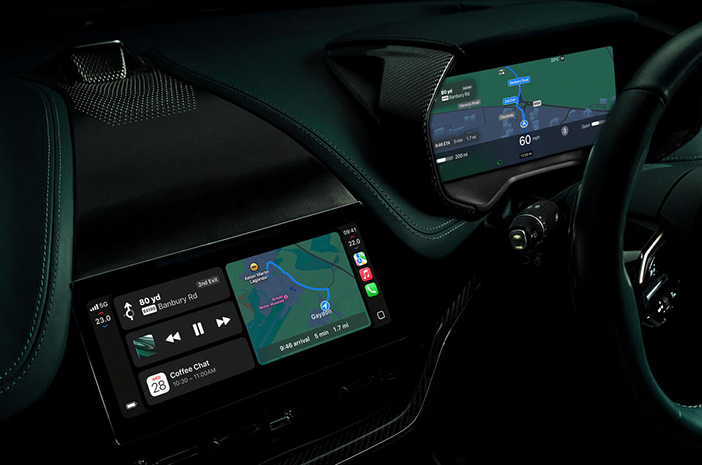
+++ ASTON MARTIN has become the first manufacturer to offer the second generation of Apple’s in-car smartphone mirroring system. Apple CarPlay Ultra dramatically expands the amount of screen space that the Apple interface can occupy, entering the car’s instrument display as well as its infotainment screen. This means users can display maps or media alongside the rev counter and speedometer. They will also be able to select one of various designs for the instruments, as well as personalised colours, backgrounds and screen layouts. Additionally, functions such as the climate and audio controls are now accessible via the CarPlay interface and can be adjusted using Apple’s Siri voice assistant. “Building on our in-house state-of-the-art infotainment system, CarPlay Ultra will provide additional functionality and personalisation opportunities which place Aston Martin at the forefront of infotainment in the sector”, said CEO Adrian Hallmark. The new system will first be rolled out in the US and Canada, then Europe within the next 12 months. CarPlay Ultra will be included as standard in the DB12, Vantage, Vanquish and DBX 707 from the 2025 model year, plus the new DBX S. Owners of existing cars with Aston Martin’s latest-generation infotainment system (introduced with the launch of the DB12) will be offered a free software update at official dealerships. CarPlay was launched in 2014 and first featured in the Ferrari FF, with the California T following shortly thereafter. Aston Martin’s current technology boss, Roberto Fedeli, held the same role at Ferrari at that time. By 2016, CarPlay had become an optional extra on many mainstream cars, such as the Mercedes-Benz A-Class, Peugeot 208 and Volkswagen Golf, and today it’s rare to see it omitted from the standard kit list on any new car. Notable exceptions include the Tesla Model 3, Tesla Model Y and Leapmotor models. +++
+++ JAGUAR LAND ROVER (JLR) raked in £2.5billion of pre-tax profit during the last financial year; its highest profits in 10 years and a 15 percent increase year‑on‑year, and saw record sales of the mighty Land Rover Defender, with 115.404 new models flying out of showrooms in that same period. JLR generated £29billion in revenues in the 12 months from the end of March last year during which time, like other car makers, it also had to navigate “global economic challenges”, particularly the 25 percent tariff imposed by president Donald Trump on foreign-made cars imported to the US, which was first announced back in February. Of course, the news of JLR’s record profits comes just a week after a trade deal was struck between the UK and US that will reduce the tariff for the first 100.000 British-made cars going across the pond down to 10 percent, and has provided some welcoming relief to the automotive industry in the UK. That’s great news for the Range Rover and Range Rover Sport which are built in Solihull in the Midlands, especially as the first-ever Range Rover Electric will be arriving very soon and has already amassed a waiting list of roughly 62.000 potential customers. However, the Land Rover Defender is made in Slovakia, meaning it’s still subject to the original 25 per cent tariff. When asked about this, JLR CEO Adrian Mardell told: “We’re working where we can to mitigate all the impact of tariffs, including on the Defender from Europe into the USA. We don’t have any news at the EU/US level of what trade agreements will be put in place, but similarly to the UK, we’re really confident at some point there will be a different trade deal, and therefore obviously we’re hopeful that will happen earlier rather than later, which will be important for our business within Defender in Europe. However, we have a series of measures that we will also be considering and taking, and depending on the time and extent that this 25 percent tariff continues with Defender, clearly the magnitude of those responses will become adjusted”. One obvious way to get around these tariffs is to simply build cars in the US, which is what president Trump is hoping companies will do. Mardell shut down any speculation JLR had such plans in the works, telling me: “We have no plans to build cars in the US at this point in time. That was the case before January, and it’s also the case after April (when the tariffs went into effect). “I’m not discounting at some point in some place going forward we do something in the US for the US, but there are no plans to do that”. JLR actually put a temporary stop on all car shipments to the US in April in response to the tariffs. It has reportedly now resumed exports to the States, but JLR’s chief financial officer Richard Molyneux is confident the pause won’t have impacted the company’s sales figures. He explained: “During the last quarter of last year we did push quite hard for US volume to make sure that we had probably more than enough stock for retailers to cover our position. Obviously knowing that something was brewing, and this did allow us to take a pause in shipments in April”. Of course, the rebirth of Jaguar as an all-electric luxury brand continues as well. Mardell confirmed by the end of this year we should be seeing a concept version of the brand’s new four-door GT, which will be built in the company’s Solihull plant, where new production lines have now been installed for the car. +++
+++ The new boss of LOTUS EUROPE is seeking to broaden production at the brand’s UK base to include new models from the wider Geely group. Matt Windle has been promoted from his position as Lotus Cars managing director following the departure of former Lotus Europe CEO Dan Balmer after less than a year. His broader role coincides with the recent merging of Lotus Cars with the Chinese-based Lotus Technology, which oversaw the brand’s so-called lifestyle EVs, the Eletre and the Emeya. “I think it’s better for the business”, Windle told in an interview. “It gives us a solid link between manufacturing and commercial on sports cars but allows me to work wider across the business as well”. Windle is keen to grow production at Hethel, which earlier this year announced 270 job cuts as demand for the Emira petrol sports car was hit by the sharp increase in tariffs in the US. “It has been a turbulent start of the year, which has had an impact on the business”, he said. Lotus last year posted record wholesales (sales to dealers) of the Emira at 5.272, up 102%, but Windle is keep to push close to the factory’s limits of 10.000 cars annually. “Back in the late 1990s and 2000s, we were building several models at Hethel, such as the Elise-based Opel Speedster and Tesla Roadster, and I think that’s a business model we’re exploring”, he said. One possibility is the forthcoming Polestar 6 electric roadster. “I think we could build it”, Windle said. “There’s an element of transition, because at the moment it’s just petrol sportscars at Hethel, but we’re going to have to go on that journey”. The US’s new car import tariff has hit Lotus hard, with the company cancelling sales of the Chinese-built Emeya and Eletre in the country due to the now-insurmountable financial hurdles. Lotus has also halted shipments of the British-built Emira to the US after the new 25% tariff was applied in April, meaning that no cars are heading to a market that last year accounted for a fifth of all Lotus sales. The deal recently agreed between the UK and US to lower those tariffs to 10% has helped Lotus, but Windle has yet to press go on restarting shipments to the US as he waits for the details. “The headline numbers have gone out there, but actually the specifics behind it still haven’t been clarified”, he said. “There’s product that’s ready to ship, but what we don’t want to do is jump the gun and end up getting clobbered. The tariffs are a negative with where we are now, but they could be a positive”. Lotus’s volume growth has been impressive, given where it has come from, with overall deliveries hitting 12.134 last year, double that of the year before. However, EV sales are below planned volumes as demand for luxury electric cars has fallen below expectations. Lotus is countering that with planned launch of ‘Hyper Hybrid’ range-extended EVs that feature a turbocharged combustion engine. The first such model will be unveiled at the end of this year for sales starting in China early next year, CEO Feng Qingfeng said on the company’s earnings call on 22 April. No date has been set for European sales, though, Windle said. The planned new electric sports car to be built in Hethel, meanwhile, is on hold as Lotus assesses likely demand. “Is the market ready for an electric sports car? I don’t really know the answer to that yet”, Windle said. One possibility is to install an electric drivetrain and batteries into the current Emira platform and offer it as a variant, but uncertain customer response is hampering decision-making. “I think being a product strategy person in the automotive industry is probably one of the most difficult jobs areas at the moment”, Windle said. His message to European governments is to keep options open for consumers past 2035, including possibility allowing a longer life for range-extended EVs. “A full BEV future might not be the answer”, he said. Windle’s elevation to Lotus Europe boss gives him oversight of sales within Lotus’s biggest global market, which accounted for 39% of the company’s global sales last year, at 4.743. He plans to growth that at first by expanding the dealers. “Network development is a big part of our strategy is around volume growth going forward”, he said. “I think the opportunity is there and it’s going to be exciting couple of years”. +++
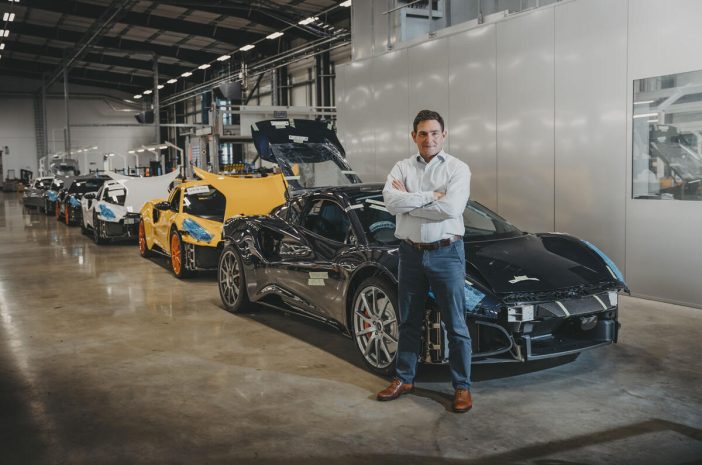
+++ It’s difficult to pin down what the ultimate variant of PORSCHE 911 is, but there’s lots of evidence to suggest it might just be the GT2 RS. This low-volume and scarily expensive model has long been a sign-off of a 911 generation, pairing the most extreme chassis derived from a GT3 RS with an even more powerful variant of a turbocharged powertrain nicked from the Turbo. For the 992 generation, Porsche looks to be going even further on both counts; if the wild prototype spied testing at the Nurburgring is anything to go by. First of all, the bodywork looks to be even wider than the one found on the GT3 RS, with cladding fitted on top of the standard rear haunches to hide a new set of prototype wheels that we’ve never before seen on previous Porsche test cars. This is matched at the front, with fat mocked-up arches that retain the arch vents and ducting from the GT3 RS, only much, much wider. The carbon-fibre bonnet with the vast openings that vent the radiator is fitted, as is the carbon roof with its longitudinal vanes. These channel air to the motorsport-sized rear wing and its DRS function. However, look closely at the back and you’ll see a number of changes compared with the naturally-aspirated GT3 RS, because not only are new 992.2 rear lights fitted, but also a different lower bumper that evidently hides a new exhaust system. In place of the GT3 RS’s twin central pipes are a pair of makeshift tips mounted on the inner part of the rear bumper. While the outlets don’t represent the ones we’ll see on the production car, their placement likely is, suggesting a brand-new rear end will be required to fit the Turbo’s exhaust system. Details are otherwise extremely thin, but until we see the new 922.2 Turbo coming later this year, I can only speculate on the extreme powertrain. It could integrate a similar hybrid system, such as the one fitted to the GTS, which incorporates a small e-motor mounted inside the dual-clutch transmission and another one inside a single large turbo. However, how the new Turbo will integrate this technology remains to be seen, by extension informing what we might see on this GT2 RS. In terms of power, Porsche could push the figure well beyond the 700 hp figure of the last GT2 RS that appeared in 2017. With the next 911 Turbo S likely to get close to that figure, I suspect the 992.2 GT2 RS will easily eclipse 700 hp, potentially treading closer to the 800 hp mark; something especially viable if Porsche wants to go the ultimate extreme before European emissions regulations render creating these figures impossible. Power will almost certainly be sent only to the rear wheels via an 8-speed dual-clutch automatic transmission; a manual option is not likely with such huge power and torque estimates. There’s also no reason not to suggest that substantial aero and chassis upgrades will be part of the package, with Porsche certain to utilise carbon fibre for a majority of the body panels and interior. High-end elements found on cars such as Ferraris and McLarens, for example spool valve or hydraulically cross-linked dampers, are the next logical step when it comes to supercars of this nature, so it wouldn’t be surprising to see Porsche using its flagship 911 as a test bed for future generations. +++
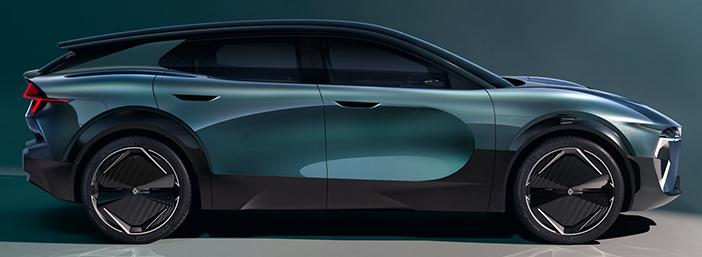
+++ RENAULT is working on an exciting new flagship crossover with lots of space and a family-friendly focus: think of it as the Espace of tomorrow. The company showed the long and sleek Embleme concept last year, and Renault’s design and engineering team is exploring ways to put a similar concept into production. It’s likely to be all-electric and will probably be the next-generation Espace, landing before the end of this decade. “What do we think will be a future D-segment electric car?” Renault brand boss Fabrice Cambolive was asked. “This is something which we are looking at. But for now it’s part of our secret recipe”. Cambolive extrapolated that Renault was eager to use the additional cabin and trunk space unlocked by electric car platforms, which don’t need to accommodate an engine, and the aerodynamic benefits of a long car to boost range: together that concept sounds a lot like the Embleme. “The Embleme is the purest expression of where we want to push the modern part of Renault design”, Renault Group’s design director Laurens van den Acker told. “Don’t underestimate Embleme: it’s a beautiful object. It’s one thing to seduce people with a form that you know. It’s another thing to seduce you with something that’s completely new”. Think of it as Renault’s alternative to the Citroen C5 X, which is nearly identical in size and also a 5-door crossover. Renault describes the Embleme’s bodystyle as a shooting brake, the classical term for a slender, often 3-door estate car. “For me, it’s the proportion of the future”, explains the Dutch design leader. “It’s a little bit lower than an SUV but it’s a little bit taller than a saloon for the simple reason that we need to put the batteries in the floor”. The Embleme show car runs a range-extender hybrid powertrain, with the 40 kWh battery pack charged from a plug or by a hydrogen fuel cell mounted in the nose. The battery feeds a 220 hp motor mounted on the rear axle. No current production Renault is rear-wheel drive, but future iterations of the Embleme’s AmpR Medium platform should be sufficiently flexible to site an electric motor up front, in the rear or even combine motors for high-performance four-wheel drive. The big question is whether the production Embleme will be electric or hybrid? While arch rival Peugeot uses ‘multi-energy’ platforms from its parent group Stellantis, meaning both EV and electrified combustion versions can be built on one architecture and go down the same assembly line, Renault’s current strategy is to have separate platforms. Van den Acker says that if you mix the 2 powertrain types, the additional frontal area needed to safely package combustion engines makes a car longer but compromises interior space that could be allocated to an EV. “So you either have a long hybrid car that isn’t spacious enough or a short electric car that is too heavy”, he argues. The Embleme has a long, 2.9-metre wheelbase (not far off the new BMW 5 Series’), relatively short overhangs and a stubby nose; the classic proportions of an EV. These proportions could be protected or even enhanced by using the next-gen AmpR Medium platform. And the smart money is on pure EV, as per brand boss Cambolive’s thinking. The cabin should live up to the spacious, flexible designs of iconic MPVs the Scenic and Espace, hints Cambolive. It doesn’t need to reach 5 meter-long to spaciously package 5 or even 7 seats: the forthcoming electric Twingo is a city car harbouring the cockpit space of a supermini. “You have the best world of both segments”, muses Cambolive. “It’s a segment which is very low for non-premium car brands, so it will be very interesting to come with this proposal. You mention our experience in the past with Scenic, or in the past with the 1992 Twingo and its sliding bench; it’s something we we could reinterpret with our next generation”. The Scenic E-Tech, which is 33 cm shorter than the Embleme, can stow 87 kWh of batteries between its wheels. Renault’s future flagship could conceivably package more cells, though the thinking behind hydrogen range extenders is to halve the size of the battery and reduce the consumption of raw materials. Thanks to the fuel cell creating electricity on board, the Embleme can drive 1.000 km with just a couple of 5-minute stops to gas up the tank, assuming you can find a hydrogen filling station. While Toyota may have productionised fuel cells with the Mirai, don’t expect Renault to follow suit. The powertrain choice is between petrol/electric hybrids (options already offered in the slightly shorter Rafale) or pure battery electric to create a zero-emissions flagship. Given that the production Embleme isn’t expected before 2028, Renault won’t have to finalise powertrains just yet and can watch if the EV adoption curve intensifies, or if Europe’s phase-out date for petrol hybrids recedes. Regardless, Renault will soon have a second battery chemistry in production. Its current batteries are NCM (nickel cobalt manganese) but it will be adding European-sourced lithium iron phosphate (LFP) cells in 2026. As popularised by Chinese car maker BYD, LFP batteries don’t need any cobalt but are typically less energy dense than NCM batteries. Renault plans to overcome this with an efficient ‘cell-to-pack’ design that crams in more cells. Switching to LFP should reduce battery cost by 20 per cent, helping boost margins and ideally bring down EV prices. The batteries will be recyclable, in keeping with the Embleme’s philosophy; half of the concept’s materials are recycled and the carbon footprint of its components reduced by 70 percent. This is an extreme example of Renault’s corporate commitment to increase the recycled content of production vehicles to a third of its weight by 2030. +++
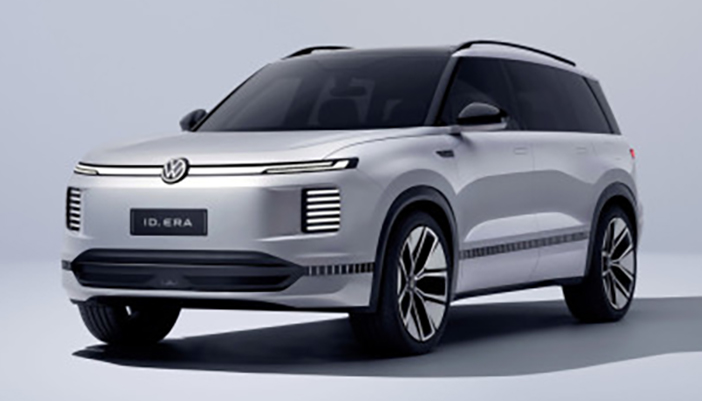
+++ VOLKSWAGEN boss Thomas Schäfer has cast doubt on the prospect of the brand introducing range-extender (REx) powertrains in Europe, because it is already well served here by more conventional hybrid powertrains. Volkswagen last month revealed the ID.Era SUV concept at the Shanghai motor show as a preview of a large, range-extender electric SUV, aimed at the Chinese market, with a total range of 1.000 km. The brand’s sales and marketing chief said at the unveiling that REx technology could provide a “very good intermediate step for many consumers” and the powertrains could even “have relevance in Europe”. But now Schäfer has told that REx powertrains make most sense in larger models (like the ID.Era) and may not have an obvious role to play in Volkswagen’s European strategy. “The technology is not really new. It came up again and spiked in China specifically, but probably also in the US it’s applicable, in predominantly larger vehicles”, he said. “It makes sense if you have any kind of CO2 regulation and you need to comply with it, but in the bigger cars. “The questionable area is in the smaller space. While you have PHEVs, do you really need range-extenders?” Indeed, Volkswagen now offers almost every car above the Polo in Europe with a plug-in hybrid powertrain, providing as much as 140 km of electric range in the Golf eHybrid, which could make it unnecessary to introduce another form of electrified powertrain. “It’s an expensive technology”, said Schäfer of a REx set-up, referencing the need to combine a large electric battery with a conventional ICE powertrain, “and from a drivability and cost point of view, it makes no sense to have both range-extenders and plug-in hybrids”. He pointed to the long EV ranges and fast-charging capabilities of Volkswagen’s latest PHEVs and said swapping this system out in the Golf, Passat, Tiguan and Tayron “is probably not the way to go”. “In bigger cars, yes. Scout, for example, in the US will have a range-extender”, he said. “But it remains to be seen if this is just a spike or it will actually be a bigger trend”. The ID.Era is 1 of 3 new Volkswagen concept cars designed for the Chinese market. It was joined at Shanghai by the Passat-sized ID.Aura saloon and the ID.Evo; a more rakish take on the SUV, but still larger than the Touareg. Schäfer said that while these 3 cars have been conceived primarily for China, Volkswagen could consider selling them globally, but only if there is demonstrable market demand and a viable business case. Asked if Volkswagen could bring the Evo or Era SUVs to Europe, he said: “We never said that we’re not going to do that. The question is: where do they fit in the portfolio, and where’s the market? When you look in Europe, for these kinds of big SUVs, the market is very small, and it’s premium-driven. So to invest in this in Europe is difficult. China: yes, United States: yes. We have in the past done similar things like the Atlas in the US and Terramont in China, so there’s a way you could work on both sides. “But for Europe, we have been working on: what is the portfolio? Where is the profit pool that we want to address? And in a time where you work with a tight budget, you have to make decisions: what do you want to address, first, second and third? And that’s not something that I would address first in the European context. We have a clear line-up now, from the ID.1 all the way up, that we’re very happy with, addressing right from the entry all the way to the upper end with the ID.Buzz. That doesn’t mean that in the long run, once we get through this transformation a bit more, we couldn’t get halo cars added to this core portfolio”. +++
+++ VOLVO is moving to a more regionalised business model that will help it better adapt to differing market demands and legislation in Europe, the US and China. Under the stewardship of recently re-appointed CEO Håkan Samuelsson, Volvo Cars will devolve more power to its American and Chinese divisions while “more directly” steering its European operations from its HQ in Sweden. The move was detailed by Samuelsson at the Financial Times Future of the Car event, shortly after Volvo announced a drastic global cost-cutting plan in response to a significant drop in sales and a “challenging external environment”. +++