
+++ AUDI is set to reveal a new concept car later this year that will preview an all-new look for the brand under design boss Massimo Frascella. Frascella joined Audi from JLR 18 months ago and his impact on the German brand will be seen for the first time before 2025 is out, CEO Gernot Döllner has confirmed. Döllner did not reveal the size or type of car the concept would preview but did say that Audi would only produce concept cars that have true production intent and it would be “a bold step” for the brand and its design. “We won’t show studies anymore”, said Döllner. “When we show things, they will be substantial. Every concept we show will have a product decision behind it”. The new design for Audi “would look to the future and the strengths of Audi design, for clarity and to bring that to the future, not copying the past”. While the new look would take some time to make its way to the road, perhaps 2028 at the earliest working on a 3-year production cycle, Döllner said the new Audis in the meantime (the brand is in the middle of rolling out 20 new cars over 3 years) are machines he is “positive about and excellent products”, but “we need a bigger step as a brand”. Döllner praised the impact Frascella was having on Audi and said that the pair of them had “a clear vision for Audi design”. He added: “I’m really happy and impressed with that already he has brought on in a year at Audi”. +++
+++ HONDA will show a concept car hinting at a new city-focused EV at next month’s Goodwood Festival of Speed. Named the Super EV Concept, it is an A-segment hatchback to rival the Hyundai Inster, Fiat 500e and upcoming Renault Twingo, with styling that draws on the previous Honda E. Technical details remain thin on the ground, but Honda said it is intended to show how a small, affordable EV can be fun to drive. It has already been tested as part of a broader international roll-out. The Super EV Concept will be unveiled at the Festival of Speed, which will take place between 10 and 13 July in West Sussex. Honda will also use the event to showcase the radical 0 Series SUV concept in Europe for the first time, as well as the Civic Type R Ultimate Edition. The new Prelude coupé will also run up the famed Goodwood hillclimb. The Super EV Concept represents another string in the bow of Honda’s future EV line-up, likely bookening the new 0 Series range. The Japanese brand plans to launch seven new EVs in the coming years, with these using a new platform, new batteries and new motor technologies, in an effective reset of its approach to electrification compared with the old E and current e:Ny1. “As society is starting to move from the early stage to the widespread adoption stage, the time has come to invest in our EV strategy”, Honda CEO Toshihiro Mibe said last year. However, Honda is also going big on partial electrification, with 13 new hybrids due globally by 2030 in a bid to bridge the gap to mass-adoption of battery-electric cars. These will use what the brand has claimed to be the most efficient combustion-engined powertrains yet. +++
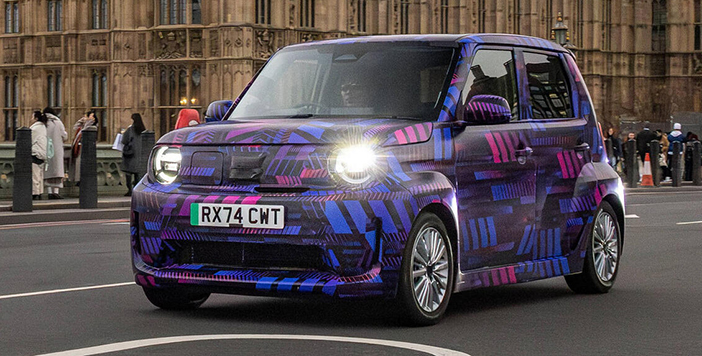
+++ The PEUGEOT 308 is gearing up for a midlife nip and tuck, promising small styling tweaks and subtle upgrades under the skin. It’s most likely the new 308’s styling will take inspiration from the newer 3008 and 5008, with sharper headlights and 3-prong daytime running lights. We can also expect Peugeot to make the grille less prominent than the outgoing car’s, probably with the use of extra body-coloured trim. The current 308’s front end is more reminiscent of a conventional petrol or diesel car, so the maker will want to modernise the model’s look with a fresher face. To the side we can see a new wheel design not currently offered on the 308. Its geometric, squared-off design isn’t dissimilar to some of the options available on the latest 5008, and should carry over to the production car unchanged. As before, the Peugeot crest features on the front wing. At the back, the 308 will get a subtly different lighting signature, but the bumper design doesn’t appear to have been altered all that much. I don’t expect any fundamental changes to the car’s underpinnings, meaning the 308 will remain on the EMP2 architecture rather than moving to the newer STLA-Medium platform. However, recent updates saw a new Plug-in Hybrid 195 model added to the range, boosting the 308 PHEV’s zero-emission range to almost 80 km. Elsewhere, the petrol-electric Hybrid will be carried over, but the diesel is likely to be ditched; the mechanically similar Opel Astra is no longer available with a diesel engine, and the fuel is used sparingly by the 308’s rivals. We may see the E-308’s battery capacity increase slightly, but its usable range is unlikely to trouble dedicated-EV rivals such as the Cupra Born. The 308 is likely to drop its camouflage over the coming months, before being revealed in full before the end of the year. +++
+++ Luca de Meo, RENAULT ’s boss, is the powerhouse of the European car industry. 5 years ago, in the summer of Covid-19, he was appointed to salvage the French car maker, which had just posted a 7.3 billion euro loss. In February he announced the best profits in the group’s history, and next month he’ll be leaving on a high. Unless you’re an investor, you might not care. But if you care about affordable small cars, charismatic electric cars or Alpine sticking with sports cars and Formula 1 despite neither being an easy win, then you should care about Luca de Meo. Because he stands for all those things and plenty more besides. Let’s start with the new Renault 5. A design proposal to bring back the chic supermini was rejected by the previous management team; de Meo arrived, saw it and instantly fast-tracked the electric city car. It’s won a string of awards including the European Car of the Year title, Renault’s second in succession following the triumphant Scenic E-Tech. The electric Megane, the first all-new car of the de Meo era, would have had smaller wheels and far less sporty looks, had the passionate Italian not injected the Renaultsport version’s details into the base car. His argument that it was a hot hatch was a prime example of De Meo’s passion getting the better of him, but the sharp steering and turn of pace do make for an engaging EV. Instantly De Meo turned Renault’s product pipeline upside down, killing several underwhelming projects and introducing the Symbioz to attack the popular small SUV market, flagship Rafale (which admittedly won’t break the German premiums’ stranglehold) and, boldly, reviving the company’s ugly but beloved sixties hatch, the Renault 4, as an electric SUV. Previously, Carlos Tavares (the man who turned around Peugeot-Citroen, bought Vauxhall/Opel, then merged the company with Fiat-Chrysler to create Stellantis) was also a powerhouse of Europe’s car industry. His cost-cutting expertise and success with bigger SUVs such as Peugeot’s 3008 and 5008 undoubtedly influenced de Meo’s turnaround plan for Renault. But Tavares’s confrontational character (often battling with politicians, car dealers and colleagues) meant he left his post early. De Meo, at a dinner early in his tenure, told me China’s grip on the electric car supply chain was one thing that kept him up at night. But instead of calling for tariffs on Chinese EVs (Tavares’ initial position before he reversed it by launching the Leapmotor joint-venture), de Meo decided that if you can’t beat ‘em, join ‘em. He established the Advanced China Development Centre, a skunkworks where Renault Group could learn the Chinese’s ultrafast EV development practices. While the Megane took 4 years to develop from design freeze to engineering sign-off, the 5 and 4 arrived in 3 years, and next year’s forthcoming Twingo took closer to 2 years to engineer. Another far-sighted alliance, Horse Powertrain, was forged when Renault folded its combustion engine, hybrid and gearbox assets in with Chinese automotive behemoth Geely, whose European brands include Volvo, Lotus and taxi-maker the London Electric Vehicle Company. Such ‘old-school’ engineering where demand is dwindling typically weighs on legacy car makers’ share prices. But Renault and Geely co-created a separate joint venture that will engineer powertrains for industry-wide customers, also supplying markets such as Latin America and Africa that will go electric more slowly. The Renault CEO also spotted the shift to software-defined vehicles and invested in the group’s digital capabilities, while enlisting expert Google to power the group’s in-car operating system. Android voice control and Google Maps work brilliantly in cars such as the Scenic and 5 E-Tech, while bigger rivals such as Volkswagen are struggling to compete with their in-house user experience. I last spoke to the Renault Group CEO on a windswept cliffside in Dieppe, France, at the unveiling of Alpine’s new A390 electric crossover. He was holding court with a few journalists, recounting how visiting the motorsport brand’s factory was one of the first things he did in 2020 upon becoming the company’s leader. “Alpine was supposed to be closed because, after the A110, we had no plan for this place”, de Meo recalled. “I started to think about how I could give new life to this brand, which has something magical. I’ve done that in other companies: reviving Abarth, launching Cupra, that’s my specialty”. While Abarth has bumbled along, de Meo’s brainchild Cupra has gone from being Seat’s sporty trim level to a standalone brand bagging almost 2 percent of the European market (219.000 units in 2024). Cars such as the distinctive Formentor and Born, which is better to drive than its Volkswagen ID.3 counterpart, make more money for VW than the Spanish brand it acquired in 1986. De Meo quickly rebranded the Renault F1 team as Alpine to promote the brand, which has grown its motorsport presence into endurance racing. Former Ferrari engineer Philippe Krief, a De Meo recruit, runs the outpost, which is unleashing a range of electric cars including the A390, A290 hot hatch, an all-electric replacement for the A110 coupe and a V6 hybrid hypercar. There’s no guarantee it will work, but the brand is fighting for a future that wasn’t even a pipe dream 5 years ago. The driven Italian’s final crusade has been to convince European regulators to relax the emissions and safety rules on compact cars, which are making superminis unaffordable for many consumers. “Between 2015 and 2030, a Renault medium-sized car will have increased in terms of cost by 20 percent, whereas for small cars it’s 40 percent”, he has said. “That’s something we have to reverse because a small car such as the next-generation Twingo with its smaller battery and smaller size with less steel, plastic and parts, will have a 75 percent lower CO2 impact cradle-to-grave than the average European car. Teaming up with Stellantis chairman John Elkann, de Meo has spoken publicly to call for policies, such as Japan’s kei car fiscal incentives, that will help sub-4 metre cars grow from just 5 percent of the European market. While there is clearly commercial self-interest at stake here (French and Italian car makers are more exposed in small cars than German ones), de Meo has reconfigured Renault to be among the leaders in lowering its cars’ carbon footprint. And reversing the tide that has seen Ford ditch the Fiesta, and most car makers exit the city car segment will boost customer choice. At the time of writing, Renault Group’s share price is down more than 8 per cent, while Kering, the struggling French luxury brand group De Meo is rumoured to be joining, is trading up. An auto industry executive going to run a luxury house is “very unusual”, an apparel industry leader told. “Because luxury brand margins are so immense, they typically just keep marketing and driving revenue with zero attention to costs. They’ve never had anyone from outside the industry to worry about costs, until Luca de Meo arrives”. “There comes a time in one’s life when one knows the job is done”, said Luca de Meo in a statement issued by Renault Group. “We have faced immense challenges in less than 5 years and achieved what many thought impossible. “The results speak for themselves: they are the best in our history. We have a strong team, an agile organisation and a strategic plan ready for the next generation of products. That is why I have decided it is time for me to hand over the baton. I am leaving a transformed company, poised for the future, to apply my experience to other sectors and embark on new adventures”. Renault, and the auto industry’s loss, looks set to be Kering’s gain. +++
+++ SMART is preparing a successor for its ForTwo city car, which could leave the door open for the Roadster to return. Introduced back in 2003, the tiny, lightweight 2-seater was respected for its balanced mid-engined layout. One noteworthy fan was legendary Formula One car designer Gordon Murray, who used a Roadster as his daily driver. I asked Smart CEO Jason Allbutt about a new Roadster during an exclusive interview. He laughed, but seemed enthusiastic: “We used to have one of those in the family, and it was particularly good fun”, he told. “For a country that has more rain than probably any other European market, we are lovers of coupés and roadsters. So yes, I could see a possibility for such a car”, As encouraging as that is to hear, Allbutt quickly added that there are no immediate plans to revive the Roadster. The brand currently has much bigger fish to fry, starting with the launch of its biggest model yet, the all-new Smart #5, which is due to go on sale this year. Following soon after that should be a new electric family hatchback called Smart #6, which we expect to see in the coming months. Hopefully, by the time that arrives, we’ll have commitment from the brand and a vision for the new ForTwo city car. But if the idea of making a new sports car catches on and the Roadster does make a comeback, what could we expect from a new interpretation of the original formula? Lightness and compact size would be key, and it’s near-certain to be electric. Smart is committed to its vision of being an EV-only brand, but that shouldn’t stop it forging ahead with plans for a new sports car. Indeed, several established names will make the switch to electric over the next 2 years. Most recently, we learned about the new Alpine A110 due to be unveiled in 2026, which its maker says will weigh less than 1.5 tonnes and feature innovative in-wheel motors. The next-generation Porsche Boxster and Cayman will also be ditching petrol power, as will the Lotus Emira and the Mazda MX-5. Given the individual look of each of Smart’s current models, it’s impossible to say with any certainty what a next-gen Roadster may look like. We believe the design team would keep the original’s relatively lengthy wheelbase, with the wheels pushed out to the corners, plus the cab-rearward look and long bonnet. Features such as the contrasting side blade and rollover hoop could also be carried over. But Allbutt clearly has reservations about how ready roadster buyers may be when it comes to embracing electric cars. “I think a lot of people that drive these cars historically have been traditional car enthusiasts”, he told us. “Part of the joy of having the roof down, in case you have less hair to be ruffled nowadays, is also to hear the sound of the engine. Maybe there’s a new audience that would be looking at an electric roadster in a different way. I’m not quite sure yet as to who the buyers of that car really are. It’s too early to tell right now, but we’ll see”. How those other sports cars perform could influence Smart’s decision to make a new Roadster. The brand is still half-owned by Mercedes, in tandem with Chinese group Geely, giving the company access to the latest technology and the ability to respond quickly to trends. +++
+++ TESLA is priming reinvigorated versions of its hottest models to contend with fearsome new EV contenders from the brand’s European rivals. Updated versions of Tesla’s Model S Plaid and Model Y Performance have been spotted testing at the Nürburgring, suggesting imminent launches. The Plaid, currently one of the world’s most powerful saloons with 1033 hp, – was seen wearing light camouflage, concealing an aero-optimising refresh of its front and rear ends. The air ducts in its lower front fascia appear more angular and aggressive than before, while the rear diffuser has gained a ledge and a more protrusive centre section that is most likely intended to reduce lift at speed. The reworked front end also conceals an additional camera for the advanced driver assistance systems. Tesla has yet to confirm whether the Plaid will get any more substantial improvements under the skin, but the brand’s more recent launches point to potential upgrades that it could receive. The Cybertruck, for example, features 800 Volt electricals rather than the 400 Volt systems used in the Models 3, S, Y and X, allowing claimed peak charging speeds in excess of 400 kW. That it’s testing at the Nürburgring could point to Tesla looking to reclaim its production EV lap record at the Nordschleife. The Plaid was dethroned by the Porsche Taycan Turbo GT last year. But the Taycan’s significant 18 seconds advantage over the Plaid (7min 7sec versus 7min 25sec) suggests the American car would need extensive modifications to close the gap, such as extra power or a new chassis package. The Plaid faces an increasingly tough market: Mercedes-AMG is on the verge of launching its own 1000bhp-plus super-saloon, while American EV maker Lucid’s Air Sapphire is the world’s most potent four-door, with 1.250 hp. The new Model Y Performance will also face a much more crowded field of rivals than the first car had to contend with. Newcomers include the Porsche Macan Turbo Electric, Alpine A390, Hyundai Ioniq 5 N and Smart #5 Brabus, each offering different takes on the sporting EV crossover at a range of price points. The Tesla is expected to employ the same dual-motor, four-wheel-drive powertrain as its Model 3 Performance counterpart, producing a combined 510 hp and allowing for a 0-100 kph sprint time comfortably below 4.0 seconds. Tesla officially quotes 3 seconds to 100 kph, although this includes a short rollout to low speed that muddies the waters somewhat. Range is likely to be less than the Model 3 Performance’s 328 miles, although the presence of a long ducktail spoiler hints at further aerodynamic tweaks to minimise drag and potentially boost range. Inside, it is expected to get the 3 Performance’s thickly bolstered sports seats, along with carbonfibre trim detailing. Given the smaller Model 3 Performance is priced from €58.490 in the Netherlands, the equivalent Y is most likely to breach the €70.000 barrier. +++
+++ American president Donald Trump and British prime minister Keir Starmer have signed the deal that rubber stamps the UNITED KINGDOM ’s reduced 10% levy when importing cars to the US. As agreed last month, UK-made vehicles will be hit with a reduced tariff for the first 100,000 cars that enter the US. It follows more than a month of negotiations between British and American officials after Trump announced sweeping import tariffs on foreign-made products, including a 25% tariff on new cars. All tariffs were due to go into effect on 1 April, but a 90-day reprieve was given so that negotiations could take place. The 2 leaders announced signing the order on Tuesday during their visit to the G7 summit in Canada. Starmer called it “a very important day” for both countries. Details on the new deal are still currently sparse, but the US confirmed that the 10% tariff – which brings it in line with the levy on other foreign goods, will apply to “100.000 cars”, suggesting that anything over that number will be hit by the higher 25% rate. Previously, before Trump’s March announcement, the tariff was 2.5%. When it was announced in May, Starmer said the 10% rate represented “a huge and important reduction” and confirmed that “we have scope now to increase that quota; this is not final”. Last year, the UK sent some 102.000 cars to the US. The US is the British car industry’s second-largest export market, behind the EU. It received 27% of all UK-made vehicles in 2024, worth some £9 billion a year. No details were given on the proposed 25% tariff on car parts, which was due to come into force in the coming months. New deals on food, chemicals, machinery and industry have also been struck. Tariffs on steel and aluminium have been removed. The UK is the first nation to reach an agreement with the US following Trump’s tariff announcement in March. China will be next, according to American officials. Announcing the deal from the White House, Trump said: “I’m thrilled to announce a breakthrough trade deal. The agreement with one our closest and most cherished allies. Final details are being written up and will be detailed in the coming weeks”. He added that the deal removes many unspecified UK tariffs that “unfairly discriminated” against the US, saying: “They are opening up their country. Their country is a little closed”. Starmer said: “This is a really fantastic, historic day, a real tribute to the history we have of working together. This [deal]is going to boost trade”. In response to the news, Society of Motor Manufacturers and Traders boss Mike Hawes said: “The agreement to reduce tariffs on UK car exports into the US is great news for the industry and consumers”. “The application of these tariffs was a severe and immediate threat to UK automotive exporters, so this deal will provide much needed relief, allowing both the industry and those that work in it to approach the future more positively”, The news marks a major step down from Trump’s announcement in March, when he signed a bill that penalised all car makers importing cars into the US market. At the time, Trump said the decision was made because of the imbalance of American-made car sales in other markets and claimed that 0move would lead to “tremendous growth” for the US automotive industry. Around 8 million cars were imported into the US last year, approximately half the total sold in the market. Most were from Mexico, Canada, Germany and Japan. The news will offer relief to the UK’s car makers, especially JLR (Jaguar Land Rover), which counts the US as its biggest market, having sent 130.000 cars there in 2024. It last month paused shipments to the US as it worked to “address the new trading terms”. Speaking today, JLR CEO Adrian Mardell said: “The car industry is vital to the UK’s economic prosperity, sustaining 250,000 jobs. We warmly welcome this deal which brings greater certainty for our sector and the communities it supports. We would like to thank the UK and US governments for agreeing this deal at pace and look forward to continued engagement over the coming months”, Mini will also welcome the news, given that the Cooper hatchback, which has nearly doubled its US sales so far this year, is made at Oxford. However, the Countryman, made bigger in its most recent generation as part of a US market push, is made in Germany, which remains subject to the 25% tariff. Tariff negotiations between the EU (of which Germany is a member) and the US remain ongoing. +++