+++ Ferdinand Porsche, it seems, was always ahead of the curve. He conceived one of the earliest electric cars back in 1900, which later added a gas engine to compensate for its primitive lead batteries. Today, we’d call that a range-extended EV and those may be the next big thing in electrification. But that car had another bit of technology that’s coming around again: IN-WHEEL HUB MOTORS , which eventually gave rise to the first all-wheel-drive vehicle. In-wheel motors differ from the ubiquitous inboard motors because they are essentially part of the wheel, eliminating the need for drive shafts or differentials. They allow for more direct power transmission to the road and have several advantages that you’d think would have made them more popular by now. Hub motors also seem like a great way to turn a conventional combustion car into a hybrid with minimal cost. Yet, while a few automakers and tech suppliers have toyed with these ideas, nothing has come to fruition, so I couldn’t help but wonder: Why haven’t we seen them on production EVs or as a third-party solution to electrify vehicles? What Makes Hub Motors Great? First, a primer on electric motors may be necessary here. On a conventional EV, the traction battery (i.e. the main battery) supplies power to electric motors that drive the wheels. Most modern EVs have one electric motor for front- or rear-wheel-drive, or two motors for all-wheel-drive. Some automakers are adding three or even four motors to their cars for even more power. But those motors are always located inboard between the wheels, integrated into the transaxle itself. Considering their increasingly compact size, couldn’t electric motors go into the wheels themselves? Having the motors in the wheels seems like a great way to make more room in the vehicle. This can either allow for a bigger battery to be used, or it can simply be a way to increase the level of cargo or passenger room in the cabin. Hub motors would also simplify EV platforms and make subframe designs considerably simpler, too. This lower complexity would make them cheaper to manufacture and also facilitate platform modularity by making it easier to vary the wheelbase and track width without requiring modifications to many other components. In other words, if you don’t have to make room for motors somewhere in the middle or body of the car, you get a lot more freedom in terms of design. It would also make having front-, rear- and all-wheel-drive vehicles on the same platform with minimal modifications. Being able to build multiple different vehicles on the same platform would certainly help startups reduce the upfront cost of engineering and manufacturing, while also reducing the time it takes to actually build cars, giving fledgling companies a higher chance of success. Another big advantage of hub motors is the significant reduction of drivetrain losses. These are highest in a combustion vehicle, which sends power from the engine to the wheels through a gearbox, differential and drive shafts, all of which incur losses. Even current EVs still have reduction gears, differentials and drive shafts, and some of the power is still lost when transmitted from the motor to the wheels. Having the motor inside the wheel powering it directly results in less friction and less wasted energy. It not only ensures that most of the motor’s power is put to the ground, but it should also improve efficiency and range. You can never have enough range in an EV, so having more of it by having a simpler, cheaper drivetrain seems like a good idea. It would also allow for more precise torque control and torque vectoring. Having individual motors can not only simulate what a limited-slip differential does, but it can go beyond that and offer traction levels you simply couldn’t achieve otherwise through exact control of each motor. What Are Hub Motors’ Disadvantages? Hub motors have many advantages over having them inboard, but they also bring new problems to the table. Increased unsprung mass is the first issue that springs to mind. Unsprung mass refers to the weight of the suspension components (and the wheel) not supported by the suspension, and keeping it low improves comfort, grip and handling precision. This could be offset by having the heavy brakes inboard, but this would also increase the complexity of the suspension and subframe design, likely eliminating much of the advantage of having hub motors in the first place. Mercedes wants to integrate and fully enclose the brake disk in the drive unit, which has a number of benefits, including eliminating emissions of brake pad dust, which is a source of air pollution that has mostly been ignored but is starting to gain attention. The rotor part of the electric motor would probably be directly connected to the wheel, while the stator would be fixed to the suspension. With the stator essentially being part of the wheel, this would increase its rotational inertia, meaning it will resist speed and direction changes more, reducing its ability to accelerate and change direction, thus potentially lowering a vehicle’s agility. Another potential issue with hub motors has to do with them taking a considerably more brutal beating than if they were inboard—whatever abuse your tires and suspension take could potentially transfer to the motor in some way. Every pothole or road imperfection would send a jolt through the motor, affecting the longevity of moving parts such as bearings or the rotor itself. The motors would also be exposed to water, snow and salt, which could cause accelerated wear on seals and potentially seep into the motor, causing all sorts of problems. Cooling could be another potential hurdle to overcome, although engineers could come up with clever wheel designs that dissipate heat, as well as ways of channeling cool air toward the motors to prevent overheating. Many performance cars employ this to keep their brakes cool, and it should also work for drive units, albeit not quite as efficiently, since you wouldn’t be cooling the actual internal components that get hot. There would also be high-voltage cables running through the suspension from the battery to the motors. These would be needed to power the motors, but they would also be subjected to a lot of movement, and, in the event of a crash that causes the vehicle to lose a wheel, they would potentially expose the high-voltage cable, posing a significant danger of electrocution for occupants and emergency services around the vehicle. There are ways that this risk can be mitigated, but it would also add complexity to a system whose main attraction was supposed to be its simplicity. Hub traction motors’ rarity also drives up their price, and the economic factor surely plays a big part in why OEMs haven’t embraced them. Renault has announced its ambition to equip the upcoming 5 Turbo 3e with two hub motors driving each of its rear wheels individually. The big advantage that Renault touts with in-wheel motors is responsiveness, “for an effect not unlike the turbos of yesteryear, but without the lag time”. Allowing careful control of how much power goes to each wheel will allow for fun tail-out handling and an obligatory drift mode. Using this type of drive unit, which also houses the disk brakes, brings “significant weight and space savings on the rear axle”. The car needs 20-inch wheels to be able to accommodate the drive units, each of which produces 268 horsepower and a combined peak of 536 hp. Renault expects it to accelerate to 100 km/h in around 3.5 seconds with a top speed of 270 km/h. Hyundai is one of the few other OEMs working on hub motors. Its project, called Uni Wheel, envisions a broad range of drive units for uses in EVs and other products, touting the same benefits of improved packaging and freeing up more interior room. The manufacturer says it plans to use in-wheel motors in all types of vehicles, from small cars to performance EVs, in the future. Hub motors would also make sense in an urban delivery vehicle, where they could allow for even more cargo room within a set track width and wheelbase. Since you can get rid of a conventional axle, there’s no reason why you couldn’t use the space between the wheels for extra storage capacity, allowing the van to carry even more boxes. Automotive driveline supplier Neapco teamed up with in-wheel motor specialist Elaphe and designed a hub motor called SuperBear specifically for this purpose, touting the above advantages. Its drive units even feature a built-in two-speed gearbox, and they are designed to fit on a regular commercial-grade rim for both front- and rear-wheel drive applications. Having heavy motors that power the front wheels can’t be good for steering, though. Having hub motors on the front axle may require additional reengineering of the front suspension and steering system to make it controllable and reduce what could potentially be very severe torque steer. They are designed to power a vehicle on their own or together with a combustion engine as part of a hybrid system. Electrifying older vehicles is also a viable use for these motors, although the idea isn’t new and other companies have also tried developing similar solutions but ultimately failed to deliver them to market as promised. +++
+++ I’ve always had a soft spot for base models, and lately, I’ve been trying to channel my mild obsession with zero-option cars into work. That’s how I discovered that Fiat sells a Grande Panda without a center screen, while Volkswagen offers an ID.Buzz with unpainted bumpers and Audi has a 95-horsepower car with a 5-speed manual gearbox. I’m now adding the new LEAF to the list because Nissan’s crossover skips the fancier taillights if you stick to the cheaper configurations. As usual, press images show the EV in its most appealing form, fully loaded with all the bells and whistles. The high-end version even evokes some Z vibes when viewed from the rear, not just because of the taillights, but also thanks to the black panel on the tailgate.
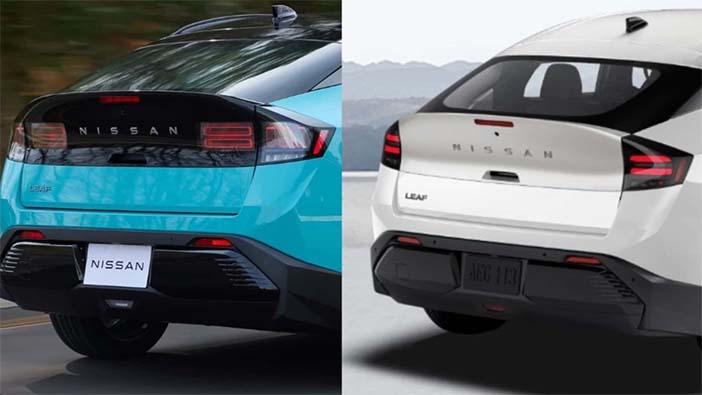
However, the online configurator reveals that this look is exclusive to the most expensive trim, while cheaper models have a more basic rear end. The lower trims miss out on the extra taillights mounted on the tailgate. It’s an unexpected move in today’s cost-cutting climate, especially considering Nissan spent more to design two different taillight assemblies. The tailgates aren’t identical either, since the premium version extends the taillights onto the hatch, requiring a different panel altogether. The upgraded taillights, which Nissan describes as having a “3D, holographic design”, include an Easter egg: the 2+3 motif, a nod to “ni” and “san” in Japanese.
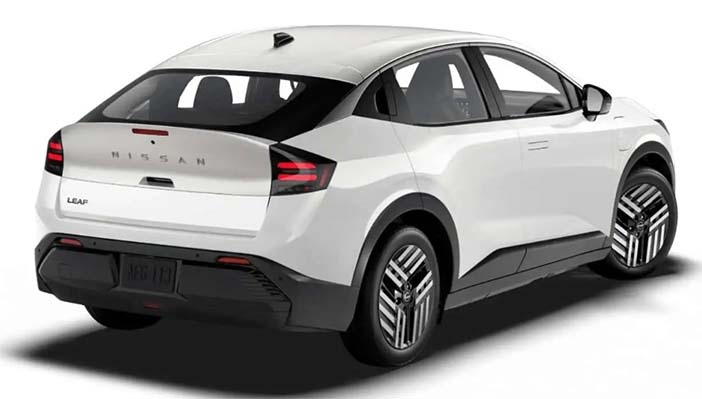
But the cheaper trims don’t get that. The absence of the black panel, reminiscent of current and past Z models, also makes the tailgate handle stand out, particularly on white cars. A full-blown configurator isn’t available yet, as the vehicle has just debuted, but we’re curious whether the Z-style rear design will be offered as an option basic trim levels. +++
+++ Most new CEOs get a honeymoon period from their board, so it’ll be interesting to see how new Stellantis CEO Antonio Filosa chooses to use this coveted time after he takes the helm Monday. Given the many issues facing Stellantis, Filosa faces a myriad of potential uses for his limited supply of leadership gold coins to spend on tough decisions. One of them will be the company’s ongoing review of its 14 brands; several of them teetering on the chopping block. In the U.S., speculation revolves around the future of Dodge and Chrysler, but globally the troubled ultraluxury brand MASERATI could be in the mix. Another report emerged today that Maserati could be sold. Of course, Stellantis denied the report, but a companywide review of the brands has already been underway for months. Maserati sales plunged by more than half last year (a drop of 4 percent in the U.S.) and plummeted 24 percent in the U.S. during the first quarter. But who would buy a money-losing brand despite its global cachet? A Chinese buyer perhaps? Filosa, chairman John Elkann and the board would have to wrestle with that one. As said, sales for Maserati collapsed in 2024, and the Italian brand saw a 48 percent decline through the first 3 months of 2025. That’s bleak. The poor sales have led to rumours that Stellantis might sell the Italian brand, but the automotive conglomerate continues to deny any such allegations. Stellantis did so again this week when Reuters asked the automaker if it had plans to sell Maserati amid a new rumour. A spokesperson rebuffed the allegation and told: “Respectfully, Maserati is not for sale”, reconfirming its commitment to the brand. However, Reuters’s 2 sources allege McKinsey, the consultant Stellantis hired in April to navigate president Donald Trump’s new import tariffs, could recommend that the automaker divest in Maserati in some way. It’s supposedly one of the options McKinsey is exploring for the automaker. According to one source, Stellantis has told the consultancy to consider all possibilities for the ailing brand. However, McKinsey is allegedly still in the early phases of its work, so any definitive decision about Maserati’s future is unlikely to arrive anytime soon. Another source told Reuters there is disagreement among the board about what to do with the Italian company. Some supposedly believe the brand has value to the automaker as its only luxury marque. However, others think Stellantis doesn’t have the resources to support Maserati as it struggles to revamp its line-up. Maserati has discontinued the Ghibli and the Levante, two of its best-selling models, but their replacements won’t arrive until 2028 and 2027, respectively. That leaves the Grecale as its only SUV in an industry where consumers continue to flock to such vehicles. It also sells the Gran Turismo/Cabrio and the MC20 supercar. Neither of those cars has broad appeal, and neither are enough to keep a brand afloat. Last year, former Stellantis CEO Carlos Tavares admitted that Maserati was “in the red”. Replacing the Levante and Ghibli could help turn around the brand’s sales and financial outlook, but the luxury market is highly competitive. Alfa Romeo, another of Stellantis’s Italian companies, is revamping its line-up, and it can’t have products that interfere with Maserati’s and vice versa. That leaves little room for either. +++
+++ MAZDA , which derives 90 percent of its global sales from outside its home market, wants to boost sales at home by about a third to buffer the blow from U.S. tariffs. +++
+++ It was only a few days ago that Audi announced plans to continue producing petrol-powered cars longer than initially intended, and now its long-time rival, MERCEDES , is essentially saying the same thing. Head honcho Ola Källenius admitted the Stuttgart-based automaker has had to make a “course correction” and retain internal combustion engines longer than initially planned. As a refresher, the company announced a few years back that it aimed to go fully electric “where market conditions allow” as early as 2030. The Mercedes chairman and CEO told that “electrified high-tech combustion engines will run longer than we originally expected”. While he didn’t provide an exact timeline, he referred to the dual gas-and-electric strategy as the optimal solution given the slower-than-expected EV adoption: “In the current situation, I think the most rational approach is for an established manufacturer to do both and not neglect either technology”. Automakers retreating from their previously lofty EV goals has fueled a misconception about a general decline in the electric car market. While it’s true that some companies are struggling, including Mercedes, which reported a 23% drop in 2024, the overall segment is growing. The International Energy Agency reports EV sales jumped by more than 25% last year, reaching 17 million vehicles. Additionally, sales of plug-in hybrids and electric vehicles will surge by 25% this year compared to 2024, reaching nearly 22 million units. As you’d expect, China is estimated to account for the lion’s share, with almost two-thirds of PHEV and EV sales. As with rivals BMW and Audi, China remains Mercedes’ largest market, despite a 7% decline in sales last year to 683.600 combustion and electric vehicles. Speaking of which, Källenius claims Chinese buyers “don’t just use their cars to get from A to B. For many, it’s also a second living room”. Maybe that explains the heavy reliance on screens in recent models wearing the three-pointed star. Germany’s luxury trio will continue to offer a mix of combustion and electric cars well into the 2030s, appealing to both camps. It remains unclear what will happen in countries that follow European Union regulations, which from the middle of the next decade will prohibit automakers from selling new vehicles that emit harmful pollutants. Some car companies are likely hoping for a delay in the ban, but the EU shows no signs of backing down. +++
+++ At STELLANTIS, May saw a significant leap in hybrid car sales in Europe: a share of 16% and an increase of 4.9 percentage points. The Peugeot brand is consistently growing in this segment (+3.8 percentage points). Order intake is also positive: +8% compared to May 2024. Stellantis remains in second place for total sales in the European market, while maintaining its leadership in the markets of France, Italy and Portugal. For the year-to-date, 3 Stellantis models were among the top-10 bestsellers: the Peugeot 208 and 2008, and the Citroën C3. In Portugal, where Stellantis remains the undisputed leader in the total market, a particular performance stands out: in May, the 2 bestselling cars were the Peugeot 2008 (also the bestseller for the year-to-date) and the Citroën C3. The new Citroën C3 also performs well in its electric version, establishing itself as the leader in BEV sales in Spain and grabbing the second place in France. In Italy, the Panda is the bestseller in the total market and the Jeep Avenger is the bestselling SUV, while Alfa Romeo records another great performance: +31% in sales on a YTD base, with Alfa Romeo Junior reigning in the premium B-SUV segment. Belgium records the best market share in 20 months with an increase of 4.4 percentage points vs. May 2024, while in Austria, the share growth (+2.7 percentage points) is accompanied by a volume jump: +45%. Finally, in Germany, the Opel Corsa is B-Hatch segment leader with a share of 14.3%, and confirms its bestseller status in the UK, once again outperforming all competitors in the B segment. And the first units of FIAT Grande Panda have just been delivered to the final customers… +++
+++ From the GR Yaris to the Land Cruiser, TOYOTA has several new models for all kinds of enthusiasts, be it those who enjoy track days or adventure junkies who prefer off-roading. However, there are a few cheaper Toyotas that still give off the dependable-but-entirely-unrema
+++ A year since it began marketing EV-specific tyres for electric vans and taxis, British company Enso has launched its first TYRES for passenger EVs, specifically, the Tesla Model 3 and Y and Jaguar I-Pace. There are currently more than 1.5 million electric cars on UK roads, and this year car makers expect to sell a further 450.000. Meanwhile, in 2022, 40 million car tyres were sold in the UK in a market worth around £2.3 billion. By 2030, the market is expected to be worth around £3.9 billion. Compared with giants such as Michelin, Enso is a relative minnow, but it punches above its weight thanks to initiatives such as direct sales and an emphasis on technical innovation, including reducing particulate pollution through improved tyre wear rates. “The sheer weight of EVs impacts the tyres”, said Gunnlaugur Erlendsson, founder and CEO of Enso. “The fact that you then have high torque and the cars being driven in urban areas also has an impact. The tyres wear down, but we reduce the rate at which they do by using better raw materials, construction and ‘recipes’, and by collecting data continuously from the field to understand how EVs are reacting to the road”. Balancing tyre wear with optimal rolling efficiency, the desired wet and dry handling performance and acceptable noise levels are among the challenges confronting Enso and other manufacturers of EV tyres. “Today, tyres are coping with far heavier vehicle loads than in the past”, said Jaap Leendertse, general manager of tyre development at Falken Tyres. “Previously, you had 50% of a tyre’s load capacity utilised; now we are at 70-80%, and that means we are more focused on the tyre lasting longer”. Michelin has stated that EVs wear tyres 20% faster than ICE vehicles. According to Kwik Fit, Tesla models are the heaviest on tyres, while Citroën, Mercedes and BMW models are among those needing fresh tyres at an above-average rate. Enso’s new EV-specific tyres are marketed as such (although they can be used with other fuel types), but many new tyres coming to market today are touted by their makers as suitable for EVs, hybrids and even ICE vehicles. Chris Staincliffe, senior marketing manager at Micheldever, a leading tyre wholesaler, said: “The reason is that the EV tyre market is still small, so they would rather design a tyre for all applications. They are still required to have an EV tyre’s strengthened sidewall, lower rolling resistance, low road noise levels and good wear rates, but being made in volume means they can have all these things and still be affordable. In any case, all tyres, regardless of the car they are fitted to, need to satisfy these goals in order to achieve good ratings. It’s also easier for consumers when one tyre fits all. We’ve seen EVs arrive at our fitting centres on incompatible ICE tyres that are completely shredded. The trend for dual-purpose tyres is catching on, with more now appearing at mid-price. Customers are becoming savvy about dual-purpose tyres and asking for them”. When prices of premium EV-ready tyres for 3 electric cars are compared with tyres for their ICE equivalents. Compared with a Volkswagen Golf 1.5 TSI, the tyres for a VW ID 3 were on average 55% more expensive; probably because its 18 inch wheels are 2 inch larger. Those for a BMW iX3 M Sport are different sizes front and rear than for a BMW X3, whose tyres are all the same size. The iX3’s tyres were 10% more expensive at the front and 13% more expensive at the rear. The tyres for a Mini Cooper and Cooper Electric cost the same. “As the number of EV-ready tyres grows, prices should fall, but there are few signs of it at the moment”, says Micheldever’s Chris Staincliffe. “However, they are still much cheaper than OE, EV-only tyres”. +++
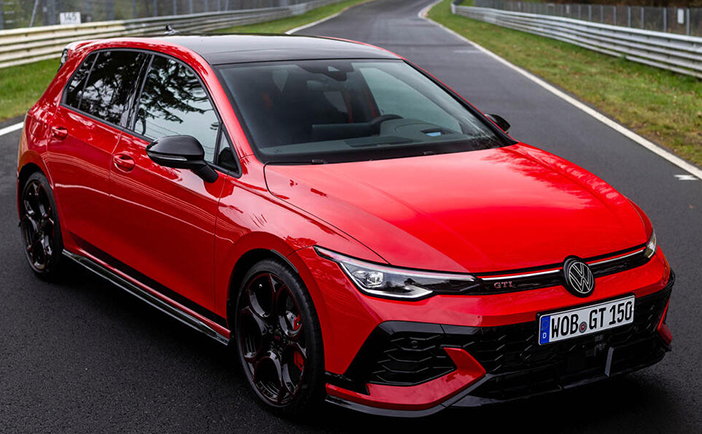
+++ VOLKSWAGEN has revealed the new Golf GTI Edition 50 as the most powerful and “the most dynamically adept” in the model’s 50-year history. The special hot hatch has been unveiled as part of the golden jubilee celebrations for the iconic GTI badge, first introduced on the Golf GTI in 1975 and standing for Grand Touring Injection. It builds on the existing Mk8.5 car but uses a more powerful iteration of VW’s turbocharged 2.0-litre four-cylinder EA888 petrol engine, which now delivers 325 hp and 420 Nm. That represents a 60 hp and 50 Nm hike over the standard Golf GTI and a 25 hp and 20 Nm increase over the more track-focused GTI Clubsport. While the four-wheel-drive Golf R 20 Years retains a small power advantage, at 333 hp, the special GTI matches that car’s torque output. The extra reserves help the Edition 50 improve on the GTI Clubsport’s straight-line performance, with 0-100 kph taking 5.5sec (down 0.1sec). This brings it closer to rivals such as the Honda Civic Type R (0-100 kph in 5.4 seconds). Top speed is again limited to 270 kph. However, engineers behind the project insist the focus wasn’t on raw output. “It is also the most capable on the track”, said chassis development boss Lars Frömmig. “Performance is about much more than just power”. The foundation for the Edition 50’s chassis revisions is a reworked version of the GTI’s standard MacPherson-strut front and multi-link rear suspension, which is now 20mm lower than the GTI and 5mm lower than the GTI Clubsport. Key changes include revised spring and damper rates and significantly increased negative front camber, which is now around −2.0deg. This is achieved through stiffer upper suspension mounts, modified wheel carriers and uprated bushings in the lower control arms. The iconic hot hatch took on a harder edge with its 8th generation, at the expense of its intoxicating blend of everyday performance. At the rear, the Edition 50 reintroduces a twin-attachment track rod (reminiscent of the Golf VII GTI) and new wheel carrier geometry for greater lateral stiffness and toe stability under load, particularly in fast direction changes. VW has also recalibrated the electromechanical steering, DCC (Dynamic Chassis Control) and VDM (Vehicle Dynamics Manager) to suit the Edition 50’s more aggressive hardware set-up. Complementing the chassis upgrades are 235/35 R19 Bridgestone Potenza Race semislick tyres, developed specifically for this car. They are 1.2kg lighter per tyre than previous-generation Potenza Races and paired with 19 inch forged aluminium Warmenau wheels. The tyre and wheel combination alone is said to reduce unsprung mass by more than 2kg per corner compared with the Clubsport’s cast wheels and standard rubber; a key factor in improving steering response, says Frömmig. A further 11kg can be shed with the optional Akrapovic titanium exhaust system. Beyond weight, the semislicks improve grip in both dry and wet conditions and increase sidewall stiffness for better support under load – all aimed at greater lap-time consistency and real-world drivability. According to Frömmig, the Edition 50 turns in more decisively and offers significantly greater body control than the existing GTI variants. He said: “There’s less roll and a more progressive build-up of lateral force. We’re absolutely serious about performance in this car”. The Edition 50 has already made its mark with a 7 minutes 46.13sec lap of the Nürburgring Nordschleife; the fastest time recorded by any production VW, including the 4-wheeldrive Golf R 20 Years. The Edition 50 retains the same exterior styling as the GTI Clubsport but with subtle giveaways such as black graphics on the lower parts of the doors, ‘50’ decals on the roof spoiler and black tailpipes. VW has yet to confirm prices nor how many units will be built, but it is understood to be a limited-run model, and prices are expected to start around €70.000 in the Netherlands. Order books are due to open towards the end of this year, with first deliveries in early 2026. +++