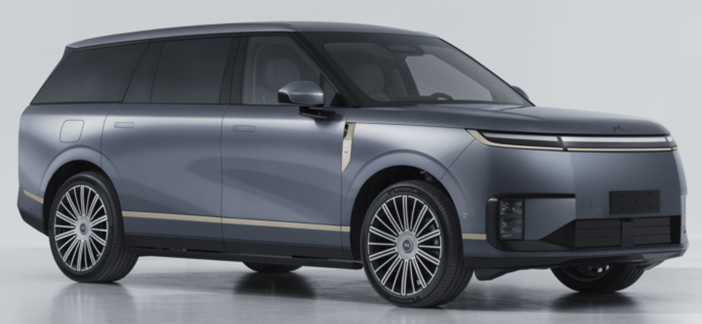
+++ Information from the latest regulatory filings in China has revealed details of BYD ‘s upcoming flagship SUV, the Great Tang. Positioned as a 9-series product within the brand’s Dynasty series, the new vehicle is set to become the line-up’s new top-tier offering, targeting the market segment above 75.000 euro. The Great Tang is expected to make its official debut in the first half of this year. The Great Tang showcases a brand-new design language. Its front fascia features a closed grille complemented by star-ring-like chrome trim and a ‘Tang’ logo rendered in ancient small seal script. Vertical air ducts on either side of the front bumper add a touch of sportiness. Along the sides, the SUV adopts newly designed semi-hidden door handles and intricate multi-spoke wheels. The rear is characterized by a full-width taillight cluster. In terms of dimensions, the Great Tang measures 5.302 mm in length, 1.999 mm in width and 1.800 mm in height. The wheelbase extends to 3.130 mm. The vehicle’s gross mass is listed at 3.245 kg. The models submitted for approval offer 3 powertrain configurations: single-motor versions with outputs of 408 hp and 504 hp, and a dual-motor version featuring a 292 hp front motor and a 504 hp rear motor. The Great Tang is significantly larger than current Tang models: with a length of over 5,3 meter and a wheelbase of over 3,1 meter, placing it in full‑size SUV territory. Being built on the Super e-platform suggests that Tang 9 would have megawatt flash charging and a 30.000 rpm motor. Furthermore, early tests of camouflaged prototypes indicate that the Datang will be the first BYD model to feature rear-wheel steering technology. +++
+++ Demand for electric cars in CHINA may be cooling, and some of the country’s biggest automakers are starting to feel the chill. Several of the most prominent domestic brands, including BYD, Xpeng and Xiaomi, reported noticeable drops in January sales. Data shows that BYD sold 205.518 vehicles in China last month. The number sounds solid on its own, but it marks a sharp decline from the 300.538 vehicles the company moved in January 2025. Both BYD’s electric vehicles and plug-in hybrids were affected. Of the 205.518 vehicles sold last month, 83.249 were EVs and 122.269 were PHEVs. A year earlier, those numbers stood at 125.377 and 171.069 respectively. Exports took a hit too, dropping to 100.482 units in January from 133.172 in December. These figures suggest weakening demand in China and possibly overproduction for overseas markets, but a recent government policy change may go some way to explaining the drop. As of January 1, the country reinstated a 5 percent purchase tax for new energy vehicles, having previously exempted them from a 10 percent tax for more than a decade. “We see increasing pressure on China’s auto market in 2026, driven by a combination of policy and competitive factors”, Helen Liu, partner at Bain & Company, told. She added that recent tax changes may prompt some consumers to delay purchases, while automakers hold back on new model launches. “We know EV sales will slow, we just don’t know by how much”, added Tu Le, founder of Sino Auto Insights. “We’ll know much better after the first quarter is over”. Xiaomi also struggled out of the gate. It sold 39.000 cars in January, which was an improvement over the same time last year, but a steep drop from the more than 50.000 EVs delivered in December. Xpeng’s January was even rougher. Sales fell 34.1 percent year-on-year to 20.011 units, and the month-on-month drop was starker still at 46 percent compared to December 2025. Li Auto’s performance dipped as well, with deliveries slipping to 27.668 units for the month. However, it’s not all bad news. One of the few bright spots was Aito, a newer brand backed by Huawei’s operating system, which reported more than 40.000 deliveries in January, marking a gain of more than 80 percent compared to the same month last year. Sales at Leapmotor rose to 32.059, while Nio also reported an increase to 27.182 units. Geely sold more than 270.000 cars in January, a 1 percent increase year-on-year. Interestingly, its EV sales fell by 15 percent, while its PHEV sales rose 37 percent. That performance has pushed Geely into second place in the country’s EV market behind BYD, thanks in part to strong momentum from its Galaxy and Zeekr brands. +++
+++ The wait is almost over, because the ground breaking (not to mention highly controversial) 4-door JAGUAR GT will be this summer’s blockbuster reveal. But before then, Autointernationaal.nl can reveal all the latest details on the upcoming electric car. The still as-yet-unnamed car may not have been revealed in 2025, as was originally intended, but Jaguar’s new beginning continues to rapidly gather pace. A few journalists had the privilege of driving a pre-production prototype of the new Jaguar GT, which revealed it has a more Bentley-like character than Porsche-esque sportiness. Underneath the long, low and wide body is a new platform, the Jaguar Electric Architecture (JEA), featuring an 850 volt electrical system, a 120 kWh battery pack and 3 e-motors: 1 up front and 2 at the back. Combined power output will be around 1.000 hp plus a colossal 1.366 Nm of torque, which is more than the Bugatti Veyron had, so the 0-100 kph sprint should take about 4 seconds. However, the Jaguar GT is also a lot heavier than the Veyron, weighing in at around 2.700 kg, which also makes it some half a tonne heavier than a Porsche Taycan. That’s the main side effect of having such an enormous battery pack though, which will at least provide up to 700 km of range from a single charge. Plus, Jaguar says it can be recharged at 350 kW, meaning owners can add 320 km of range in under 15 minutes. Keeping that weight in check and hopefully delivering the ride quality of a true Jaguar, the 4-door GT’s chassis includes twin-chamber air suspension and adaptive dampers, while rear-wheel steering is supposed to give the big cat a turning circle to match a Honda Civic’s. +++
+++ LEAPMOTOR is set to introduce a high-power variant of its B5 model. The new declaration images, revealed in the latest Ministry of Industry and Information Technology (MIIT) catalogue, showcase a series of athletic upgrades and a boost in motor output. The most notable changes on the exterior are concentrated on the front fascia, where the B5 high-power version adopts a more aggressive front lip with a sporty spoiler design, creating a distinctive dual-layer air vent structure. Along the sides, the vehicle is equipped with sporty side skirts and will offer 2 tire specifications: 225/45 R19 and 235/45 R19. The rear of the car has also been redesigned, featuring a new spoiler and rear bumper. Under the hood, the new B5 variant will be powered by an electric motor with a maximum output of 245 hp. The battery cells for this model will be supplied by CATL, Gotion High-tech, and CALB. By contrast, the currently available Leapmotor B5 was officially launched on November 28 last year, with motor power options of 180 hp and 218 hp. Late last year, Leapmotor CEO Zhu Jiangming stated that the company’s goal for a decade from now is to achieve annual sales of 4 million vehicles, aiming to become one of the top ten global automakers. +++
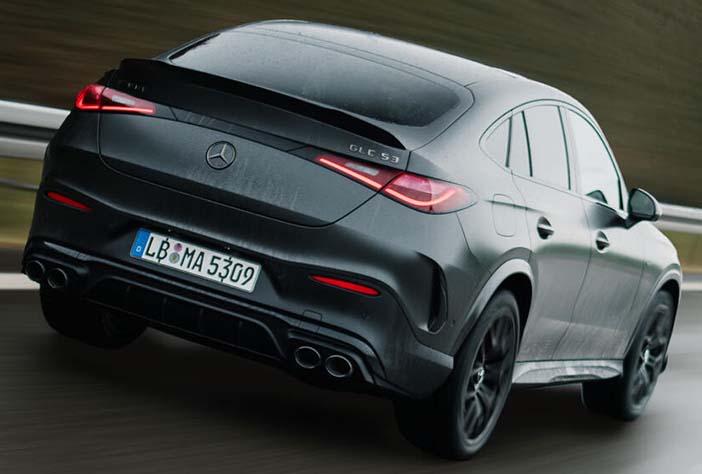
+++ MERCEDES-AMG has unveiled the GLC 53, a new 6-cylinder rival to the Audi SQ5 and BMW X3 M50 that marks a clear shift in its strategy and spells the end for the four-cylinder GLC 43 and 63 SE Performance models. Due later this year, the 53 will be the only hot version of the GLC until a new electric model with advanced axial-flux motors joins the range in 2027. Its arrival comes as new regulations, including the forthcoming Euro 7 emission standards, have rendered obsolete the 4-cylinder engine used by the GLC 43 and GLC 63 S E Performance. It also underlines a new direction in strategy as Mercedes-AMG forgoes plug-in hybrid powertrains, as used by the previous GLC 63 and the E 53 saloon, for a new mild-hybrid set-up that emphasises its combustion engine. The GLC 53 combines a reworked version of Mercedes’ turbocharged 3.0-litre straight-6 engine with a 48V starter-generator mounted in the gearbox. The starter-generator can provide a boost of up to 22 hp and 200 Nm, combining with the engine to put out a system total of 449 hp and 600 Nm. An overboost mode can increase torque reserves to 630 Nm for up to 10 seconds per activation. This represents increases of 34 hp and 140 Nm over the outgoing GLC 43, cutting its 0-100 kph time by 0.3 seconds to 4.2 seconds. The top speed is artificially limited to 250 kph but can be extended to 270 kph with an optional AMG Driver’s Package. Beyond its raw performance, the new GLC 53 aims to appeal with its acoustic character. Mercedes-AMG says it has focused heavily on the response and sound of its 6-cylinder engine, a development of that used by the E 53. The firm has fitted a new cylinder head, intake system and an exhaust with “special resonators” that promise “characteristic crackling” and “AMG-typical” pops and bangs. The engine comes with a 9-speed automatic gearbox and 4-wheel drive, which can send up to 100% of drive to the rear axle. For the first time on an AMG SUV, an electronic rear limited-slip differential is available as part of an optional package, which also adds a drift mode. Meanwhile, a rear-wheel steering system (offering up to 2.5 degrees of articulation), adaptive damping and variable-ratio steering aim to boost agility. +++
+++ MERCEDES-BENZ is giving the A-Class a little more time on the road by moving production to Hungary in early 2026. While that might sound like the end of the line, it’s actually preparing for something entirely new. A successor is reportedly in the works for 2028, and it won’t stick to the familiar hatchback or sedan templates. According to sources familiar with the plan, the next-generation entry-level Mercedes will move toward a shape that blends SUV and MPV cues. Think of it as a mix between the current GLA and the B-Class, the latter of which is on its way out. Mercedes development chief Jörg Burzer describes the upcoming model as “unlike anything else that has existed before”, calling it a “very attractive vehicle”. His choice of words suggests the company is aiming for more than just a straightforward replacement. Burzer also confirmed that the new model will be built on the brand’s MMA platform, the same architecture that underpins the CLA, CLA Shooting Brake, GLA and GLB. The modular platform is flexible enough to support gasoline, hybrid and full-electric setups, which leaves the door open for a wide range of configurations. The new A-Class replacement will be designed with a younger audience in mind. That doesn’t just mean price, it also points to a different approach in styling and layout. With a higher seating position and packaging reminiscent of a compact MPV, the model could serve as a single, practical alternative to both the A- and B-Class. At the same time, it might undercut the GLA and GLB in price, giving buyers a more budget-friendly option with similar space. It also aligns with changing preferences among young families and urban drivers looking for flexibility without going full SUV. Production is likely to happen at the Kecskemét plant in Hungary. That’s the same facility set to take over A-Class manufacturing in the first quarter of 2026. The move allows Mercedes to reduce costs and transfer resources at its Rastatt factory in Germany, which will handle other MMA-based models going forward. Despite being around since 2018, the current A-Class remains popular. In Europe, the compact model sold 69.777 units in 2025 (down from 75.240 in 2024), making it the 4th best-selling Mercedes in the region behind the GLC, CLA and GLA. Rising demand for more affordable Mercedes models is a key reason the A-Class remains on sale. It’s also why the brand is developing a replacement, even after earlier signals that the compact range would be trimmed to focus on higher-margin vehicles. The new crossover-style vehicle is expected to be priced below the GLA, keeping it within reach for first-time buyers and budget-conscious drivers. Burzer believes there’s still “profitable growth potential” in the compact segment, particularly in Europe. The CLA’s performance seems to back that up, reinforcing the case for a next-gen A-Class that looks and feels different, but keeps the same essential mission. +++
+++ NIO has announced a significant financial milestone, projecting its first-ever quarterly adjusted operating profit for the fourth quarter of 2025. This achievement comes 11 years after the company’s establishment, marking a pivotal moment in its financial trajectory. According to a preliminary assessment based on the company’s unaudited consolidated management accounts and currently available information to the board, Nio anticipates an adjusted operating profit (Non-GAAP), excluding share-based compensation expenses, to be between approximately 700 million yuan (100 million dollar) and 1.2 billion yuan (170 million dollar) for Q4 2025. This represents the first time the company expects to record a single-quarter adjusted operating profit. On a generally accepted accounting principles (GAAP) basis, Nio projects an operating profit of approximately 200 million yuan (29 million dollar) to 700 million yuan (100 million dollar) for the same period. Nio attributed this positive financial turnaround to a combination of strategic factors. These include sustained sales growth throughout the fourth quarter of 2025, an optimized vehicle gross margin driven by a favourable product mix, and the company’s ongoing commitment to comprehensive cost reduction and efficiency improvement measures. The ES8 has been instrumental in Nio’s achievements, becoming a cash cow for the company, after the brief initial sales surge of the Onvo L90. To illustrate the ES8’s significance to Nio, consider these figures: On December 29, ES8 deliveries reached 40.000 units. By February 2, this number climbed to 60.000 units. This indicates that approximately 20.000 ES8s were delivered in January 2026. Given that Nio’s total brand sales for January 2026 were 20.894 units, it’s clear that the ES8 accounted for nearly all of the brand’s sales during that month. However, the segment in which the ES8 competes is becoming increasingly crowded. Products like the Zeekr 9X are formidable rivals, and there are even more challengers, such as the Leapmotor D19, slated for release. We will have to wait and see how Nio plans to sustain its profitability moving forward. Overall, this is a highly commendable achievement for Nio. +++
+++ The long-awaited, second-generation TESLA ROADSTER could be just around the corner, given that two new trademark filings have just emerged. One image shows the profile of the Roadster, depicted simply by three lines. The cab-forward shape associated with supercars is still clear to see, although the rear haunch looks straighter than on the prototype model we’ve previously seen; indeed Tesla’s design language has shifted somewhat since the car was first announced in 2017. The other image is a trademark for the logo of the name ‘Roadster’ in a unique font for the car. The trademarks, filed to the US Patent and Trademark Office on 3 February, increase speculation that the unveiling of the Roadster is imminent, just a few weeks after Tesla CEO Elon Musk had touted a potential springtime event. Musk had alluded to the Roadster on the Joe Rogan podcast last October, when he claimed it “has potential to be the most memorable product unveil ever”.

Production of the Roadster is set to start 12 to 18 months after the reveal, meaning buyers might not receive their cars until late 2027. Since that podcast, Musk has declared the Roadster will be the “best of the last human-driven cars”, as his company shifts its focus to more autonomous vehicles. In the 2025 Q4 earnings call, Musk said: “The only vehicles that we’ll make will be autonomous vehicles, with the exception of the next-generation Roadster, which we’re hoping to debut in April. Hopefully. It’s gonna be something out of this world.” The event is expected to take place on 1 April, which would give Tesla a justification to delay the Roadster again if it wants to play an April Fools’ joke. Back in 2024, Musk acknowledged that development had slowed on the Roadster, stating “I’d certainly like to thank our long-suffering deposit holders of the Tesla Roadster”, but also backtracked on earlier updates, saying, “We are close to finalising the car’s design”. The reasoning behind those rounds of delays was due to other models in Tesla’s line-up, including the new Robotaxi. “The Roadster has to come behind the things that have a more serious impact on the good of the world”, said Musk. “The Roadster is the cherry on the icing on the cake”. The Tesla Roadster has been delayed many times since it was announced in 2017, partly due to supply chain shortages. The same happened with the brand’s Cybertruck pick-up. Tesla has already started taking reservations for the Roadster. Prices for the entry-level model are expected to start from around 175.000 euro. Tesla will also launch a special-edition Founders Series model, which will be limited to just 1.000 examples. A final price for this version is yet to be confirmed, but the company has confirmed that buyers will need to place a 200.000 euro deposit just to secure their build slot. Musk also previously hinted at a version “beyond the base model,” which could deliver even more performance. When the Tesla Roadster finally reaches production, Musk promises that it’ll set new benchmarks for electric car range and performance. The firm has already shown the potential of its latest battery and powertrain technology with the Tesla Model S Plaid, which has a maximum output of 1.008 hp and an impressive claimed range of more than 830 km. In the Model S Plaid, the tri-motor powertrain has enough grunt for a 0-100 kph time of 2.1 seconds and a top speed of 320 kph. However, Tesla will push the powertrain even further once it’s been shoehorned into the Roadster. Naturally, there’ll be some parts shared between the Model S Plaid and the Roadster, which should speed production. However, unlike the original Roadster, the Mk2 car no longer occupies a class of its own: it will wade into an increasingly populated marketplace of pure-electric hyper cars, including the Lotus Evija and Pininfarina Battista. Elon Musk has already said the Roadster will have the same 2.1-second 0-100 kph time as the Model S Plaid, although the sports car’s top speed will be 4000 kph. What’s more, the Roadster’s 0-10 kph time could be as little as 4.2 seconds, which is faster than the Porsche Cayman GTS can accelerate from 0–100 kph. Musk is confident about the car’s ability, though, saying that the Roadster was designed to “give a hardcore smackdown to gasoline cars”. Tesla’s own website also made the rather bold claim that the Roadster is the “quickest car in the world”. As on the Model S Plaid, the Roadster’s chassis is expected to feature 2 electric motors on the rear axle and 1 on the front axle, and Elon says they’ll have a combined torque figure of 10.000 Nm. +++
+++ TOUCHSCREENS are “the wrong technology to be the primary interface” in cars, according to the man who designed the iPhone and iPad. Many car designers credit Jony Ive’s 2007 creation (the first phone to feature a touchscreen, revolutionising the phone industry) as the reason why the technology is now used in nearly every car on sale today. The most radical use has come from Mercedes-Benz, especially in the new GLC EQ, which features a dashboard-spanning 39 inch touchscreen. However, when the Ive-designed interior of the Ferrari Luce EV was unveiled on Monday, it featured an array of physical switches and buttons alongside a singular central touchscreen, rather than the predicted touchscreen array. Asked why, Ive said: “The reason we developed touch [for the iPhone]was that we were developing an idea to solve a problem. The big idea was to develop a general-purpose interface that could be a calculator, could be a typewriter, could be a camera, rather than having physical buttons. I never would have used touch in a car for the main controls. It is something I would never have dreamed of doing because it requires you to look away from the road. So that’s just the wrong technology to be the primary interface”. Asked how the Luce’s touchscreen differs from others, given his comments, Ive replied: “So much of what we did was so that you could use it intuitively, enjoy it and use it safely. “We use some touch in the central screen, but it’s very thoughtful, and the vast majority of the interfaces are physical. Every single switch feels different, so you don’t need to look”. Speaking about the popularity of touchscreens in cars, he said: “I think what happened was touch was seen almost like fashion. It was the most current technology, so companies thought ‘we need a bit of touch’, then the next year ‘we’re going to have an even bigger one’, and it will get bigger and bigger. “I think the way that we design car interiors isn’t that we’re trying to solve problems like we did with the iPhone”. +++
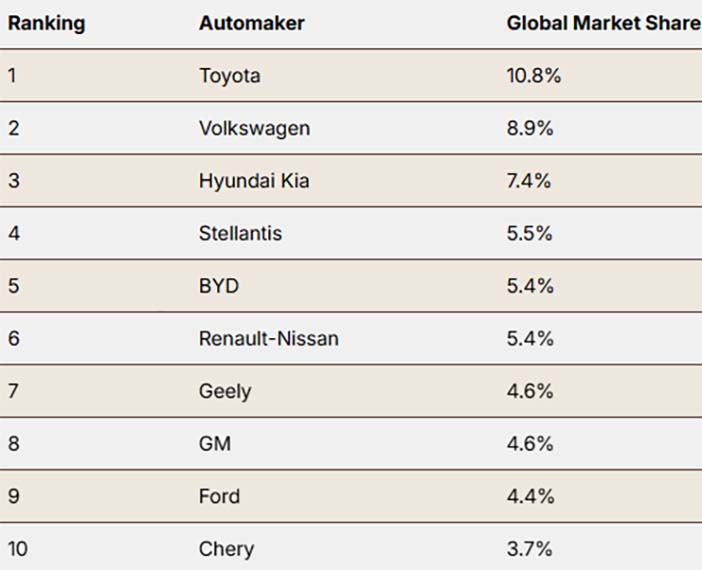
+++ In 2025, Chinese automobiles accounted for 35.6% of the WORLD MARKET SHARE . The total global car sales was 96.47 million units, and China sold 34.35 million units, a 9% increase year-on-year, according to the China Passenger Car Association (CPCA). More specifically, global car sales grew by 5%. For comparison, USA sold 16.72 million units (a 1% increase), India 5.58 million units (a 7% increase), Japan 4.56 million units (a 3% increase) and Germany 3.16 million units (a 1% increase). On the other hand, the Russian market experienced a significant decline, and growth in Mexico is slowing, while markets in South America, such as Argentina, are performing well. In the first half of 2025, China’s share of the global automotive market was 36% with 15.65 million units sold, a year-on-year increase of 11%. Then in November alone, the share increased to 40% and 37% in December 2025, reaching 35.6% for the entire year. Looking back, from 2016 to 2018, China accounted for approximately 30% of the global automotive market. In 2019, this figure decreased to 29%. From 2020 to 2021, the share rebounded to 32%. In 2022, China’s share rose to 33.5%. In 2023, the share remained at 33.8%. In 2024, the share increased to 34.2% of the global automotive market. Among the top-10 global automakers last year, 3 Chinese companies were on the list: BYD was 5th, Geely 7th and Chery 10th. Furthermore, China exported 8.32 million vehicles in 2025, a year-on-year increase of 30%, maintaining its position as the world’s largest exporter for the third consecutive year. Specifically, exports of new energy vehicles reached 3.43 million units, a 70% increase. The average export price decreased to 16.000 dollar mainly due to a decline in Tesla’s export share. Mexico was the largest destination country, and market share increased in the Middle East, Central and South America, and Europe. +++
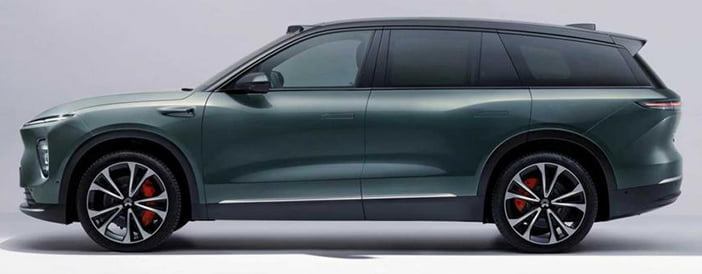
+++ The XPENG GX full-size crossover applied for a sales license in China, revealing EREV and BEV versions. It boasts a length of 5.3 meters, a peak power output of 577 hp and the L4-ready assisted driving system with a computing power of 3.000 Tops. The EREV Xpeng GX can run up to 320 km in EV mode. The Xpeng GX is the brand’s first full-size crossover with exterior styling similar to the Range Rover. This SUV adopts retractable door handles and an active air intake in the front. Blackened pillars create a floating roof effect. The car adopts 2-storey lights with headlamps sitting quite low in the front bumper. The Xpeng GX boasts hefty dimensions of 5.265/1.999/1.800 mm with a wheelbase of 3.115 mm. It rides on 21 or 22-inch wheels, depending on the version. The car’s front and rear overhangs are 980 mm and 1,170 mm, respectively. The approach and departure angles reach 18 and 20 degrees. The Xpeng GX offers six seats with a 2+2+2 layout. It has a split tailgate, just like the Range Rover. The car’s curb weight lies between 2.690 and 2.890 kg. The full weight is 3.240 – 3.405 kg. The Xpeng GX adopts 2 powertrain variants. The entry-level electric variant of this SUV adopts a single electric motor for 362 hp manufactured by Luxshare. It is powered by a CALB-made LFP battery. Its capacity has yet to be revealed. The Xpeng GX EV RWD has a top speed of 200 km/h. The AWD variant of the electric Xpeng GX adopts the additional Xpeng-made e-motor in the front, producing 215 hp. The combined peak power output of this version is 577 hp. Electric motors are powered by a ternary NMC pack from CALB. The Chinese Ministry of Industry and Information Technology didn’t reveal its capacity. The top speed also reaches 200 km/h. The EREV variant of the Xpeng GX comes standard with the 1.5-liter turbo petrol-powered 4-cylinder manufactured by Dongan Powertrain, a subsidiary of Changan Automobile. Its power output is 150 hp. However, this ICE doesn’t transfer any torque to the wheels. Instead, it sends power to a battery and electric motors. The Xpeng GX EREV is available with dual-motor AWD only. Its electric motor in the front has a peak power output of 160 kW, while a rear e-motor produces 282 hp. The combined peak power of the system is 496 hp. A CALB-made LFP battery for 63.3 kWh powers the system, providing 320 km of electric range under unknown conditions. The top speed of the GX EREV is 200 km/h. Xpeng officials previously shared that the GX EREV crossover will be equipped with 4 Turing AI chips with a total computing power surpassing 3,.000 Tops (Trillion Operations Per Second). Xpeng says this car is capable of L4 autonomous driving. The Xpeng GX will enter the market this year. +++