
+++ ALPINE ’s keenly anticipated electric-only replacement for the A110 sports car, due next year, will share both its platform and its key mechanical components with the radical Renault 5 Turbo 3E mega-hatch. Alpine CEO Philippe Krief revealed the close relationship of the 2 cars in an interview. The new electric A110 will spawn a number of variants that Krief said will help transform the Renault Group’s premium performance brand into a true Porsche 911 rival. The new EV (which will continue to wear the A110 badge) will be “only slightly” longer than today’s car, said Krief, and its styling will be close to the current model (itself inspired by the original A110 Berlinette built between 1963 and 1977), with elements such as the quad headlights and squat, mid-engined silhouette remaining but delivered in a more futuristic aesthetic, rather than a retro one.

Both the third-generation A110 and the 5 Turbo 3E will use a new aluminium chassis structure called the Alpine Performance Platform (APP), which places a 70 kWh battery pack behind the occupants to give an uncompromised driving position. The new A110 will therefore be similar in height to the present one, said Krief. As such, he expects it to have an even sportier driving position than today’s car, with the driver’s feet raised, Formula 1-style, and the seat very reclined. Power output for the EV is expected to surpass the 350 hp of the current A110’s run-out R Ultime special. At launch, power will be supplied by 2 rear-mounted electric motors, but the door is still ajar for the new A110 to be offered with in-wheel motors; the solution used by its Renault platform-mate. In the 5 Turbo 3E, combined output is pushed to 540 hp via motors within the rear wheels, giving the car a 0-100 kph time of less than 3.5 seconds and a 260 kph top speed. Thanks to the APP being designed to accept many powertrain configurations (it could even have the potential for hydrogen propulsion in the future), the technology opens the possibility of a mega-powered, four-wheel-drive A110, with in-wheel motors placed at the front. However, price will be one of the key stumbling blocks, as the 5 Turbo 3E is being sold for 155.000 euro, but it could well be part of the A110’s future as demand for higher-performance A110 electric models grows. Initially, however, Krief told that the new coupé will have a target kerb weight similar to the average of its combustion-engined rivals today (about 1.500 kg) and its battery endurance should allow 3 full-speed laps of the Nürburgring or an on-road range of 500 km. Krief, who before joining Alpine in 2023 carved an engineering career at Fiat and then Ferrari (where he masterminded the lauded 458 Speciale and 296 GTB), sees Alpine’s key qualities as lightness, sensitive handling that leads to driving pleasure and French “savoir faire”; the ability to perform with ease and flair. He believes the last of those is already built into today’s A110 and must be retained. As well as a bold new platform and powertrain, the next-generation A110 will introduce a new driver-focused cockpit that majors on physical controls. Indeed, it will be the French performance brand’s first bespoke interior, rather than one adapted from its Renault parent company. A key part of the brief is for the A110 to deliver more focused driver engagement, with minimal distractions, than it has done before. Expect therefore an interior that features minimal digital screens, offering a more analogue experience. Alpine design boss Antony Villain said the A110’s cabin will be a “new generation” that will “stay with the same ingredients, but we push further” with “a lot of physical buttons mixing with minimal digital things”. Having “instinctive access to every crucial function”, said Villain, will allow drivers to create an “emotional relationship with the machine”, because “when you buy a sports car, you want to be in control”. “It’s not the car that drives you and controls you: it’s the opposite”, he added. The new EV will be the first of what Alpine expects to be a new expanded range of A110 models, as Porsche has cultivated with its 911. This, according to Krief, amounts to at least 4 two-door versions, these being a coupé, a convertible and lengthened, 4-seat GT versions of both (which were originally tipped to revive the A310 name). Krief sees the comparison with the 911 as important: he visualises a time after Alpine has launched more products and achieved greater brand awareness when buyers will “hesitate to decide” between Alpine and Porsche. When he joined the company 3 years ago, said Krief, the major mission was to launch 7 cars in 7 years. Two of those, the A290 and A390, are already on sale and the electric A110, in its various guises, is imminent in several forms. After that, there might be a bigger SUV than the A390 (Krief said this was mainly planned for a US expansion currently on the back burner) and, once the company and its reputation are sufficiently expanded to justify it, an ultra-exclusive hypercar drawing influence from Le Mans racers. The latter has already been previewed by the 1.000 hp hydrogen-fuelled V6 Alpenglow concept and it has been suggested that a production version could be built on the flexible APP. Krief sees future Alpine models divided into what he calls 3 pillars. First there’s the A110, which will always be the icon and will be “renewed and renewed and renewed”. Then there are the cars like the A290 and A390 which offer “everyday extraordinariness”. That pillar can be expected to expand, although the only possibility Krief mentioned was a large estate car. And the third pillar embraces cars that “offer the maximum” and can join the ranks of true hypercars. Cars in this category must not just offer very high performance and high technology, said Krief, but also allow the owner a very high level of customisation. However, before Alpine can become a player in this arena, he believes there must be significant brand building to give it the credibility to sell cars in the €1 million bracket. Its F1 team, for which Krief has overall (but not day-to-day) responsibility, can help here, he suggested. For now, Alpine’s attention is firmly focused on the new A110, which should lead the brand into new markets. “The market for sports cars amounts to 360.000 units worldwide”, said Krief. “Around 90.000 of these are sold in Europe, 90.000 in Asia and 180.000 in the US. “We will launch the new car in Europe first, then in Asia, and later, if the conditions are right, we will take it to America. But over the next 4 years or so, we have a lot of work to do”. +++
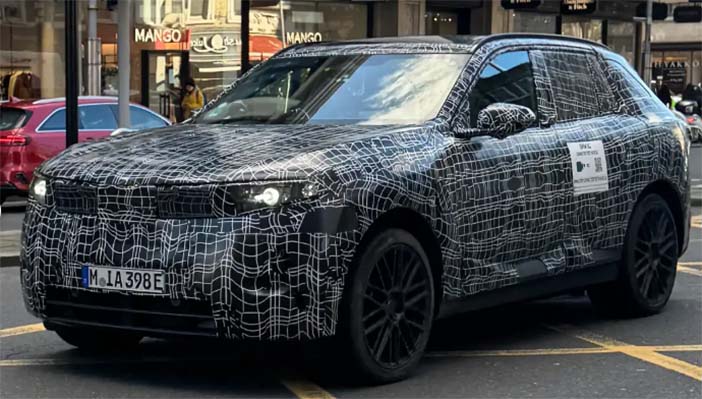
+++ We’re used to seeing all kinds of car brands testing their secret new models in the far north, or perhaps remote southern Spain, but what about West London? Not too concerned about being seen ahead of its reveal in a few months’ time, the all-new BMW X5 has been doing the rounds in its harshest testing location yet, South Kensington. This next-generation X5 will be revealed in mid-2026, where it will rival all corners of the high-end luxury SUV market. That’s because the latest X5 will have combustion, plug-in hybrid and electric powertrain options, and even a hydrogen fuel-cell in certain markets. This will open the door to a huge cross section of rivals, including both ICE and electric versions of the Porsche Cayenne, Audi’s next-generation Q7, the heavily upgraded Mercedes GLE that’s due out in a couple of months, and the Range Rover Sport. Volvo’s luxurious EX90 is also in the BMW’s crosshairs, along with the sportier Polestar 3. While the outgoing BMW X5 isn’t offered as an EV, we know the underpinnings support this tech; the current 5 Series is available with petrol, PHEV and electric powertrains, and the X5 (which will share a similar CLAR-based architecture) will follow suit. The electric version will be badged iX5. We can expect a standard eDrive40 model, bolstered by a faster iX5 M60. With around 340 hp, the cheaper of the 2 versions will cover 0-100 kph in just over 6 seconds, with the near-600 hp M60 slashing that to around 4 seconds flat. Expect plenty of trick chassis and suspension tech to keep the car’s inevitable mass in check. The BMW iX5 Hydrogen will arrive after the rest of the X5 range and uses a fuel cell to produce power using liquid hydrogen. The X5 is one of 40 new or revised BMWs set to be revealed by the end of 2027. +++
+++ The future of the CUPRA DARKREBEL was put into doubt after Cupra’s previous CEO, Wayne Griffiths, left the company last year. The concept has been given a lifeline however as Cupra’s current boss, Markus Haupt, has declared his interest in bringing the DarkRebel to production. We first saw the DarkRebel Concept at the Munich Motor Show way back in 2023, but as the Tavascan proved (hitting production 4 years after its concept) Cupra sometimes likes to take its time. Haupt reiterated that there’s still a chance that Cupra could build the DarkRebel as a halo car. “Yes, I mean for a brand like Cupra to bring a car like the DarkRebel to the streets is a dream. It’s something we’ll keep exploring for the future, we need to assure the positioning of the brand. It’s a nice dream”, he said. A prerequisite for the DarkRebel to make production was outlined by Haupt as well. “It’s super important that when we have a show car like the DarkRebel, the series car looks identical to the show car. But sometimes show cars are there to make a statement. And we achieved that with the Dark Rebel and with the Tindaya; you will see I’m not lying in the future”.
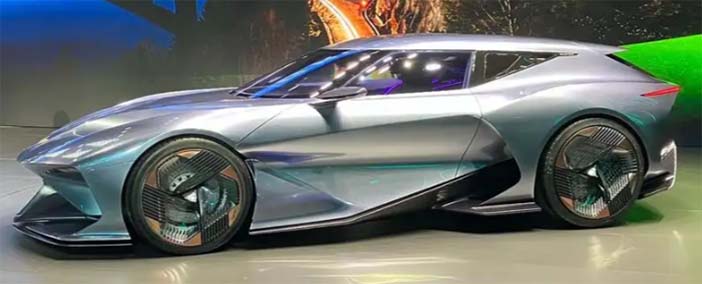
Cupra has form for staying true to its concepts. The Born looks identical to its el-Born concept, as does the Formentor, and while we can only ascertain from camouflage cars so far, the upcoming Raval looks likely to stay true to its UrbanRebel concept. The idea of the DarkRebel Concept making production as a halo sportscar for the brand still seems popular throughout the company. Sven Schuwirth, executive vice-president for Sales and Marketing added: “A sports car would perfectly fit the Cupra brand; is this dream close to reality not at the moment, no. A hero car needs to be great, but also visible on the street because then we have a real impact in the long run”. In terms of technical information there’s nothing official yet from Cupra on what would underpin the DarkRebel, aside from it being electric. The head-turning electric two-door shooting brake could potentially use the new J1.2 EV platform underpinning the next Porsche Taycan and Audi e-Tron GT, or even the new SSP architecture that looks set to underpin the new Tindaya. Shortly before ex-Cupra CEO Wayne Griffiths left the company in March 2025, he told us: “In terms of desirability and strategic importance, DarkRebel is high on the list because iconic brands need iconic cars.” Judging from what Cupra’s current bosses are saying, it appears that the iconic car is still very much on the cards. +++
+++ The EUROPEAN UNION is planning to force electric-vehicle manufacturers benefiting from state support to ensure that at least 70 percent of the components in their cars are made in the EU, as it seeks to protect the bloc’s industries from intense Chinese competition. The European Commission will stipulate that at least 25 percent of products made from aluminium and 30 percent of plastics used for windows and doors in the construction sector must be manufactured in the EU in order to qualify for government subsidies or benefit from public contracts. The targets on local content for the EV sector is part of a wider effort by the EU to try to save its manufacturing base. Manufacturing industries in the EU have been closing plants and laying off workers in their thousands as a result of low-cost Chinese competition, high energy prices and the expense of complying with the bloc’s stringent climate initiatives. The Industrial Accelerator Act, which will be published by the Commission on February 25, is aimed at protecting the EU’s industries, partly by requiring public procurement tenders to take account of carbon emissions. The draft legislation says that new EVs, hybrids and fuel cell cars benefiting from state schemes to help motorists purchase vehicles, or bought or leased for public bodies, must be assembled within the EU and have at least 70 percent of their components, excluding the battery, manufactured in the bloc, when measured by price. The legislation also says that several main components of a vehicle’s battery need to originate within the EU. Some automotive officials have said this requirement will be challenging given the EV industry’s heavy reliance on China for battery technology as well as materials. The 70 percent components threshold is still up for discussion and could be subject to change. The legislation has been the subject of heavy lobbying by industries. Those in clean technology sectors, such as renewable energy or batteries, and car parts suppliers, have been supportive of local content rules. Carmakers, however, have been split, with BMW warning that the rules would add unnecessary expense and bureaucracy, while Volkswagen and Stellantis last month called for a “made in Europe” public scheme that would incentivise manufacturers to use local content in their vehicles. +++
+++ FERRARI did not set a sales record last year, but it wasn’t far off. With 13.640 vehicles shipped to customers, it missed matching its 2024 result by just 112 units. However, an automaker’s success isn’t measured solely by the number of vehicles it sells each year. Since the Prancing Horse builds some of the most expensive cars on the market, profit margins are crucial to the company’s performance. Even though it sold fewer cars in 2025, Ferrari generated more money than the year before. Net revenues rose 7 percent to 7.1 billion euro, while operating profit jumped 12 percent to 2.1 billion euro. The company’s employees are now cashing in on the Prancing Horse’s success with record annual bonuses. Speaking with the media during the Q4 earnings call, Ferrari CEO Benedetto Vigna revealed that workers in Italy are eligible to receive a yearly competitive award of up to 14.900 euro. That’s enough to buy a new car, and ideally, for Stellantis, a Fiat Grande Panda (14.950 euro in Italy) to keep the money within the family.
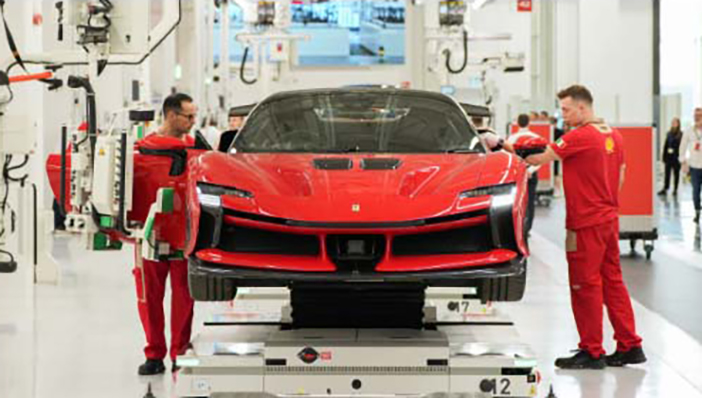
Around 5.000 people work for Ferrari in the country shaped like a boot. Ferrari is optimistic about the future. It has already sold out its 2026 production and order books are nearly full for 2027 as well, according to the CEO. Several new models are on the horizon, including the electric Luce, which premieres this year alongside four other vehicles. No fewer than 20 new cars will arrive by the end of 2030. Although Luce is ushering in change in Maranello, 80 percent of Ferrari’s models will still feature a combustion engine by the end of the decade. The company estimates that pure ICE cars will account for 40 percent, hybrids for another 40 percent, and EVs for the remaining 20 percent. Ferrari believes combustion engines have not yet peaked and will continue updating its V6, V8 and V12 to deliver more performance while meeting increasingly stringent emissions regulations. Even the F80’s record of 296 horsepower per liter from its V6 engine could be surpassed, according to Chief Research & Development Officer Ernesto Lasalandra. Offering a wide range of ICE models alongside an inaugural EV should keep most customers satisfied, at least those who can afford a new Ferrari. It’s reasonable to assume the not-an-SUV Purosangue will eventually gain a plug-in hybrid setup with a smaller engine, while another pure ICE model is also a safe bet. +++
+++ HYUNDAI Europe CEO Xavier Martinet has suggested that the EU’s forthcoming new M1E category could be an “interesting” way of making more cheap small cars available in the market, but said clarity is needed on exactly how the framework will make it easier for car makers to build such cars profitably.
Full details of the M1E class remain to be confirmed, but the general aim is to relax certain legislation for smaller cars so that manufacturers need integrate less technology and equipment, thereby making them cheaper to build and keeping the list price down for buyers. The move has been welcomed by Dacia, BYD, Peugeot and Citroën, which have each hinted at plans to introduce new entry electric cars in Europe, pending confirmation of the regulation details, and Martinet concurred that M1E could be the gateway to a new generation of cheap small car in Europe. He said that Hyundai “fully agrees” with the move to relax certain regulations, “if the EU wants to propose more affordable EVs for European customers, we fully agree”, but added that car makers need concrete details of which rules exactly would be relaxed. “Now the question is: how far does the EU want to go in terms of some other considerations for that equation? And this is where we’re waiting for the details,” he continued. “The question I have about the regulations is: which ones do you want to take away? Is it safety? Is it some of the engine specs? But then there’s confusion between electric and ICE, because some people are asking to go back to ICE for small cars, which is not what’s planned in M1E. So we’ve not seen the end of the story yet. There’s still a lot of information on our side we’re waiting for”. However, Martinet welcomed any move to relax “all the added regulation we’ve been having year after year”, which “is really increasing the cost of cars in Europe” and noted that the European car industry is especially heavily regulated compared with other global markets. “This is where Europe as a whole is certainly regulating the market way too much versus what the others are doing. If you look at the global ’tectonic plates’, in terms of regulation, Europe is way beyond what the US actually are doing”. Martinet didn’t say whether Hyundai would take advantage of the new rules in launching a circa-17.000 euro city EV, but highlighted the success of the Inster (the firm’s current cheapest EV and one of Europe’s most popular small EVs) as an indication of the firm’s strength in small cars. “M1E is trying to propose to European customers an affordable EV that meets their needs in terms of spec, equipment, range and price, and we think we’ve met that pretty well with Inster. And when you have the success story of Inster in 2025, it opens up new questions for the future but based on a very solid foundation”. +++
+++ Last fall, President Trump announced JAPAN was working to allow American-made vehicles into the country and to accept US safety certifications without additional testing. At the time, the White House said “Japan will now recognize U.S. automotive standards and lift longstanding restrictions on U.S. car and truck imports, creating billions of dollars in increased market access for U.S. automakers. Things finally appear to be taking shape as Japan’s Ministry of Land, Infrastructure, Transport and Tourism has announced the establishment of a certification system for American-made vehicles. Designed to fulfill the terms of the Japan-US agreement, the measure says “passenger vehicles manufactured in the U.S. and conforming to U.S. standards will be deemed to conform to safety standards”. The announcement doesn’t go into detail, but specifically says “Passenger cars manufactured in the US and certified for safety in the US will be accepted for sale in Japan without additional testing”. This, in theory, should be a win for automakers, employees, and Japan, which is getting tariff relief as part of the agreement. Speaking of which, Toyota has previously announced its intention to bring three American-made vehicles to Japan. This includes the Camry, Highlander, and Tundra. While the automaker described the full-size pickup as the “very embodiment of American culture”, the company believes Japanese consumers will embrace its “unique appeal”. Toyota isn’t the only Japanese automaker considering importing American-made vehicles. Honda is considering doing the same with the Pilot and Ridgeline. Nissan, on the other hand, could send over the Murano and Pathfinder. +++
++ Buyers looking for a TOYOTA supermini will be spoiled for choice in a few years’ time, because the Japanese giant is preparing a whole new generation of the Yaris. Not wanting to alienate any of its loyal customers, the all-new iteration due in late 2027 or 2028 will follow the upcoming Corolla’s lead by offering fully electric, hybrid and petrol options for markets around the world. Toyota’s European vice president of strategy and marketing, Andrea Carlucci, told: “If there is a maker with a strong presence in the lower categories, it’s Toyota. We have a position of leadership, with a lot of consistency over time. If electrification is the direction, I think we cannot avoid having a fully electrified version. When, I cannot comment, but it looks to be quite obvious”. But Toyota wants to be ready with the right product for its customers at the right time. And although it was confirmed that a new electric Yaris is on the cards, it won’t come at the expense of a hybrid-powered variant. Carlucci continued: “For now, the platform has to be strong, especially on small cars, when it comes to delivering a hybrid powertrain. The ideal path is to offer a platform where we have multi-energy options, so delivering different powertrains that are the right solution for every customer. Let me put it to you this way: a multi-energy approach isn’t just one solution. It has to be the solution”. Toyota has already announced this is the direction it’s taking with the larger Corolla for its next generation. This will see the development of a new platform capable of supporting petrol, hybrid and fully electric powertrains. All Corollas will have the same styling, interior tech and branding, offering buyers a suitable powertrain no matter where in the world they are. The same will be true of the next Yaris. Core to this flexibility is that new platform, which will be variable enough to support the vastly different requirements of its future powertrains. These will have to perform, because the electric Yaris will need to offer a 400 km range comparable to that of rivals such as the Renault 5, or future Volkswagen ID.Polo and Cupra Raval. On the petrol front, the current Yaris hybrid is one of the most efficient new cars on sale, so it would need to at least match, if not improve on the current car’s rating. This is a different choice to the ones made by key supermini rivals such as Volkswagen and Renault, which both offer distinct models with petrol/hybrid or all-electric powertrains. The ID.Polo will join an updated version of the existing car under the same name, while the French brand has entirely distinguished its Renault 5 from the latest Clio hybrid. But what will the future Yaris look and feel like? Carlucci gave a clue by telling us: “My main concern today from a planning perspective is to make sure that we keep an authenticity to what we do. For an electric car, this is a challenge. With hybrids, it was an easier game because we have so much goodwill in this area. So this is where we have to focus right now”. The Yaris will remain a 5-door hatchback in its mainstream form, but any new generation of GR Yaris (a 3-door car) is still yet to be confirmed. Looking at Gazoo Racing’s future projects, we know a new 2.0-litre 4-cylinder petrol engine is in the works for the brand’s high-performance models, but we don’t know if it could be used in something as small as the future Yaris. There’s a good chance that the brand will trickle down some of its motorsport knowledge to a less extreme, but still performance-focused model, though. Reports in Japan suggest a new turbocharged 1.3-litre 3-cylinder engine is in development and it could form the basis of a new front-wheel-drive hot hatch derived from this same platform. Just like the full-fat GR Yaris, this is being built to homologate a rally car, and it will compete in the lower Rally4 class that demands front-wheel drive. When will we see the new Yaris? Traditional model cycles suggest a replacement should be due to arrive in 2027, but Toyota has a habit of stretching these, especially if there’s a big change on the horizon. Considering the Yaris will need to adopt a new and far more flexible architecture, this is likely to be the case. I don’t expect much news until then, or possibly 2028. +++
+++ The safety concept of vehicles communicating with each other and the surrounding infrastructure has been under development in Europe for more than 20 years. Now it has come of age. VOLKSWAGEN says more than 2 million of its vehicles have ‘Car2X’ technology, which enables them to take advantage of “local swarm intelligence”, warning of traffic hazards and other relevant factors. It is available as standard or an option in a range of VWs, including the Golf, T-Roc, Tiguan, Tayron, Passat, ID.3, ID.4, and ID.7.
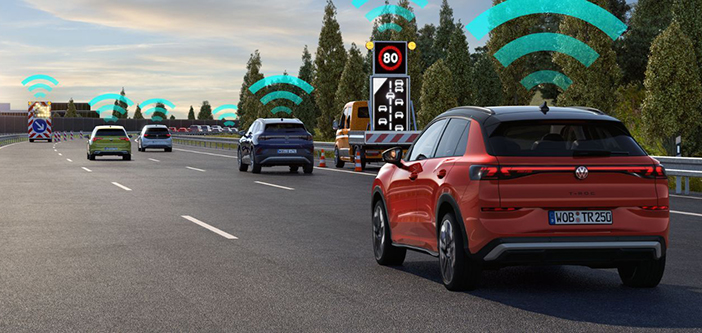
In the noughties, there were a number of European projects working on what then was known as V2V (vehicle to vehicle), often supported by major car makers and the electronics sector. The principle of the original V2V concept was simple enough: to harness low-cost wireless local area network hardware that was already widely in use. With bespoke software, the operating range was 500 metres and vehicles were able to join and leave ad hoc peer-to-peer networks consisting of a number of vehicles in range of one another on a random basis. In that way, each car was networking only with vehicles immediately relevant to it. VW’s Car2X-capable vehicles can communicate between themselves and the infrastructure and no mobile network reception is needed to do it. The communications take milliseconds, so a vehicle is instantly warned of emergency braking by a vehicle ahead, a traffic queue suddenly appearing or the approach of emergency vehicles from any direction. Connecting to infrastructure such as intelligent roadside units as well as other vehicles allows warning of specific events like drivers heading the wrong way on a street or carriageway, traffic jams, unusual weather conditions, or people, animals and objects in the road. In Germany, 1.000 roadwork trailers have already been equipped with Car2X technology and roadside units are in place across Austria’s motorway network. Other European countries are following suit with roadside units and emergency and special vehicles. Car2X technology operates on the ‘wi-fi standard, which enables vehicles to exchange warnings at a range of 800 metres. The notification process is open and standardised, allowing communication across all manufacturers’ vehicles. There’s no individual identification and exchanges are anonymous. The system can interact with other vehicle sensors. For instance, with VW’s optional Travel Assist with ACC, Car2X could reduce the vehicle’s speed when it detects a traffic queue ahead that isn’t yet visible. It can also help control acceleration in assisted lane-change manoeuvres. +++