
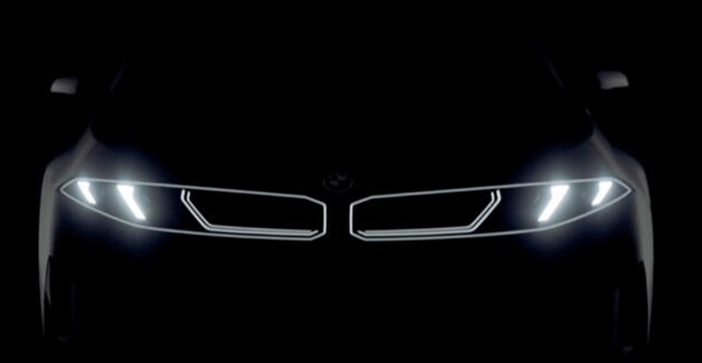
+++ BMW will introduce the second member of its Neue Klasse family of EVs later this month when it unwraps the new i3 saloon: the electric version of the next-generation 3 Series. Reprising a badge last used for the seminal electric hatchback of the 2010s, the new i3 will make its debut on 18 March as the second model in BMW’s Neue Klasse family of electric cars, following hot on the heels of the closely related iX3, which is just beginning deliveries. Previewed by a series of concepts and shown recently in heavily camouflaged prototype form, Munich’s answer to the best-selling Tesla Model 3 will depart dramatically from today’s G20-generation 3 Series with a sharp, heavily angled design treatment that nods to historic BMW models while embracing a more minimalist, futuristic ethos. A new preview image confirms that the saloon will feature a wraparound, illuminated ‘kidney’ motif on its front end that mimics the trademark BMW grille, with the distinctive new diagonal light signature that will be a calling card of the Neue Klasse line-up. It is expected that this full-width graphic will be shared with other saloons in BMW’s next-gen line-up, while the SUVs will wear the smaller, vertically oriented kidney design that features on the iX3. BMW is gearing up to refresh its entire range with 40 new EVs and heavily updated combustion cars, which all share the Neue Klasse look and are due by the end of 2027. While the X3 is now BMW’s best-seller, the 3 Series saloon remains the cornerstone of the brand and this will be the first time an electric version has been offered. BMW has sold the similar-sized i4 four-door coupé since 2021, but it chose to wait until EV technology could deliver a closer match to combustion models before launching a battery-powered 3 Series. While the i3 will be new, it will face some familiar rivals, with a Mercedes-Benz C-Class EQ set to be launched shortly afterwards, and an Audi A4 e-Tron is expected by 2028. But the i3 will also be key to taking on newer rivals such as Tesla and Chinese premium brands including Xpeng and BYD’s Denza. The i3 will be offered with a variety of power outputs (including a hot electric M3) and the launch model is set to be a 50 xDrive, as with the iX3. It is likely to offer the same 468 hp and 625 Nm from a dual-motor set-up as the iX3, with power drawn from a 108 kWh nickel manganese-cobalt battery. That system gives the SUV a range of 800 km, so the more aerodynamic shape of the saloon will potentially make it the longest-range EV on sale in Europe and should give it an edge over the C-Class EQ, which will offer a maximum 800 km range. The Gen6 platform employed by the i3 features an 800V architecture, allowing for charging speeds of up to 400kW. The i3 will be joined by a heavily updated version of the petrol-engined 3 Series, which will remain on the unrelated CLAR architecture but will receive a makeover with the Neue Klasse design language and the latest in-car technology. The Vision Neue Klasse saloon concept previewed how the upcoming EV and ICE 3 Series will look, with a distinctly different interpretation of BMW’s kidney grille that is also destined for the iX3 and future SUVs. The camouflaged i3 prototype shown recently confirms that the EV will retain the typical 3 Series body shape with smoother lines and BMW’s signature Hofmeister kink employed for the C-pillar. Inside, the i3 will feature BMW’s new Panoramic iDrive system, seen in the iX3, which mates an angled touchscreen with a projected head-up display that runs the length of the windscreen. The company claims that this system enables key data to be displayed closer to the driver’s eyeline. Given the importance of driving dynamics to BMW, the firm’s engineers have put a major focus on attempting to ensure the i3 can match the petrol 3 Series models when it comes to ride and handling. Key to that is the new centralised computing architecture, which is built around a greatly reduced number of processing chips. The set-up includes the ‘Heart of Joy’ system, which unites all of the driving experience controls to enable faster and more intuitive reactions. The system also essentially merges the braking and energy recuperation, automatically adjusting between them to offer maximum stopping power. BMW claims that 98% of retardation can be done using the energy regen system. While BMW has not given official details about the full i3 line-up, design chief Adrian van Hooydonk has confirmed that a Touring estate version will follow, along with a range of powertrain options. After that, the first electric M3 is due in 2028 and prototype versions have already been seen testing. While it will adopt the same Heart of Joy control system, M boss Frank van Meel has previously confirmed to Autocar that it will use bespoke electric powertrain and battery components. These will be based on standard BMW components but heavily developed by the M performance division. The electric M3 is expected to adopt a quad-motor set-up that could make it the most powerful M model yet, using advanced torque vectoring enabled by the new software architecture for control. +++
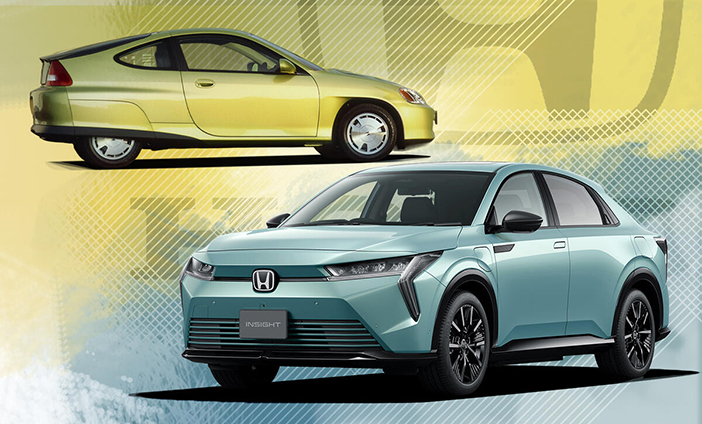
+++ The HONDA INSIGHT has returned as an electric hatchback with 500 km of range. It is effectively a renamed version of the Chinese-market eNS2, built by Dongfeng. Although the new Insight is a considerably less radical prospect than the original hybrid coupé that was first launched in 1999, Honda said it reprised the name because the new car provides insight into the needs and trends of today’s market. It will initially be offered in Japan and plans for a wider launch have yet to be confirmed. Techncial specifications for the Japanese market have yet to be announced, but Honda said its single front-mounted motor puts out 300 Nm and claims it will have “exciting, nimble” handling”. That torque output aligns with that quoted for the eNS2, suggesting the Insight also puts out 204 hp. Inside, it follows the existing Honda e:Ny1 in almost completely eschewing physical buttons, with the climate controls (apart from the window demisters) moved to its centrally mounted 12.8in touchscreen. Honda said the new Insight’s interior was designed to prioritise comfort, with a high driving position and reclining rear seats. It also has a built-in aroma diffuser, offering 6 different scents. +++
+++ MG will unveil a concept that previews its long-awaited new small electric car at the Goodwood Festival of Speed in July, the brand has told. Expected to take the MG 2 nameplate, the new 4-metre-long model will sit below the new MG 4 Urban to give the brand a rival to small EVs such as the Renault 5, BYD Dolphin Surf and upcoming Volkswagen ID.Polo. The production car will arrive toward the end of 2027, MG head of Europe William Wang told . The ‘2’ is expected to use the same front-wheel-drive E3 electric platform that underpins the MG 4 Urban, which has a 42.8 kWh battery. The EV could also be offered with the Urban’s forthcoming semi-solid-state battery, which uses a gel-like electrolyte to reduce the impact of cold temperatures on the range as well as improve the safety of the cells. The MG 2 forms part of a new model push by the SAIC-owned brand to increase the number of models it sells in Europe to up to 18 within the next two years, said Wang. A MG spokesman has previously told that the segment below the MG 4 was “the obvious area of the market that’s next to happen” and MG “obviously” had to be in there. “I’ve always felt that was the next market that was going to happen, because as Europe transitions towards EVs, inevitably the easiest way of making them more affordable is downsizing”, he added. The response to the launch of the Renault 5 also gave the brand confidence that the market for small, affordable EVs in the UK is much bigger than previously expected. “The Renault 5 has made the job much more important”, he said. The incoming MG 2 will have a much more European-focused design than other models in the line-up to reflect its bigger role in the region, compared with other markets. As such, it will be designed in the UK, said Allison previously. The model is also expected to expand MG’s EV presence in small-car markets like Italy, although current tariffs on China-built EVs would make it a good candidate for MG’s new European plant, which could come on stream as early as 2027. MG has yet to announce the location for the plant. As well as launching smaller-sized models, MG will also expand its range at the bigger end of the market with the S9, a large plug-in hybrid SUV due later this year. Euro NCAP inadvertently announced the model’s European arrival, prior to its official unveiling, when it released its crash test results. MG’s sales in Europe are currently dominated by the HS in hybrid and plug-in hybrid formats and the smaller ZS, largely as a hybrid. +++
+++ The 4th-generation NISSAN X-TRAIL has been given a mid-life update, introducing subtle updates to its design, interior and technology. Introduced in 2021, the latest generation X-Trail has often sat in the shadow of the more popular Qashqai, something this new facelifted model will be aiming to change. Key differences on the outside include new front and rear bumpers, reshaped LED headlights and a more sophisticated grille design. These will compliment new wheels in 18 and 19-inch sizes, plus an updated range of exterior and interior colours and trim elements. In markets like the USA, Nissan now offers the X-Trail in a rugged ‘Rock Creek’ model variant which ups the visual attitude. This introduces contrasting bumper inserts, orange flashes on the badges and lower bumpers, plus all-terrain tyres. However, it’s unlikely we’ll see these beefed-up X-Trails in Europe. Inside the cabin the current model’s fundamental layout will remain, with two 12.3-inch displays taking care of the main infotainment system and a digital driver’s display. New, higher-grade materials are expected to be applied, though, including the possible inclusion of new tan-coloured leather in high-grade models. 5-seat models will make up the majority of the range, but a 7-seat option will also be available. It’ll be part of a busy year for the Japanese brand, with the new Micra now reaching customers. The new Leaf is also only weeks away from full-production, and an imminent reveal of the all-electric Juke isn’t far away either. +++
+++ PORSCHE is considering merging the Taycan and Panamera into a single, unified model line with petrol, plug-in hybrid and fully electric variants. The proposals are part of broader cost-cutting measures from the new CEO Michael Leiters following a downturn in global sales and huge costs associated with former CEO Oliver Blume’s decision last year to scale back the firm’s electrification plans. The reining in of development spending, which this unification would work towards, is understood to be a key focus for Leiters. The petrol-engined Panamera and electric Taycan are both performance saloons that sit alongside each other in Porsche’s line-up, although they are underpinned by different platforms and have substantially different bodystyles. The Panamera is based on Porsche’s MSB platform, which it shares with the Bentley Continental GT. This architecture is due to be replaced by the newer PPC when a third-generation Panamera arrives later this decade. The Taycan, meanwhile, sits on the J1 platform shared with the Audi e-Tron GT and its successor was expected to migrate to the delayed SSP Sport architecture. With the cost of developing dedicated electric models weighing increasingly on profitability, Porsche is reassessing the long-term viability of running the Panamera and Taycan as entirely separate engineering programmes. Sources have suggested it is exploring greater parts sharing and the possibility of a common identity, even if successor versions continue to use different platforms. Porsche already operates parallel architectures under a single model name. The combustion Macan continues to be sold alongside the electric Macan in several markets, despite the 2 being based on different platforms. The same approach has been adopted with the Cayenne. It is not yet known if the 2 performance saloons would take the Panamera or Taycan name. Indeed, the 2 models are close in footprint, with wheelbases of 2950 mm and 2900 mm respectively. These are not trivial differences, but insiders have suggested that it is not a deal-breaker if a replacement model (supporting 2 different platforms) is engineered from the outset with sufficient engineering flexibility. The Panamera’s availability in extended-wheelbase form is also seen as a potential route for introducing 2 wheelbase options for a Taycan replacement. From a financial perspective, the consolidation of the Panamera and Taycan models lines is hard to ignore. Porsche has already written down €1.8 billion related to delayed platform development and has warned of reduced profitability as it reworks its original electric model strategy. Merging the Panamera and Taycan into a single model line could potentially deliver savings across multiple departments while avoiding a situation where the brand has to decide to axe one due to costs. How such a model might be styled remains unclear, although Porsche’s current Cayenne range, where both ICE and EV variants feature distinct exterior designs, offers a potential blueprint. +++
+++ The next 6 months should be the best, easiest and most enjoyable of the year for driving. So in addition to preparing your existing car, or even buying or leasing a new one, for the spring/summer, get ready for the Geneva Motor SHOW (once the greatest annual car exhibition on earth) is coming back from the dead. Sadly, it isn’t. But thanks to a plucky pair of entrepreneurs with years of auto-exhibition experience, a new Geneva-type show is scheduled for Great Britain around this time next year. Like the Swiss Palexpo, the chosen venue is colossal, concrete and a stone’s throw from a city airport. So, applause please for the London International Motor Show (LIMS) at the Excel centre. Initially at least, it’s being promoted as a 3-day event, from 26-28 February next year. But if sales of exhibition space and public tickets go well, there seems no reason why it couldn’t be an annual event with public entry days extended into early March. Excel has long been the venue for occasional or regular car exhibitions and races (including Formula E). So it’s a familiar location, and therefore as qualified as any place to stage a Brit version (well, sort of) of the once great, now defunct Geneva bash. It’d be too easy to argue that the United Kingdom can’t do car exhibitions as well as mainland Europe, and that the London International Motor Show will be the same as the previous incarnations known as the plain old London Motor Show, London Motorfair or whatever. But credit where it’s due, eh? Alec Mumford and Stephen Maitland-Oxley are investing much time and money bringing the London show to us in 2027… and beyond, hopefully. Similarly, another proud, hard-working British entrepreneur, Andy Entwistle, successfully delivered The British Motor Show at the Farnborough Exhibition Centre between 2021 and 2025. And he’ll be doing the same from 21-23 August this year. Many major car-producing countries don’t stage local motor shows in their capital cities or national car exhibitions in more rural areas on an annual basis. But from 2027, Britain will do both. And for this we should be immensely grateful. +++
+++ SUBARU is looking to “reignite old passions” with a new halo model among 7 fresh electric cars coming to Europe by the end of 2028. The brand, famous for its performance saloons and rally cars in the late-90s and early 2000s, is aiming to instil some of that sporting dynamic into its electric vehicles to rebuild enthusiasm for the niche badge. Subaru has long been pressured by enthusiasts to return to the type of cars that made it popular in Europe, before huge success in areas like the US and Australia moved the company’s focus away from performance models to rugged estates and SUVs. And electrification could prove the unlikely catalyst, sparking quick hot Subarus back into life. “EVs are coming and they’re making things that we’ve been dreaming of possible again, so we’re seeing almost a rebirth of that sort of blue car with the yellow paint on it. It’s becoming possible again”, David Dello Stritto, Subaru general manager for Europe, said. “This is very exciting; they’re not the biggest group of Subaru buyers in Europe, but they’re very vocal and keep pushing us. “Now we’ve got electric powertrains allowing us to do that, maybe at some point in the future we could start playing with that”, he continued. “There’s a recognition that Subaru has been out of the game for a long time and it would be good to get back into it, although it’s a bit early to say how that would look”, a Subaru insider told. “It’s about product that reignites old passion, which is more difficult with an EV because a lot of the love for the Impreza was the noise. If you don’t concentrate on range too much, you can get good performance, but the fun factor is more difficult”. The potential halo car, which could carry the famous STi badge like the 2025 STi concept car, is one that Subaru is likely to engineer in-house, rather than in conjunction with Toyota. The fellow Japanese brand is co-developing the majority of the new EVs Subaru will bring to market, including the three already confirmed. However, Subaru is working to ensure all its cars feel “more Subaru-y”, pointing to 146 differences between the Soltera SUV and its Toyota BZ4X sibling as evidence of these efforts. As well as the Solterra, which recently got a mid-life update, Subaru revealed the Uncharted, a sister car to Toyota’s C-HR+, which will also be on European roads in early 2026. The rugged e-Outback, revealed earlier in 2025 and known as the Trailseeker in certain markets including the US, is due in Europe this summer as the third Subaru EV. Of the remaining 4 cars (one of which won’t come to Europe), the halo performance model is the only one not being developed in conjunction with Toyota. The new models will either enter segments Subaru has previously been in (potentially opening the door to a revival of the Justy small hatchback) or enter new sectors, rather than being offshoots or variants of existing EVs. Insiders admit that Subaru has been serving a niche audience of people that already love the brand’s reputation for dependable reliability, and is “behind the curve on vehicles and technology”. This makes the transition into EVs more challenging, because the brand needs to attract a new audience, with buyers of its Outback, Forester and Crosstrek less likely to be looking to transition into EVs. That’s why Subaru says its petrol cars will continue to be sold as long as there is customer appetite, to retain its loyal drivers in the run-up to petrol and diesel new-car sales being banned. The brand’s huge sales in petrol-dominated America, where it registered 600.000 cars last year versus 15.000 in Europe, mean continuing with ICE models is very much on the table as long as legislation allows. +++
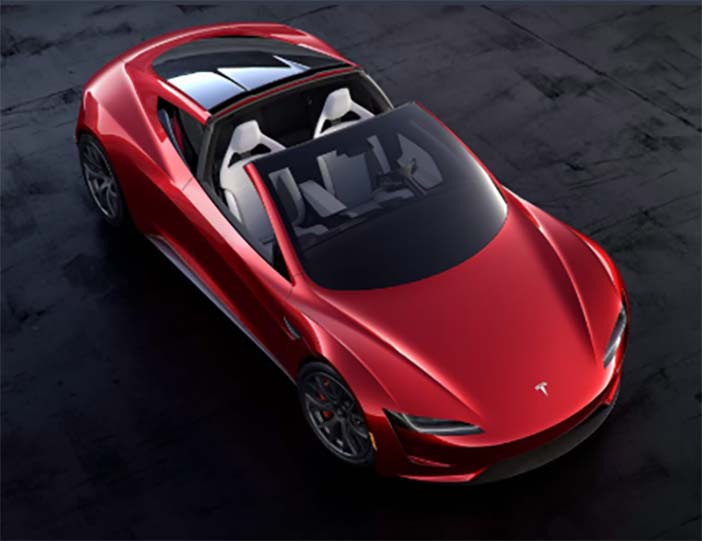
+++ The TESLA Roadster has been coming “soon” for so long that when Elon Musk announced an April 1st reveal date, the internet couldn’t decide if it was a joke or not. Given the car was first unveiled way back in 2017 with a price tag sitting around €270.000 and promises that have been delayed ever since, scepticism is fair. But a patent quietly published recently, discovered by a patent analyst on X, suggests things might actually be moving. And what it describes is genuinely unlike anything Tesla, or really anyone, has put in a production car before. Traditional car seats are an assembly of dozens of components, with metal brackets, recliner mechanisms, headrest stalks, and bolster frames, all bolted or riveted together.
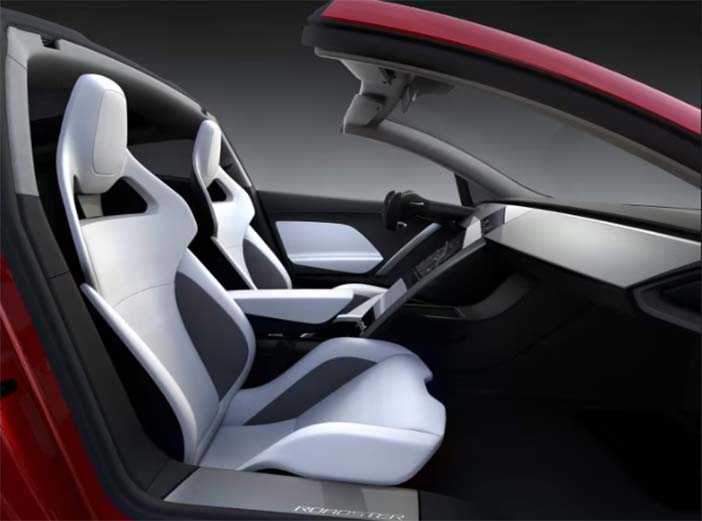
Tesla’s new patent throws that entire approach out. The design is built around a single continuous composite frame where the seat base, backrest, headrest, and bolsters are all thermoformed as one unified piece. Tesla is calling it a monolithic structure, and it’s the same philosophy behind their giga-casting push: fewer parts, fewer failure points, less weight, cleaner manufacturing. It’s closer in concept to the carbon tub chassis you’d find at the core of a hypercar like a McLaren than anything you’d expect to find under a seat cushion. The engineering goes well beyond just making it one piece. The frame is divided into up to 6 distinct stiffness zones, each tuned differently for ergonomics and structural support. Rather than a mechanical recliner, a built-in flexible hinge made from fiber composite material handles movement. 4 pairs of actuators give the seat 6 degrees of freedom, and an ECU manages all of it through software, meaning the seat is essentially programmable. Ventilation channels are molded directly in. Airbag deployment paths are shaped into the bolsters. Even the soft trim attaches without separate hardware. All this goes to say that Tesla’s given this seat more thought than just bolting in a plastic poolside chair, a thought we’re sure has entered the minds of many reading this. The implications go beyond just the Roadster.
If this manufacturing approach scales, it could meaningfully simplify seat production across Tesla’s entire line-up, cutting assembly complexity and weight in one move. For now though, it’s one more sign that the Roadster is closer to reality than it has ever been. And if the April 1st reveal turns out to be no joke at all, this might just be the seat that takes you from 0 to 100 kph in 2 seconds. +++