
+++ ALFA ROMEO is ushering in its new era. Not with another SUV, but with a gorgeous GT concept instead. The Italian automaker is unveiling its new performance car concept at the 2026 Paris Motor Show with 4 doors, 4 seats and, yes, a real petrol engine. Meet the Alfa Romeo Cuorerosso, a striking concept that previews Alfa Romeo’s future design language while offering a glimpse at how the brand could approach performance in an increasingly electrified automotive world. Alfa Romeo says the concept was developed as a “multi-energy” manifesto, meaning it could eventually be adapted to hybrid, plug-in hybrid, or even fully electric powertrains. For now, the Cuorerosso is built around something enthusiasts should recognize: the brand’s iconic twin-turbocharged 2.9-liter V6. Some of the early Cuorerosso teasers made it seem to other car news websites that Alfa Romeo was preparing another gorgeous 2-door sports car.
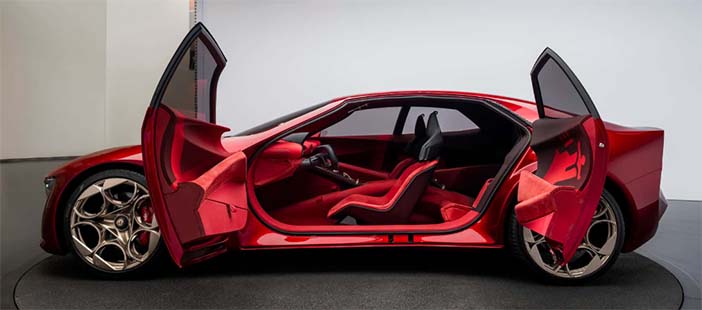
Clearly, that’s not the case. The finished concept is a 4-door performance car with 4 seats. The Cuorerosso isn’t massive, either: it’s about as long as a Tesla Model 3. Alfa says the dimensions are deliberately realistic, with enough rear headroom to fit 2 normal-sized adults. Those dimensions are: Length: 4.7 Meters, Width: 2.0 Meters and Height: 1.3 Meters. Underneath the bodywork is the same 2.9-liter V6 used by the current Giulia and Stelvio Quadrifoglio. Alfa Romeo hasn’t announced an output figure for the Cuorerosso, but the company says electrification could push its power beyond the current high-performance benchmark. The concept could also feature all-wheel drive as part of its electrified setup. The Cuorerosso was designed by Alfa Romeo’s styling team under the leadership of Alejandro Mesonero. But rather than beginning with familiar Alfa cues, designers initially sculpted the basic shape without wheels, windows, or even the traditional grille. The goal was to focus on the proportions and surfaces before adding the final elements. The result is a remarkably clean design. The windows sit flush with the bodywork, while the exterior avoids the glossy-black trim that’s increasingly common on modern vehicles. The front end features sharp, triangular headlights surrounding a simplified interpretation of Alfa Romeo’s iconic “Trefoil” grille. The goal was to focus on the proportions and surfaces before adding the final elements. Even the badge was reworked; a flat, 2-dimensional Alfa Romeo logo sits on the nose, while the brand’s famous serpent emblem is integrated into the grille. From the side, the Cuorerosso has a long, low profil, but the rear half of the car is where things get more aggressive. The body swells around the rear wheel arches, giving the concept a muscular stance with clear visual similarities to the Alfa Romeo 33 Stradale. Alfa Romeo says the concept has a drag coefficient of 0.28, on par with some modern EVs. Inside, the Cuorerosso uses a combination of digital and physical controls, with the primary infotainment display integrated into the center console. Alfa Romeo calls the driver’s display a “dynamic telescope” that changes depending on the drive mode: Cruise, Sport, or Quadrifoglio. It can display navigation and vehicle information simultaneously using 2 elements, or simplify itself to focus the driver’s attention on the road. Alfa Romeo says the system, along with the center-console display, has been patented and could eventually appear on future production vehicles. The rest of the cabin is designed around the human body. Sculpted structures wrap around the seats and center of the cabin, while red accents fade into darker tones, creating an effect Alfa Romeo says is meant to evoke a beating heart. The Alfa Romeo Cuorerosso, as it sits, almost certainly won’t reach production, but its design elements and technology will help shape future models. That includes the C-segment crossover Alfa Romeo has announced for 2027 and which will replace the Tonale. Whether the production cars look exactly like this remains to be seen. But we know that Alfa’s next chapter won’t be defined exclusively by SUVs or battery-electric vehicles; Alfa Romeo still sees a future for its 6-cylinder performance cars, even if they’ll increasingly need some help from electrification. +++
+++ BMW GROUP NORTH AMERICA asked 1.005 adults in the United States how much range they actually use … and the gap with what buyers say they want is massive. A whopping 73 percent of respondents said 120 km or less would cover a typical day behind the wheel. Most commutes and errands barely dent a modern EV’s battery, yet when asked what they’d want before buying one, the same people said the number jumped significantly. The survey, run from September 11 to 13, found that: 42 percent of people wanted at least 500 km of range. 18 percent would not settle for less than 650 km before even considering an electric vehicle. But daily driving rarely tops 120 km. The split is not new to anyone who has watched range anxiety coverage push shoppers toward bigger batteries, but the size of the gap is striking here. Most American driving is short hops: school runs, grocery trips, the commute. BMW’s data backs that up directly. 72 percent of respondents said minimum driving range would be a deciding factor when shopping for an EV, regardless of how little of that range they would use on a given Tuesday. Price still beat range as a worry, with 51 percent stating purchase cost as the main barrier to buying electric. Alexander Schleicher, head of e-mobility for BMW Group North America, called it a sign the market is maturing: “As range and charging capability continue to advance, we’re seeing consumers evaluate EVs the same way they’d evaluate any other vehicle: on performance, features and value, not on outdated assumptions about range”. Cost still cuts both ways. Just 27 percent cited lower ownership and operating costs as a reason to go electric, while 55 percent said they would consider a certified pre-owned or used EV if the savings were big enough. BMW’s survey zeroed in on one number that might change more than total range: charging speed. Respondents were asked about an EV that could add roughly 250 km in a 10-minute stop, the kind of top-up that turns a highway break into a bathroom-and-coffee errand. Fifty-three percent said that capability would make them more likely to consider an EV. The generational split is wide: 70 percent of Gen Z respondents said fast charging would move the needle. 65 percent of Millennials said the same. Just 30 percent of Baby Boomers agreed. Acceptable charging windows are loosening too. This year, 55 percent of respondents called 30 minutes or less an acceptable fast-charging stop, up from 48 percent in a 2024 Mini USA survey on EV attitudes. That is still a world away from a Level 1 home outlet, where federal guidance says charging times typically run 8 to 16 hours depending on the vehicle and battery size. Perception of who buys EVs is shifting too. Just 56 percent of respondents still viewed EV buyers as early adopters, down from 62 percent in BMW’s 2025 survey, even as 68 percent overall said they would consider buying one. +++
+++ Fiat set the template with the 500 and Renault followed with the latest Twingo. Now, CITROEN wants in on the retro city-car revival with a modern take on one of France’s most recognizable cars: the 2CV. Known affectionately as the “Duck,” or “La Deuche” in France, the 2CV is making a comeback at the 2026 Paris Motor Show. And judging by the concept, Citroën isn’t simply trying to copy the original. Citroën’s goal was to create a small EV that’s practical and inexpensive, but something that still feels special to drive.
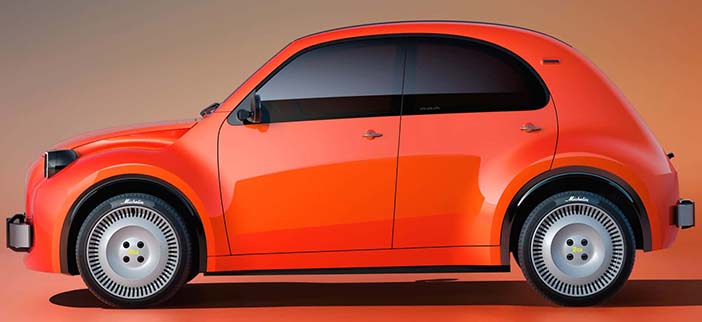
The production car could slot between the tiny Ami and the C3 in Citroën’s line-up. Despite its modern technology, the 2CV Concept is actually smaller than the original. It measures about 3.7 meters long, compared to the roughly 3.8 meters of the original 2CV. Citroën says keeping the dimensions compact was intentional. The idea was to bring back the light, playful nature of small cars while making the vehicle easy to drive and park in crowded cities. The target weight is around 1.000 kilos, too. Keeping the car light means Citroën doesn’t need an enormous battery to provide useful everyday range. That should also help keep the purchase price and running costs down. The concept takes the same minimalist approach to its construction. Broad, flat body panels, simple air intakes below the windshield, and separate bumpers that can be replaced individually are all designed to make the car easier and cheaper to build and repair. Citroën is also working with Michelin on a “universal digital tire twin”, which is designed to monitor tire health and continuously adapt the vehicle’s behavior based on road and environmental conditions. The design is where the connection to the original 2CV is most obvious. The concept has the same basic proportions and rounded silhouette, but Citroën has tightened up the details for the modern era. There’s a steep windshield, a gently curved roof, prominent fenders, and relatively simple body surfacing. Up front are freestanding round headlights paired with a modern LED light signature. The hood also incorporates a reference to the historic TPV project (the “Toute Petite Voiture”, or “very small car” that eventually became the 2CV). There are also some deliberately old-school touches, including exposed windshield wipers and air openings integrated into the front end. From the side, the concept gets more playful. The door handles take inspiration from the original 2CV, while slim turn signals sit in the rear roof pillars. The 19-inch steel wheels are another modern interpretation of a classic design. The rear is arguably the most distinctive part of the car, with a curved roofline, black tailgate extending down into the bumper, and horizontal LED lighting elements. Even the license plate is a little Easter egg, with the various nicknames given to the 2CV around the world. Citroën isn’t trying to turn the 2CV into another screen-filled EV, either. The interior is bright and open, with wide seats featuring the company’s Advanced Comfort technology. The passenger seat can slide outward, while removable storage baskets and soft strap-style door handles add some useful practicality. Instead of a conventional dashboard, the driver gets a minimalist control setup centered around a cylindrical structure. It houses the steering wheel, control stalks, shift paddle, and Citroën Smart Vision Display, which projects important information into the driver’s line of sight.There’s also an 8.0-inch square touchscreen that combines digital functions with physical controls. Its graphics are inspired by comic books, adding a little personality to what could otherwise be a very basic interface. Then there’s Radioën: a removable radio that doubles as a portable speaker. You can take it out of the car and bring the music with you, which is neat. A fabric folding roof is another obvious nod to the original 2CV, giving the cabin a more open and airy feel. The elaborate string of lights around the interior, however, probably isn’t making the transition to production. The 2CV Concept is filled with tons of little references to the original. The exterior is finished in a color called Infra Red, combining orange, yellow and red tones as a nod to the classic 2CV Spot. Inside, the seats feature a modern take on the old 2CV’s checkered upholstery. There are also beige Bakelite-inspired elements throughout the cabin. Bakelite was one of the first fully synthetic plastics and was used for various components on early 2CVs. Wood, textured fabrics, wicker-inspired materials, and 3D-printed storage baskets give the interior a warmer, more tactile feel than the typical modern EV cabin. Even the pedals get in on the joke; a turtle represents the brake, while a hare marks the accelerator. The door pockets are another clever callback. They’re designed to carry eggs, referencing one of the famous requirements from the original 2CV’s development brief. The horn and electric motor sounds reference the original car, while the ventilation flaps beneath the windshield and umbrella-handle-style selector mimic familiar 2CV details. The numbers 48, 90 and 26 on the windshield represent the original car’s launch year, the end of its production run, and the year of this concept’s debut. Citroën says the production version will be built in Europe and is targeting a starting price of around €15,000. That would make it one of the more affordable ways to get into an electric car, assuming Citroën can keep the final price anywhere close to that target. The production model is expected to arrive by 2028, potentially making its debut at the 2028 Paris Motor Show. If that happens, the timing would be perfect: exactly 80 years after the original 2CV first appeared. Of course, not everything on this concept will survive the trip to production, but if Citroën can preserve the basic formula (a lightweight, inexpensive, practical EV with plenty of personality) the 2CV could be one of the more interesting entries in Europe’s growing crop of affordable electric city cars. +++
++ Remember DS AUTOMOBILES ? The French premium brand is still around, and it has a new concept car to prove it. The DS F3VER is a futuristic design study unveiled ahead of the 2026 Paris Motor Show, previewing where the Stellantis-owned marque wants to go next.
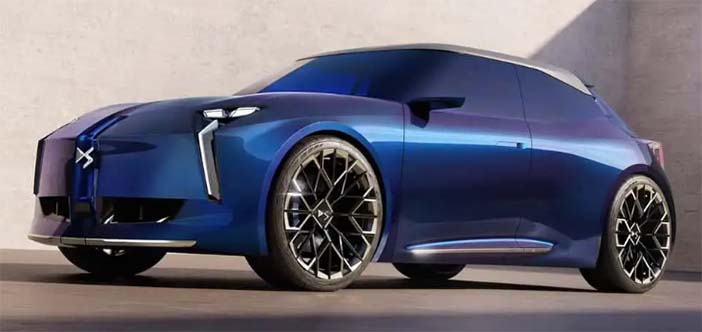
Let’s be honest: DS doesn’t exactly dominate conversations about premium cars, or cars in general. The brand has been working to establish its identity beyond its Citroën roots, competing in a crowded segment where German luxury brands and Mini have a considerable head start. Now, it’s trying to stand out with a concept that promises bold styling, extensive customization and everyday versatility. The new Fever (sorry, F3VER) isn’t a preview of a confirmed production model. Instead, DS describes it as a design manifesto exploring the brand’s future direction. It’s meant to show that the French automaker still has its own ambitions, even as Stellantis juggles a sprawling portfolio of brands. We can easily imagine this becoming the successor to the DS 3. Measuring 4.19 meters long, 1.84 meters wide and 1.46 meters tall, the F3VER has a compact footprint but an assertive presence. Its sculpted bodywork, taut lines, and distinctive proportions aim to make it stand out without resorting to the oversized dimensions of many modern SUVs. The front end is particularly striking. A vertical central element carrying the DS emblem anchors the design, flanked by Y-shaped lighting signatures that give the concept a futuristic look. The rear follows a similar theme, with a central digitalized logo and multidimensional lighting that creates the impression of an illuminated tunnel. The taillights consist of 16 LED panels mounted on a lightweight magnesium structure inspired by the vaulted roof of Paris’ Grand Palais. It’s an elaborate lighting signature, but the point is to make a memorable impression. DS has also developed an exclusive Cosmic Blue paint finish that shifts between vivid blue and deep violet depending on the lighting. The two-tone bodywork extends beyond the usual roof treatment, with the contrasting color wrapping around the rear to emphasize the car’s shape. Even the roof trim is customizable, allowing buyers to add another personal touch. The wheels feature champagne-colored details and a subtle Clous de Paris pattern, a decorative finish associated with the brand’s attention to detail. DS wants the F3VER to be more than a pretty design exercise. The concept explores a future in which customization becomes a core part of the ownership experience, extending beyond paint colors and upholstery. In Audi fashion, the rear lighting system can display different animations, serving as both a visual signature and a way to communicate information. DS envisions light becoming a language through which the car expresses its personality and interacts with its surroundings. It’s an ambitious idea, though the company hasn’t explained how much of this technology could realistically reach production or what customers would have to pay for it. Underneath the flashy design is what DS calls “Design Intelligence”: an approach focused on creating more with fewer components. The idea is to simplify the vehicle’s construction, reduce weight, improve aerodynamic efficiency, and create cleaner surfaces without sacrificing perceived quality. The concept uses integrated lighting assemblies, one-piece bumpers, and fewer add-on plastic elements around the wheel arches and lower body. As the saying goes, sometimes less is indeed more. Beyond giving the F3VER a more cohesive look, these solutions could simplify manufacturing if adapted for production vehicles. Despite its dramatic appearance, the F3VER is designed for everyday practicality. Its 2.70-meter wheelbase is intended to maximize cabin space. At the same time, the 400-liter trunk offers cargo capacity typically associated with larger vehicles. DS says the concept combines urban agility with comfort and versatility for longer journeys, leisure activities, and weekend getaways. However, the company hasn’t disclosed a powertrain, battery capacity, charging specifications or an estimated driving range. It describes the F3VER as part of a new generation of electric vehicles and promises class-leading range. Without specific figures, though, it’s impossible to determine how competitive it would be against established electric rivals. The F3VER is a statement of intent. Its distinctive lighting, extensive customization options, and focus on packaging suggest DS wants to pursue a more individual design direction rather than follow prevailing trends. Whether those ideas translate into compelling production cars remains to be seen. For now, DS has reminded us it’s still in the game, and that Stellantis isn’t about to kill off the struggling brand. The next step is making sure customers remember that when it’s time to buy a new car… +++
+++ Station wagons have been part of OPEL ’s identity for decades. The company introduced the Olympia Rekord Car-A-Van in 1953, followed by the Kadett Caravan and plenty more wagons over the years. Now, Opel is showing what the future of the body style could look like in Paris.
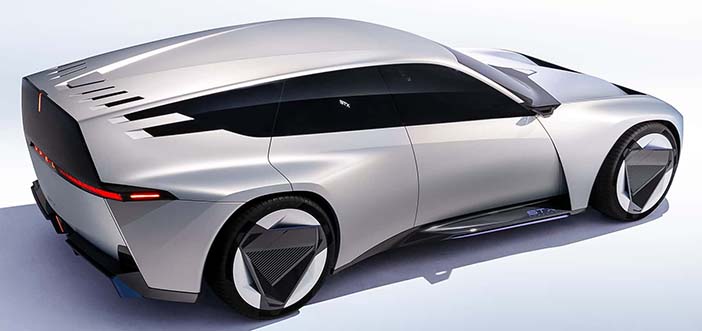
The new Opel STX Concept will take center stage at the 2026 Paris Motor Show. More specifically, it’s the Opel Sports Tourer eXperimental Concept, or STX Concept for short. The name is meant to signal the German automaker’s vision for the future of the wagon. The ‘ST’ designation is already closely associated with Opel’s Sports Tourer models, including the latest Astra Sports Tourer. So, this must be a preview of the next Astra wagon? Not exactly. Opel says the STX Concept is more a preview of future models than a look at one specific model. According to the company, it also represents the next evolution of its design philosophy. Opel describes it as “the bold vision of the electric wagon of tomorrow”. Opel CEO Florian Huettl says the STX Concept “offers a taste of how exciting and emotional the wagon of tomorrow can be, with maximum functionality and efficiency”. He adds that the concept includes “characteristic features that will appear in future Opel models” and reinforces Opel’s position as a pioneer of the wagon in Europe. The first thing that catches your eye is the latest evolution of Opel’s Vizor front end. The brand’s signature face looks even bolder here than on previous models. While many modern EVs have gone with ultra-slim front ends, the STX Concept’s Vizor is taller and more prominent, matching the size and proportions of the wagon. The lighting signature is made up of vertically angled slats that form the outer edges of the Vizor before tapering toward the center. The illuminated Opel lightning bolt remains the focal point, while the brand’s signature crease running down the center of the hood is emphasized by the sharp, sporty front end. While many modern EVs have gone with ultra-slim front ends, the STX Concept’s Vizor is taller and more prominent, matching the size and proportions of the wagon. The rear follows a similar design theme. The roofline drops off steeply, which Opel says helps combine “maximum everyday usability through additional cargo space with modern design”. Slim, illuminated compass-axis elements and an illuminated Opel wordmark sit in the center of the tailgate. The prominent C-pillars are another standout feature. Glass light strips extend rearward from the window line and continue into the roof, creating a distinctive visual element. Illuminated STX lettering runs along the sides, while cameras replace traditional side mirrors. In profile, the silver-blue STX Concept has a low, aerodynamic silhouette designed with long-distance efficiency and high-speed stability in mind. The tightly fitted bodywork, short overhangs, and wide, flared wheel arches give the wagon a planted stance. Aerodynamics play a major role in the STX Concept, with Opel aiming to improve not only efficiency and range, but also straight-line stability and driving dynamics. Helping with that are specially designed alloy wheels wrapped in 285/35 R22 Goodyear tires. The concept also features an active aerodynamic system that continuously adjusts to the driving situation. Movable elements at the rear help manage airflow, reduce drag and improve stability. At higher speeds, blue-colored diffusers extend from underneath the rear, while vertical elements behind the wheels extend outward from the bumper to further smooth the airflow. Underneath the concept’s sleek body is what Opel calls an “innovative electric architecture with all-wheel drive”. The company hasn’t provided detailed specifications, but it says the STX Concept has a top speed of more than 200 km/h. Inside, Opel is taking its “Painting with Light” theme to the next level. The idea first appeared on the 2023 Opel Experimental and later on the 2025 Opel Corsa GSE Vision Gran Turismo. The STX Concept builds on that approach with immersive lighting elements and lightweight seats. That makes the STX Concept more than just another flashy show car. It’s Opel’s vision for what the station wagon could become in the electric era, and the company says the concept already incorporates design elements that will appear on future production models. As for when we might see some of that technology and styling make its way into a showroom, don’t expect it anytime soon. My guess? Probably not before 2028. +++
+++ PEUGEOT is bringing back the RCZ, but don’t get your hopes up just yet. The French automaker unveiled the RCZ Vision hours before the 2026 Paris Motor Show actually begins. The futuristic electric sports coupe previews where the brand is headed in design, technology and driving experience, but a production version isn’t a done deal yet. Peugeot produced (well, technically Magna Steyr did) the original RCZ from 2009 to 2015, giving it a stylish alternative to established sports coupes from neighbouring Germany.
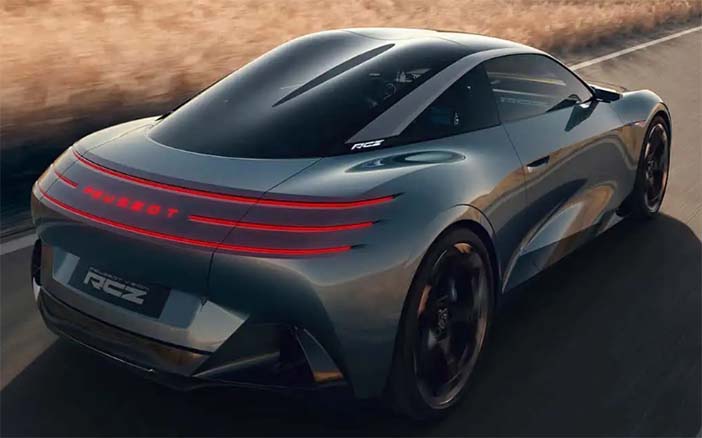
Its successor isn’t a production model just yet, though. Instead, the RCZ Vision serves as a rolling manifesto for the company’s future, combining a dramatic exterior with next-generation cabin technology and a solid-state battery developed with Factorial Energy. Peugeot says the concept is built around its fresh “Feline Future” design language, which will influence upcoming models. Five principles define the approach: freedom, courage, elegance, inner force, and instinct. That’s an ambitious list, but the RCZ Vision certainly makes a strong first impression. The coupe has a low-slung stance, muscular shoulders, and a slim glass cabin that contrasts with its sculpted bodywork. The showcar brings back the distinctive, Zagato-inspired double-bubble roof as a nod to the original RCZ. At the same time, the lighting signature reinterprets Peugeot’s familiar three-claw motif with ultra-slim horizontal elements at both ends. An active rear spoiler remains hidden when the car is stationary and deploys while driving. The wheels are appropriately extravagant, measuring 21 inches at the front and 22 inches at the rear. Peugeot has also replaced solid aluminum with paint made from recycled aluminum, giving the concept a more sustainable metallic finish. The design isn’t just about making a statement. Peugeot says the RCZ Vision’s aerodynamic shape and exceptionally thin battery help keep energy consumption down to a projected 11.5 kWh per 100 kilometers. That figure is still unconfirmed, but it would be impressive for a coupe with this much power. Then again, if this stays only a concept, the specs aren’t that relevant. While there’s still hope it’ll see the light of day as a production car, we need to talk about that solid-state battery. It’s just 110 millimeters (4.3 inches) thick and works with a 1,000 volt electrical architecture. The setup promises up to 600 kilometers of range and a 10-minute charge from 10 to 80 percent. Performance should be pretty solid, considering the RCZ packs a mighty 500-horsepower punch. Peugeot doesn’t say whether it’s rear- or all-wheel drive, though. The petrol-powered RCZ was front-wheel-drive, but I can’t imagine 500 hp going exclusively to the front wheels. As for size, the RCZ Vision measures 4.65 meters long, 1.94 meters wide and just 1.35 meters tall, giving it a wide, low-slung stance with plenty of road presence. It’s substantially bigger than its predecessor while sitting just as low. The dimensions give it the proportions of a more substantial grand tourer, even though it’s only a concept for now. The concept also previews Peugeot’s next-generation i-Cockpit, including the Hypersquare steering control and transparent Micro LED displays. Rather than covering the dashboard with ever-larger screens, the company wants to make information more configurable and less distracting. The central display can even be switched off, effectively disappearing into the dashboard when it isn’t needed. Hypersquare isn’t entirely a flight of fancy, either. Peugeot claims the concept uses the same production version of the unusual steering control planned for the next-generation E-208. Combined with steer-by-wire technology, it eliminates the mechanical connection between the steering control and the front wheels. Peugeot claims the system can make low-speed maneuvers easier while adjusting the steering ratio for greater stability at higher speeds. The RCZ Vision also introduces brake-by-wire technology, replacing the conventional hydraulic connection between the brake pedal and the brakes with electronic control. The company says this should improve braking modulation and integration with regenerative braking. Level 2++ automated driving, including hands-free functionality, is another part of the concept’s technology showcase. Inside, the four-seat cabin aims for a grand touring atmosphere rather than a stripped-out track-car feel. Peugeot combines Alcantara, recycled leather, machined aluminum, and a light-blue color scheme, while the rear seats can accommodate two adults and fold down to expand luggage capacity. A clock developed with French watchmaker SERICA adds a traditional touch to the otherwise futuristic interior. Peugeot describes the RCZ Vision as a preview of its future, not a promise that the coupe will reach showrooms. Still, reviving a distinctive sports car nameplate with an electric powertrain, solid-state battery technology, and a driver-focused cockpit is a compelling way to make that future feel a little more exciting. Now, if only the French would tell us whether any of this will eventually make it into a production car… +++
+++ PORSCHE ’s upcoming hypercar already sounds like it could be something special. And this latest teaser clip has us very excited. Today, the automaker released a new teaser video on social media for its upcoming Mission S. While it doesn’t show much, the clip does reveal one particularly interesting detail: a tachometer climbing to 8.000 rpm. We also see extending and retracting gauges, à la Lexus F cars.

Considering what Porsche has said about the project thus far, it’s just enough to get our attention. Porsche confirmed earlier this week that it’s developing a new mid-engine supercar/hypercar platform that will sit above the 911. The company says the architecture could eventually underpin an entire model line, giving Porsche a new family of high-end performance cars positioned above its iconic sports car. The project marks Porsche’s return to the hypercar space. The company’s last true halo car was the 918 Spyder, which paired a naturally aspirated V8 with electric motors to produce 887 horsepower. Before that came the legendary Carrera GT and, further back, the 959. Porsche hasn’t confirmed the Mission S’s powertrain yet, and we don’t know many specifics beyond what’s shown in the teaser. Still, the company has made one thing clear: This new platform will sit above the 911 in Porsche’s lineup. So, What’s Powering It? Your guess is as good as mine. Though some early reports suggest that Porsche will use a new flat-eight engine, the first of its kind in a production model from Stuttgart. This video suggests that it will be paired with a quick-shifting PDK gearbox and it will almost certainly be turbocharged. Questions linger surrounding potential hybridization, but I wouldn’t be surprised to see it here. The 918 Spyder was a plug-in hybrid and Porsche already has the high-performing 911 Carrera GTS T-Hybrid, which has been a relative hit among Porsche faithful. We’ll find out much more when the Porsche Mission S makes its debut on October 15. +++