
+++ BYD ’s luxury brand is eyeing its own European car loans because the number most buyers actually care about is the monthly payment. Be honest: when you shop for a luxury car, you don’t think about the sticker price first. You think about the monthly payment. DENZA , BYD’s premium brand, seems to know it. It’s no secret that most buyers of expensive new cars finance their purchases, not only because they have to, but also because sometimes it is the financially sensible thing to do. BYD intends to use this dynamic in the same way that luxury brands in the West have for years. According to a report from Bloomberg, the brand is considering launching its own vehicle-financing business in Europe, possibly starting in 2027. It’s a possibility, not a confirmed launch, and there’s no word yet on who owns it, which banks are involved, or where it would start. In Europe’s premium segment, payments and resale values often decide which badge ends up in your driveway, which is why BMW and Mercedes-Benz both run huge in-house finance arms to fund leases and loans at their dealers. A Denza version could offer loans, leasing and other payment packages right next to the car, so you wouldn’t need to haggle with a bank at all. Whether the deals would actually be cheaper is a different question, and nothing has been announced on terms. Running a car bank isn’t easy. Denza would have to fund the loans, vet borrowers, absorb the ones that go bad, and predict what its cars will be worth in three years. That last part is the problem for a brand that only launched in Paris in April and has no European used-car history. Partnering with an existing lender is the easier route, and the report says no structure has been picked. Denza began life as a BYD-Mercedes-Benz joint venture before BYD bought it outright. Its first models outside China are the Z9 GT electric shooting brake and the D9 plug-in hybrid minivan, and it says it will be in more than 30 European countries with over 150 outlets by the end of 2026. Chinese brands are also gaining fast: they took a record 11.7 percent of European registrations in August, up 111 percent from a year earlier. BYD alone held 3.1 percent of the EU, EFTA and UK market, up from 1.4 percent, per ACEA data. BYD first passed Tesla in Europe in 2025, and it hasn’t slowed down. +++
+++ FIAT is “ready” to reveal a new entry-level electric car twinned with the reborn Citroën 2CV and it could be called the Koala. The new EV is expected to be an electric counterpart to the existing combustion-engined Panda, which has been on sale in Europe for the past 15 years and is now also known as the Pandina. It will share Stellantis’s new bespoke platform for small EVs with the 2CV, which was unveiled in concept form at the Paris motor show and will go on sale in 2028. It has been designed to take advantage of the EU’s mooted E-car ruleset, which has been devised to incentivise manufacturers to sell electric cars measuring less than 4.2 meter long. This ruleset is inspired by the framework that underpins Japan’s kei cars, which account for roughly 40% of its home market, and is intended to reduce prices to boost the mainstream transition to EVs. Although the European class (first proposed by Stellantis and the Renault Group in 2025) has yet to be signed into law, several manufacturers have described it as key to securing a future for European manufacturing. Fiat’s first entry into the segment will be the electric Panda replacement, but the company is already working on follow-ups as part of its renewed strategic focus on small, affordable cars. Speaking at the Paris motor show, new Fiat boss Arnauld Belloni said: “We are working on a few cars based on the E-car platform. We are preparing a small car which will be based on the 2CV and it’s going to be a ‘wow’ “. Design chief François Leboine told that the first of Fiat’s E-cars is as “ready as the 2CV is”, but that the brand decided it was “not the right moment for us to show what we are doing”, likely so it didn’t upstage its French counterpart at its home show. Leboine suggested that, having now launched larger models in the Grande Panda and Grizzly, Fiat’s priority is to revitalise its city car range. Although it revealed the Multiplay concept (a Grizzly-sized cross between a pick-up, SUV and MPV) at the Paris show, it also displayed a near-production concept for the Multiplina 4-seat quadricycle. “We are redoing the bottom part of our range”, he said. “It is Pandina today but also 500. The maturity of the 2CV concept is evident, and we will follow exactly the same maturity. We will show it at a good moment”. Although the first of Fiat’s E-cars will sit within the Panda family, it won’t necessarily take that name. Belloni revealed that Fiat has trademarked the Koala name, in keeping with Fiat’s scheme of naming different models in the Panda range after different bears. “Koala now belongs to Fiat”, he said. “We have a Koala, a Panda and a Grizzly”. Indeed, he joked that the only bear name Fiat can’t use is Kodiak, because Skoda uses this for its large SUV. This would clearly distinguish the EV from the combustion-engined Panda, which remains Italy’s best-seller, and the brand has committed to continuing to serve the market for an affordable petrol-powered car. Fiat Europe boss Gaetano Thorel earlier this year said: “I need to find a proper answer for my Panda population. We need to find a multi-energy solution”. Although the new E-car is expected to draw on familiar Panda cues, Belloni ruled out a revival of any previous iterations of the city car, in the same vein as the 2CV. He described it as “a very different approach, not neo-retro”.
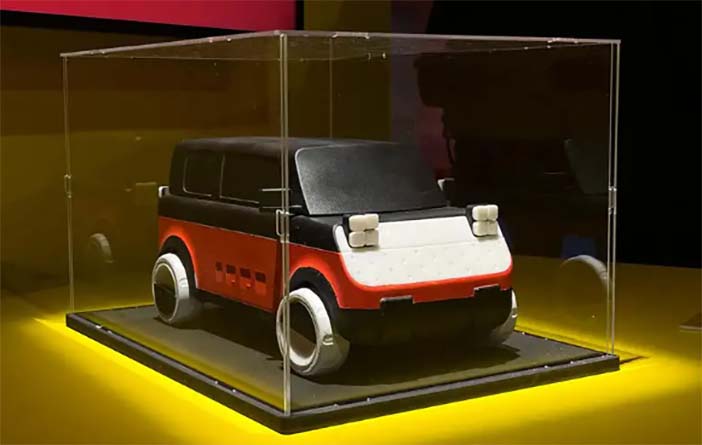
Leboine referenced an E-car design competition for Italian university students that Fiat ran earlier this year. Public voting awarded victory to the Ippo concept, a blocky hatchback reminiscent of Pandas past and present, and suggested that Fiat could borrow cues from it, as well as the runners-up, the Lumo Su Misura and the Fizz. Fiat has since shown the Ippo in strategic presentations alongside the Multiplina and Grizzly, hinting at the high regard in which it held the proposal. It also gave seven of the students apprenticeships in its design studio, and four remain with the company. Leboine said they brought “some ideas that we were surprised by, cool ideas that we share”, which have influenced future Fiats. “We could take some bits and pieces, and now they are working in Fiat and they see things happening, and that’s cool”, he added. “We are quite happy with what we have, but I cannot say more”. +++
+++ HONDA has trademarked the name ‘Type-Trail’, and the enthusiast in us couldn’t be happier about the implications. The filing gives us the obvious reading of a hotter Passport TrailSport, but nothing is confirmed, with precious little in the way of details in the trademark filing, meaning that this take is deduction and a little wishful thinking. There is precedent, though. Honda trademarked the TrailSport name in 2020 and the first Passport TrailSport showed up for the 2022 model year. A filing, in other words, is a long fuse. Considering the TrailSport now accounts for over 80 percent of Passport sales, we can see why Honda would light that fuse. The only Type R sold currently is the Civic. It’s also why it makes sense that Civic Type R owners with growing families end up leaving to another brand. A hotter Type-Trail would be a neat way to keep those buyers within the fold. Best of both worlds, for an enthusiast who puts practicality first, in theory at least. The Civic Type R’s 2.0-liter turbo four makes 315 hp and 410 Nm, with torque arriving between 2.600 and 4.000 rpm, a handy window for light off-road work. The catch is that the Civic is front-wheel drive and manual only, while buyers of a trail-ready SUV probably want Honda’s i-VTM all-wheel drive and automatic. So to be fair, considering the badge has never sat on an SUV, let alone one meant for mud, I’m keeping our fingers crossed that the trademark filing is a sign of things to come. +++
+++ LEXUS is one of the top-selling luxury marques in the United States and has quickly become a benchmark for the segment. 2025 was a particularly strong year for them, when it sold about 882.000 cars worldwide, which represented a 4% increase over 2024. It stands as the Japanese automaker’s best-selling year. With a volatile buying market, 2026 paints a different picture. People have slowed on luxury purchases. Lexus points to a slowdown in sales, particularly in Q3 and Q4 of 2026, but has a plan in the meantime. The luxury brand has decided to shift its strategy for the tail end of this year. 35.000 cars destined for global markets have been redirected instead to the U.S. dealer network to supply the growing demand in North America. Lexus’ biggest market is still North America, accounting for the majority of its sales. The report details that this was done to protect the brand’s record sales performance while also shifting back to propping up its core models after a slew of new model launches. Lexus dealers have been asking for more inventory, with the struggling supply as the main reason for Lexus’ 2.9% drop in September. Lexus secured the fresh 35.000 units from China and the Middle East, which are slowing in terms of sales for the rest of the year. DeJuan Ross, group vice president and general manager of the Lexus Division at Toyota Motor North America, told that about 90% of what the 246 U.S. dealers will sell will be all-new or refreshed over the next 18 months. To also bolster confidence, the dealers will also get a sneak peek at the brand’s replacement for the aging and slow-selling UX crossover. “Reinvesting in the core and refreshing those core products at a more regular cadence will be well received by the dealers, said Ross. Lexus has recently updated the NX and ES, with a planned upgrade also slated for the top-selling RX and the expectation of the arrival of the new 3-row TZ next year in its showrooms. Another interesting aspect of the report details the upcoming retail future of the Century and GR brand in the U.S. Select dealerships will soon begin sales of the new GR GT and GT3 cars towards the end of 2027. Ross says that around 100 dealers have been selected to participate as retail hubs for the GR GT cars. These dealerships sent representatives overseas to be trained to deal and represent the new high-performance cars, with Ross also saying they expect nationwide sales of the GR GT models to be 250 to 300 units for the first year. Meanwhile, the ultra-luxury Century-branded cars are set to arrive in the U.S. sometime in 2028, with the dealer list being much smaller compared to the GR GT group. +++
+++ For many Americans, choosing a car isn’t just about fuel efficiency, performance, or passenger space. Their 4-legged companions are becoming part of the equation, too. A new survey commissioned by Subaru of America and conducted by Talker Research found that 73 percent of respondents were more likely to drive than fly so they could bring their PETS along. The findings suggest that pet-friendly features are becoming an important consideration for people who want their animals to join them on everyday drives and longer road trips. When pets travel in a car, space matters. According to the survey, 32 percent of respondents prioritized having enough room for pets, passengers and luggage. Good visibility to keep an eye on their animals ranked next at 29 percent, followed by easy-to-clean seats and cargo areas at 27 percent. Another 26 percent said cargo space for crates, carriers, pet beds and other essentials was important. These preferences help explain why thoughtfully designed interiors and cargo areas can make a difference to pet owners. Subaru’s redesigned 2026 Outback, for example, features a multifunctional cargo cover that can serve as a pet barrier and help protect the rear bumper from scratches. It’s a practical example of how automakers can accommodate pets without compromising everyday usability. The survey suggests that pets affect travel decisions as well as the features drivers look for in a vehicle. More than two-thirds of respondents, or 68 percent, said their pets would influence their holiday travel plans, while 45 percent had turned down travel opportunities that couldn’t accommodate their animals. Among respondents who had traveled with pets, younger generations were more likely than older ones to have taken their animals on road trips in the past 5 years. There are limits to what the findings tell us. The online survey covered 2.000 US adults who drive and own cats or dogs, and it was commissioned by Subaru, an automaker with an established pet-friendly brand identity. It measures travel preferences and desired vehicle features rather than proving that pet ownership directly determines which cars people buy. Still, as automakers compete on everyday practicality, designing vehicles that accommodate pets could give them another way to appeal to buyers. +++
+++ At this point, software-defined vehicles (SDVs) seem inevitable. They essentially rely on advanced software systems that monitor, control, and even upgrade cars through over-the-air updates. Volkswagen has tapped Rivian to develop an SDV architecture, while Nissan and Honda have agreed to share key operating system components. Now, TOYOTA has announced a similar strategy with its software platform called Arene. The Japanese marque aims to expand Arene from 2 models today to 50 nameplates and 10 million vehicles annually by 2030. As the world’s best-selling automaker, the expansion could accelerate the adoption of SDVs, signaling a shift away from traditional, hardware-focused vehicles. The Toyota RAV4 and Lexus ES are the 2 models currently using Arene, which supports advanced safety systems and digital cockpits. Toyota plans to expand the platform to manage body controls and powertrain functions. Beyond the vehicles themselves, Toyota said Arene reduced the time needed to evaluate advanced driver-assistance software in the new RAV4 by 70%. As such, the platform could help accelerate development, reduce engineering expenses and bring software improvements to customers faster. This is a noteworthy development, as many high-profile SDV initiatives have focused on EVs, including Tesla’s approach. Given the EV slowdown, Toyota could help introduce SDVs to more mass-market buyers, especially considering that the automaker plans to share the system with alliance partners, including Suzuki, Daihatsu, Mazda and Subaru, around 2035. This could expand Arene’s reach to approximately 16 million vehicles annually. Toyota hasn’t specified which models will receive the software platform next, though with 2030 just a few years away, more details should emerge soon. In the future, SDVs could pave the way for smarter capabilities, including fully autonomous driving. Continuous software updates could help automakers refine these systems to better handle complex road conditions and unexpected situations. For now, however, most automakers offer SAE Level 2 systems, which still require constant driver supervision. BMW and Mercedes-Benz’s decisions to scale back their Level 3 systems also highlight the challenges of bringing these costly technologies to market. Beyond cars, Toyota plans to expand Arene into infrastructure systems, homes, and even robotics, an area Tesla is also exploring with Optimus. This could open up new revenue streams while providing valuable data to further refine and improve the platform. +++
+++ In the UNITED STATES , the Hyundai Tucson posts a bigger year-over-year gain than the Honda CR-V, while Toyota’s RAV4 barely moves. Hyundai is giving its top-selling vehicle a new design and the Tucson is coming off its strongest quarter so far.
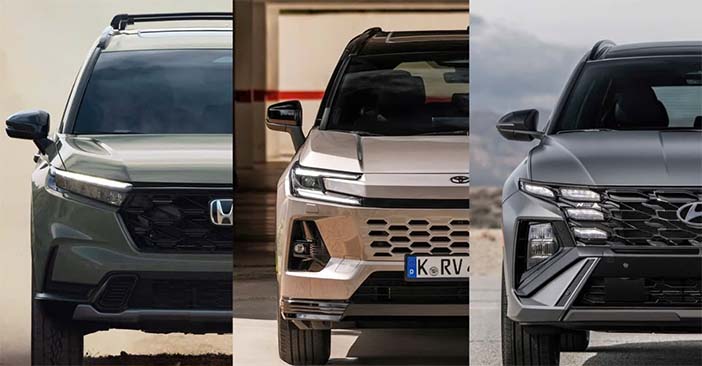
According to Hyundai’s third-quarter report, Tucson sales hit 64.075; a 23% jump from last year and a quarterly record, as the company announces the completely new Tucson. That growth outpaces the Honda CR-V, which is up 16.6% to its own record of 110.730, while the Toyota RAV4 slips -6.6%. Honda is growing the fastest at the brand level. Honda is up 9.3% to 358.388 and Hyundai 3% to a record 246.896, while the Toyota brand grows only 0.5% to 540.167, per Toyota’s report.
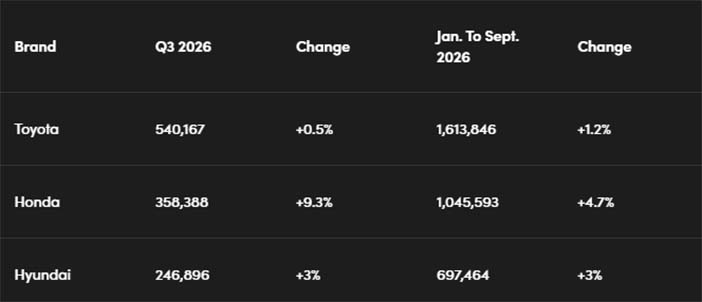
Toyota gives RAV4 sales for each month and for the year so far, not for each quarter, which means September is the one stretch all three have in common. The CR-V beat the RAV4 by 596 vehicles, but the Tucson had the largest gain over last year. For the whole third quarter, the CR-V went up 16.6% to 110.730, and the Tucson climbed 23% to 64.075. The picture so far this year is even sharper. RAV4 sales through September are down 29.2% to 253.664, while the Tucson has climbed 10% to 181.687.
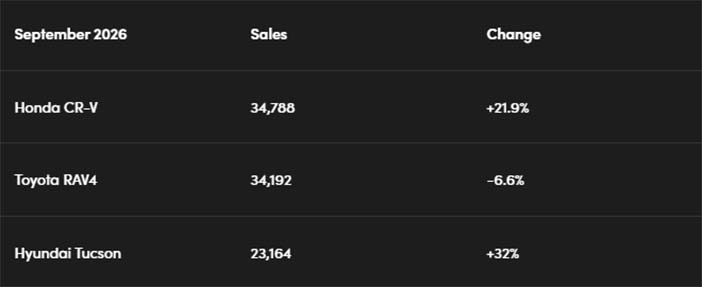
In its September report, Toyota breaks the RAV4’s 2026 sales into 200.209 hybrids, 32.228 plug-in hybrids and roughly 21.200 that are neither. Toyota’s release doesn’t say why the decline happened. Hyundai’s sedans grew as well. The Elantra went up 18% to 48.764, and the Sonata rose 34% to 17.273. Hyundai’s hybrid sales also climbed 35% in the quarter. Its EVs dropped, though. The Ioniq 5 fell 53% to 10.382 and in 3 months Hyundai sold 107 Ioniq 6s. In unit terms, Honda gained roughly 30.000 sales compared with last year’s third quarter, while Hyundai picked up 7.827 and Toyota fewer than 3.000. Honda’s hybrids passed 106.000; a record for a quarter. Lance Woelfer, who is vice president of auto sales at American Honda, gives credit to “a winning formula focused on affordability, record sales of hybrid models and a commitment to offer our customers a balanced line-up of passenger cars and light trucks”. Toyota moved 325.227 electrified vehicles for the quarter, a 29.2% jump, or about 6 out of every 10 Toyotas. Since the brand’s overall number stayed almost flat, our math puts gas-only Toyotas down about a quarter, though the release doesn’t name which models. In September, Toyota sales climbed 7.9% to 171.469. Of the 3 brands, Honda had the best overall quarter, gaining more sales than either competitor. Among the 3 SUVs, the Tucson’s 32% jump in September stood out the most, while the RAV4 was the only1 of the 3 to fall in September and its sales are down 29.2% for the year. +++
+++ The race toward automated driving is on, and one name that keeps popping up is Nvidia. That’s because Nvidia has partnered with several legacy automakers to build their next-generation automated driving systems, including VOLVO , which recently expanded its partnership with the tech giant following the announcement of its largest-ever product push. Automation can provide several benefits, including greater convenience, reduced driver fatigue and even improved road safety by reducing human factors like distraction, fatigue and impaired driving.
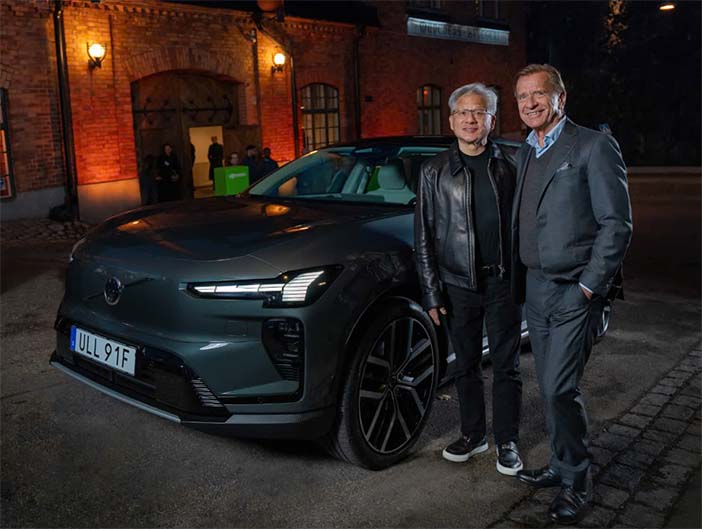
There is still scepticism about computers taking over the wheel, but perhaps Volvo’s reputation as an industry leader in safety could help strengthen this expanded partnership with Nvidia. According to Volvo, the expanded partnership aims to deliver improved and safer automated driving functions in complex real-world environments, including highways, busy urban streets, and parking scenarios. The system, which will be developed with eyes-off and mind-off capabilities in mind for future releases, will use Nvidia’s AI and accelerated computing technologies, including its Hyperion sensor and compute architecture, Halos OS and Alpamayo Stack driving software. These are the same technologies Mercedes-Benz recently announced it would use. They will also support the development of SAE Level 4 systems, which can operate without driver intervention under specific conditions, as seen with robotaxi operations. Meanwhile, General Motors, which also has a partnership with Nvidia, is scheduled to launch its first eyes-off driving system in the Cadillac Escalade IQ in 2028. As for Volvo, the press release hasn’t given a timeline for its next-gen automated driving system, but according to a Reuters report, the Swedish marque expects to launch it before 2030. That would be in time for the brand’s push to deliver 13 all-new models by the end of the decade, seven of which will be developed for Western markets, including the U.S. and Europe, while the rest are for China.
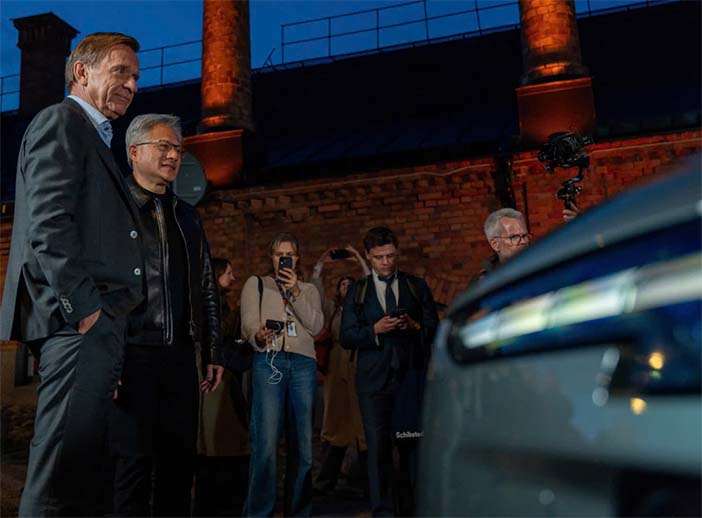
Volvo hasn’t specified which models will get the automated driving system first. But given its strong reputation for safety, the company believes the technology could set a new benchmark for automated driving that is “safe, convenient and worthy of customer trust”. The expanded Nvidia partnership comes amid growing U.S. scrutiny of Chinese-linked vehicle technology, which will prevent sister brand Polestar from selling new model-year 2027 vehicles in the American market. Volvo, however, secured U.S. government authorization in May 2026 to continue selling its vehicles despite its Chinese ownership. The use of American-developed NVIDIA technology could further help address security concerns surrounding its future automated driving systems. +++