
+++ French sports car-maker ALPINE is preparing to reinvent itself as a radically-changed, EV-only company with a 3-car lineup. And the first of those 3 models is a hot hatch based on parent company Renault’s retro 5 EV and is expected to arrive in 2024. Renault revealed the 5 Prototype concept earlier this year, and as soon as the images hit the internet there was speculation that it would make the perfect base for a modern day Alpine A5 hot hatch, particularly now that the French company has killed off its Renault Sport sub brand to make way for the Alpine marque. Then Alpine confirmed plans to turn the R5 supermini into a junior GTI in June when it released a teaser image showing the silhouetted rooflines of three cars: a successor to the Alpine A110 sports car being developed with Lotus, a bigger four-door coupe, and a third car that was clearly a hot hatch. Alpine will follow the A5 hot hatch with an A110 successor and four-door GT, all EVs.
The original Renault 5 Alpine actually predated the Mk1 Volkswagen Golf GTi, making it one of the very first hot hatches. It later spawned a more powerful turbo version, but Renault retired the badge in the 1980s for its second generation of fast Fives, preferring the simpler GT Turbo badge. Like those original Alpines (and unlike the crazy rear-engined Renault 5 Turbo 1 and 2 built for rallying in the early 1980s), the new Alpine A5 is front-wheel drive. Built around a shortened version of the Renault-Nissan Alliance’s CMF-EV electric platform seen on the Nissan Ariya, the standard 5 is expected to use a single 136 hp motor mounted over the front axle. But the Alpine will upgrade that to the 218 hp motor from the bigger Ariya and upcoming Renault Megane E-Tech Electric crossover. Though it’s reasonable to assume the weight of the Alpine’s battery pack will make it heavier than the 1.260 kg of a conventional ICE hot hatch like the Ford Fiesta ST, a 218 hp output should be enough to deliver 0-100 km/h times of well under 7 seconds, versus the 8 seconds Renault claimed for the 2020 concept version of the heavier Megane E-Tech with the same hardware. And with around 300 Nm of instantly available torque, mid-range performance should be equally strong. Renault says the 60 kW battery in the Megane E-tech Electric is good for a 450 km WLTP range, so it’s safe to assume that a smaller hot hatch using the same pack and 218 hp motor would deliver over 480 km of driving. But Alpine may opt for a smaller battery to improve agility, particularly if, as Renault’s boss suggested, the 5 is engineered to accept LFP batteries. These are less energy dense, and therefore heavier for a given output, but cheaper to produce, helping keep costs down. Renault recently announced it was partnering with Chinese company Envision AESC and French start-up Verkor to produce batteries for its future EVs. Renault hasn’t revealed any pictures of the 5’s interior to help us predict how the Alpine’s cabin might look, though one shot of the windscreen showing a transparent digital head-up display screen capable of giving information to the driver and displaying messages to other drivers and pedestrians, offered a glimpse into Renault’s thinking (plus a glimpse of some cool quilted sports seats). But it’s easier to imagine how Alpine might build on the concept’s exterior, blending the stock hatch’s retro style with design cues from the current A110 sports car to create a 5 with a clear Alpine identity. Like the stock 5, the Alpine is a 5-door hatch, a format that’s increasingly common even among junior hot hatches. The most obvious change is at the nose, which is likely to gain a pair of driving lights and perhaps swap the diamond-shaped Renault logo for simple letters spelling out the company’s name. That branding change will likely be emulated at the rear, which Alpine’s silhouette teaser revealed will be topped off by a huge roof-mounted wing. And if those changes don’t draw your attention, the flared arches will. The Renault 5 concept already looked fairly swollen in the fender department, but Alpine’s executive vice-president for engineering, Gilles le Borgne, confirmed that the hot hatch will be wider again, saying “we’ll adjust the track because it’ll be a more sporty look on the R5 Alpine”. Alpine’s take on the Renault 5 should be in showrooms before the end of 2024 and will signal a shift in the brand’s positioning from a nice sports car maker almost unheard of outside the car enthusiast community to a builder of desirable, relatable and practical performance cars. Naturally, it will carry a significant premium over the standard Renault 5 EV, which the company hopes to bring to market for between €20-30,000 before government incentives. That suggests the Alpine would come in closer to €35-40,000, but as one of the very first genuinely small electric hot hatches (the substantially bigger Cupra Born is Megane-sized), the hottest 5 could be shooting at an open goal. Theoretically, it could also shoot much higher. As used on the Nissan Ariya and Renault Megane E-Tech Electric, the CMF-EV platform is also engineered to take a second motor on the rear axle. Space would be tight on the shorter 5, though, and Alpine’s Gilles le Borgne says there are no plans to build such a car. But the prospect of a twin-motor, all-wheel drive 5 Alpine with over 300 hp sounds like it would be a riot. It would certainly make a fascinating counterpoint to the even more retro, but wholly independently produced, Legend Automobiles Turbo 3, a restomod inspired by the mid-engined Renault 5 Turbo 1 and 2. +++
+++ This anecdote will date me: During the 1979 oil crisis, I was filling up my Volkswagen one day when an old guy on the opposite pump began bitterly cursing about having to pay $1.50 a gallon for gasoline ($5.60 in today’s money). He probably expected to hear a “damn right, mister”, but I nodded toward my car. Sure, I said, gas prices are nuts. But I get almost 30 mpg on the highway. If my choice is to walk 30 miles, a buck fifty still seems like a bargain. This, of course, pissed him off even more. One problem with humans is that our view of life is colored by where we’ve come from: our past experiences. As a kid, I remember “gas wars” in which competing stations sold regular for as little as 19.9 cents a gallon. That’s the world this man was from. He was driving some ‘60s or ‘70s beast that got 12 mpg. In postwar America, cheap gas and profligate burning of it were birthrights. So, he felt entitled and angry. Meanwhile, I felt only minor inconvenience. Why lose your cool over something you can’t control? I was a college student, just a couple of years into owning my first car and still over the moon. I’d have paid anything to drive it. 4 decades and many hundreds of thousands of miles later, I’m the old guy now, but a car still seems like a privilege and a marvel. Any car, even an ELECTRIC VEHICLE . But many Americans still cling to past expectations of what a car is. Some are even hostile to EVs if you go by internet commenting, which admittedly is a dubious yardstick for public opinion: Electric cars are worse cars! Charging takes too long! Range is pitiful! They cost too much! They don’t make engine noises! The government’s forcing them down our throats! A lot of that is true. There’s a learning curve, and yes they have problems, just like any newly introduced vehicle or technology. Yet satisfaction among actual EV owners is high. My neighbor, for example, is hoping GM will buy back her car in the big Chevrolet Bolt fire-risk recall. What would she do with the money? Buy another Bolt! She loves the car that much. Broader acceptance is coming on fast. Nearly half of Americans in a Pew Research poll this summer said they’ll consider an EV as their next purchase. This is 2021, and that’s already jibing with projections that EVs will be half of all sales in 2030. We might hit that mark early. But the poll also says half of Americans still won’t consider one. Some are measuring EV capabilities against the cars they’ve owned; understandable, but apples and oranges. And then there’s also the basic human resistance to change. It would be interesting to see a Venn diagram showing the overlapping sets of EV skeptics, climate change deniers, Covid minimizers and vaccine resisters. The diagram might simply be a circle labeled, “We don’t like being told what to do. Even if it makes sense”. Imagine an alternate universe in which electricity became the dominant fuel at the dawn of the automotive age (as it well could have), and only today were we starting to consider gasoline power. The objections would be just as vivid. Drive around with a tank of explosive liquid, what are you, nuts?! Why would I pay big bucks at some “filling station” when everybody knows cars are repowered at home? Combustion cars stink! They can go 400 miles without refueling? Big deal, when’s the last time I needed to do that in one sitting? Now, EV early adopters are hard to tolerate, we’ll grant you that. When they incessantly boast about the superiority of electric cars (seemingly one brand in particular) they might not be helping their cause. Be annoyed at them all you want, but what good does it do to be dismissive of the actual cars? For one thing, you’re aiming at a moving target. EVs are evolving fast. The choices you’ll have in the technology, function and value of electric vehicles by the end of this decade won’t be anything like today; much as the EVs of today make the original 120 km Nissan Leaf of a dozen years ago look quaint. We’re now introducing a new electric vehicle just about every week around here, from trucks and crossovers to cars with performance cred. Sooner or later, a car will come along that will draw you in. As we point out often, nobody’s going to make you quit buying gas anytime soon: plenty of internal combustion cars will still be on the road for decades to come, based on slow fleet turnover. But imagine this: Today, the base Leaf’s range remains one of the most modest at 240 km, and its price just dipped to around $20 grand after the federal tax credit. If every 2-car family woke up tomorrow to find one gasoline vehicle had vanished, replaced by an EV even as basic as that, you’d still have all the bases covered: range and economy. You’d never miss a beat, and emissions would be cut in half overnight. You might even see your gas consumption in the remaining ICE vehicle drop because you’ll find yourself preferring to drive the EV on a daily basis. Some of the objections to EVs clearly are from folks who have not yet owned one. Building more public charging stations, as per the infrastructure deal, would be nice for peace of mind, but once you own an EV, you’ll discover you rarely, if ever, charge in public: you’d prefer not to. Refueling at home will always be the trick that makes an EV cool. And like any tech, the prices will fall. Remember what you paid for your first flat-screen TV? But dear holdouts, resistance is futile. EVs are inevitable. Though Toyota still bucks the trend, the entire industry is investing billions and betting that the marketplace will meet it halfway. Automakers wouldn’t all be doing this if it wasn’t a solid play. When even Dodge is building an EV, you know internal combustion’s days are numbered. Maybe it’s pointless to try to convince skeptics. But just as the global petroleum marketplace was oblivious to one man’s wailing at the pump back in 1979, today’s ICE holdouts face something far bigger than themselves: a global transformation fueled by hundreds of billions of dollars in automaker R&D and government incentives. There’s no stopping it. So why not make peace with it? The change we’ll see in this decade will be fun, if you allow yourself to be pleasantly surprised. The cars you get will be different than the cars you’ve known, but you’ll still love driving. And at least you’ll never curse at gas prices again. +++
+++ Shares of China EVERGRANDE Group’s electric vehicle unit are collapsing in Hong Kong, wiping about $80 billion from what was the property developer’s most valuable listed asset. China Evergrande New Energy Vehicle Group sank as much as 22% after its parent said the unit lost 4.8 billion yuan ($740 million) in the first half of the year. The EV business’s market value was about $87 billion at its April 16 peak, greater than that of Ford and almost 4 times the capitalization of China Evergrande itself at the time. Evergrande NEV shares are down 92 % since, the worst performance in the BW index and lagging even China’s tutoring stocks. NEV owns the remnants of Swedish automaker Saab, and markets a compact electric vehicle in China based on the old Saab 9-3. Evergrande’s subsidiaries are being punished on concern the world’s most indebted developer will need to sell assets at a steep discount amid mounting pressure from Beijing. Shares of listed businesses (including the 65 % stake it owns in Evergrande NEV) are the most liquid if Evergrande needs to generate cash quickly. Evergrande in May raised $1.4 billion from the unit in a heavily-discounted share sale. “It’s very obvious that Evergrande New Energy is short of money”, said Castor Pang, head of research at Core Pacific-Yamaichi International. “Now that the parent company has a liquidity problem, it’s impossible for Evergrande New Energy to meet previous targets for car production”. The electric car upstart was already a capital-intensive project for Evergrande chairman Hui Ka Yan, who funneled billions of yuan into the business in a bid to make it “the world’s largest and most powerful new energy vehicle group” by 2025. Previously known as Evergrande Health Industry Group before a name change last year, the company still generates the majority of its revenue from its health business. Speaking on an earnings call in late March after Evergrande NEV’s full-year loss for 2020 widened by 67 %, Hui said the company planned to begin trial production of cars at the end of this year, delayed from an original timeline of last September. Evergrande said earlier this month it was in talks with “several independent third-party investors” to sell stakes in the electric vehicle and property services subsidiaries. It’s selling a Hong Kong development project at a loss, people familiar with the matter said this week. Almost 93 million Evergrande NEV shares changed hands on Thursday, about 7 times this year’s daily average. The stock closed down 19 % at $5.18, the lowest price since March 2020. +++
+++ HYUNDAI ’s wide range of SUVs is going to expand further with the addition of a tiny A-Segment SUV that could be offered in both petrol and full electric variants. The new model is rumored to bear the Casper nameplate which is already a Hyundai trademark. Initially, it will be offered in Korea and India, but in the future, it might also be offered in Europe as Hyundai’s entry-level SUV. Originally codenamed AX-1, the Casper was teased a few months ago with two dark images revealing double headlights with round LEDs on the front bumper and a futuristic honeycomb taillight design. Camouflaged prototypes have been spotted wearing the same lighting units with compact exterior dimensions and bold design features. The Bayon is currently the cheapest SUV in Hyundai’s range in Europe, sharing its underpinnings with the i20. Indeed, the Casper will be significantly smaller than the Bayon and the Kona, all of which are classified as B-SUVs sold in different parts of the world. Based on the K1 platform that is currently underpinning the Hyundai i10, the Casper is rumored to be around 3,6 meter in length. Rival models will include the likes of Suzuki Ignis, Renault Kwid and Tata Punch. Citing leaked documents, local media suggest that the Casper will be available in South Korea with a 1.0-liter engine in naturally aspirated and turbocharged variants producing 67 hp and 100 hp respectively. However, Indian-spec models could also get other powertrains including the existing 1.2-liter petrol engine found in other similarly sized models. Besides the rumored petrol powered variants, the Casper could also be offered in electric form. It has been confirmed by BorgWarner that a fully electric A-Segment vehicle from Hyundai will start production in mid-2023. While we are not sure whether it will be a city car or a city SUV and whether it will be sold with Hyundai or Kia badges (or both), it is possible that the document refers to the Casper given the timing of the release. BorgWarner will supply the integrated drive module (iDM) for the A-Segment vehicle. The iDM146 powertrain will consist of the electric motor, gearbox, and inverter while being customizable. It will operate at 400 Volt with a peak power of 184 hp although it is likely that such a lightweight vehicle will use a less powerful version. I expect to learn more about the petrol powered Hyundai Casper in the official reveal expected before the end of 2021. Production will allegedly start this September in Korea, with a 2022 market launch for India. As for the fully electric version, we expect it to hit the market in mid-2023 but an earlier debut is also possible. +++
+++ LORDSTOWN MOTORS new chief executive said his focus will be on making sure the electric vehicle maker successfully rolls out its pickup in the face of intense regulatory scrutiny. After that, raising further necessary funds will take care of itself. The Ohio-based startup appointed Daniel Ninivaggi as CEO, handing over the reins to the former employee of investor Carl Icahn, sending shares up as much as 41 %, before they later fell back to a 16 % gain. “Job No. 1 is to make sure we stay on track from a production standpoint”, Ninivaggi told in a telephone interview. “Without that, you can’t raise capital”. While Lordstown is working to launch the Endurance truck, it will work in parallel on raising further funds, he said, adding he had spoken with a lot of people from his past since he was named CEO, but not yet Icahn. The company’s founder and largest shareholder, Steve Burns, resigned as CEO in June following an internal investigation into claims made by short-seller Hindenburg Research. The company, which previously warned it needs to raise additional funding, is hiring industry veteran Ninivaggi, who has also overseen Icahn Enterprises’ automotive aftermarket service network and parts distribution businesses. Ninivaggi, who serves as the chairman for autoparts maker Garrett Motion, has also been a director at companies including Motorola Mobility, Navistar International and Hertz Global Holdings. Last month, Lordstown said a hedge fund had committed to purchasing up to $400 million of the startup’s shares over a 3-year period. Executives said that the firm was exploring other financing options, including debt. Lordstown, which hung an “open for business” sign on its northeastern Ohio plant earlier this month, has struggled with the launch of its Endurance pickup. Lordstown still faces a lot of scrutiny from federal prosecutors in Manhattan and the U.S. Securities and Exchange Commission related to its merger with a special-purpose acquisition company (SPAC) and statements it previously made about preorders for its vehicles. +++
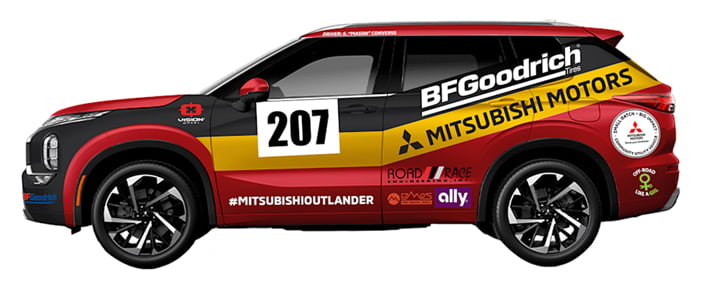
+++ Just like Ford, MITSUBISHI will again compete in the 2021 Rebelle Rally. This year, the competition car will be the redesigned Outlander. However, it takes its color scheme from a far older Mitsubishi racing vehicle: one that’s a perfect tribute for the all-women Rebelle Rally. The Outlander’s flashy red, gold and black wrap is inspired by a 2001 Pajero entered in that year’s Paris-Dakar Rally. The Mitsubishi won thanks to driver Jutta Kleinschmidt, the first (and so far only) woman ever to win the grueling off-road endurance race. So creating a tribute of her Pajero for an all-women off-road rally seems like a superb way to celebrate the 20th anniversary of her victory. Mitsubishi hasn’t given many more details about the Outlander, but based on its past entries, it should be mostly stock. It will also likely compete in the X-Cross class for crossovers. This year’s Rebelle Rally will run from October 7 to October 16. The route is estimated at around 2.000 miles across California and Nevada. +++
+++ It was almost 3 years ago that RIVIAN drove up silently out of nowhere to jolt the Los Angeles Auto Show with its R1T pickup. Back then, the company planned fall 2020 delivery of the pickup, and deliveries in 2021 of the R1S SUV. Coronavirus pushed the pickup to 2021, coronavirus side effects adding a couple more months to the wait, deliveries most recently promised to begin in September. At last, if all goes to plan, a certain number of Rivian reservation holders will be able to park R1T production units in their driveways next month. Rivian CEO R.J. Scaringe has sent a note to reservation holders, the key line being: “We are currently working with various governing agencies on the final approvals needed for us to make the first deliveries to preorder customers in September”. Some members at Rivian forums have parsed the line like comparative literature students attacking the meaning of a poem. The simple reading is that Rivian is waiting for the EPA and NHTSA to give the all-clear, then it’s “You get a car!” and “You get a car!” The lit student reading begins with the questions, “How many agencies is ‘various?’ Does ‘various’ mean 2?” We can’t know. But I know that the R1T hasn’t found a place on the EPA’s fuel economy site, so there’s 1 agency and 1 big task still in the asking. Meanwhile, Scaringe believes the company’s got its production process sorted, writing, “I am excited to report we have started producing vehicles that reflect all of our quality iterations and design refinements”. Teams have also spent the past few months preparing for the production ramp-up. After deliveries begin, owners will have access to the five service centers currently in operation in Brooklyn, Normal and El Segundo, but new centers will open up at an average rate of almost one per week through the end of 2023. Scaringe said the repair network will also include “a large fleet of mobile service vans for performing onsite vehicle repairs”. A few forum posts have mentioned that Rivian guides, the reps who shepherd reservation holders through the final order process, haven’t been in touch about nailing down the final specs for the Launch Edition models, so there are questions. When deliveries were scheduled for last month, Scaringe didn’t tell order-holders until July 16 about the new September date. But hey, 2 trucks headed to new owners on September 30 still counts as plural deliveries in September, so no need to think about grabbing a torch or pitchfork for at least 4 more weeks. And as far as delays go, Rivian’s aren’t egregious: the Tesla Semi was supposed to be on the road 2 years ago, and has anyone heard about their Elio or Aptera reservation lately? +++
+++ Not quite a decade ago, the potential for defective TAKATA AIRBAG to explode in a crash erupted into the global auto industry’s most complex and far-reaching safety crisis in history. Roughly 100 million of them were recalled worldwide. But Ruy Drisaldi, a 42-year-old originally from Buenos Aires, Argentina, never learned of the risks until last December, when the airbag in his wife’s used Honda CR-V exploded after another car backed into hers near their home in the southeastern Mexican city of Merida, killing her. Neither Drisaldi nor his wife, Janett Perez, an American citizen, had received a single warning about the recall, he says. “Someone needs to be held responsible”, he says. “You buy a car with airbags and assume you’re protected. I now realize all the years we had that car, we were driving with a gun pointed to our heads”. Although the Takata callbacks have largely faded from the public eye in much of the world, Drisaldi’s story is a reminder that the defective parts continue to put drivers at risk. As of early July, more than 14 million still hadn’t been fixed in the U.S. alone, in addition to an unknown but likely substantial number in the rest of the world. That means that millions of car owners like Drisaldi (especially in countries with weak consumer protections) may remain unaware that the propellant used in their cars’ air bags could be degrading as a result of heat and humidity, turning their vehicles into potential explosion hazards. At least 37 fatalities and 450 injuries allegedly linked to the defective parts worldwide have been reported to U.S. auto safety regulators. Of the deaths, 19 were in the U.S., while others have been reported from all corners of the globe, including in French Guiana, Nigeria, Brazil, Australia, and China. Perez’s death, caused by a piece of metal that ruptured the airbag and struck her neck, added Mexico to the fatalities list. The next day, a friend from Argentina sent Drisaldi a news clip about the exploding Takata air bag inflators and the worldwide recall that ultimately sent the company into bankruptcy. Honda later confirmed that the driver side airbag in Perez’s SUV exploded. The incident in Mexico illustrates how auto safety recalls, even for deadly defects, can fly under the radar in parts of the world with weak regulatory regimes. In the U.S., the National Highway Traffic Safety Administration (NHTSA) has taken unprecedented steps to not only oversee but also coordinate the industry’s campaign to replace the tens of millions of inflators. An independent monitor also prodded companies into adopting more effective outreach techniques beyond what’s required by law. Nothing similar is going on in Mexico, where companies say there’s not even an effective registration system through which they can locate owners of used cars. “While the U.S. recall system is flawed, in other countries we see systems that are virtually nonexistent”, says Sean Kane, president of Safety Research and Strategies Inc., a consultant and advocacy organization in Rehoboth. The death of a driver of a Honda Accord in April is the latest Takata-linked fatality in the U.S. Since then, Honda said it had made more than 100 attempts to reach owners of that particular vehicle through calls, emails, mailed letters and even in-person visits. But in Mexico, companies have mainly used broad outreach campaigns through ads placed in newspapers and notices on websites. Merida, where Perez was killed, is well-known for heat and humidity. Those are factors investigators have said cause the air bags’ ammonium nitrate propellant to become unstable and prone to ignite with too much force in an accident, shattering the metal inflator canister. Many of the potentially deadly inflators were manufactured at Takata’s plant in Monclova, Mexico, and were exposed to uncontrolled moisture conditions, according to a NHTSA report. Frank Melton, a lawyer for Perez’s family, says her death “could have been prevented had the same recall efforts used in the U.S. been implemented in Mexico”. Perez was born in Los Angeles, and because of her U.S. citizenship, her family was able to file a claim with the Takata victims’ fund in the U.S. But Mexican citizens who’ve been injured by Takata airbags there have no such recourse. Honda has repaired about 72 % of its affected cars in Mexico, compared with 89 % in the U.S. That means it has yet to fix almost 114.000 vehicles in Mexico. Toyota’s 41 % rate there means almost 144.000 owners may be driving unaware of the potentially deadly airbags. General Motors says it’s repaired just 36 % of its vehicles with recalled Takata bags in Mexico, leaving 213.000 such vehicles with potential problems. Nissan and Mitsubishi declined to share information on repaired cars but said they’re working to reach customers. Ford and Toyota didn’t reply to requests for comment. Honda defended its outreach efforts in Mexico, saying it’s tried to increase awareness and track down owners of recalled vehicles. “We proactively do everything within our reach to find the owners of vehicles that have been recalled”, says spokesman Fernando Maqueo. As cars change hands to second, third and even fourth owners, it gets harder for carmakers to locate them, says Chris Martin, regulatory and legal communications manager at Honda in the U.S. Automakers in the U.S. are required to alert drivers about recalls using mailed notices and rely on state vehicle-registration systems for addresses. For the Takata recalls, most automakers have used multiple sources of driver information that are updated more frequently than state systems, such as insurers and repairshop data. They’ve also used e-mail, postcards, certified mail and targeted social media ads, according to a January report by the NHTSA-appointed monitor overseeing the campaign. “We’ve gone to really unprecedented extents in the U.S. to repair these, using lots of different outreach mechanisms including even knocking on doors”, Martin says. In Mexico, there is no equivalent vehicle registry, Maqueo says. Mexico’s consumer protection agency, Profeco, pointed to a recall alert on its website and didn’t respond to additional questions on the disparity between efforts to reach car owners there and in the U.S. Perez’s death is the only one tied to a faulty Takata airbag in Mexico, Honda says. Experts say there’s no global database or investigative process used by authorities to know whether that’s true. “Cases are tied to these failures only when companies acknowledge the problem”, says Alejandro Furas, head of the New Car Assessment Program for Latin America and the Caribbean. The nonprofit has been lobbying governments in the region to upgrade safety rules. “We’re regrettably in the hands of the industry. The companies know this and take advantage of it”. Honda’s Martin acknowledges that other Takata-related deaths could have gone unreported in parts of the world where the problem isn’t well-known or that lack the same regulatory and safety infrastructure that exists in the U.S. “If somebody doesn’t tell us or a government official about it, there’s no way to be sure”, he says. “People picking up the pieces after a crash may not know what they’re looking at”. Indeed, Kevin Fitzgerald, a former Takata propellant engineer who resigned in 2014 and cooperated with the U.S. government’s investigation of the supplier, says he’s skeptical that only one injury and one fatality have occurred in Mexico. “That’s awful hard to believe,” he says. “I just cannot wrap my head around that”. Furas says Mexico (and Latin America as a whole) needs governments to get ahead of these problems by setting up vehicle certification systems. But that’s no easy task. “The truth is Latin American governments don’t like these kinds of regulations”, he says. “They require investments”. +++
+++ Like a tide’s ebb and flow, retro car design is making a comeback. Whilst your mind may immediately default to the mid-2000’s trend that gifted us such ‘beauties; as the Chrysler PT Cruiser, Volkswagen New Beetle and Mini, the odds are this time it’ll be design done right. Want proof? Just look at the smashing new Fiat 500e and Renault 5 concept as prime examples. Another carmaker about to re-join the retrolicious bandwagon is VOLKSWAGEN . You may recall the ID. Buzz concept from 2017, an exciting homage to the original Kombi van underpinned with EV credentials. The German automaker is putting it into production next year. While VW engineers have used clever camouflage to disguise prototypes currently in testing, it hasn’t stopped me from deciphering the final look. For example, the front end is easy to decode with curvaceous styling that nods to the original Kombi, as is the character line separating the lower and upper 2-tone paint scheme. The daylight opening area (DLO) has lost a little of its conceptual uniqueness, instead adopting a more traditional look shared with the new T7 Multivan. Sadly, elements like the flush door handles and mirrors haven’t made the cut, although it does retain the concept’s LED headlamps, rear pillar details and smooth sheet metal surfacing. Open space is Volkswagen’s theme for the cabin (which, depending on configuration, seats 6-8 people), with clever spatial utilization aided by its EV underpinnings and flat-floor design. The Buzz will have a free-standing digital instrument cluster and tablet-style infotainment screen with wireless Android Auto, Apple CarPlay and phone charging capabilities like other ID models. A plethora of driver convenience and assists will be available; these include over-the-air updates, augmented reality (AR) heads-up display, speed sign recognition and autonomous emergency braking with pedestrian detection. Level 2 semi-autonomous driving on highways will be available at launch, with Level 4 capable autonomous driving coming on-stream in 2025 via a partnership with U.S.-based tech firm Argo AI. Rear- and all-wheel drive versions will be available; the former has a 204 hp single-motor setup, while the all-paw variant pumps out a healthy 370 hp via its dual motors. The newest member of the ID family will also use Volkswagen’s flexible MEB-XL platform, which can accommodate lithium-ion battery packs ranging from 48 kWh to 111 kWh in size. The biggest battery pack can cover over 550 km of range and be charged to 80 % within 30 minutes using a 150 kW fast charger. A 230 Volt socket provides additional freedom for worksites needing power for tools and other equipment, and bi-directional charging is expected to be available too. Arguably, the ID. Buzz will be a standout amongst the current crop of minivans; it’ll also have an eco-advantage of being a people mover that’s fully electric. Sales across Europe will kick off in 2022. Multiple configurations with flexible seating options will be offered, plus a commercial variant called the ID. Buzz Cargo. Pricing is tipped to start around the USD $40,000 mark for the passenger version. +++