+++ China’s No 1 new energy vehicle manufacturer BYD is assisting some international carmakers’ electrification drives with its expertise in batteries. Ssangyong became BYD’s latest partner, when the 2 signed a deal last week to develop battery packs for the South Korean carmaker. “FinDreams Industry, a wholly-owned battery manufacturer of BYD, will participate in the battery development project”, Ssangyong said in a statement. BYD launched FinDreams in March 2020, which specializes in core component production for eco-friendly electric vehicles. Ssangyong plans to dispatch its researchers to BYD despite the Covid-19 pandemic, saying the partnership will pave the way for its efforts to transform itself into an EV maker, said a company representative. The batteries to be developed by the two companies will be installed on Ssangyong’s U100 EV, which is expected to be mass-produced in 2023. The South Korean carmaker said cooperation with BYD is aimed at eliminating the market’s worries about the company’s future and establishing a stable supply and demand system for its electric vehicles in the future. In addition, the partnership is expected to shorten the time needed for electric vehicle development, which is an opportunity for Ssangyong to improve its competitiveness in the coming years. Toyota, the world’s No 1 carmaker, has also turned to BYD to build an affordable and competitive small electric sedan in China in 2022, Reuters reported earlier this month. The breakthrough was chiefly down to BYD’s less bulky lithium-iron-phosphate blade batteries and its lower-cost engineering know-how, said people familiar with the matter. Toyota now has 2 dozen engineers in Shenzhen working side-by-side with about 100 BYD counterparts. Toyota established a battery joint venture with BYD in 2020 to assist its electrification plans in China. “We appreciate that BYD and Toyota can become ’teammates’, able to put aside our rivalry and collaborate. We hope to further advance and expand both BYD and Toyota from the efforts of the joint venture with BYD”, said Shigeki Terashi, an executive of Toyota. BYD was founded in 1995 as a battery business and has grown into an energy solutions company, manufacturing not only electrified vehicles but other products such as large-sized energy storage cells. In 2008, BYD became the first company in the world to sell mass-produced plug-in hybrid electrified vehicles. It is now the bestselling new energy vehicle maker in China, with over 90.000 units sold in November, according to statistics from the China Association of Automobile Manufacturers. BYD is also one of the largest battery makers worldwide. Statistics from SNE Research showed that it ranked fourth in October in terms of the installed capacity of power batteries. Shi Jinman, an automobile analyst at Guotai Jun’an Securities, said: “The establishment of the independent brand (FinDreams) benefits the company as the move makes it easier to reach more clients overseas”. “In addition, the overseas subsidiaries can work more efficiently on making decisions such as building local plants and taking advantage of BYD’s digital channels to boost global expansion”, said Shi. Earlier this year, BYD started to hire engineers for its first overseas battery plant in Europe. It did not offer details about its operations, including its location and manufacturing capacity. +++
+++ Volkswagen, BMW and Daimler plan electric future in CHINA as Nio and Great Wall set down in Europe. Automotive companies in China and Germany are stepping up efforts to explore each other’s markets as the automotive industry speeds into the era of electrification. Last week, Volkswagen CEO Herbert Diess called for more cooperation with China, saying it will not keep pace with innovation if it does not face the competition in the world’s largest vehicle market. “We need more cooperation and presence in China, not less”, said Diess. “It would be very damaging if Germany or the EU wanted to decouple from China”, he said. China is Volkswagen’s biggest market worldwide and also the world’s largest market for new energy vehicles. Sales of electric cars and plug-in hybrids totaled 2.99 million in the first 11 months of the year. Another 400.000 are expected to be sold in December, according to the China Association of Automobile Manufacturers. The association said those sales would rise to 5 million in 2022. Diess said Volkswagen has significantly raised its NEV sales target in China in 2022. It has launched the electric ID.3, ID.4 and ID.6 models in the country and is planning to introduce more. Volkswagen unveiled in July a campaign called New Auto which focuses on electrification, autonomous driving and software-driven mobility. “We have to use the Chinese speed and local technology platforms to remain globally relevant in New Auto”, said Diess. Just one week before Diess’ remarks, German premium carmaker BMW released a new “China First” strategy to grow its market share in the country. The carmaker said the strategy will enable it to respond quickly to market changes, especially taking into account Chinese customers’ expectations at an early phase of vehicle development. Among other things, BMW will open 3 plants in China in 2022, and it will produce the electric 3 Series sedan in the country, said Nicolas Peter, a BMW board member responsible for finance and China affairs. In total, the company will offer 5 electric vehicles in China in 2022 and that figure will rise to around 13 by the end of 2023. “BMW’s success in internal combustion engines has fully displayed this (China First) thinking, and the BMW Group will continue to deepen its ‘China First’ approach in electrification”, it said in a statement. Other carmakers, including Mercedes-Benz parent Daimler, are accelerating efforts to grow their share in China’s new energy vehicle market. Daimler is producing and selling three Mercedes-Benz-branded electric vehicles in China, and another one is to be added in 2022. It also sells an imported electric model in the country. The German carmaker said it will only sell electric vehicles “where market conditions allow” from 2030. “There is no doubt in my mind that China will play an important role in the future of our industry”, said Hubertus Troska, a board member of Daimler and Mercedes-Benz responsible for operations in China. Chinese companies are accelerating their foray into Europe, with Germany as one of the most important markets, with electrified vehicles. The International Motor Show Germany, held in September in Munich, attracted Great Wall Motors, Huawei, Xpeng and Leapmotor to showcase their products and solutions. In Germany, 70 percent of respondents said they would like to change mobility behavior to cut their carbon footprint, according to the Digital Auto Report 2021 by consultancy firm Strategy&. Chinese carmakers are ahead of European giants in offering such products. They are doing a far better job when it comes to smart operating systems for vehicles, industry experts said. New York-listed electric car startup Nio announced in December that it will make inroads into Germany, the Netherlands, Sweden and Denmark in 2022. Nio started its global expansion in September with Norway as the first stop. It launched its flagship ES8 in the country, with its ET7 sedan to follow in 2022. Great Wall Motors has opened a European headquarters in Munich, which will serve as the base for China’s largest SUV and pickup maker to reach more markets on the continent. Its premium brand Wey is to launch its flagship European model, which is a plug-in hybrid SUV, in early 2022. It is scheduled to open its first European experience center in Munich in 2022 and more than 60 service stations are to be set up that year. Great Wall Motors’ electric marque Ora announced its European campaign as well, with the first model to be delivered in 2022. The marque said it will offer 5 models within 2 years for European customers and more than 10 models will be available on the continent in 10 years’ time. Other major Chinese carmakers (including SAIC, BYD as well as electric car startups such as Aiways and Xpeng) have been exploring the European market. China’s battery makers including CATL and Svolt are building plants in Germany to supply carmakers there. “Only when Chinese auto companies enter the markets of developed countries can they truly participate in international competition”, said Cui Dongshu, secretary-general of the China Passenger Car Association. +++
+++ The fourth generation NISSAN X-Trail is being readied for launch. The latest version of the Japanese brand’s large SUV will go on sale in Europe next year as a fresh rival for the Kia Sorento, Peugeot 5008 and Skoda Kodiaq. The next X-Trail will move onto the same CMF-C underpinnings as the newest Qashqai, meaning it’ll be available with Nissan’s latest e-Power hybrid powertrain. Unlike the smaller SUV, buyers will also be offered the new hybrid technology from launch. Nissan’s e-Power hybrid system blends a turbocharged 1.5-litre four-cylinder petrol engine with a compact battery pack and an electric motor to deliver 184 hp and 330 Nm. It’s a bit more complicated than the systems found in hybrids such as the Toyota Prius, because the petrol engine never drives the wheels directly. Instead, it acts as a generator, constantly topping up the battery pack, which then sends power to the electric motor. The set-up ensures the petrol engine is always running at its optimal efficiency, which helps lower emissions and fuel consumption. Nissan also says the system provides a driving experience similar to that of an electric car, with instant torque from the electric motor. There’ll also be a 4-wheeldrive version of the X-Trail, although specifications for that powertrain are still yet to be confirmed. However, Nissan says the system will give the X-Trail “rugged versatility,” offering specific drivetrain settings for snow, gravel and mud. For the new X-Trail, Nissan pulled a leaf from the latest Qashqai’s styling book, with the SUV receiving the same V-Motion grille and slim headlamps as its smaller sibling. It’ll also get some more angular body lines to give it a chunkier look than its softer-surfaced predecessor. Silver trim inserts and a contrasting roof complete the look. Inside, the X-Trail will receive some advanced technology, which includes a host of driver-assistance kit and a brand-new infotainment set-up, which will more than likely be lifted from the latest Qashqai. Nissan also says the new CMF-C platform will help improve the SUV’s refinement and dynamic performance. Another benefit of the new underpinnings is that the X-Trail will also be available with a third seating row, offering 7-seat capability for larger families. It’ll be a while before the next-generation X-Trail goes on sale, so Nissan hasn’t yet confirmed the car’s starting price. However, given the new platform and the increased level of technology on offer, I expect the new SUV will be considerably more expensive than the outgoing model. For comparison, prices for the old car stars from €38.606 in the Netherlands. Also, the X-Trail’s market has changed since the Mk3 model was launched back in 2013. Prices for the Skoda Kodiaq (which is a key competitor for the X-Trail) start from €40.490 euro, while the cheapest Kia Sorento costs €45.995. So, we expect that Nissan will target a starting price of at least €45.000 to keep pace with the competition. Nissan will complete the overhaul of its SUV line-up with the Mk4 X-Trail. The process started in late 2019 with the second-generation Juke. It was followed by the launch of the pure-electric Ariya and the exclusively hybrid replacement for the Qashqai, both of which were revealed in early 2021. +++
+++ PORTUGAL could next year approve lithium mining that will reduce Europe’s dependence on outside sources for a key ingredient in the frenetic global race to decarbonize the auto industry. The southern European nation is thought to have the continent’s largest lithium reserves. Alongside nickel and cobalt, lithium has become a prized raw material as it is a vital element in the production of electric vehicle batteries. Demand is soaring as manufacturers scramble to produce low-emission fleets and governments seek to phase out fossil fuel-powered vehicles in the battle against climate change. Portugal’s environment regulator will deliver its verdict on the approval of a major new lithium mine in the north of the country in early 2022. With lithium mostly mined in Australia and South America, while China dominates the supply chain, the regulator’s decision could bolster Europe’s independent supplies of the coveted resource. China has more than 40 percent of world lithium production and almost 60 percent of global lithium refining capacity. That could change if a deal between Portuguese oil firm Galp Energia and Swedish electric battery maker Northvolt bears fruit. The 2 companies sealed a deal earlier this month to set up one of Europe’s largest lithium refineries in northern Portugal. Costing an estimated 700 million euros ($787 million), the facility would process enough ore to produce batteries for around 700,000 electric vehicles per year by 2026. But Galp and Northvolt intend to secure lithium supplies from British mining firm Savannah, which says it holds one of Western Europe’s largest lithium deposits in northeastern Portugal but must await the regulator’s decision next year. Savannah says the deposit could provide enough lithium for up to 600,000 electric vehicles per year for 10 years. Portuguese company Lusorecursos also submitted an environmental effects study this year to open a second mine in a neighboring municipality that would have its own refining facility. A “white gold rush” for lithium in Portugal follows Canadian group Rock Tech Lithium’s decision to invest 470 million euros in a German lithium plant from 2024. Environment minister Joao Pedro Matos Fernandes welcomed the mining sector’s buoyancy and said the government founded its industrial strategy on Portugal’s natural resources. But a much-delayed tender for prospecting rights for 8 other potential deposits will only begin after legislative elections on January 30, he added. Europe’s dependence on outside sources for lithium comes amid growing demand partly fueled by an auto industry scrambling to decarbonize. According to the World Economic Forum, the global auto industry produces more greenhouse gas emissions than the entire European Union. The International Energy Agency estimates that global demand for lithium will increase by 42 percent between 2020 and 2040. This demand is driving technological innovation to increase extraction capacity. Chemicals company Bondalti (a subsidiary of Portugal’s historic corporate giant Mello) announced this month it had teamed up with Australian firms to test a new refining technology which would treat lithium extracted from South American brine. Future developments could even see lithium extracted from Portugal’s granite-rich northeast and add to a European lithium bonanza. While lithium may help decarbonize the automotive industry, its extraction and refining are not without environmental effects, and the projects have generated plenty of concern. “The exploitation of lithium cannot become a national enterprise that would allow us to extract in any way or at any price,” said Nuno Forner of environmental NGO Zero. Forner did not rule out the environment regulator reaching a “surprise” verdict but expected it to approve Savannah’s project under certain conditions. In Covas do Barroso, a remote northern municipality famed for its beef, where Savannah’s mine is to be sunk, the project has caused consternation. “We already know that it’s the political and economic powers who decide”, said Nelson Gomes, president of a local pressure group. He predicted the mine would “destroy agricultural land, reroute streams and create enormous slag heaps” and vowed to “do everything” to stop it. Savannah chief executive David Archer said the company had planned 238 measures to “eliminate or minimize” the project’s impact involving investment of around 15 million euros. +++
+++ In SOUTH KOREA , registrations for electric vehicles jumped to 91.575 units, up 202.8 percent from the same period a year prior by November this year, data showed Monday, suggesting the quick expansion of their presence in the market. Riding on the sustainability bandwagon, more than 100.000 electric vehicles were sold in South Korea and more than 150.000 domestic electric vehicles were exported as of this month, according to Carisyou Data Lab. The Trade Ministry expects registrations to surpass 100.000 when December’s numbers are added. The leading contributors to opening the new era of electric vehicles in South Korea were Hyundai’s Ioniq 5, Kia’s EV6 and Kona, and Tesla. From January to November this year, 20.956 units of the Ioniq 5 were sold, followed by 17.818 Tesla cars, 11.168 units of the Kona and 9.045 EV6s. Due to the fast growing market, automakers are actively developing electric vehicles. Next year, around 20 different electric models are expected to be sold in South Korea. That includes South Korean carmaker Hyundai Motor Group’s Ioniq 6, EV6 GT and Genesis G70 EV models. Hyundai announced last week that it aims to sell 220.000 electric vehicles around the world next year; 56 percent more than they have sold this year. GM Korea is expected to resume selling the Bolt EV and Bolt EUV, models that were delayed in distribution due to a recall over battery fire risks. Renault Samsung Motors, currently selling the Zoé as its only electric model, is planning to produce environmentally friendly cars with Chinese carmaker Geely Auto in its Busan plant next year. SsangYong Motors will introduce its Korando e-Motion within next year and Edison Motors, set to acquire SsangYong, is also expected to concentrate in developing electric vehicles instead of combustion engine cars. Foreign carmakers are also focusing on launching electric vehicles in South Korea next year. That includes Volvo’s C40 Recharge and XX40 Recharge, Mercedes-Benz’s EQE and EQB, BMW’s i4 and Polestar’s 2. The new era of electric vehicles to come is also being backed by the South Korean government, which is putting efforts into popularizing eco-friendly cars in 2022. The Moon Jae-in administration will use around 2 trillion won ($1.69 billion) from its budget next year to double the number of registered electric vehicles. Likewise, the government aims to have up to 500.000 eco-friendly cars registered by next year through active investment in core technologies to develop sustainable cars. Electric vehicle battery systems, hydrogen fuel cell systems, autonomous driving communication systems, automobile semiconductors and sensors and autonomous driving software development are six core technologies the government is investing in. +++
+++ Edison Motors, South Korea’s leading EV bus maker, and bankrupt SSANGYONG are likely to seal their Merger and Acquisition (M&A) deal this week. Legal circles and automobile industry insiders expect the procedure to take place by this week or by January 7 the latest. “We need to adjust the contents of the contract, but if the discussion goes well, it can be done within this month. If the adjustment is prolonged, it could be early January”, said an official from Edison Motors. Seoul Bankruptcy Court had set the deadline for signing the formal M&A deal of SsangYong Motor for December 27 but plans to extend the date till January 10, 2022. Some disagreements on employment contracts and how the acquisition will be progressed are known to have delayed the formal contract between Edison Motors and SsangYong. Edison Motors had asked for an adjustment in the acquisition price after finding additional bad assets during due diligence early December. Once the M&A deal is sealed, the next step is coming up with a corporate rehabilitation procedure. The plan for corporate rehabilitation procedure will have to earn approval from two-thirds of its creditors. In fact, the deadline for submitting the plan for corporate rehabilitation procedure was July 1 but it was delayed 4 times until March 1, 2022. Edison Motors is considering selling SsangYong’s Pyeongtaek plant site that is valued at 900 billion won ($757.9 million), to secure liquidity by selling assets instead of making more loans. “Selling the Pyeongtaek plant site can relieve Ssangyong from debt and making an electric vehicle plant elsewhere could support Ssangyong Motor employees, component makers, and small business owners in Pyeongtaek”, said Kang Young-kwon, CEO of Edison Motor. If that does not work out, Edison Motors will have to renegotiate loans with the Korea Development Bank. Edison Motors had previously sought to borrow 800 billion won, about half of 1.5 trillion won need to acquire SsangYong Motor, from the Korea Development Bank with the Pyeongtaek plant site as collateral. But the Korea Development Bank had said no financial support will be available unless the company has a clear and sustainable business plan for SsangYong Motor and requested SsangYong Motor to present a verification of its financial and technological capability from a third party. SsangYong Motor has suffered from plunging sales in recent years due to lack of new models and its Indian parent Mahindra making no cash injection into Ssangyong. Ssangyong was once again placed under court receivership last April. Edison Motors was named the preferred bidder for Ssangyong by the bankruptcy court after offering 310 billion won for a controlling stake in September. The EV bus maker wired 15.5 billion, 5 percent of its proposed acquisition price, to SsangYong in November. Edison Motors, an electric carmaker, aims to transform SsangYong into an electric vehicle-focused carmaker in the next 3 to 5 years and reach 10 trillion won in sales by 2030. +++
+++ TOYOTA said its global production in November fell 0.8 % to 821.329 vehicles, almost returning to the level a year earlier after months of lost output due to parts supply constraints amid the coronavirus pandemic. The recovery in production reflected an easing of the supply crunch in Southeast Asia, the automaker said. The November figure marked the fourth straight monthly fall, but the pace of decline slowed compared with double-digit drops in September and October. Global sales decreased 9.2 % to 774.143 vehicles, down for the third consecutive month but showing a recovery trend. Domestic production fell 7.9 % to 275.234 vehicles, while sales in Japan including those of minivehicles declined 18.5 % to 116.370 units. Toyota and other carmakers were forced to curb production in response to global shortages of chips and other parts caused by factory shutdowns in Southeast Asia due to surging coronavirus cases. The chip crunch also reflected rising demand for electronics, with more people staying at home amid the pandemic. The supply bottleneck meant many customers had to wait for months for dealerships to deliver vehicles. Toyota is maintaining its global production target of 9 million vehicles for the current fiscal year through March, aiming for monthly output of around 800.000 vehicles in December and January. +++
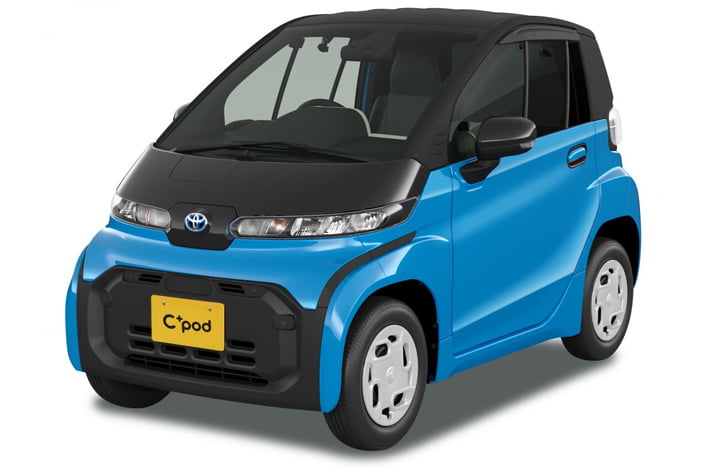
+++ TOYOTA has started to expand sales of the C+pod ultra-compact battery electric vehicle (BEV) to all corporate and municipal customers, and now the general public as well. The vehicle was launched for select corporate and municipal customers in December last year. All vehicles will be offered via lease contracts, starting from Toyota vehicle dealers and Toyota Rental & Lease Agencies throughout Japan. The C+pod is an environmentally-friendly 2-seater battery electric vehicle (BEV). Smaller than a minivehicle, it has been designed as a mobility option for a diverse group of daily users who frequently travel short distances with few passengers. This might include young, single new drivers, or older individuals who may be nervous about driving. The lease agreement enables casual C+pod use while also ensuring comprehensive vehicle collection with proactive 3R (reduce, re-use, recycle) initiatives for the onboard batteries. This is part of Toyota’s goal of achieving a carbon neutral mobility society. Toyota will continue to offer a diverse mobility lineup, including the C+pod and C+walk T(3), to provide safe and secure mobility matched to the needs of customers no matter their stage of life or ability, from new daily drivers to the older drivers, and wheelchair users. Price plans vary according to dealer. Please contact your local dealer or Toyota Rental & Lease Agency. +++