
+++ The CUPRA BORN range is set to expand later this year with a hotter model, boasting a lightly-tickled 240 hp powertrain, bespoke paint options and possible performance parts. The new range flagship will pave the way for future fast Cupras, with CEO Wayne Griffiths saying the brand will “redefine” performance in the EV age. Speaking from the Cupra stand at the Munich Motor Show, Griffiths said that performance won’t be about super-quick acceleration times in the future: “It’s going be a lot of things”, he told. “It’s going to be about emotions and your experience in the car”. Referring specifically to the Born, Griffiths confirmed “a more powerful version, with 240 hp” was also on the way. This model will arrive ahead of the car’s mid-life facelift, which isn’t due until 2025, despite the Cupra’s Volkswagen ID.3 sister car being updated early following widespread customer criticism. “The redesign will come after”, Griffths told. “The Cupra Born is still quite new. We’ve not been able to explore the full potential of Born until now”. The Cupra Born is currently available with 2 battery sizes (58 kWh and 77 kWh); the base Born gets 204 hp, although there is the option of 231 hp thanks to an e-Boost function that temporarily increases the power output. It’s no secret that Volkswagen is developing a sporty ID.3 GTX; a car I’ve sampled from the passenger seat. However, it’s thought that at this time, Cupra will steer clear of the VW’s potent 333 hp dual-motor setup in favor of something more modest. With just one motor, I don’t expect the hot Born to trouble the existing 550 km maximum range, though the possibility of uprated suspension and beefier brakes should make it even sharper to drive. The added power will make the Born capable of 0-100 kph in less than 7 seconds. Cupra’s product plan includes the Tavascan (a SUV) and Raval (a supermini), both of which are expected to be offered with a choice of powertrains, including faster models, as per the aforementioned flagship Born. Hotter dual-motor versions of the Tavascan cannot be ruled out, either. The sporty Born is due to be revealed later this year, though production isn’t slated to start until the middle of 2024. Expect first customer cars to arrive in the autumn. +++
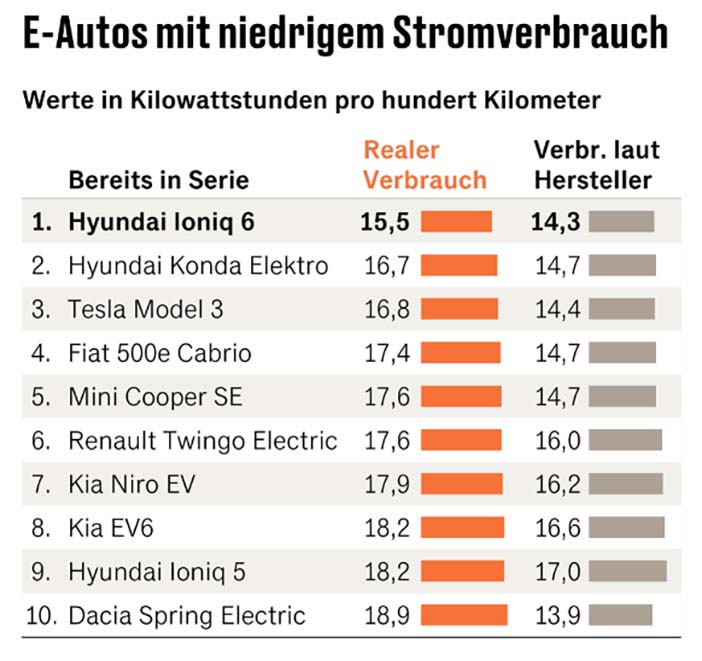
+++ MERCEDES-BENZ boss Ola Källenius told the automaker’s newest electric vehicle architecture, launching with the CLA compact electric sedan late next year, will target 30% to 35% more driving range for each kWhour of energy stored in the battery than the brand’s current EVs. Mercedes will also offer a lithium-iron-phosphate, or LFP, battery in the new CLA model lineup due to hit showrooms in early 2025, a first for any Mercedes EV, the CEO said in an interview. With an LFP battery pack, Mercedes could offer a lower-priced model in a competitive segment currently dominated by Tesla. In China, the new CLA will also face competition from Chinese EV brands that use LFP batteries. The CLA prototype is a physical demonstration of Mercedes’ strategy for closing the technology gap with Tesla and other new EV manufacturers. Getting more driving range using less energy from the battery is the key target for the German automaker’s future EV development, Källenius said. “Efficiency is really the new currency when we go into electric vehicles”, he said. The new CLA is targeting power use of 12 kWh per 100 kilometers, and 750 km of driving range, Källenius said. That compares to the 17 to 18 kWh per 100 km in a EQA 350 model Mercedes offers today. A current Tesla Model 3 is rated at 13.1 kWh per 100 km. At these levels of efficiency, the future CLA should be the electric equivalent of a car that consumes 1 liter of gasoline per 100 km of driving, Källenius said. The so-called 1-liter car has long been an aspirational target for European automakers. Volkswagen’s XL1 car achieved that benchmark, with a diesel-electric powertrain. VW sold only 200 of them. Driving range remains a critical competitive benchmark in the EV market. Consumers can easily compare how far an EV can drive between charging stops. For manufacturers, the real competition is designing vehicles that can deliver more driving range with a smaller, less costly battery pack. Reducing battery costs is critical as Tesla and other EV brands have launched a price war to sustain sales growth in China, Europe and the United States. “When you talk about the efficiency of an electric car, you optimize the whole system”, Källenius said. Mercedes has the added challenge of offsetting the power consumption of the high-powered Nvidia chips that will be used to control driver assistance, large infotainment screens and other systems in the CLA and future EVs, he said. Mercedes engineers have been testing ways to improve EV efficiency using long road trips in a prototype vehicle called the Vision EQXX. That vehicle has pushed power consumption down as far as 8.3 kWh per 100 km, Mercedes has said. For the Vision EQXX, “we gave the engineers no limits”, Källenius said. The production of CLA will have limits set by customers and the prices rivals are charging in an increasingly crowded EV market. +++
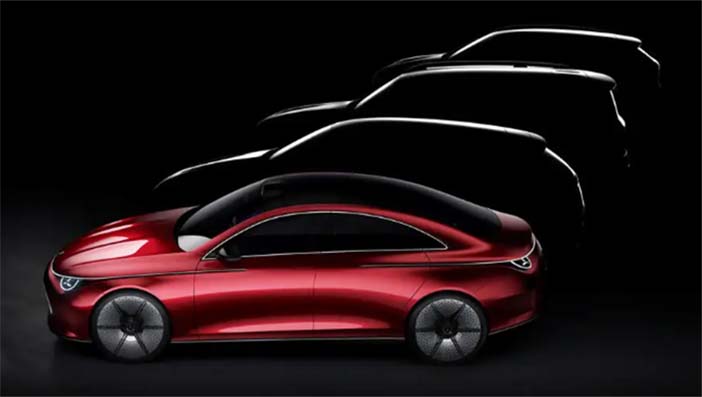
+++ Mercedes-Benz will launch 4 new compact cars on its new MERCEDES MODULAR ARCHITECTURE (MMA) platform, including next-generation successors to the EQA and EQB, and a Shooting Brake version of the forthcoming CLA. The new compact MMA platform has been developed with a focus on electric powertrains, with an 800 Volt architecture that allows for faster charging and different battery chemistries, but it can also house combustion-engined powertrains. The first Mercedes to sit on the new platform will be the Tesla Model 3-rivalling CLA, previewed at the 2023 Munich motor show with a concept version that offers a range of 750 km. Speaking at the Concept CLA Class reveal, Mercedes boss Ola Källenius said that the model was “the forerunner to an entirely new portfolio of electric-first vehicles. This really is the start of a new era for us”. He added: “We will introduce 4 new models developed from scratch on MMA: a 4-door coupé, a Shooting Brake and 2 stunning SUVs. All of them were created by our engineers and designers to fulfil one mission: elevating every aspect of what customers expect from Mercedes”. The new MMA platform will replace the existing MFA architecture, which was developed for combustion-engined cars and then adapted for EVs. Asked if the 2 new SUVs would serve as replacements for the firm’s existing compact SUVs, Christoph Starzynski, Mercedes’ vice-president for electric vehicle architecture, said: “If you take the GLA and GLB as the 2 SUVs on the MFA, yes, we are also going to have 2 SUVs on the MMA platform”. Mercedes design chief Gorden Wagener confirmed that the forthcoming compact SUVs and Shooting Brake will take family design cues that are seen on the Concept CLA. When asked if the other compact MMA models would be similar in styling to the concept, Wagener said that they would share key styling themes, but added: “We have a lot of iconic elements to play with, but we will bring in more diversity in the front end. We don’t want to do Russian dolls, so that every car looks like the CLA. We will give it more identity, so that each car is significant and has its own iconic character”. +++
+++ MAGNA STEYR (a division of Magna International) is in talks with a Chinese brand to produce cars in Europe, president Uwe Geissinger has revealed at the 2023 Munich motor show in Germany. Citing extra capacity at the company’s contract manufacturing facility in Graz, Austria, Geissinger said talks had started with a Chinese brand on the possibility of production there, although he indicated that no firm agreement had yet been made. “Whether we make them in Graz or a new facility depends on how the talks turn out”, he told when asked about the possibility of Chinese EVs being produced in Austria, without revealing the identity of the company. Magna Steyr already closely co-operates with BAIC and its Arcfox EV brand in China under a joint venture called Magna Blue Sky Technology. +++
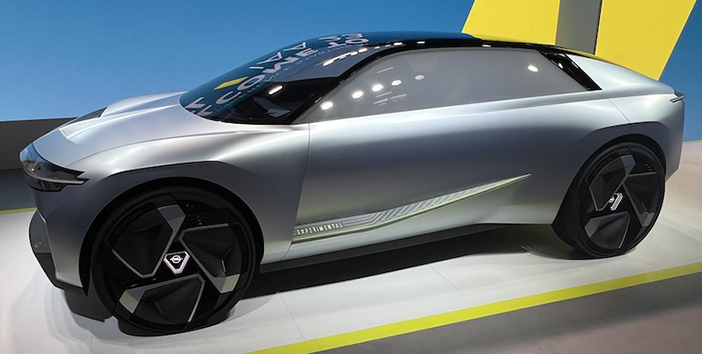
+++ The next-generation OPEL Insignia will be a very different car to its predecessor. Florian Huettl, CEO of Opel, announced at the Munich motor show that the company was “quite advanced in our conceptual work on a replacement” and that it would arrive after 2025 as an all-electric car. “It will not be a classic D-segment car as the old Insignia was”, he said. “We will develop it further as the market develops. The D-segment cars that we’ve made for many years will take a different shape that will be aerodynamic. They will give versatility and the charging capacity that we need. They won’t be standard”. Autointernationaal.nl understands the next Insignia will be a more rakish and premium crossover, higher-riding than the old saloon but not a full-blown SUV. It’s therefore likely to be similar in concept to Stellantis siblings the Peugeot 408 and Citroën C5 X. Underpinning the new Opel (which is unlikely to inherit the Insignia name, given the limited visual relationship between the 2 cars) will be Stellantis’s new STLA Medium architecture. This will be 1 of 2 architectures used for future Opels, alongside the new STLA Small, which will underpin the likes of the Corsa and Mokka in the future, and the STLA Medium, which will underpin the Astra and models above it. Huettl said these architectures would allow for up to 700 km range for EVs, 25-minute charging from 20-80% battery capacity, reduced weight and 4-wheeldrive from a second electric motor at the rear. Huettl reiterated Opel’s plan to launch only cars with electric powertrains from 2025 and for all its models to be EV-only by the end of 2028. The final 2 models that will be launched with multiple powertrain options, including EVs, will come next year as replacements for the Crossland and Grandland. While Huettl said that a Corsa would always be called a Corsa, he hinted that the Crossland and Grandland replacements might not keep those names. Spy pictures of the Crossland suggest a completely different size and positioning the B-segment. Mystery surrounds any production plans for the Opel Experimental concept car that made its public debut at Munich. “It’s a model that sets a path to a new generation of Opels”, Huettl said. “Will we make a car that is close to that? You will see a lot of what we show on it on the street in the future”. This cools expectations that Opel had been planning to launch a sporty crossover called Manta with the footprint of the Astra, as the Experimental (photo) seemed to suggest. In performance models, the GSe badge is set to continue, but there remains no plans for Opel OPC to come back, in line with plans to have more rounded range-toppers that aren’t just about high performance. +++
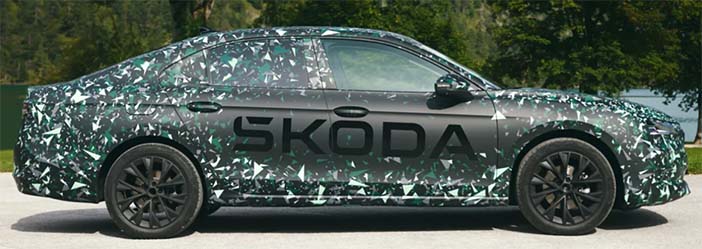
+++ SKODA has confirmed that its new Superb family car will be available in a traditional liftback form as well as the previously previewed Combi. This is a change from VW’s decision to offer the closely related new Passat only as a Variant, and continues Skoda’s drip-feed of information on its upcoming 4th generation model. This new image previews the Superb liftback’s shape for the first time, and are joined by the first pictures showing off the Superb’s smart new cabin. I’ve actually driven the new Superb in Combi form where it impressed on many fronts, despite still being a prototype. The car is expected to go on sale by early 2024 after a full, official reveal this November. The exterior images we’ve seen so far show the Superb Combi clad in camouflage but we can see evidence of a more 3-dimensional grille situated between thinner headlights with new-generation LED technology. Beneath, there’s a new lower grille shape and isolated air intakes at the side. The classic Skoda badge indent from the bonnet to the grille remains, but the clamshell bonnet isn’t as seamlessly integrated due to a more complex headlight shape. From the side, there’s a generous rear overhang on both the saloon and estate. Meanwhile, a typical razor-sharp crease has appeared on the flanks and towards the rear we see a restrained bumper design. The C-shaped rear light unit is similar to that of the new Fabia, creating a more dynamic light graphic for following traffic at night. The liftback will retain its overall proportion set in comparison to the existing model, with a long and heavily raked rear screen. Despite a relatively short space between the front wheels and the windscreen, the Superb’s clamshell bonnet helps balance out its silhouette, just as the previous model’s did.
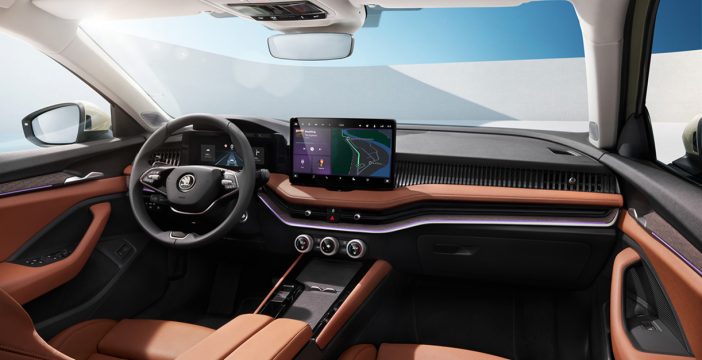
There are big changes inside, with Skoda’s latest images showing us the dashboard layout of both the Superb and the next-generation Kodiaq. There are some elements you’d expect, like a larger, 13 inch infotainment display sitting proud of the dashboard (something former Skoda CEO Thomas Schäfer hinted at when I last spoke to him) and a fully digital 10 inch instrument cluster, as well as derigeur modern touches like ambient lighting. But Skoda has also shuffled things around a bit, and even gone back to the future with a trio of physical knobs that control various interior functions; something the brand calls Skoda Smart Dials. The outgoing Superb hadn’t yet abandoned dials for climate control functions, but the ones in the new car have multifunction capabilities, from predictable ones like controlling fan speed and heating, to volume for the audio system, driving mode selection, and zooming in and out on the navigation screen. Pushing the relevant dial cycles between the modes. Skoda has also relocated the gear selector to the steering column, Mercedes-style, this frees up space on the centre console for extra storage. Air vents are now fashionably integrated into a straked dashboard design, there’s a USB-C port behind the rear-view mirror for plugging in a dashcam, and sustainable materials are used throughout. And don’t worry, the brand’s existing ‘Simply Clever’ features, such as umbrellas hidden in the door panels, are still present and correct. The new Superb sits on a revised version of the MQB evo platform and Skoda proudly states that it was tasked with the development of the chassis, which will ultimately be used for the next-generation Passat. There’s a slight increase in length and wheelbase, unlocking even more space in the already cavernous interior. Boot space has even gone up from 660 to 690 litres in the Superb Combi. There will be no pure-electric Superb in this generation, instead, we’ll see the VW Group’s latest generation of combustion engines. While the popularity of diesel has waned, there’s still a choice of two 2.0-litre diesel options, with either 150 hp or 195 hp. Petrol power is offered in 3 forms. For the first time there’s a mild-hybird option: a 1.5-litre TSI with 150 hp. A 2.0-litre turbocharged unit comes with either 204 hp or 265 hp and there’s a 1.5-litre TSI petrol mated to a 25.7 kWh battery in the plug-in hybrid version. Skoda says the extra battery size will enable a pure-electric range of over 100 km, increasing from the old PHEV’s 70 km maximum. +++
+++ Hardcore environmentalists often reject SYNTHETIC low carbon petrol and diesel substitutes as an alternative to battery EVs, because they only reduce tailpipe emissions by 70 percent. However, a joint venture between Stellantis and the Aramco energy and chemical group suggests so-called eFuels could be safely used in 28 million existing Stellantis vehicles, potentially saving 400 million tons of CO2 between 2025 and 2050. Low carbon eFuels are made by reacting CO2 captured from industrial processes or from the atmosphere, with green hydrogen electrolysed using solar, wind or other renewable energy sources. The latest study over several months orchestrated by Stellantis and Aramco is said to prove that eFuel can be safely used in 24 Stellantis engine families introduced since 2014 without the need for any modification. That amounts to millions of vehicles in use today, with the potential, Stellantis says, to drastically cut the lifecycle emissions of existing and still-to-be-built ICE cars that are likely to be on the road for years to come. The company says its testing covered “tailpipe emissions, startability, engine power, reliability endurance, oil dilution, fuel tank, fuel lines and filters, as well as fuel performance in extreme cold and hot temperatures”. Stellantis has a strategic plan to cut its carbon footprint in half by 2030, and be a ‘net zero’ manufacturer by 2038. It believes synthetic eFuels could play a major part in that journey, if owners were simply able to substitute eFuels for refined petrol or diesel at any filling station. The numbers appear to make its argument stack up, but Stellantis and its fellow car makers, together with the energy industry, still have a job to do convincing politicians that eFuels are a worthwhile transitional stage in the long march towards net zero. The potential success of eFuel as a means to lower greenhouse gas emissions, along with the success of fuel cell vehicles, depends heavily on the rapid industrialisation of green hydrogen production around the world. Aramco is currently working on two pilot projects to achieve just that, including an eFuel plant in Saudi Arabia making synthetic petrol and a plant in Bilbao, Spain making synthetic eFuel diesel and aviation fuel. “Drop-in eFuels can have a massive and almost immediate impact on reducing the CO2 emissions of the existing vehicle fleet, offering our customers an easy and economically efficient option to reduce their carbon footprint; one as simple as choosing a different fuel pump at the station, with no additional modification to their vehicles”, says Stellantis Chief Engineering and Technology Officer Ned Curic. +++
+++ VOLKSWAGEN is looking to cut its development times of new cars from 54 months to 36 months in order to keep up with the quicker pace of development of Chinese rivals. Speaking at the Munich motor show, Volkswagen technical boss Kai Grunitz said the upcoming ID.2 was 1 of 3 pilot models working to the shorter 36-month development cycle. The first design sketches of that car were done in December last year and VW wants to have it on the road by the end of 2025. “You see with Chinese competitors that it’s doable”, said Grunitz about the shorter development times. “We have concrete ideas about how to do this”. Grunitz said the shorter development times will require VW to build new simulation tools and ways of validating development work. He added that the development cycle can be shorted by removing various on-road validations of simulation work, reducing the number of test cycles and cutting the likes of cold-weather testing from two or three winters down to one. The shorter development cycles bring “risk”, said Grunitz. “The risk is that you don’t know where you’ll end up when you start the development process. In Germany, we have clear lines about what we want, especially at Volkswagen, and we don’t want to go into a development process with any risks. But in any enterprise, there are risks. The competitors in China start development and are agile. If something comes up, they find a solution. That’s what we have to do in Germany. It’s a different approach. But it’s possible, really possible”. Grunitz highlighted BYD as a Chinese competitor he respects the most in building quality cars in shorter timeframes. “They have a real platform strategy, low costs, a really good battery and are all over the world building up some good sites”. VW will also work more closely with suppliers to integrate their technology and ideas into its models rather than “wanting to develop everything on our own”. Grunitz said: “Now we’re developing interfaces with ideas from our suppliers”. Grunitz also acknowledged there are further risks around ensuring the quality of the cars is consistent and at a standard expected by VW customers, particularly after well-publicised problems with the 8th generation Golf and ID.3, which were built using the longer, 54-month development time. “That’s exactly the challenge. We won’t bring any cars to the road like you’ve seen with the Golf 8 or ID.3, with thousands of faults coming to our customers. The question is how we reduce test cycles and stay within the quality”. +++