
+++ ALPINE is set to launch D- and E-segment SUVs that will feature “high-performance and energized” chassis dynamics inspired by the A110, while fulfilling a brief to give the French brand a footprint in the crucial luxury car market. The electric range-toppers, which are expected in 2027 and 2028, will take the form of highly specified electric SUVs to rival the Porsche Macan and Cayenne. As such, they will be marketed as ‘lifestyle’ products, rather than pure-performance machines, but Alpine bosses have promised that engaging dynamics will still be among their core attributes. Alpine’s head of design, Antony Villain, said: “The idea is to use the driving experience of the A110 and duplicate it in different segments. We want something high-performance, sporty and energized. We don’t want something that just goes in straight lines super-quickly”. Villain admitted how “ambitious” this is, not least because electric cars are inherently heavier than their combustion-engined equivalents. Translating the driving dynamics of the A110 to an electric SUV requires “various technical solutions”, said Villain, such as a low center of gravity, torque vectoring and four-wheel steering, all of which are expected to feature on Alpine’s ‘lifestyle’ models. Asked for clues to the larger E-segment car’s overall dimensions, Villain said: “We’re using it to expand our footprint and especially to enter the US market. That’s why it’s bigger compared with Europe. I wouldn’t say it’s a compact car, but it’s not a large car. For Europe it’s a large car, but for the US it’s still compact”. Villain hinted at the E-segment model being about 5 meter in length, which would make it a natural rival to SUVs such as the Audi Q8 e-Tron and BMW iX. The D-segment model is expected to be about 4.7 meter. +++
+++ Wall Street analysts tore down a Chinese Tesla competitor and found a great Model 3 alternative, for a fraction of the cost. The Seal, a mid-sized electric sedan made by Chinese EV giant BYD , is a close rival to the Tesla Model 3. Analysts at UBS recently investigated to see just how comparable to Elon Musk’s popular model it might be. Ultimately, tearing down the Seal (“a good example of Chinese EV models’ technological edges and cost optimization”) reinforced the bank’s belief that Chinese auto companies are here to stay and dominate the global electric car market, it said in a note to clients. The Seal rivals the Model 3 in many ways, according to UBS, and it does so at a “10-20% lower selling price”. Analysts noted features such as its larger interior space, 5G connectivity and rotational central cockpit screen, as well as how it “opts for slower acceleration, lower top speed, slower charging speed” as some of its advantages over Musk’s popular car. They also noted BYD’s battery technology (coined cell-to-body), allows for more in-vehicle legroom, a unique car shape, improved performance, and (given the tech introduces a more efficient way of integrating the battery) lower manufacturing costs. “The floor carpet of the passenger cabin is directly above the battery cell stack, and the top cover of the battery pack serves as the floor of the car body, eliminating one more layer of aluminum or steel”, UBS analysts noted. “Such a thin battery pack occupies less floor space than others, allowing the car’s profile to be low, which reduces aerodynamic resistance and creates a more spacious interior for drivers and passengers”. UBS also said that, when comparing power performance, cost efficiency, and energy density, the BYD Seal’s electric system “is in-line with the competition despite being at the relatively lower end of the range, especially compared to the leading solution provided by Tesla’s Model 3”. Interestingly, unlike Tesla, BYD seems to be steering clear from autonomous driving technology, and instead, is opting for a standard, Level 2, advanced driver assistance system. The company is also outsourcing this tech instead of developing it in-house. At a high level, UBS analysts said the BYD Seal is “cost competitive, thanks to its vertical integration, suitable specs, and volume scale”. That’s exactly what a lot of the Chinese carmakers have going for them. BYD and other Chinese firms like Geely, Li Auto and XPeng are tech-savvy, have longstanding advantages in terms of the EV battery supply chain and easily churn out EVs with greater scale at lower costs. UBS analysts did note that incumbent automakers, like BYD, have an advantage over the younger Chinese companies, but that all are progressing. That growth is not only in China (where Chinese auto firms are expected to outpace foreign companies this year for the first time), but in Europe, too. China is exporting autos at a rapid pace and Chinese companies dominated conversations at the recent Munich auto show, historically heavily influenced by German carmakers. “Heading into the EV era, there is essentially little price gap between foreign and Chinese brands, and the volume could even be higher on Chinese side”, the UBS analysts wrote in their note. “Given the Chinese EV development cycle is still faster than that of the foreign brands, we believe Chinese brands’ market share gains from foreign brands will be structural and continuous”. And experts suggest it’s not unlikely they’ll find success in the US in the near future, too. “Chinese carmakers currently have systematic EV cost advantages versus US and European incumbents while offering wider product line-ups than Tesla and covering more segments, especially mass market”, they added. +++
+++ Mini is in the process of overhauling its range, and it unveiled the new Cooper hatchback and the third-generation Countryman at the 2023 Munich auto show. While additional models are in the pipeline, the BMW-owned brand has confirmed that the CLUBMAN won’t return. “I wouldn’t say the space is filled, but we will not have a Clubman”, company boss Stefanie Wurst told. She added that the brand will instead focus on crossovers and SUVs. “The Aceman is a smaller concept, but I think the 5-door space (if not the 6-door) is filled well by the Countryman and the Aceman. If you look at the sales numbers worldwide, the Countryman doubles the Clubman”, she added. Her argument holds water: broadly speaking, buyers in the United States and in China (2 very important markets for Mini) prefer crossovers and SUVs over stationwagons by a significant margin. Even in Europe, where the wagon held its ground for much longer than elsewhere, the fight is seemingly lost: new SUV sales grew by 23% during the first half of 2023, and the body style now accounts for over half of the market with a share of 51%. It’s the first time this has happened. In contrast, that figure stood at 48% during the first half of 2022. If the name Aceman doesn’t ring a bell, it’s likely because the model hasn’t made its debut yet. It’s due out in the coming months as a small crossover positioned below the new Countryman and offered exclusively with an electric powertrain. It was previewed by a concept in July 2022, and spy shots taken later that year suggest that its exterior design won’t significantly change as it transitions to a production model. Pour one out for the Clubman, then, and act fast if you want to put a new one in your garage. Mini unveiled a highly equipped limited Final Edition model. +++
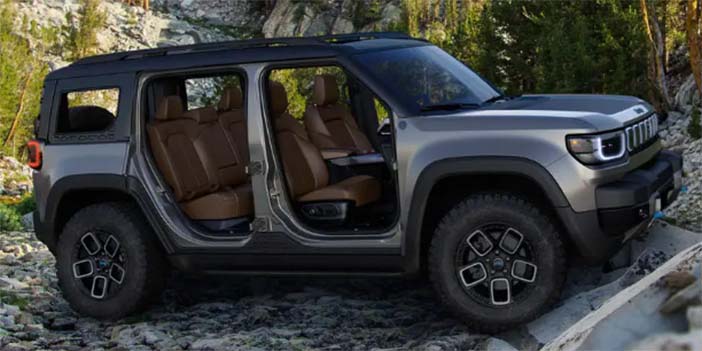
+++ JEEP will take on the Land Rover Defender with the 600 hp Recon electric off-roader as part of a big push to reinvigorate itself in Europe. Launching in 2025 with a range of around 600 km, the Recon will arrive as an unofficial electric sibling to the famed Wrangler. Sharing underpinning with the also 2025-bound Wagoneer S, the pair (along with the already released Avenger) will swell the brand’s European range to 7 models by the middle of the decade. This includes a 4th EV that CEO Christian Meunier has described as a look into the future of the brand. Covered teaser pictures indicate this will sit at the lower end of the lineup. The Stellantis-owned American brand will go electric car-only in Europe in 2030. One of the most anticipated of those new models, the Defender-challenging Recon, will, like the range-topping Wagoneer S, be based on Stellantis’s new STLA Large architecture, making them some of the first models to be so. Although further technical details have yet to be released, a 0-100 kph time of 3.5 seconds for both models has been confirmed. Built in the US and released there first, the Recon will be offered and positioned as a raw take on off-road Jeeps of old, with options including removable doors and an open-top design, as on the Wrangler. The Recon will sit alongside the Wrangler, confirmed Jeep’s European boss, Antonella Bruno, but the 2 cars will have slightly different sizes and positions in the range. “The Recon in Europe will be a white-space car”, said Bruno. “It’s a unique car, very boxy and very capable. It will sit in a lower part of the market segment to the Wrangler”. “At a global level, we want to be the 4×4 leader in electrification”, said Bruno. She noted that despite Jeep’s 4×4 heritage and positioning, it wasn’t targeting Land Rover as a rival in Europe, instead citing the likes of Volkswagen and Mini as brands from which it could conquer sales. Despite Jeep’s poor recent performance in Europe, Bruno believes the brand remains in good standing. “The brand is incredibly well known”, she said. “The customer is ready to accept our new products”. +++
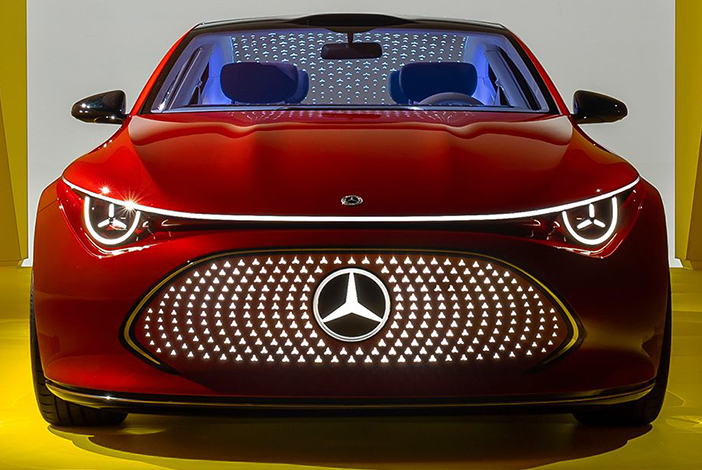
+++ The 3-pointed star daytime-running lights (DRLs) on the new MERCEDES-BENZ CONCEPT CLA will become a new design “signature” of its future electric cars that will be the equivalent to the exhaust pipes of a combustion-engined car, according to the firm’s design boss. The bold new concept features distinctive DRLs in the shape of the brand’s logo that are built into the round lights at the front and rear of the car. Along with a striking new digital grille, which is illuminated with a pattern of star graphics, they will be seen on the production version of the CLA and the 3 further compact models that will be built on the new MMA platform. Asked which styling elements of the Concept CLA will be carried over to the production car, Mercedes design chief Gorden Wagener said: “Pretty much everything”. Highlighting the new star-shaped DRLs, he said: “Iconic elements like the new daytime-running lights, the star, that’s a new signature for Mercedes and it’s very cool. It’s a new electric exhaust: electric cars obviously don’t have one, and for customers having good pipes is always great, so these are the new pipes”. Wagener also highlighted the new grille as being a key element. He said: “It is a new interpretation of the Mercedes grille, but we still use the grille. There are so many faceless cars around and we want to make a difference here. Our grille is very iconic. Everything we do is along our design philosophy of central purity. So that’s a significant style for a luxury brand similar to the style of Chanel. We almost evolve it like an operating system (1.2, 1.3 and so on) and at some point there will be 2.0, but that will be further in the future. This car is maybe 1.8, so already going into the new generation with a couple of things. What’s crucial for us is being iconic. We want to make a difference to the sea of sameness, all these faceless cars that have no identity. We want to stick out of that with iconic features, and with Mercedes we have all the possibilities to do so”. +++
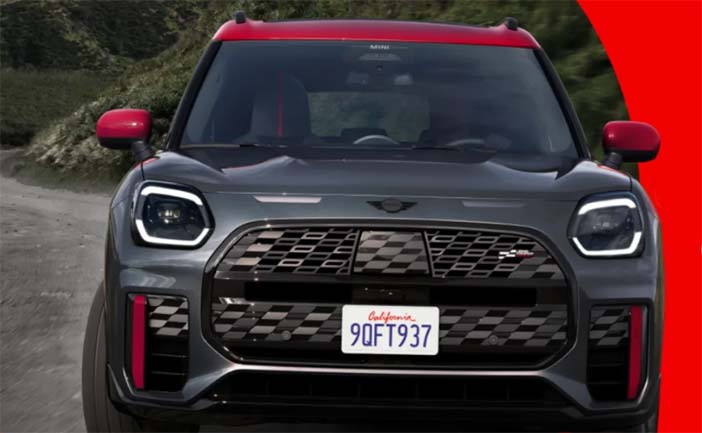
+++ MINI clued us in that there’d be a John Cooper Works version of the all-new Countryman unveiled around the Munich Auto Show. I didn’t get images of the go-faster Mini until now, Mini posting 2 exterior shots to its Instagram channel. As usual, Mini’s made a number of subtle changes to the JCW that the average driver might not notice, but which brand fans and car spotters will quickly catch. The upper grille on the Countryman JCW is not only a different mesh pattern than the standard car, now done up like a checkered flag, it sits above a defined bumper structure bearing the same pattern graphic. The grille’s set into a black surround, and above it, 2 faintly embossed channels lead to air outlets in front of the hood shutline. At the edges, breaks in the headlight DRLs turn them into a set of horizontal brackets. Further down, where the standard Countryman has small fog light recesses in the front fascia’s corners, the Countryman JCW has a pair of tall intakes topped by the bumper and flanked by side curtains. Chili Red accents on the curtains match the same color on the mirror caps and roof. The redrawn JCW logo appears on the plaque behind the B-pillar; Ford isn’t the only one spiffing up its corporate identity. The previous logo spelled out the JCW name, with the “Works” bit set into a stretched, horizontal oval pendant. The updated logo sheds the pendant, placing the wordmark next to a checkered flag motif. Among the Instagram images, checkered flags appear again in the rear seatbacks and we have a feeling there are a few more around the cabin.
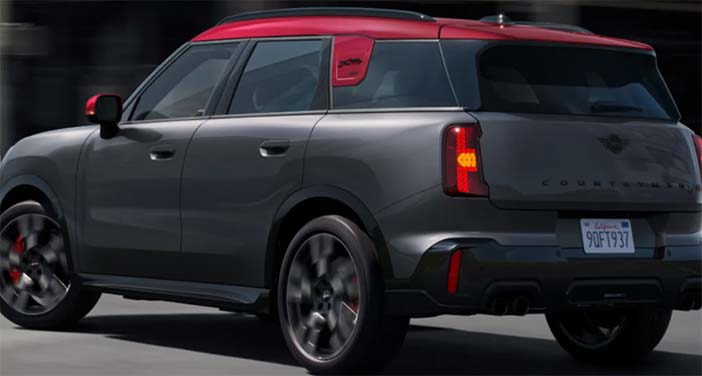
Back outside, the Countryman JCW’s taillights sport a stylized version of the Union Jack motif on the standard car above quad pipes poking through the rear bumper. This petrol-powered Countryman JCW is anticipated to use the same turbocharged 2.0-liter 4-cylinder from the current car but with more output than the present 306 horsepower and 450 Nm of torque. It’s due sometime next year in all-wheel-drive form along with a petrol-powered Mini Cooper JCW hatch. Mini product line chief Stefan Flöck told that come 2025, both the Cooper JCW and Countryman JCW will offer battery-electric versions. Now that Mini has opened its BEV account, and by 2030 the automaker plans to go BEV-only, there might be a John Cooper Works GP sendoff at some point. Brand boss Stefanie Wurst told about the chances of the raucous hot hatch, “Yes, definitely. We don’t know when or how, but I would love it”, adding: “I think there is a future for that nameplate and I think it makes it even more credible that we have teams racing at the Nürburgring”. The most recent JCW GP hit the market in 2020, making 320 hp and limited to 3.000 units. +++
+++ A trio of new electric vehicles (the Hyundai Ioniq 6, Lexus RZ, and Genesis Electrified GV70) have just earned the TOP SAFETY PICK+ RATING by the Insurance Institute for Highway Safety. The prestigious award from the IIHS requires that the cars and SUVs achieve top scores in a number of crash tests and that they have an “Advanced” or “Superior” front crash avoidance system that activates to help inattentive drivers prevent vehicle or pedestrian crashes. Previous selections for the award among EVs have included the Rivian R1T/R1S, Kia EV6, Hyundai Ioniq 5 and Tesla Model 3 and Model Y. To earn the “+” designation, the agency stipulates that headlights rated “Acceptable or Good” must be standard across all trims, and that a front crash prevention system that earns Advanced or Superior ratings in both the daytime and nighttime vehicle-to-pedestrian evaluations be available. The GV70 earned “Advanced” ratings in both the daytime and nighttime vehicle-to-pedestrian front crash prevention evaluations. The Ioniq 6 and the Lexus RZ earned “Superior” ratings in these 2 tests. “To be environmentally friendly, our vehicles and our cities also need to be pedestrian-friendly”, said IIHS president David Harkey. “All 3 of these vehicles have standard front crash prevention systems designed to protect pedestrians both during the day and at night, when most fatal pedestrian crashes happen”. Overall in its latest list, the IIHS named 51 cars in the “Top Safety Pick+” grouping and 25 in the secondary Top Safety Pick tier. That’s down from 101 total award-winning models last year, likely because the organization has implemented its tough new side-impact test and is also testing for night-time pedestrian detection for collision warning and prevention systems. The IIHS is one of two major automotive safety rating organizations, along with the federal government’s National Highway Transportation Safety Administration. IIHS is a private organization funded by insurance companies. +++
+++ In the UNITED STATES , the United Auto Workers announced at midnight last night that they would begin targeted strikes at Ford’s Michigan Assembly, Stellantis’ Toledo Assembly and GM’s Wentzville Assembly; all 3 home to midsize pickups and, in the case of Toledo and Michigan, popular midsize SUVs. The Ford Ranger, Jeep Gladiator (just updated for 2024), Chevrolet Colorado and GMC Canyon are all built on lines that have been shut down by the strike. The Ford Bronco and Jeep Wrangler, which share fundamental underpinnings with the Ranger and Gladiator, respectively, are also in on the party. GM’s Wentzville Assembly also builds the GMC Savana and Chevrolet Express vans, neither of which is a big player in the retail market. While midsize pickups may not move in the quantities we see from the half-ton segment, all of these are fairly high-volume models. Ford sold nearly 120.000 Broncos along with more than 55.000 Rangers in 2022; Wrangler and Gladiator combined for nearly 260.000 units last year (181.000 of those were Wranglers) and the Colorado/Canyon represented more than 117.000 sales for General Motors. Throw in the nearly 80.000 units for Chevrolet Express and GMC Savana, and production from these facilities equated to more than 500.000 units sold in 2022. Ford has been struggling since launch to deliver its wildly popular Bronco to waiting enthusiasts. With supply woes largely easing last year, the company caught up to a great deal of its pre-existing demand, but lingering supply chain and quality control issues have continued to plague the manufacturer even as general constraints have eased. Even earlier this year, Ford said it was selling every unit it could produce. The Ranger, freshly redesigned for the U.S. market, is still getting its feet wet. Jeep likewise has been on a tear. Sales of the 4×4 have remained so steady that the Wrangler 4xe became the country’s bestselling plug-in hybrid vehicle pretty much by accident. Jeep just formally confirmed this week that a 4xe variant of the Gladiator pickup is on the way by 2025 and they said you couldn’t sell hybrids to truck and SUV buyers. At GM, meanwhile, the Colorado and Canyon are sporting fresh redesigns for the 2023 model year, with production of both still ramping up. And while the Chevrolet Express and GMC Savana vans may not be popular consumer models, GM still sold more than 77.000 of them last year combined. +++
+++ VOLVO has pledged to resolve the often frustrating nagging of driver attention monitoring technology with the new Driver Understanding system, which makes its debut on the upcoming EX90. The system uses 2 interior cameras to monitor a driver’s eye patterns and detect early signs of distraction from the road. Similar set-ups are deployed in many new cars (as mandated by the GSR2 safety regulations coming into effect in the United States next year) but these are often too sensitive and so become a distraction. Volvo aims to resolve this by using proprietary technology to scan eye-gaze patterns (for drowsiness, intoxication or other cognitive impairments) and applying a more pragmatic approach to the data gathered by the system. Speaking at the first public crash test of the EX90, Volvo senior safety technical lead Mikael Ljung Aust told: “you spend about 80% of your time looking at the road ahead and 20% elsewhere”, highlighting a need to keep drivers’ eyes on the road. However, “people have learned to do this in a way that works for safe driving”, added Ljung Aust. Crashes are only caused by “inopportune” glances “every once in a blue moon”, he said, so “it’s really hard to say people are doing the wrong thing”. As such, the Volvo system will warn a driver only when their distraction creates a scenario that requires computer intervention to avoid a hazard or collision. These warnings will then escalate if the system continues to be triggered, or if the hazards increase in severity. Discussing the approach, Volvo Cars Safety Centre head Åsa Haglund recalled her experience of teaching her son to drive and her realization that constant warnings can break the trust between a driver and their safety system. “We started off with me being quite an annoying active safety system screaming ‘watch out!’ ”, said Haglund, joking. “My son soon doesn’t listen to me any more, does he? It’s super annoying and for sure it doesn’t make him a better driver. So we have to find that balance. When you look away and something happens (and the car’s safety systems are looking), that’s when we want to tell you when the help is needed and not any other time. That’s when we make an effective safety system, not by calling out anything we see at any time”. +++