
+++ One stat leapt out from the AUDI GROUP ’s financial results from the first quarter of 2024: Lamborghini made more money than Audi. Bentley came close, too. That’s overall operating profit, not just profit per car. We all know how good margins can be on selling luxury motors, but Lamborghini delivered just 2.630 cars in the quarter, compared with Audi’s 397.000. From those deliveries, Lamborghini booked profits of €187 million, compared with €135 million for Audi. Bentley made €120 million from 2.506 cars sold. Explanation for the relatively low profit of Audi is the lack of a vital component for its V6 and V8 engines. There for far less luxury cars could be delivered to customers in the first quarter of 2024 than planned. +++
+++ Last year, some 9.6 million ELECTRIC CARS were sold worldwide. This total excludes plug-in hybrids and range-extenders, as well as hydrogen-powered cars. The number of BEVs (Battery Energy Vehicles) has increased by 30% since 2022, which is no mean feat given the difficulties the sector is currently experiencing. Growth has been mainly driven by China, which has stimulated NEVs (New Energy Vehicles), followed by Europe, the United States, South Korea and other smaller markets such as Thailand, India and some Latin American markets. The adoption of electric cars is therefore proceeding at 2 different speeds: Chinese speed, where it is virtually compulsory to buy and drive an electric car (mainly because of the bureaucratic complications involved in buying a combustion car), and non-Chinese speed, where doubts about the economic and social potential of a 100% electric car are growing. As predicted in an article published in January, Tesla (and not BYD) has been confirmed as the world’s leading manufacturer of electric cars in 2023. The American brand delivered almost 1.81 million units worldwide, increasing its share of the global BEV market from 17.8% to 18.9%, mainly thanks to the success of the Model Y in all markets. China’s BYD came second, but recorded a bigger increase in market share, selling 1.57 million electric cars, 80% more than in 2022. In addition to its strong performance in China, BYD achieved excellent results in markets such as South-East Asia, Latin America, the Middle East and Central Asia. It has also arrived in Europe with the mainstream and relatively inexpensive Atto 3. In China, BYD is very popular, mainly thanks to the success of Han (it is present on practically every street in Beijing and Shanghai), Song and Qin. BYD’s share of the global BEV market is set to rise from 11.9% in 2022 to 16.4% in 2023. In third place is the Volkswagen Group, with 769.000 units. Here, the increase in share has been more moderate, rising from 7.9% in 2022 to 8% in 2023. While Volkswagen’s ID models have struggled in China and the United States, and to some extent in Europe, Audi has performed well with its e-Tron models, but has not matched the results achieved by BMW and Mercedes. It’s also worth noting that while China accounts for 52% of global BEV sales, the Volkswagen Group’s pure electric models only account for 23% of the total. The BMW Group, the 13th largest in the world, has sold more electric cars than Stellantis, the 4th largest in the world. The German manufacturer delivered 376.000 BEVs compared with 323.300 from Stellantis. Mercedes comes next, with 315.300 units, 95% more than in 2022. +++
+++ FORD is so delighted with the burgeoning worldwide sales of its 60-year-old, petrol-powered Mustang that it is contemplating launching a new range of “authentic” combustion-engined variants that could include a 4-door model for the first time in history. Ford CEO Jim Farley claims the Mustang is now “by far” the world’s best-selling coupé and has developed a huge body of followers worldwide. However, he acknowledged that new derivatives would only be accepted by these supporters if they had the “performance and attitude” of existing models. “We will never build a Mustang that isn’t a Mustang”, he insisted. “For instance, there will never be room for a small SUV with a Mustang badge stuck on it. But could we do other Mustang body forms, a 4-door or whatever? I believe we could, as long as these models have all the performance and attitude of the original”. To begin this latest Mustang expansion phase, Farley believes Ford must start by adding lustre to the original coupé, investing both in models that are accessible to traditional buyers and in other versions that take the coupé further upmarket, the way that Porsche has done with its 911 GT3 RS and GT2 RS models. “Porsche has been smart about creating derivatives over the past 20 years”, he said. “But we wouldn’t want to do things their way. We want to give them a good, American-style run for their money”. One way of keeping costs down while increasing performance in the affordable version, he believes, may be to cut weight and a development programme is already under way to explore ways of achieving this. Farley calls the recently announced, track-focused Mustang GTD; a Nürburgring-tested creation with 800 hp, a sophisticated aero package and a price of over €300.000; “a down payment” on the performance Mustangs of the future. “We won’t stop with the GTD”, he said. “At our best, we are an irreverent company. We need to keep doing derivatives that will surprise people”. For all his expansionist plans, Farley believes Ford needs to be careful about diversifying the brand too far. He said: “Some people think we could mix Mustang with off-road driving; look at what Porsche has done with the 911 Dakar, and what Lamborghini has been doing. But I’m not so sure about that”. One point of reassurance for Mustang stalwarts is Ford’s intention to continue building V8s “as long as God and the politicians let us”. Farley promises he will fight hard to keep these iconic engines and the manual gearboxes often linked to them in production. He believes he can keep that promise even longer than specialist performance car makers (such as Aston Martin) because Ford is fast developing a supporting range of pure-EV models that will provide the fleet offsets needed to keep its ICE-powered siblings legal. However, future Mustangs are likely to offer hybrid power, to reduce carbon emissions and to improve performance. Farley said: “We’ve been testing and we really do believe partial electric powertrains work well for performance drivers. One thing I can promise, however, is that we will never make an all-electric Mustang”, added Farley, discounting the unrelated Mustang Mach-E electric SUV that shares its name. “I look at other users of pure-electric power such as Formula E and even companies like Rimac, and I just don’t think that would be right for Mustang. Great for other Fords (look at the worldwide success of the Transit), but not for the Mustang”. Farley, who was appointed CEO in late 2020 and has been rebuilding its model range ever since, sees the Mustang’s rise to global prominence as a big win for the firm. He said: “When we decided, in around 2015, that the Mustang should go global (with righthand drive and other expensive changes) it looked like we were taking a big risk. But it has paid off. Nowadays some of our biggest dealers are in countries like Sweden and Australia. I’d say Mustang’s future has never been brighter”. +++
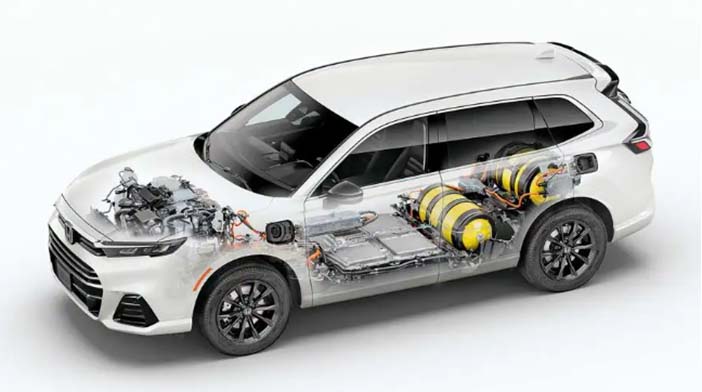
+++ Just over half a century since the automotive world got properly revved up by the prospect of HYDROGEN fuel cell electric vehicles (FCEVs), they still haven’t happened. They failed to take over the world in the same way that BEVs appear to be doing. But the same key FCEV players from back in the day are still quietly getting on with it. General Motors and Honda are 2 of those and both have a track record, Honda since the early 1990s and GM since the Electrovan FCEV in 1966. In February, Honda unveiled the production version of its CR-V e:FCEV plug-in, which goes on lease sale to customers in Japan and the US later this year. The FCEV is powered by a fuel cell system made by a GM and Honda joint venture called Fuel Cell System Manufacturing (FCSM), based in Michigan. With a range of 600 km on a full tank of hydrogen plus a further 60 km of battery range (according to the WLTP test cycle) and a refuelling time akin to that of a petrol or diesel car, the CR-V e:FCEV is built in Ohio at Honda’s Performance Manufacturing Centre. FCSM started mass production of fuel cell systems in January and what is possibly more significant than the launch of the new car is Honda’s claim that this is the first time hydrogen fuel cell systems have been produced “at scale”. Fuel cells consume hydrogen and oxygen from the air, producing only electricity, water and heat as by-products with no CO2 or toxic emissions. What they have in common with batteries is that a hydrogen fuel cell is actually a ‘stack’ of small fuel cells combined to make the electrical power required in the same way an EV battery is composed of many small cells, but that’s where the similarity ends. The GM-Honda system produces around 92 kW of electrical energy and the drive motor-generator 177 hp and 300 Nm of torque. The battery has a capacity of 17.7 kWh and the hydrogen fuel is gaseous and stored in tanks at 10.000 psi. But the biggest news is perhaps how the decades of R&D into making fuel cell systems may be paying off at last. The cost of the system has been reduced by two-thirds compared with the 2019 Honda Clarity FCEV, partly through a reduction in platinum used as a catalyst in the cells, as well as through the benefits of large-scale production. Durability of the system is also said to have doubled along with resilience to low-temperature operation, which has always been a challenge with fuel cell systems, partly because of the amount of water they produce internally. Size and weight have been reduced, too, and vibration and noise further improved over that of the Clarity. The elephant in the room with FCEVs is still the availability (or lack of) a hydrogen network, and as a practical proposition in Europe, FCEVs are still a non-starter. In the United States, there were 59 stations at the end of 2023, but that is expected to grow to 4.300 by 2030, according to Statista. +++
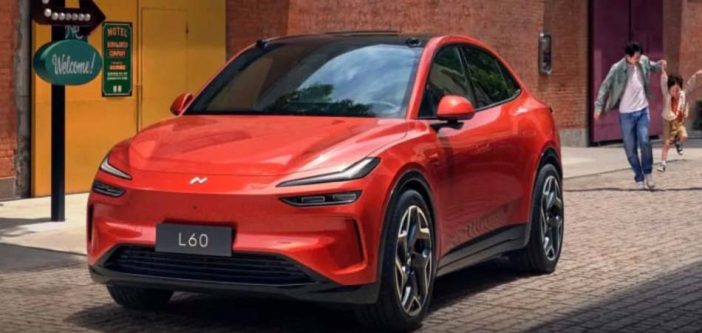
+++ Chinese electric vehicle maker NIO on Wednesday launched the first vehicle in its new lower-priced brand Onvo which aims to compete there with Tesla’s Model Y, the world’s best-selling electric vehicle. Nio unveiled the Onvo L60, a SUV, with a sticker price starting from 219.900 yuan (photo), which is 12 % below the price of Tesla’s Model Y which starts at 249.900 yuan in China. Nio plans to start delivery of the Onvo L60 in September. Chief executive William Li introduced the SUV in Shanghai, saying the company also aimed to take on Toyota’s RAV4 by providing family cars that balance customer experience and ownership costs. “The RAV4 and Model Y were the benchmark for family cars in their time. With technologies evolving and people’s understanding in smart electric vehicles deepening, today it’s time for us to redefine the new standards for family cars”, Li said at the event. The vehicle is more spacious than Tesla’s Model Y, he added. With a lower price tag, the Onvo brand could also help Nio expand outside China, although branching out into Europe is overshadowed by an ongoing anti-subsidy probe the European Union has launched into electric vehicles imports from China. The Onvo L60 is equipped with Nio’s self-developed 900 volt fast-charging system and has an average energy consumption of 12.1 kWh per 100 kilometers, slightly lower than Tesla’s Model Y, said Ai Tiecheng, president of the Onvo brand. The Onvo cars will have access to more than 1.000 battery swapping stations and 25.000 public chargers belonging to Nio, Ai added. Li said previously that the bill of materials of the Onvo car would be 10% lower than that of Tesla’s Model Y, according to Chinese media. Its lower cost, together with Nio’s EV battery rental programme, would allow it to better compete at a lower price. Last week, Nio has struck a deal to source batteries from BYD for the Onvo line-up, as it abandoned plans to produce batteries in-house as part of the efforts to reduce costs amid a bruising price war in China’s ultra-competitive electric vehicle market. Nio, whose namesake line-up is priced from 298.900 yuan (around 30% higher than the Model 3 in China), sold 45.673 electric vehicles in the first 4 months of this year, accounting for 3% of China’s overall sales in the segment. By contrast, Tesla delivered 163.841 units in China to take an 11.4% market share, according to data from the China Passenger Car Association. +++
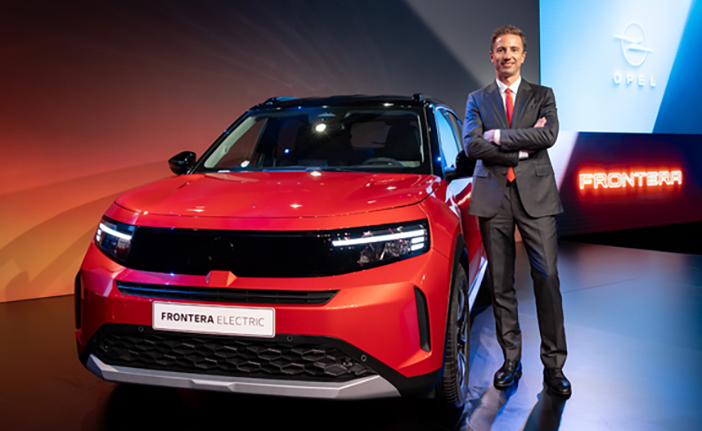
+++ Electric car sales in Europe and beyond are not taking off as hoped and many manufacturers are revising their plans, extending the life of models and combustion engines in anticipation of better times. This does not include OPEL , which indeed confirms its original plans to sell only electric cars on the Old Continent from 2025. This was confirmed directly by Opel’s chief executive Florian Huettl in an interview, in which he stated that the Rüsselsheim-based company is “strongly” creating electric cars, adding: “Our goal is to make these cars really accessible to a broader customer base”. A strong statement of intent was made during the presentation of the new electric Opel Frontera, heir to the Crossland. It is a model also available with mild hybrid or battery powertrain, with a declared range calculated according to the WLTP cycle of more than 300 km for the basic version and over 400 km for the Long Range and prices starting from €29.499 euro in the Netherlands. Powertrain options made possible by the Stellantis multi-energy platform, which Opel does not, however, want to continue to exploit. “With the Frontera and the new Grandland we are completing Opel’s first phase of electrification, where electric and combustion engines coexist”, said Huettl, who went on to emphasise that “we will move forward with the next generation of Opel models that will be exclusively electric. We set a good example with the Experimental concept. Opel-Vauxhall likes to work with concept cars and turn them into reality. The Experimental shows the next step in our plans to go fully electric with future models. In order to make electrics more and more accessible, Huettl anticipated that Opel is working on a new economy electric car with a starting price of less than €25.000. It will in fact be a ‘cousin’ of the new Citroën ë-C3 and the upcoming electric Fiat Panda, thus based on the Stellantis Smart Car platform. +++
+++ POLESTAR has announced that future models will be named chronologically upon their release, rather than use the numbers of the existing models they replace. That means the current ‘2’ will be replaced by a similar model in future called the ‘7’. Polestar is growing its range of all-electric vehicles with the ‘3’ (a large SUV) and the ‘4’ (a mediumsize coupe-SUV), the upcoming Porsche Taycan-rivalling ‘5’ and the drop-top ‘6’. A new ‘1’ has been ruled out, however, with the Swedish firm saying it’ll keep increasing model name numbers with each new release. At a recent event, Autointernationaal.nl was told by a Polestar representative that the strategy “will be like Apple iPhones” and the replacement for the ‘2’ “will have a new name”. The model arriving after the ‘6’ will probably be the next-generation ‘2’ so that car is in line to take on the ‘7’ name. The Polestar 6 will be launched in 2026 and with the ‘2’ gaining a hefty update last year, we’re not likely to see the ‘7’ until the end of the decade. By then it’ll have fresh competition in the shape of BMW’s 3 Series-sized Neue Klasse and the production version of Mercedes’ Concept CLA Class. I expect the Polestar 7 will sit on new Sustainable Experience Architecture like the new ‘4’ instead of the Compact Modular Architecture of the ‘2’ which is also used on the Volvo XC40 and C40. Range for the Polestar 4 stands at up to 620 km, but if the supposedly smaller ‘7’ gets the same 94 kWh battery and some technological improvements, by the time of its release a figure north of 640 km would seem likely. +++
+++ Vehicle data outfit iSeeCars is out with an interesting new calculation. It looked at RECALL data from the National Highway Traffic Safety Administration and used that to create a projection of the cars that in the future will be most likely subject to further recalls in the United States. Last year alone, NHTSA issued 300 recalls affecting 35 million vehicles. So what will next year bring, or the year after that? Here’s iSeeCars’ assessment of how many recalls these cars might face over the course of their entire lifetimes. The top-5 of cars most likely to face future calls are: 1) Porsche Taycan: expected 30-Year Lifetime Recalls: 21.9x; 2) Tesla Model Y: 20.7x; 3) Tesla Model 3: 18.8x; 4) Porsche Panamera: 13.3x and 5) Lucid Air: 12.4x. Note that there are a number of Tesla’s and other electric cars high in those ranks. In many cases, recalls on those vehicles can be done Over The Air (OTA), with little or no inconvenience to owners. When iSeeCars excluded OTAs from its calculation (and to be honest, I’m a little unsure how they could figure that, but they must be basing it on a past ratio of OTA vs. physical repairs), all Tesla models fell out of the top-5, while the Lucid Air moved down to the last spot. However, the Porsche Taycan and Panamera remained, as Nos. 1 and 2. On the flip side, iSeeCars also created a list of vehicles that should afford you very little in the way of recall troubles; a list dominated by Lexus. The top-5 cars least likely to face future calls are: 1) Mini Convertible: 0.1x; 2) Lexus ES 300h: 0.1x; 3) Lexus RX 450h: 0.1x; 4) Lexus NX 300h: 0.1x and 5) Lexus ES 250: 0.1x. “If you’re hoping to avoid recall hassles, you can significantly improve your odds by choosing the right model”, said Karl Brauer, iSeeCars’ executive analyst. “A vehicle like the Mini Convertible or Lexus RX 450h has, literally, a fractional chance of being recalled even once, versus a lot more projected recalls for the Porsche Taycan, Tesla Model Y and Tesla Model 3. Even the industry median of 3.2 lifetime recalls sounds much better than the approximately 15-plus projected recalls for all of the cars on the most recalled list”. +++
+++ ROLLS-ROYCE will soon break ground on a significant extension of its factory at Goodwood, West Sussex, that will enable it to offer substantially more personalisation on each car that it builds. Planning permission was recently granted by Chichester District Council, enabling the firm to progress with what will be the most substantial investment in the factory since it was opened in 2003. Extending it is high on the priorities list for Chris Brownridge (photo), the former BMW manager who took the helm at Rolls-Royce at the end of last year, following the departure of long-standing CEO Torsten Müller-Ötvös.
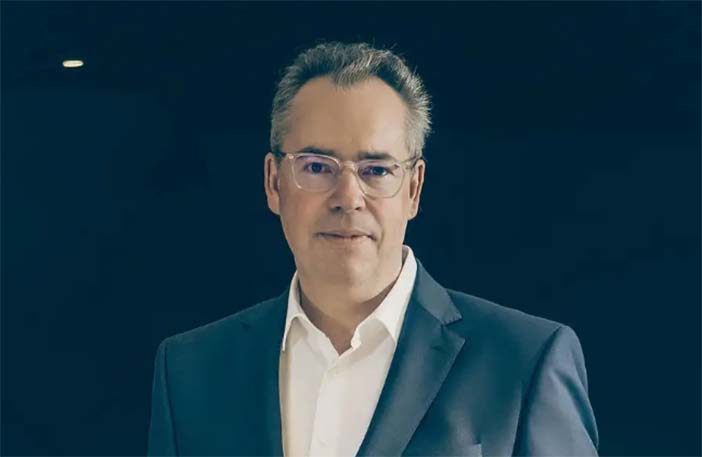
Speaking to media for the first time since taking the job, Brownridge (who has held several high-ranking positions in the BMW Group since joining in 2005) said that expanding the factory isn’t just important from a commercial standpoint but also in terms of nurturing the automotive industry in the United Kingdom: “We’re proud as a British institution. Rolls-Royce has a very relevant voice in the world of luxury but also contributes to the British economy”, he said, before highlighting that Goodwood employs 2.600 people directly and some 7.500 people across the national supply chain, while annually contributing some €600 million to the Treasury. “We’re a significant player”, said Brownridge. “This little organisation that builds just 6.000 cars a year gives a livelihood to many people”. Rolls-Royce estimates that the expanded factory will boost its contribution to the local economy by some €80 million and could create more than 1.000 new jobs, although Brownridge emphasised that the aim isn’t to boost overall car output. “When this magnificent facility was built, the business was designed around making 1.000-1.500 cars annually, and today we make significantly more than that; every single one requested by a client”, he said. “Our strategy moving forward isn’t to grow volume, it’s to grow the bespoke content of the cars, because that’s what makes it a special experience for our clients”. The Bespoke programme has become a fundamental strand of Rolls-Royce’s operations, with every car produced in 2023 (a record year for deliveries) personalised to some extent. The company also set a new record for ultra-exclusive Bespoke commissions in both number and value. “We want to invest in our capability to deliver more and more genuinely bespoke and individual motor cars for our clients”, said Brownridge, highlighting that certain bottlenecks in the existing production line limit the scope of the programme currently. For example, the paint shop is currently able to apply a 2-tone colour scheme on 15% of cars but demand for such finishes is at more than 50%. The paint shop will be among the first parts of the factory to be upgraded, and the entire programme is set to be completed in 2028 or 2029. Brownridge said that growing Rolls-Royce and catering to the increasingly exacting demands of its clients are his driving priorities. “Everything we make is bespoke to the individual”, he said, “and what we’re trying to do is create amazing bespoke goods for people and give them a great experience. It’s unlike anything I’ve done before”.
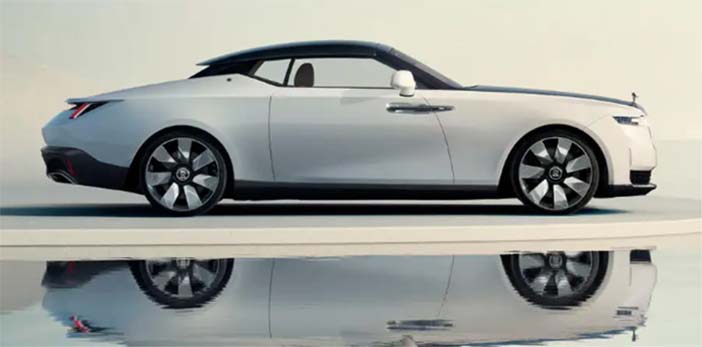
Having spent time with MG, Rover and Land Rover as well as the BMW Group, Brownridge said “I thought I knew everything about cars” but admitted that his first months at Rolls-Royce have been “absolutely fascinating” and an “eye-opener”. He said that his lengthy experience in the automotive industry stands him in good stead to lead the marque into the future. “I know a lot about brand management and the business of client-centricity”, he said, but “the world of luxury for me is a new area completely, so I need to learn a lot about that too. That’s why I’m spending so much time with our clients to understand their interests”. Asked whether he plans to continue the work of his predecessor, who was CEO of Rolls-Royce for 14 years, Brownridge said: “Rolls-Royce had its most successful year last year, so it’s in great shape, but what we can also see is that the business has a very exciting future ahead of it. The foundations for that future are already in place. My job is to deliver that, and deliver it perfectly, and define the next chapter of Rolls-Royce”. +++