
+++ BYD will launch 3 new plug-in hybrids alongside 3 electric cars in Europe next year as it pushes for a more comprehensive product portfolio to boost its market share in the face of ailing EV demand and swingeing import tariffs. The Chinese company is the world’s second best-selling electric car manufacturer, only narrowly being outstripped by Tesla in the second quarter of this year, and is quickly growing its market share in Europe following its launch in the market in 2022. Its European line-up is predominantly pure-electric, but it has recently launched a plug-in hybrid version of the Seal U and BYD president Stella Li has told that PHEVs have a “very important role” to play in sustaining the company’s upward trajectory. “BYD is different. Tesla only has EVs but we have PHEVs”, she said, referring to them as a “game-changer” offering. Li says PHEVs like the Seal U DM-i are gaining importance as a bridge to full electrification for wary would-be electric car buyers. She said: “A lot of people want to try electric cars, but currently they have range anxiety and hesitate, but this car gives them the solution”. According to Li, this is particularly prevalent in China, where the popularity of PHEVs and range-extender vehicles (REVs) currently outstrips pure EV. She said: “China is the leading country for the new-energy car, and the yearly penetration of EVs is 40%, but more than 50% is PHEV, and our data shows that mainstream people use PHEV as the first experience for EVs. “But after several years, they replace that with a new car, and 60-70% were very open to buying an EV”. However, this phenomenon is not unique to China, she emphasised, highlighting that 60-70% of BYD’s sales in Spain are for the Seal U DM-i, which is the company’s “global sales champion”, though 85% of units are sold in its home country. Li cited the flexibility and reduced running costs of a PHEV powertrain as the principal selling points. “Once you introduce PHEVs and educate people and offer them at a competitive price, people realise the saving. Then the number of NEVs (New Energy Vehicles) will see very solid growth”, she said. Li stopped short of confirming which PHEVs BYD will bring to Europe next year, but it sells DM-i versions of the Seal 06 and Seal 07 saloons in China, as well as the Song-L crossover. The brand plans to launch its Fangchengbao range-extender 4x4s in mainland Europe in the near future, but these are separate from BYD’s PHEV push. The company will also bring 3 new EVs to the European market, possibly including the Ocean-M (a hatchback) and the Sea Lion (a crossover). Diversifying its powertrain offering in Europe will help BYD to mitigate the impact of the substantial 17.4% import tariffs that have been imposed on its Chinese-built pure-electric cars by the EU Commission, though the company is also working to quickly establish European factories so it can avoid these entirely. The company will begin building cars at its new factory in Hungary by the end of 2025 and a separate new facility in Turkey will come online shortly after, which would make BYD the first Chinese car brand to open its own European factory. “BYD is a global leader and now we are turning ourselves into a local company”, Li said. “Localisation is one of our key targets. In the next 2 years, BYD will become a European company. We will produce locally. We will do R&D locally. BYD will become really a European brand”. She said BYD has not yet decided which cars it will build on the site but suggested all current and future European-market models would be considered. “The most popular cars we will produce locally here”, Li said. +++
+++ A lot of doom and gloom has been painted around the state of the ELECTRIC VEHICLE market, including in the United States. However, a look at sales figures through the second quarter reveals that demand for EVs continues to rise, and they now account for 8% of new vehicle sales across the country. During the second quarter of the year, 330.463 EVs were sold in the U.S. representing an 11.3% year-over-year increase and an impressive 23% increase from Q1. This meant the proportion of new vehicles sold in the U.S. that are EVs rose from 7.1% in Q1 to 8% in Q2, and up from 7.2% in Q2 of 2023. Cox Automotive notes the sales growth can be attributed to improved availability, higher discounts and elevated leasing levels. The growth also came despite Tesla’s share of total EV sales slipping below the 50% mark in the U.S. for the first time, dropping to 49.7%. Tesla wasn’t the only manufacturer to see its EV sales slip in the second quarter. EV sales from Mercedes-Benz, Polestar, Porsche, Volvo, Volkswagen and Chevrolet saw dips, with the latter experiencing a 19% decrease in sales year over year. Several new entries to the market played a role in an overall increase, including the arrival of the BMW i5, Cadillac Lyriq, Honda Prologue, and Kia EV9. Surprisingly, the brand with the second highest proportion of total EV sales in the U.S. was Cadillac, with roughly 19% of its vehicles sold being EVs. It was followed by BMW with ~15%, Genesis with ~13% and Audi with ~11%. Other brands in the top 10 include Kia, Hyundai, Volkswagen, Ford and Lexus. “EV sales exceeded expectations during a record-breaking quarter”, Cox Automotive’s Stephanie Valdez Streaty said. “Despite Tesla’s declining sales, with its EV sales share now below 50% for the first time, the overall competitive landscape for electric vehicles is intensifying. This increased competition is leading to continued price pressure, gradually boosting EV adoption. Automakers that deliver the right product at the right price and offer an excellent consumer experience will lead the way in EV adoption”. +++
+++ FERRARI first electric car has already completed several thousand kilometers of on-road testing and company boss Benedetto Vigna promises it will be made “in the right way” to ensure buyers can “have a lot of fun”. The Italian firm has yet to give any details about what form its first battery-electric vehicle will take, but Vigna confirmed it will be revealed late next year before going on sale in 2026. Recent spy shots show what are understood to be Ferrari EV test mules using modified Maserati Levante bodywork and give some hints as to the form the final car might adopt. Whether it will be obviously comparable with the Levante in silhouette remains to be seen. Notably, though, Ferrari used Maserati’s SUV as the basis for the first Purosangue prototype and that car is radically different from its Italian contemporary, while still sitting high off the ground and having rear seats. It is possible Ferrari could seek to emulate the characteristic dynamic qualities of its combustion cars by centralising the mass of the batteries in the chassis; much in the way that its current cars are either front-mid-engined or rear-mid-engined. Vigna said he expects the new EV to appeal to both existing Ferrari customers and tech-savvy newcomers to the brand. He added: “There is not a pattern really. People buy a Ferrari because when they buy a Ferrari, they have a lot of fun. They don’t buy a Ferrari because A, B, C, D or a single element. It’s a combination of things. When we do electric cars, we will produce them in the right way. Consider that we have prototypes already on the road that have done several thousand kilometres, and we have in our company very qualified clients: test drivers. The first clients of our cars are the test drivers. They drive a lot of cars, and they can easily make a comparison between one and another, so for us this is an important metric that we are making a reference to”. A recent report suggested that the new EV will be priced from €460.000 in the Netherlands and claimed that a second electric model is already under development. Vigna called those reports “a surprise” and declined to confirm any of those details. He added: “The way we define the price of a car is one month before we launch it”. The Ferrari EV will be produced in the firm’s new E-building, which has recently been opened on its Maranello campus. The facility contains an advanced new production line that will come on stream in January 2025. Production there is likely to start with the Purosangue and SF90 before the EV joins in 2026. The new production line will not replace either of Ferrari’s 2 existing lines, but the firm refused to be drawn on whether it will increase capacity. Vigna said Ferrari will offer internal combustion, hybrid and electric models in the future but insisted that the sales split between those models will not be set by sales or production targets but by customer demand. “We always refer to what is our offer, not ‘what are the sales?’” said Vigna. “Forecasting the sales by the kind of propulsion is an act of arrogance, a lack of respect to the client. We will never talk about sales splits. “How can we understand what the client wants? We’re not talking about computers selecting a car. We’re talking about human beings with emotion”. The E-building will help Ferrari reduce development times and increase the level of personalisation that it can offer, which is key to the company’s goal of increasing “revenue quality over quantity”. It will also eventually house production of all of Ferrari’s powertrains, including high-voltage batteries, electric motors and axles that will be used for its future electric models. Bringing production of those key electric components in-house is vital to the firm’s ambitions to ensure that its electric models have points of difference from rivals and that it can continue to service all its models in the future. Ferrari will buy its battery cells from a number of unspecified providers. Vigna declined to give any information about which firms it will use but did drop a hint about battery technology. He said: “You hear people in the market going for LFP (lithiumiron-phosphate] batteries. Well, LFP batteries are not for Ferrari. It’s not good for us”. +++
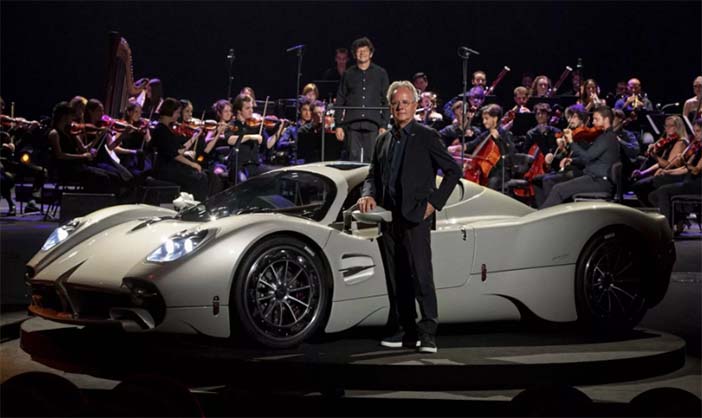
+++ PAGANI sportscars are like rolling pieces of jewelry, filled with mechanical mastery, and in the case of the Huayra and Utopia, they are powered by a ferocious 6.0-liter twin-turbocharged V12. However, the brand’s marketing director and son of Horacio Pagani, Christopher Pagani, says the brand continues to work on an EV, despite previously pausing development on the car. Pagani first dipped its toe into the idea of an EV in 2018, but last year, it said it had no plans to launch an electric model in the near future, citing concerns with battery technology and charging speeds. However, while recently speaking at the Goodwood Festival of Speed, Christopher Pagani acknowledged the marque is still interested in an EV. “We loved working on the electric car, and we still are working on this project, so it’s not a closed chapter for us”, Pagani revealed. Christopher added that after having meetings with its dealer network worldwide, the Italian brand noted there was “no interest in a fully electric Pagani hypercar”, but said it was a “fun project to build”. While the brand spent many years toying with the idea of an EV, it never got to the point of building a full-scale prototype and only developed it virtually. The weight of batteries continues to concern it as, according to Christopher, Pagani models are not about “horsepower” or “top speed”, but rather “vehicle dynamics”. It seems that Pagani will not venture into the world of EVs until it can develop something that meets its standards and brings new innovations. “We’ve always tried to be innovators. The Zonda was a car with a lot of innovations in using composite materials, something that had never happened in an automotive scenario in the past”, Christopher told. “Huayra was the first twin-turbo hypercar, so we again worked with AMG to develop something that didn’t exist. And Utopia gave us the opportunity to go back to the manual gearbox”. +++
+++ The SEAT TARRACO has been axed to make way for sibling brand Cupra’s new Terramar. Seat’s family SUV, which is closely related to the previous-generation Skoda Kodiaq and Volkswagen Tiguan Allspace, had been on sale since 2018. Seat said: “There will be no Tarraco successor. From mid-2024, we will focus on the new Cupra Terramar in the segment, and it will fill this space very well. The Tarraco will then be phased out; it will end its production by the second quarter of 2024”. The Terramar, which is 0.2 meter shorter than the Tarraco, will arrive in Dutch showrooms with a range of plug-in hybrid petrol powertrains. They are said to be capable of achieving around 100 km under electric-only propulsion, putting it on a par with the new plug-in Volkswagen Passat and Skoda Superb. The new SUV will prove key in the expansion of the Cupra’s brand, targeting one of the market’s biggest-selling segments. It will also be Cupra’s final combustion-engined car as it looks to go all-electric in 2030. Seat, meanwhile, has emphasised its ongoing rebound from the pandemic-induced semiconductor shortage. “Sales of the Seat brand in 2023 grew 24%, reaching 288.400 cars sold,” it said in its statement. The brand added that it will now move to update its remaining models (he Ateca, Arona, Ibiza and Leon) “to continue offering plug-in hybrid and fuel-efficient cars until the end of the combustion era”. +++
+++ STELLANTIS dealers in the United States have called on their CEO to help them battle sluggish demand and falling share in a market that is growing overall. Dealers wrote to Carlos Tavares in May outlining their grievances and the reasons they think Stellantis is falling behind other automakers, Kevin Farrish, chairman of the Stellantis National Dealer Council, told. While the US market overall grew 2.2 percent in the first half of 2024, Stellantis sales dropped 16 percent in the same period, and fell by 21 percent in the second quarter. The half-year drop reduced the automaker’s share of the car market by 2 points. One of the dealers’ big complaints was their inability to order in-demand vehicles such as the base-grade Grand Cherokee and Wrangler, and the loaded Grand Cherokee Limited. But following a meeting between Farrish, other dealers, Tavares and Stellantis North America COO Carlos Zarlenga, access to those SUVs has improved, Farrish told reporters. Other changes were implemented in an effort to improve sales, including price cuts up up to $4.000 on the Grand Cherokee and discounts of up to $2.000 on other vehicles as part of a summer campaign. Those reductions are designed to tackle the problem of Stellantis prices generally being higher than those of rival automakers. One problem that doesn’t have a fast fix available is the gaps in the various Stellantis brands’ product lineups as a result of vehicles being discontinued and not replaced. Chrysler, Dodge and Jeep are all lighter on product this year that they were in previous seasons following the death of cars like the 300, Charger, Challenger, Cherokee and Renegade. All 3 brands will add new models over the course of the next few years, including the electric and combustion versions of the new Charger, a Chrysler EV and the Jeep Recon and electric Wagoner S. +++