+++ At a packed investor day in Dearborn, Michigan, last year, FORD executives lauded their forthcoming 3-row electric SUV, which they said would be rolling off assembly lines in 2025. “We call it a personal bullet train. It’s beautiful and it’s unlike anything in the segment so far”, Doug Field, Ford’s head of EVs, and a former executive at Apple and Tesla, said at the May 2023 event. 15 months later, the personal bullet train has been officially derailed as the U.S. automaker killed it before it was even launched; a sign of the industry’s deepening retrenchment on EVs as consumers have been slower than anticipated to jump on board battery-powered technology. “The reality is that the market changed”, Marin Gjaja, Ford’s chief operating officer for its EV division, told. “As we saw the growth and adoption rate fade, we were furiously trying to catch up”. Ford executives said they would instead focus on hybrid 3-row SUVs, one of the most prominent EV product pivots to date, and one that could cost the company up to $1.9 billion. Removing a significant vehicle from Ford’s EV future, one that executives had promised would differentiate the company in a crowded field, also means leaders will have to refresh their pitch to investors about how they will turn around the automaker’s slumping stock. “You’ve been in that box with all of us and it’s now time to break out”, CEO Jim Farley told investors during the May 2023 event, referring to the company’s stock valuation, after touting the 3-row SUV. Ford shares have fallen 25% from their July peak this year, and are down about 5% from the 2023 investor day. But Gjaja said Ford’s pivot is a sign the company is making the hard decisions necessary to produce profitable EVs, something he said is a challenge even for EV giants like Tesla. “The real question here is, how do we create enough scale with the right products, with the right features and offerings that can get us to a scale level where we can be profitable on both the vehicle side and on the software services,” Gjaja said. Ford also said it planned to push back another much-anticipated vehicle, the new electric version of its F-150 truck, until 2027, 2 years after it was initially intended to launch. It said it will add an electric Van to its future line-up as it doubles down on its strengths: pick-up trucks and commercial vehicles. Ford will provide an update on its EV plans in the first half of 2025. Some industry observers wondered why it took the automaker so long to switch gears. “The criticism Ford will have to face is why its product plan was not more flexible from the beginning, why it has been slow to implement these changes, and why investors will need to wait for a comprehensive update until next year”, Bernstein analyst Daniel Roeska said in a research note. With the EV truck delayed, the 3-row SUV killed and Ford facing EV losses of up to $5.5 billion this year, investors are eagerly awaiting Ford’s affordable EVs from its “skunkworks” team, made up of more than 100 engineers and software specialists based in California. Farley has said he is taking the company’s future on this group’s success. The first such product will be a midsized electric pickup, Ford said Wednesday. “The progress they’ve made in 2 years is nothing short of breathtaking, and we’re starting to see the fruits of that”, Gjaja said. Still, buyers will have to wait more than 2 years before that model rolls off assembly lines. Ford’s decision to shift into building 3-row hybrid SUVs, instead of EVs, is providing some reassurance to analysts about its near-term strategy. The automaker and many rivals are increasingly leaning in to hybrid technology that combines an electric motor with a gasoline-powered engine as a bridge to EVs, and Farley has said hybrids will likely be a significant part of Ford’s portfolio in the future. The $1.9 billion hit on the cancellation of the 3-row SUV will sting, but many analysts said Ford ultimately made the right call. “There’s no sense making what’s potentially already going to be a $1.9 billion hit an even bigger number by sticking with the vehicle even though you know you don’t have a path to profitability with it”, Morningstar analyst David Whiston said. Still, Ford’s crosstown rival General Motors is standing by plans to begin production of an electric 3-row SUV this year, the Cadillac Escalade IQ, which Whiston said is a result of GM’s earlier start into building ground-up EVs. +++
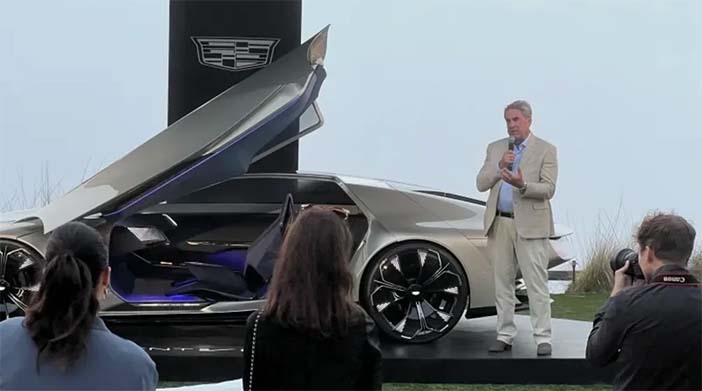
+++ Mark Reuss has a unique vantage point from his perch at GENERAL MOTORS (GM). Reuss, GM’s president since 2019 and a 34-year GM employee, has his hands in all GM brands, including Cadillac, Chevrolet and Buick. He’s in charge of everything from global research and development to manufacturing and electric vehicle initiatives, such as battery strategy and development. He’s also an avid motorsports and track driver who has seen GM push deeper on the racetrack with programs through Chevrolet and Cadillac. Reuss visited the Monterey Car Week, where Cadillac unveiled its latest creation: the Opulent Velocity concept car that not only showcases the next stage of Cadillac’s EV expansion but also marks the 20th anniversary of the brand’s foray into motor sports, which Reuss spearheaded. Here is an edited excerpt from the interview. Question: The Monterey Car Week is an important event for Cadillac, with plenty of high-end customers and clients milling about looking to see the company’s vision. Is the Opulent Velocity a vision of Cadillac’s future? Answer: You know, if you think back to the Celestiq (Cadillac’s $300,000 EV sedan), when we showed it for the first time, it was a concept car and people were like, ‘Wow, you should make that. That’s really a statement. It’s something that would really set Cadillac apart.’ And, of course, we were going to make it, and we tried it out. But if you think about that, we’re looking over the horizon at the future of Cadillac and what that design language was going to be. And if you look at our product portfolio, we’ve taken that language from the front to the rear to the really progressive design of Celestiq into all of our products. And it’s time to take a step back again and use this car to look over the horizon and look at technology, performance, and elegance and what Cadillac is going to become. So you’ll see some of these things, maybe quite a bit of them, come into the portfolio as we go forward. Cadillac’s electrification strategy has seen a pivot, where 2030 was supposed to be the target for full electrification”. Q: Now Cadillac is sort of saying, ‘We’re going to have options for people for all kinds of powertrains.’ Is that the strategy? A: “Absolutely. We’ve always said, we have a really good inherent advantage on our manufacturing capacity and footprint where we can actually do both, and we can let the market really tell us what they want and when they want it. And so that’s what we’re doing. And, you know, Lyriq is off to a great start; it’s sort of the No. 2 luxury EV in the world. And we’re doing close to 3.000 in sales a month, which is fantastic, and we’re doing that because it’s a fantastic car”.Q: You also noted that GM’s EV sales are growing, up 40% from a year ago in the second quarter. Let’s talk about the overall auto market in the U.S. and GM’s positioning. How is the market looking right now for that consumer, both at the higher end and down market? A: “Well, General Motors has been known for basically our whole company’s history of making different things for different people of all income levels, of all interests. It’s kind of America, right? And we do that for everybody. So it’s everything from the Chevrolet Trax to the Buick Envista, the Cadillac Celestiq to all those things, and we’re really proud of that. And so I don’t think that changes. The market outlook itself: we’re right around a 16 million annual run rate. Maybe 16.2 million, 16.3 million. We’ll see. But we’re nearing full capacity for that, and we’ll make those decisions, but we will not overproduce the vehicles. In fact, we’re running the lowest incentives of anybody in the industry, and that’s because of our product strength. So people really want what we have; we charge a fair price, and so we’re not out there incentivizing things”. Q: The new Corvette ZR1 has been on display here at Monterey in a few locations. I know you played a big part in making that program happen. What did you have to do to push your engineers, push your people, to take this car to level it needs to be to be called a ZR1? A: “I think it starts with doing a mid-engine car. We’ve got the best people in the world, and that’s a big advantage. So when we started off architecting the Stingray, we architected the car to carry the batteries for the E-Ray hybrid. We architected the car to carry the 67-millimeter twin turbos on ZR1’s]Gemini engine. On the front-engine car (prior generation C7), it had to be supercharged because we could not package those turbochargers. So those are things that we had to do on the ZR1. When you start opening the architecture and the aperture up, people get really creative and they get really excited, and we’re just blessed to have those people in our company”. +++
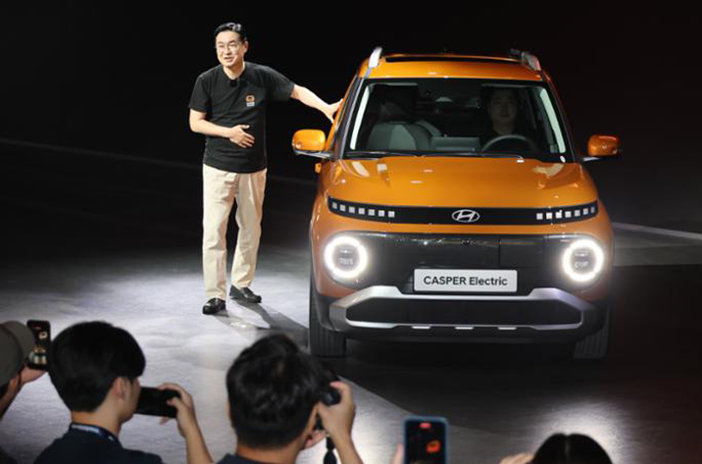
+++ The Casper Electric, HYUNDAI ’s newest all-electric sub-compact SUV, might look unassuming but it wins consumers’ hearts with a big surprise inside. Korean media got to check out the EV model of the Casper, known as the Inster in overseas markets, in a test drive in Seoul and Gyeonggi Province on Wednesday. The first impression of the EV was the distinguished adorableness featuring harmless-looking circular headlights with pixel-style eyebrows on the front side. The tininess and boxy exterior of the car added even more to its cuteness. Measuring 3.825 millimeters in length, 1.610 mm in width and 1.575 mm in height, with a wheelbase of 2.580 mm, the Casper Electric added 180 mm to its wheelbase compared to the existing internal combustion engine model. The extra length contributed 80 mm of legroom in the rear row. Though it is still a tighter fit than other subcompact SUVs, it felt more spacious than the petrol model. Featuring a maximum driving range of up to 315 kilometers per charge, the battery was 79 percent charged at the beginning of the test drive as the cluster indicated that the remaining driving range was 254 km. After driving the EV for about 60 km, the battery stood at 64 percent with the remaining driving range of 203 km. The Casper Electric is equipped with LG Energy Solution’s 49 kWh nickel, cobalt and manganese (or NCM) battery, which can be charged from 10 percent to 80 percent in 30 minutes using a 120 kW-class charger. The overall riding experience was satisfactory given that it is far from the most powerful EV in the market. Under the sports driving mode, the Casper Electric’s acceleration became quicker and stronger for those who enjoy a more vigorous ride. There were four different levels of regenerative braking force and the second level made a smooth drive. The test drive included a hands-on experience of the EV’s Pedal Misapplication Safety Assist, or PMSA; Hyundai’s new technology that can take over the control of the vehicle’s immediately stops the car when the driver floors the acceleration pedal suddenly from a standstill if there is an obstacle within one meter away from either the front or rear side of the car. With the reporter sitting in the passenger seat of the Casper Electric, a Hyundai instructor demonstrated how PMSA works. An inflated tube was placed within one meter in front of the vehicle, the driver pushed down the acceleration pedal. The vehicle, which began sudden acceleration, stopped moving instantly as the cluster on the dashboard popped up a warning message to lift the foot off the acceleration pedal and place it on the brake pedal, preventing a possible clash from sudden acceleration. The vehicle’s acceleration differed greatly from the launch control start of high-performance EVs. The price of the Casper Electric begins at 31.49 million won ($23,569 or €22.000). The EV will be launched in the global market, including Europe and Japan, next year. +++
+++ LAMBORGHINI boss Stephan Winkelmann will likely go down as one of the most influential leaders in the Italian luxury automaker’s history. From getting the Gallardo supercar launched back in the early 2000s, to shepherding the Urus into the marketplace 15 years or so later to a smashing sales success, much has happened over the years, across his 2 stints at Lamborghini. Now with the much-loved Huracán supercar heading out to pasture, Winkelmann’s latest release is the Temerario, the successor to the Huracán. Though the Temerario lacks the much-loved V-10 naturally aspirated motor that powered the Huracán, Winkelmann believes its evolution will still bring the passion for the Lamborghini faithful. The new Lambo’s V8 bi-turbo engine still revs to an astounding 10.000 rpm. That combined with 3 electric motors (2 on the front axle, 1 between the engine and the gearbox) provide 920 hp, taking the Temerario from from 0 to 100 kph in just 2.7 seconds, all the way up to a 343 kph top speed. “You have to be more performing than the generation before, and this including handling behaviour, so the weight to power ratio is paramount for the success for us, because this is one of the peculiarities of Lamborghini”, Winkelmann said. Winkelmann believes the ability for the hybrid powertrain to reduce emissions through its battery system, and improve performance with the electric motors is “the right direction for Lamborghini”. It’s the recipe the company is following with the success of the Revuelto hypercar, the big brother to the Temerario which has a V12 hybrid powertrain. The Revuelto is sold out for at least the next year of production, if not longer. While introducing a brand new, cutting edge supercar is a great success for the automaker, it comes as the luxury consumer has hit some speed bumps. Concerns about a slowdown in the US and abroad, global tensions, and high interest rates are taking their toll. The CEO acknowledges those concerns, but for his particular clientele, they are still buying. “Since the end of the covid, we have this ‘YOLO’ effect (You Only Live Once) which, despite the global crisis we have here, or the crisis we have here and there, in the markets, geopolitics changing, we’re still going strong, and the people still want to buy those cars, and we have a long waiting time”, he said when asked about his buyers. While his fingers are “crossed”, he said, the sales data shows the Italian company is one of the few successes in the luxury automotive world. One doesn’t have to follow in the footsteps of a storied rival like Ferrari, if it can build its own organic passion through bold design for its supercars like the Temerario, and cutting edge powertrains that now count hybrid power across all its vehicles. Winkelmann has shown since the release of the Gallardo some 20 years ago, that this is indeed possible. “This year is going in a perfect way, we had another record first 6 months in 2024”, Winklemann notes. “So if things are going ahead like this, the year 2024 will be a very good one for Lamborghini”. Can the YOLO effect last through the balance of the year, and beyond? Winkelmann and Lamborghini believe they have the right recipe in place. +++
+++ LUCID MOTORS has a lot riding on its next EV, the Gravity SUV, when it comes out later this year. CEO Peter Rawlinson spoke from the Pebble Beach Concept lawn, where select automakers show off new vehicles of note during Monterey Auto Week. Rawlinson is bullish on the Gravity and believes it can more than double the company’s sales, which hit 2.394 deliveries of its pricey Air sedan in the second quarter. “We believe that the total addressable market for Gravity is 6 times that of Lucid Air”, Rawlinson said. “We’re just in in the process of completing the build-out of our plant in Arizona to a capacity of 90.000 units per annum. We’re on track for manufacturing around 9.000 Airs this year, the Gravity is going to come in, and our finances are dominated by scale. It’s all scale, scale, scale. And this is a big step in that scale”, Rawlinson added. While financial flexibility (and the backing of Saudi Arabia’s Public Investment Fund) will give Lucid the runway it needs, Rawlinson believes Lucid’s technology will push it over the top to trump Tesla’s. “We are considerably ahead of where Tesla is. We’ve taken that mantle. When I was at Tesla, Tesla was the tech leader. They’ve become distracted, and we have taken that place”, he said, referring to what he believes is Lucid’s tech advantage in batteries, software, and powertrain. Rawlinson posted data showing how far ahead of Tesla Lucid’s tech is, in terms of efficiency. Rawlinson mentioned Lucid vehicles have the capability to eke out 8 km of distance in 1 kWh, which is remarkable when the industry average is around 5 to 6 km, which is where Tesla stands. Other manufacturers, like Aston Martin, for example, have inked technology licensing deals for Lucid tech, believing it to be best in class. Rawlinson’s dig at a “distracted” Tesla may have more to do with Elon Musk than the company itself. Musk’s various side projects, his posting of inflammatory material on X, making moves like laying off Tesla’s Supercharger team, and focusing his team’s efforts on robot taxis have been questioned by critics and Wall Street analysts alike. Nevertheless, while Rawlinson touts Lucid’s tech, his company is nowhere near profitable, and that’s one area Musk and Tesla can hang their hat on. Investors will be keenly watching whether Lucid and its CEO can turn their perceived tech advantage into positive cash flow when the Gravity comes out later this year. +++
+++ High-end automakers have offered extreme vehicle customization options through bespoke configuration programs for years. Rolls-Royce, Bentley, Porsche and others give buyers the opportunity to select custom colours and other features, though it’s always at a very steep price. MCLAREN Special Operations (MSO) does the same, and now, it’s the new 750S’ turn. The MSO Contrast Pack adds appearance upgrades and custom color options to the “standard” 750S. Buyers have 12 preconfigured themes to choose from, and the automaker can accommodate fully custom orders upon request. McLaren said the packs can be ordered at the time of purchase or through the dealer configuration process. Contrast Pack 1 offers a range of bespoke colors not available on McLaren’s standard vehicles, and buyers can extend the colour selection to the brake calipers and door mirror caps. The Contrast Pack 2 builds on the first package with a full Alcantara interior and other cabin accents. McLaren also offers a Stealth Badging package, which blacks out the exterior badges and wheel center caps. Carbon fiber front fenders are included, along with available carbon fiber louvers. All 750S models now get a Papaya orange stop/start button, a nod to McLaren’s long-running racing heritage. The company’s chief sales and marketing officer, George Biggs, said, “In its first year on sale, the 750S has been a huge success. The car’s stellar reception with both the media who have driven it and with customers has exceeded all expectations and the Model Year enhancements for 750S with new options from McLaren Special Operations ensure it remains a benchmark defining supercar with exclusivity and remarkable craftsmanship”. The McLaren 750S is available for order now at one of the company’s more than 100 dealer locations in 40 markets globally. Buyers can also virtually configure the car with MSO by contacting the dealer to set an appointment. +++
+++ Turning heads as they cruise past office buildings and malls, driverless taxis are slowly spreading through Chinese cities, prompting both wariness and wonder. China’s tech companies and automakers have poured billions of dollars into self-driving technology in recent years in an effort to catch industry leaders in the United States. Now the central city of Wuhan boasts one of the world’s largest networks of self-driving cars, home to a fleet of over 500 taxis that can be hailed on an app just like regular rides. At one intersection in an industrial area of Wuhan, reporters saw at least 5 ROBOTAXIS passing each other as they navigated regular traffic. “It looks kind of magical, like a sci-fi movie,” a local surnamed Yang told. But not everyone shares Yang’s awe. Debate around safety was sparked in April when a Huawei-backed Aito car was involved in a fatal accident, with the company saying its automatic braking system failed. A minor collision between a jaywalker and a Wuhan robotaxi last month re-ignited concerns. Taxi drivers and workers in traditional ride-hailing companies have also raised fears of being replaced by artificial intelligence, although the technology is far from fully developed. Wuhan’s driverless cabs are part of tech giant Baidu’s Apollo Go project, which first received licenses to operate in the city in 2022. Initially only five robocars ferried passengers around 13 square kilometers of the city of around 14 million. Baidu says the taxis now operate in a 3.000 square kilometer patch, more than a third of the total land area of Wuhan, including a small part of the city centre. In comparison, U.S. leader Waymo says the largest area it covers is 816 square kilometers, in Arizona. When a car reaches its pickup point, riders scan a QR code with their phones to unlock the vehicle, with the front seats blocked off over safety concerns. The fares are currently heavily discounted, with a 30 minute ride taken costing just 39 yuan ($5.43) compared with 64 yuan in a normal taxi. “They are stealing our rice bowls, so of course we don’t like them”, Wuhan taxi driver Deng Haibing told, using a popular Chinese term for livelihoods. Deng said he fears robotaxi companies will push traditional drivers out of business with subsidised fares, before raising prices once they achieve domination, similar to the strategy employed by ride-hailing apps in the 2010s. “Currently the impact isn’t too big because robotaxis aren’t fully popularised and can’t drive everywhere yet”, Deng said. The robotaxi fleet is a tiny fraction of the tens of thousands of taxis and ride-hailing cars in Wuhan. More and more Chinese cities are rolling out policies to promote self-driving services though, part of a national push for tech supremacy. Baidu and domestic rival Pony.ai have for years tested models of varying autonomy levels in industrial parks around the country. Shanghai issued its first batch of provisional permits for fully driverless cars last month, and the capital Beijing has approved fully autonomous robotaxis in suburban areas. The southwest city of Chongqing and southern tech hub of Shenzhen also have pilot projects underway. Technology wise, there’s still a long way to go before self-driving taxis become ubiquitous though, according to Tom Nunlist, tech policy analyst at Trivium China. “Everybody seems to think autonomous driving is inevitable at this point, and frankly, I don’t know that it is”, he told. “Presently fully autonomous driving tech is simply not ready for large-scale deployment”. Even in Wuhan’s Apollo Go taxis (which can spot obstacles and wait scrupulously at intersections) ultimate responsibility for safety still lies with human officers monitoring rides remotely. During one ride in an Apollo Go car, one manipulated the car’s built-in touchscreen to remind reporters to put on their seatbelts. “Safety personnel provide strong assurances for your ride via remote 5G assistance technology”, the Apollo Go app tells users. Robotaxis are also far from able to replicate the human touch. “Some customers have disabilities and driverless cars definitely wouldn’t be able to help them, and some passengers are carrying large items”, ride-hailing driver Zhao told. “Only a human can help”. +++
+++ For about the last week, there have been a lot of rumours about General Motors in China. These suggest that GM will retrench its operations in the Middle Kingdom and will sell the Buick brand to SAIC . However, the GM joint venture is not SAIC’s only problem, as evidenced by the 37.16% year-on-year drop in sales in July; a drop shared by almost every major business unit and not just the joint ventures. Furthermore the drop is not just symptomatic of the switch from ICE to new energy vehicles with NEV sales also declining. Sales at the GM joint venture saw the greatest drop with a fall of 82.42% and the sales for the year so far are down 55.14%. This stands in stark contrast to the performance of SAIC’s other main joint venture with Volkswagen. Although July was a black spot with a decline of 18.18% the overall decline for the year is negligible at just 1.53%. The Volkswagen joint venture fared much better than most of SAIC’s own brands. SAIC Motor’s passenger vehicle division, which is made up of the MG, Roewe and Rising brands so far this year has sales down by 20.19% and in July saw a 29.95% decrease. Both the Maxus and IM brands are reported separately. Maxus fared nearly as badly, with a 23.34% year-on-year decline for July, but the reduction is a more modest 11.30% for the year so far. The IM brand is one of the few bright spots for SAIC. July sales were up by 142.74%, but at just 4.180, they hardly make much difference to the overall figure for SAIC. It should be noted that July’s performance for IM is very much in line with the brand’s performance so far this year, which has seen an increase of 131.34%. Going forward, SAIC will be increasingly reliant on the GM Wuling joint venture. Sales for the year so far are 646.009 cars; an increase year on year of 2.31, and now account for the largest single share, with the only other unit coming close being Volkswagen. Even though the performance for the year so far is up, July sales for the unit were down and by one of the larger percentages at 31.72%. The problem does not just lie with domestic sales; both the Indonesian branch of the Wuling JV and the Indian branch of MG experienced drops not only in July but also for the year as a whole. The total figures for both these branches are not particularly significant but what is more worrying is that the overall figure for exports and overseas business have seen a significant decline at 15.77% year-on-year for July and 9.65% for the year so far. This indicates that the problem is far more deep-rooted than a reduction due to the implementation of EU tariffs on EV imports in July. What shows SAIC’s problems more than anything else is the figures for new energy vehicles. Last month, retail sales of new energy vehicles broke the 50 percent barrier for the first time with a figure of around 51%. What we see with SAIC is a decline of 21.85% during July for new energy vehicles, although sales for the year are up by 14.91%. A crude penetration figure purely based on total sales and not excluding exports is 28.2%, clearly well below the general level of the Chinese market; the percentage for the year to date is even worse at 25.6%. There currently appears to be a rot setting in at SAIC. The 2023 annual report showed operating income had increased by 0.72%, but net profit was down by 12.48%, and sales were down on 2022 levels. Sales are obviously further down this year, and first quarter figures for operating income were down 1.95%, and there was a 2.48% year-on-year decline in net profit. SAIC in 2023 implemented a 3-year action plan for the development of new energy vehicles. Under the plans, the sales target for 2025 is 3.5 million new energy vehicles, but in the first seven months of this year, the sales only amounted to 532.133. If it is to achieve anywhere near such a target for next year, SAIC needs to sell far more. The company is also aiming to stem the decline in ICE sales. +++
+++ STELLANTIS boss Carlos Tavares will visit Detroit this week, where he will seek to develop a strategy to fix the European automaker’s struggling North American operations and reassure employees and investors, a person familiar with the plans said. The strategy is likely to be developed by the end of this week, said the source, who asked not to be identified. While Tavares typically visits the North American operations every 4 to 6 weeks according to the source and a second person, one of them added that the CEO’s visit this week during his summer break was meant to send a clear signal. “He wanted to make clear he was handling it personally”, the source said. “North American operations are basically funding the rest of the group”. Tavares, who described Stellantis’ first-half results as “humbling”, has said the French-Italian automaker’s North American business suffered from a mix of high vehicle inventories, manufacturing issues and a lack of “sophistication” in how it addressed the local market. Stellantis shares have tumbled almost 50% from March highs as a result. During the visit this week to the U.S. offices in Auburn Hills, Michigan, Tavares will initially meet with top-line managers before formulating a strategy by week’s end to fix things, the source said. Stellantis’ first-half operating income fell 40%, mainly due to poor business performance in North America, its profit powerhouse. Vehicle sales in the region for Stellantis’ top brands, Ram and Jeep, have both declined at least 33% from the first half of 2019 to the same period this year, according to research firm Cox Automotive. Tavares blamed himself for not being quick enough to act while problems at the group’s North American operations were piling up and, when presenting first-half results, said he would spend part of his summer holidays there to fix them. “We were arrogant”, he said earlier this year at Stellantis’ investor day in Michigan. “I’m talking about myself, nobody else”. Those results came just after Tavares enjoyed a compensation package on Stellantis’ 2023 results of up to 36.5 million euros ($40.6 million), a 56% increase from a year earlier. Stellantis’ main mistake in North America was to keep increasing prices in a bid to boost margins even as the market was signalling customers were not ready to pay, making some models too expensive, Jefferies analyst Philippe Houchois said. “They have lacked pragmatism to address straight away the inventories building, they should have made more tactical prices to avoid that”, Houchois said. Massimo Baggiani, founder at Niche Asset Management in London, said Tavares remains “the best executive in the industry”. “It’s key now for him to keep financial discipline. He needs to show that he can increase car sales without compressing margins, losing money and burning cash”, Baggiani said of Tavares. Stellantis already has moved to cut costs by reducing its U.S. workforce. It said this month it would lay off up to 2.450 factory workers from its Warren Truck assembly plant outside of Detroit as the automaker ends production of the Ram 1500 Classic truck. In late July, the company said it would also offer a round of voluntary buyouts to U.S. salaried employees. Tavares also has said there are particular inefficiencies at 2 U.S. plants, but has declined to specify which ones. In July, he told reporters the run rate at its Sterling Heights Assembly Plant in Michigan was poor. Tavares’ visit comes amid increasing uneasiness among some investors and union workers over the North American struggles. United Auto Workers president Shawn Fain has threatened that the U.S. union representing U.S. plant workers may strike if the automaker fails to keep the investment commitments outlined in last autumn’s labor deal. Relationships between the union and automaker have been tense as Stellantis has laid off hourly workers at plants this year. Meanwhile, a group of shareholders last week sued Stellantis, saying it defrauded them by concealing rising inventories and other weaknesses before posting disappointing earnings that caused its stock price to fall. The company has said the lawsuit was “without merit” and told the UAW it had not violated terms of their bargaining agreement and the union could not legally strike. +++
+++ Chinese tech giant XIAOMI , known for making smartphones, turned heads in March when its maiden electric vehicle sold out with almost 90.000 preorders within a day of launch. Its new auto branch posted an adjusted loss of $252 million for the second quarter ending June 30; its first-ever full delivery quarter, the company said in its unaudited results filed on Wednesday. That’s despite Xiaomi saying it’s on track to smash its target of 100.000 deliveries of its first car, the Speed Ultra 7, by November. The new electric vehicle maker said it delivered 27.307 SU7s in the second quarter, meaning that, on average, it lost $9.200 for each car. The base price of the SU7 is 215,900 yuan, or about €43.000. That’s not to say that Xiaomi loses more money when it delivers more cars: The firm reported a higher-than-anticipated gross profit margin of 15.4%. Yet it’s signaled for a while that its auto segment would take time to break even, with CEO Lei Jun mentioning in April that the car was selling at at a loss, though he didn’t say by how much. Citibank analysts wrote in a report at the time that they expected Xiaomi to turn a profit only after hitting annual sales of 300.000 to 400.000 vehicles. They forecast sales of 260.000 cars in 2026. Xiaomi operates 1 factory, which it built itself. Since June, it’s been running double-shift operations to push monthly deliveries past 10.000 cars. A company spokesperson told that the firm is focusing on increasing the scale of its EV arm to narrow per-car costs. “The scale of Xiaomi EV business is relatively small at the moment, while the auto industry is a typical industry with economies of scale”, the spokesperson said. For comparison, competing Chinese EV maker BYD sold 426.039 cars in the April-June quarter. Xiaomi’s spokesperson added: “In addition, our first EV is a pure electric sedan, and its investment cost is relatively high, so it will take some time to digest this part of the cost”. Lei Jun, the billionaire cofounder of Xiaomi, said in March that he intended to pour “tens of billions of investment” over the next few years into building Xiaomi’s EV division and car technologies. The tech firm has long said its vision for the SU7 is to create a smart car that rivals Elon Musk’s Tesla but is priced more in line with the average Chinese income. Xiaomi said customers are still coming in, with 13.000 more vehicles sold in the second quarter and July combined. Its ambitions for its EV range far, including self-driving and self-parking capabilities and an audio-based artificial intelligence assistant to be fully shipped this month. Overall, Xiaomi posted strong results for its second quarter, with sales across all its sectors rising 32% to 88.7 billion yuan compared to the same period in 2023. Net income also hit 5 billion yuan, up 38% from 3.6 billion yuan in the second quarter last year. The company said it plans to build a variety of EV models beyond the SU7 sedan but has not said what they will be. +++
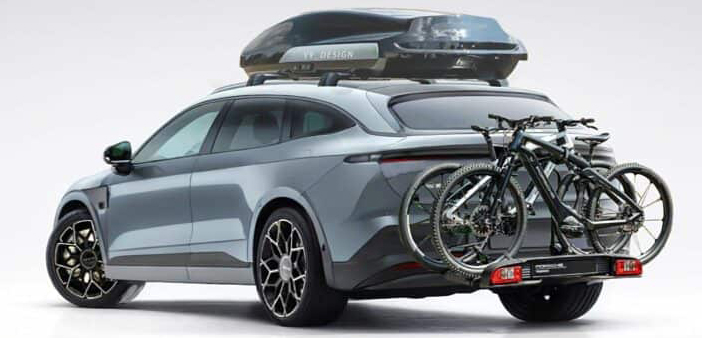
+++ Earlier this year, I reported that the ZEEKR 007 station wagon was in pre-production. CEO An Conghui has confirmed the existence of such a car and said that it will be released in 2025. Codenamed CC1E, little is known about the Nio ET5 Touring competitor. At the same time, An mentioned that Zeekr’s new flagship large SUV will be released in the third quarter of 2025. The car is currently known by the EX1E code name. Traditionally, station wagons have not been popular in the Chinese market. However, in recent years, especially with the adoption of EVs, they have begun creeping in, partly to make Chinese cars more appealing when exported to Europe. We can get some idea of what to expect from the forthcoming wagon version of the 007 by looking at the sedan version and also how competitors have transitioned the design of a sedan over to a wagon. In the case of Nio, we can see that the ET5 Touring has exactly the same dimensions as the sedan with 4.790, 1.960, 1.499 mm (l/w/h) and a wheelbase of 2.888 mm. Therefore, we can expect the dimensions of the Zeekr 007 Wagon to match those of the sedan (see specs) quite closely so, being 4.880, 1.900 and 1.448 mm (l/w/h) and a wheelbase of 2.928 mm. Various fan renderings have been posted on the internet claiming that the car will adopt a wagon style similar to that of the Nio ET5 Touring. But at the moment, this is pure speculation for the 007, with so far no published spy shots to confirm the shape. It is possible that the wagon version will be part of a 2026 model year Zeekr 007 launch. However, at the moment, our best idea of what to expect with regard to performance and configuration comes from the recently launched 2025 model-year sedan. This means a choice between a 75 kWh Golden Brick battery, or a 100 kWh Qilin battery from CATL The former is a self-developed battery, which in its second generation form supports 5.5C charging. This Zeekr claims means that the 007 is the world’s fastest charging production EV with a 10 to 80% SOC in 10.5 minutes. The 007 sedan is available in single- and dual-motor versions. All versions use a 310 kW electric motor on the rear axle, and dual-motor versions add a 165 kW electric motor to the front. Depending on the configuration and battery pack fitted, ranges vary between 616 and 870 km. As part of the 2025 model year upgrade, the Zeekr 007 received the Haohan intelligent driving 2.0 system, which boosts the car’s self-driving ability. The car has over 30 sensors, including Lidar, and the system works on a Lidar plus visual fusion basis. By the time the wagon launches in 2025, the system will have a door-to-door capability. Two Nvidia Orin X Chips provide 508 TOPS computing power, enabling the smart driving system. Inside the cockpit, the Zeekr 007 features a 15-inch OLED center screen, a 35.5-inch HUD system and an LCD instrument panel. Other features include a 21-speaker premium audio system, an AI fragrance system, and a panoramic roof. The Zeekr 007 was the brand’s breakout car in terms of sales. Although little is known about the wagon version currently, it is sure to further increase the model’s appeal, especially when exported. +++