
+++ ASTON MARTIN issues a profit warning off the back of supplier delays and weak demand in China. The 2024’s production guidance has been trimmed by 1.000 units. This comes as supply chain disruptions have seen a growing number of late-arriving parts. Demand in China has also been weak as it continues to wrestle with its own economic challenges. As a result, expectations for underlying cash profit margins have been downgraded. This means full-year underlying cash profits are set to be below last year’s level. Despite material improvements compared to the first half of the year, the group no longer expects to turn free cash flow positive in the second half. All targets for 2025 remain unchanged, however. +++
+++ Just ahead of his elevation to the position of Chief Exective Officer at BMW in 2019, then production head Oliver Zipse spoke at an event at the Mini plant in Oxford about the need for caution when it came to EVs. “Flexibility is key”, he told journalists. “If we predict the success of the 3-series, we can be pretty much spot-on. To predict electromobility is much more difficult”. 5 years later, BMW is reaping the rewards of its more circumspect strategy. In July, the company actually sold more electric cars in Europe than the global EV leader Tesla, according to market research firm Jato Dynamics. But BMW’s EVs are even today still just adapted versions of combustion-engined models, built on the same production lines. +++
+++ Some years ago, Akio Toyoda said Toyota would stop selling the “boring” cars it had become synonymous with and thanks to the launch of several compelling new vehicles, it’s done just that. FORD chief executive Jim Farley wants to do the same. Farley recently visited Europe to launch the all-electric Explorer and believes the brand can replicate the success of its ‘Raptor’ models with future passenger cars, allowing it to ditch some of its more mundane models. “We’re getting out of the boring-car business and into the iconic-vehicle business”, Farley told in a recent interview. “We’d always competed at the heart of the passenger-car market, which didn’t work out too well for Mondeo, Focus and Fiesta. They were loved by a lot of customers but they could never justify more capital allocation, unlike commercial vehicles”. The car manufacturer is moving away from offering vehicles that cater to all consumers and is moving slightly upmarket with more “carefully targeted vehicles”. “We’re naturally good at fast Fords and Broncos and authentic off-roaders”, Farley added. “Ford’s brand perception was the same around the world: we were a ubiquitous company. But we had these little areas of brightness: we have heritage centers around the world filled with these [great]vehicles, but they were never mainstream. Take Raptor: it came from desert racing in Mexico and we made it global and mainstream. The Raptor story is a great example of where I think our passenger cars should go”. With Farley at the helm, Ford has re-focused on enthusiast products, like the Mustang, Raptor and Bronco. The carmaker is also spending millions on motorsport, will become a Formula 1 engine supplier and recently returned to Le Mans with the Mustang. “Ford never funded enthusiast products: they were always a side business. Now with Mustang, Raptor and Bronco, they’re our business”, he noted. Farley has also been tasked with working out the best path to electrification for the brand. He acknowledges that Tesla and the Chinese automakers are its main competitors in the EV business and needs to decide if future vehicle platforms are pure-electric or offer support for different propulsion systems. Working out the best strategy for global markets won’t be easy. Even in the US, customer demands vary significantly between states. For example, Farley said 85% of F-150 sales in California are for the hybrid or electric variants, while in Texas, 85% of F-150 sales are combustion models. +++
+++ News that INEOS Automotive has been forced to stop production of the Grenadier off-roader because of a component shortage (understood to be seats from Recaro following its insolvency) underscores the fragility of the automotive supply chain, particularly for smaller car makers. “Automotive supply chains are always complex and challenging, but this hits at such a busy time for us”, Ineos told in a statement. “We are leaving no stone unturned in our efforts to get our manufacturing back up and running, to catch up with demand as swiftly as we can”. +++
+++ JAGUAR LAND ROVER ( JLR ) has announced a further €300 million investment in its plant in Halewood, Merseyside, to ready it for the production of new Range Rover models. The plant is being transformed to enable the production of new SUVs on the upcoming EMA platform, which supports pure-combustion, hybrid and battery-electric powertrains. +++
+++ MCLAREN has confirmed that the follow-up to the P1 and F1 will be called the W1. The company said the name “celebrates its world championship mindset”, with the new car due to be revealed on 6 October; 50 years since McLaren won its first constructors’ title in Formula 1. The W1 comes just over a decade after the P1 arrived as the successor to the 385 kph F1. It is anticipated to take advantage of the developments made with electrification since the P1 was launched 12 years ago. McLaren has said on numerous occasions that there would need to be a generational change in technologies to justify a new ‘1’ car. With a pure-electric McLaren supercar understood to still be some years off, this next ‘1’ hypercar is set to stick with a high-output hybrid powertrain that will no doubt comfortably outpace the 903bhp P1. McLaren chief Michael Leiters last year told that the company was “not sure” on electric supercars yet because of their weight at present. “We don’t want to make a car that is 2.000 kg and 2.000 hp. Anybody can do that”, said Leiters. “We want to make a car that is comparable to the McLaren 750S weight-wise”. Such a car will be possible “maybe at the end of the decade”, he added. +++
+++ Oh dear. As Volkswagen Group’s former CEO Martin Winterkorn goes on trial for alleged Dieselgate-related “fraud”, those in the boardroom at Wolfsburg HQ are discussing the possible closure of some German factories for the first time ever. Yikes. Too many brands overlap and therefore directly and expensively fight each other in the showrooms. They desperately need clearer identities and price differentials to attract a wider clientele. To these eyes, SEAT has to be the bargain brand, offering low-spec, Dacia-bashing city cars, including reborn versions of the Marbella supermini and van. Think of SEAT as the entry point, whose cars have insurance ratings of 1-10. It matters not that they’ll be as basic (but safer than) an original Beetle. Cupra has a simpler job: to offer affordable and fun performance cars that’ll be the Alfa Romeos of Spain. Skodas are good, perhaps too good, these days. And certainly too talented to be blessed with low price tags. But they must offer unrivalled value for money to fight off Chinese makers such as BYD. VWs need to remain classless, durable, long-lasting, reasonably priced for the masses and more ‘business class’ than the above brands. As with Porsches they can be great long-term investments, and should be marketed as such. Models sold via VW Commercial Vehicles are too brilliant not to share. So Seat and Skoda versions are a must. Audi is a proper premium brand that, at the top end, is borderline luxury. So just keep it that way. The world’s ultimate thoroughbred sports car marque is Porsche. It ain’t broke, so there’s no need to fix it, but couldn’t the ‘System Porsche’ badge be used on Cupras, as Seat did in the eighties? Also, Caymans and Boxsters with sub-€110.000 starting prices have to continue for those wanting to get a foot on the Porsche ladder. Car companies can’t just ‘reimagine’ themselves as luxury brands. But at Bentley luxury is standard with every model, while heritage, provenance and quintessential British class are thrown in for good measure. A Bugatti is the definition of a hypercar. Fair enough. But sales are minuscule. And are these desperately low-volume cars to be used? Or are they investments to be locked away like gold bars? Everyone acknowledges that Lamborghini builds some of the world’s most in-demand supercars. Not so well known is that it sold its tractor-making business. Shame. VW Group needs diversification. That’s why Ducati should build bicycles, trikes and quads; some designed to be slotted into VW Group vehicles. Talking of diversity, Volkswagen has adopted the Scout brand, whose US-built SUV is unveiled next month. If the sketches are anything to go by, it’ll be spot on. Of this lot, It’s the vehicle I’d most like parked on my driveway. Alongside that Lambo tractor. +++
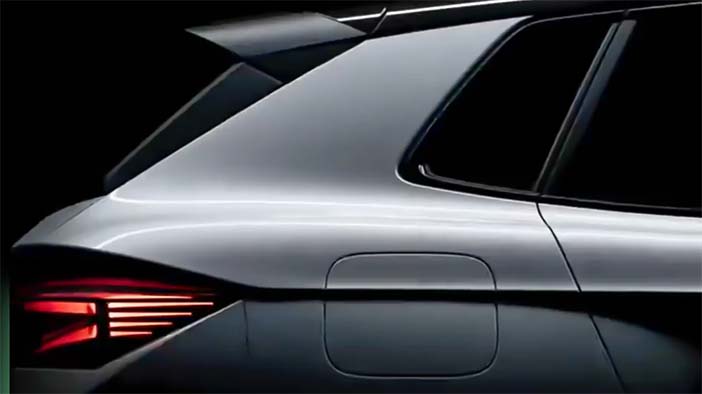
+++ The new SKODA ELROQ will finally be revealed on 1 October, after more than a year of having details and teaser images drip-fed to us about the all-electric compact SUV. But to continue building anticipation until the last possible moment, Skoda has shared another short video that provides a couple of glimpses of the long-awaited follow-up to the Enyaq. This time in First Edition specification, as we can see the unique badging and a set of aero-optimised wheels with similar red accents. The Elroq is the first car to be designed using Skoda‘s new ‘Modern Solid’ design philosophy, and the other teasers and drawings released by the company have already given us a clear idea of the electric SUV’s striking yet robust styling. The face of the Elroq includes a split headlight design, with a slimmer upper section wrapping around to the front wings, and the new blanked-off ‘Tech-Deck Face’, which is a flatter and wider interpretation of the traditional Skoda grille. Also at the front, the Elroq features a sharply contoured bonnet with dark chrome Skoda lettering, meanwhile the rear has a small roof spoiler, further dark Skoda lettering across the bootlid and very slim LED tail-lights According to Skoda, the Elroq will come with some large wheel designs with 2D Skoda logos in the centre caps, and will be offered in an exclusive Timiano Green paint colour. Skoda says that the Elroq’s interior “emphasises simplicity, spaciousness, and clean lines”, and has shared some sketches of what it looks like as well. The switches and overall layout of the Elroq’s centre console are similar to the Enyaq’s, as is the dash, which appears to have borrowed the 13-inch central touchscreen and slim digital driver’s display from its larger sibling. The seats look identical to the ones in the Enyaq, too. As expected, the Elroq will be available with a variety of different interior ‘Design Selections’ Studio, Loft, Lodge and Suite. Skoda has prioritised the use of recycled material in the Elroq, and each interior theme uses different sustainable materials. For instance, the Loft Design Selection uses something called ‘Recytitan’, which is a material comprising 78 per cent recycled PET (polyethylene terephthalate) and, for the first time in any Skoda, recycled clothing. Importantly for a family car, Skoda is promising the 4.5-metre-long Elroq (the same length as the BMW iX1) will offer a generous amount of interior space and “exceptional practicality”. The Elroq has a 470-litre boot, plus 48 litres of additional storage in the cabin, and the luggage capacity can expand to 1.580 litres when the rear seats are folded down. There are plenty of Skoda’s signature ‘Simply Clever’ touches onboard as well, including some brand new ones such as a storage net for the charging cables and a QR code in the boot that links to some handy instructional videos. The Skoda Elroq sits on the Volkswagen Group’s EV-dedicated MEB platform, also used by the Enyaq and its coupé counterpart. I’m told there will be 4 versions available, starting with the Elroq 50 that uses a 55 kWh battery and a 170 hp rear-mounted electric motor. Next up, the Elroq 60 gets a larger 63 kWh battery and 204 hp e-motor. The range-topping Elroq 85 gets an 82kWh battery for a claimed range of more than 560 km and a single 286 hp e-motor. The Elroq 85x adds a dual-motor set-up offering four-wheel drive and a combined output of 299 hp. I also know that there will be a high-performance Elroq vRS model further down the road. The Elroq is the one of six new electric cars that Skoda plans to launch over the next few years, including its own seven-seater flagship, a road-going version of the Skoda Epiq concept and an affordable entry-level EV. +++
+++ VOLKSWAGEN is set to move away from cheap interior plastics in favour of higher-quality fabrics, claiming that this shift will actually save the company money. If it means we’ll finally be rid of those scratchy black plastics, count me in for this upgrade. VW’s head of design, Andy Mindt, and head of design strategy, Christian Schreiber, made clear that VW cabins will prioritize functionality over flamboyance, saying they need to “play with all the touchpoints you have in life. When you open the door of a Volkswagen it needs to be simple and usable, and not overly decorated”, Schreiber told. “This should be the same once you use the car; it’s meant to work with you and not make things more complicated. There will be Easter eggs from cars of the past. For example, we’ll have certain patterns, specifically for GTI models, and we are very protective about things like this so we won’t use them on other models”. Mindt chimed in with more on the brand’s commitment to quality, noting a focus on high-end materials and simplified parts. “We’re going to try and kick out cheap plastic materials and put the money instead into fabrics and improving quality, which helps save money and means we can use it elsewhere”, he explained. “An example could be a door card that’s made of 3 pieces. We’ll try instead to design it using one island in the middle. There will still be a door handle and arm rest as before, but it’ll all be built from one piece. It also makes the whole process more sustainable”. While speaking about the brand’s design philosophy more broadly, the 2 designers expressed a desire to differentiate themselves from the aggressive styling of some competitors. Instead, they want to be seen as “nice guys”. “I believe most people don’t want to be the coolest or appear aggressive in public”, Mindt said. “They want to have a suit and a good outside appearance while being happy and optimistic. What is the need to be aggressive? Our core is like this: be the nice guys”. +++