
+++ The AUTO-INDUSTRY is loaded with joint ventures, alliances and cooperation agreements, but there are certain rivalries that rarely yield anything more than competitive venom. General Motors and Ford come to mind. Toyota and Hyundai also would have fit that description until recently. A Hyundai-Toyota racing event in South-Korea this week give us dramatic evidence that these 2 arch rivals are getting friendly. To see Euisun Chung and Akio Toyoda hugging each other on stage sends a vivid symbolic message to the rest of the world’s auto industry, particularly China. Hyundai and Toyota compete around the world, especially in North America, where they both routinely challenge the Detroit 3 in multiple segments. Despite the historical conflicts between Korea and Japan, Greimel’s story points out common ground between Hyundai and Toyota. Notably, both Chung and Toyoda are third-generation leaders of their family-dominated corporations. But perhaps most importantly, both companies face a very real competitive threat from Chinese automakers. The prospect of seeing Hyundai and Toyota cooperate beyond a friendly racing event is fascinating. +++

+++ BYD notched another win over Tesla on Wednesday, reporting quarterly revenue that beat Elon Musk’s carmaker for the first time since the pair have gone head-to-head in global electric vehicles sales. Revenue for China’s best-selling automaker soared 24% to 201.1 billion yuan ($28.2 billion) for the three months that ended in September, falling short of estimates but exceeding Tesla’s $25.2 billion in sales for the same period. Tesla has been dealing with a limited and increasingly stale EV-only line-up, focused more on ramping up production of its Cybertruck and expanding the use of its partial-automation system. BYD meanwhile has been racing ahead with new models. +++
+++ The JAGUAR F-PACE is new no longer available, meaning the brand no longer sells any new cars in the market and won’t until its first next-generation model arrives in 2026. This follows the axing of the XE, XF and F-Type, made at Castle Bromwich, and the E-Pace and I-Pace, assembled by Magna Steyr in Austria, in the summer. The decision comes ahead of Jaguar’s major brand reinvention later this year, which is expected to preview a 600 hp electric 4-seat GT in the vein of the Porsche Taycan. That will later be joined by a Bentley Bentayga-style luxury SUV in 2026 and then a large luxury saloon. All 3 cars will sit on a new, bespoke platform called JEA. Ahead of these 3 cars hitting the road, Jaguar will take a “reset period”, managing director Rawdon Glover previously told. A statement from Jaguar parent company JLR reads: “From November 2024, new Jaguar sales will come to an end ahead of our new brand reveal later this year and product launch in 2026. We have now ceased allocation of our current generation of Jaguar vehicles. We do have a selection of models available to acquire on an Approved Pre-Owned basis through our retail network”. Last year, Jaguar sold 21.943 examples of the F-Pace globally, outselling the rest of the 6-car line-up combined and achieving more than double the sales of the second-placed I-Pace (7.000). Speaking previously about axing Jaguar’s current line up, JLR boss Adrian Mardell said: “None of those are vehicles on which we made any money, so we are replacing them with new vehicles on newly designed architectures”. The decision was made easier by the fact that JLR sales are dominated by the Range Rover, Range Rover Sport and Land Rover Defender, the trio making up more than half of the total. +++
+++ MCLAREN is set to be sold to Abu Dhabi-based CYVN Holdings, with the promise of fresh cash injection for the British sports car maker. Bahrain’s sovereign wealth fund, Mumtalakat, which in April took full ownership of the McLaren Group (parent of the car firm and McLaren Racing), announced earlier today it has signed a non-binding agreement with the ‘specialist investment vehicle’. This, the 2 firms said in a joint statement, was to “explore a potential partnership”. The deal would also include a non-controlling stake in the McLaren Group. The statement added: “This transformative investment by CYVN Holdings would bring access to additional capital, advanced engineering expertise and pioneering technology, particularly in the field of electric vehicles”. +++
+++ The third-generation NISSAN LEAF has been spotted testing for the first time ahead of production getting under way in Sunderland next year. Morphing from hatchback to crossover, the next Leaf is 1 of 3 electric SUVs (alongside replacements for the Juke and Qashqai) due to start running down the lines at Nissan’s UK factory by the end of the decade. Production of the previous Leaf ended in March this year, and while Nissan has yet to confirm a launch date for its successor, it’s understood to have begun production trials in the summer and could be in production as early as spring 2025. The Japanese firm has previously given an indication of what to expect from the next Leaf with the Chill-Out concept; a sleek, minimalist compact SUV touting high levels of digital functionality and advanced autonomous driving capabilities. The production car looks to remain true to the concept’s overall silhouette, clearly aero-optimised in a bid to maximise range, but it seems to have more conventional led light signatures at each end, rather than digital graphics. Proportionally, it’s a clear relation to the Polestar 2. The new Leaf will share the modular EV-specific platform (previously known as CMF-EV and now dubbed Ampr Medium) with the Ariya. Notably, Nissan’s alliance partner Renault uses that architecture for the similarly sized Mégane E-Tech, which could give clues as to what to expect of the batteries and powertrain options. The Renault can be had with either a 40 kWh or 60 kWh battery, for official ranges of 308 or 451 km respectively, and a choice of either a 130 hp or 218 hp motor on the front axle. It’s expected to have a dashboard topped by a wraparound digital interface and a row of haptic buttons in the dashboard for the climate control. It could also get a sliding centre console, which makes it easier to move from the passenger’s side to the driver’s seat. +++
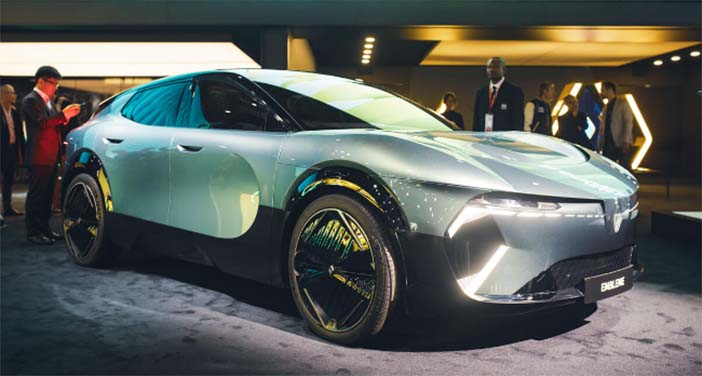
+++ RENAULT will introduce a new generation of electric cars from 2028, promising such drastic improvements in efficiency, charging, sustainability and functionality that they will effectively “catch up 2 generations in 1”. One year on from its foundation, the Renault Group’s Ampere EV division is well advanced with development on the cars that will take Renault into the next decade, outlining plans to slash battery costs by 50% in the next 3 years, boost efficiency and cut charging times to as little as 15 minutes. The technological developments will be accompanied by a whole new approach to exterior and interior design. The new Emblème concept, revealed at the Paris motor show last month, gives strong clues as to what to expect from these upcoming EVs, with sleek, aerodynamically optimised bodywork, a futuristic minimalist interior and a radical powertrain that uniquely combines a hydrogen fuel cell with a battery-electric powertrain. Renault CEO Luca de Meo went as far as to strongly hint that a subtly evolved evolution of the Emblème will be among the first of these cars to arrive, saying: “Maybe you think it is just a concept or a vision, but if you know me a little, you know that whenever I put something on a stage, I tend to do it in the end”. Notably, Renault’s last 3 high-profile concepts (the 4 E-Tech, the 5 E-Tech and the Scenic E-Tech) have all made production relatively unaltered. Notably, De Meo suggested that the production version of the Emblème will ride on a “next-generation, revolutionary segment platform”, suggesting it will be technically unrelated to the Ampr platform-based EVs on sale today. “Continuing to invest heavily in Renault’s upcoming EVs is important”, he said (even amid slowing growth in European EV uptake) because “EVs are the future, no matter the short-term bumps and hurdles. People are expressing concerns about the EV market plateauing and don’t count on me to say that everything is fine: there are obviously huge challenges, and I think Europe must fix them urgently. But I also think it’s important that we put the focus back on the big future. And I would say from a long-term perspective, in fact, EV is the future, or at least it’s a very big part of the future”. The EV market, he said, “is where growth is going to happen for the automotive industry in Europe”, while “the rest of the market will be flat or potentially declining”; justifying the decision to spin off Ampere from Renault 1 year ago. Already, De Meo said, there is “scientifically no doubt” that an EV has a lower carbon footprint than a petrolengine alternative from cradle to grave and Ampere’s development efforts mean Renault’s EVs will have a 70% smaller carbon footprint than their ICE counterparts by 2030. Also, he said that EVs are already cheaper than ICE cars from a total cost of ownership perspective and suggested that work to increase battery energy density, reduce production costs and make cars more efficient overall will help to further widen that disparity. Among the most significant technical developments for Renault’s new-generation EVs will be the introduction of much more energy-dense battery packs, which it said will combine “the energy density of nickel-manganese-cobalt NMC chemistry, the cost and safety of lithium-iron-phosphate LFP chemistry and less than 15-minute charges”. Chemistry currently accounts for 60-75% of a battery’s cost, Renault said, which is the main factor in their price premium compared with ICE alternatives and the key incentive to invest in new types of cell that can reduce the cost to consumer. From 2026, Renault will swap its mainstream EV batteries from NMC to LFP, which it says will reduce costs by 20% while having no impact on range. Ampere has worked with Renault’s platform developers to design a new cell-to-pack battery arrangement to compensate for the inherent reduced efficiency of LFP compared with NMC, so the cost reduction won’t be accompanied by any drop in energy output. Renault will boost that cost reduction to 50% (compared with today) by 2028, with the introduction of a new chemistry that combines a cobalt-free cathode with a silicon anode, which gives the energy density of NMC at the cost (and with the safety credentials) of LFP. An added benefit, De Meo said, is that this chemistry allows for much quicker (15-minute) charging times. Within the next decade, Ampere will look to double the energy density of its NMC packs by replacing the silicon anode with lithium metal; a composition that it refers to as the “building block” for solid state technology, which Renault plans to have in a production car within the next decade. Alliance partner Nissan notably has confirmed plans to sell a solid-state EV from 2028, but when pressed for details about whether Renault could match that timeline, Ampere’s head of cell chemistry development, Mohamed Taggougui, would only say that the company was “talking to” its Japanese counterparts. Renault’s engineers highlighted that 25-40% of the cost of a battery pertains to integration costs (the casing and the way it’s mounted into the chassis) and halving that cost by 2028 is also key to Ampere’s plans. Crucial developments here include the adoption of a new cell-to-pack battery design that maximises usable capacity. Work is in progress to adopt a cell-to-chassis arrangement in upcoming EVs, further increasing efficiency. At the heart of Renault’s electrification strategy is a push to dramatically reduce the carbon footprint of both its cars and its global operations. That ambition is symbolised by the Emblème concept, which is projected to have a total lifecycle (15 years or 200.000 km) carbon footprint of just five tonnes, compared with the circa-50 tonnes emitted by a petrol-engined, current-generation Captur. Making the Captur electric would only solve “half this problem”, claimed sustainability boss Cléa Martinet, because of the impact of sourcing battery materials and the huge array of other components used throughout the car. Martinet said that achieving net-zero in vehicle production is contingent on sourcing low-carbon energy, optimising the efficiency of battery factories and procuring battery materials with as small an impact as possible – all goals that Renault is attaching to the roll-out of its next-generation EVs. Using recycled aluminium for battery casings and making steel bodywork panels the most resistant and demanding components of the car by combining iron ore with hydrogen in an electric furnace will also be crucial steps towards achieving that goal. Asked how Ampere will work to lower the carbon footprint of its wider supply network, Martinet said: “That’s part of our logistics decarbonisation strategy. We have an objective to reduce it by 20% by 2030. What’s really crucial here is that 75% of our tier-1 suppliers are located in a 300 km radius, because this is an automotive industry neurologic centre we’re in at the moment”, referring to the region around Renault’s ElectriCity EV production hub in northern France. “It’s helpful for an EV car maker to have this very strong localisation in Europe”, she said, adding that it will be especially helpful when the EU’s new carbon border adjustment mechanism (which taxes the import of several key car-building materials) comes into effect. +++
+++ VOLKSWAGEN plans to close at least 3 factories, eliminate thousands of jobs and slash wages for tens of thousands of German workers as Europe’s biggest automaker tries to halt its tailspin. The proposals to fix the struggling brand represent unprecedented cuts and underscore the extent of the crisis at Volkswagen. The German manufacturer has never closed a factory in its home country and a plan to reduce salaries by 10% could affect some 140.000 workers there. VW’s employees are worried that the cuts are just the beginning of plans to downsize the carmaker’s operations in Germany, which is struggling with relatively high energy and personnel costs. The moves would be another blow for Europe’s largest economy, which is expected to contract in 2024 for the second straight year. +++