+++ ALFA ROMEO has been fighting an uphill battle to reclaim its old swagger, and the Tonale was supposed to be the crossover that finally turned the tide. Yet, here we are, watching the new Junior do all the heavy lifting in Europe while the Tonale tries to figure out where it fits in. Granted, total sales rose by a considerable (and certainly very welcome) 20 percent in the first quarter of the year compared to 2024. Surely the Tonale, which recently broke the 100.000-unit mark, played a big role in that, yes? Well, not really. In fact, only 5.000 models were built in the first quarter of 2025. By comparison, Alfa Romeo built 82.000 units in total last year compared to just 36.000 in 2023. How did the Tonale drop when, only a few months ago, after it was doing just fine in 2024? I’ll get to that in a moment. For the time being, Alfa Romeo has no option but to give its crossover a big jolt that will bring it back on track. The Tonale, which was launched in 2022 and received a mild update for the 2025 model year, will receive yet another facelift at the end of the year. Director of Alfa Romeo France, Alain Descat, was adamant about that in an interview: “We have to revive the Tonale, because it is the pivot of the range”, he said. “It will also be revamped at the end of the year. Today, the Tonale is suffering because we were doing a lot of PHEV, a motor that is now declining for tax reasons. The priority is to rebuild the brand and sustain sales beyond Junior alone”. So the answer is simple and, as it happens, sometimes it is one of your siblings that outshines you. In the Tonale’s case, that family member is the Junior. The Tonale was supposed to be the chosen one, Alfa’s Neo in the industry’s Matrix that would guide its resurrection. It has all the right ingredients. Its design makes it instantly recognizable as an Alfa Romeo, but keeping up with the times; you know, slim LED lights, all the latest safety and infotainment tech and all that. Second, it’s an SUV. Well, technically a crossover, as it wouldn’t be wise to do any serious off-roading with it, but the 2 terms mean more or less the same in consumers’ minds. And SUVs/crossovers are the bodystyle to have right now. However, while the Tonale sales have dropped sharply in Q1, the younger Junior (see what I did there?) EV is following the opposite trajectory. It accounts for 51 percent of total Alfa registrations in Italy, 68 percent in France, 59 percent in Germany and 64 percent in Spain. If that’s not a big hit for a brand new model, I don’t know what is. For the time being, Alfa Romeo is betting that, come 2026, the facelifted Tonale will bounce back stronger than ever, ready to fulfill its makers’ plans. Or, who knows, if it decides it could replicate the Junior’s success in Europe, it may also bring the Junior Stateside. But that’s a very big “if”. +++
+++ BMW will reveal the future of the ALPINA next year, as it officially takes ownership of the 60-year-old performance brand and installs a dedicated designer, previously of Polestar, at the helm. Munich announced it had acquired Buchloe-based Alpina from its founders, the Bovensiepen family, in 2022, but the firm will continue to operate at arm’s length through 2025, having recently launched the B8 GT super-saloon as a swansong for its independent era. Details of exactly what the future holds for Alpina as it comes under the BMW Group umbrella are unclear, but chief designer Adrian van Hooydonk told that the company will break its silence in 2026, when the handover is complete. “Alpina has always been very special to us. We had a very good relationship, and we still do, with the Bovensiepen family who founded that brand”, he said. “The Alpina cars are produced in our factory, so there was already a very strong technical tie-up as well. It has been quiet because the agreement that we struck with the Bovensiepen family is such that from next year, we will talk more about it; this year, it is all still under their direction. We love the brand and we want it to prosper in the future, but you will see some of that next year”. Historically, Alpina models have been extensively modified versions of BMW models that offer similar power and performance capabilities to their racier M-badged equivalents but put more of a focus on subtlety and touring refinement. There is no word yet on whether Alpina will maintain that positioning (with dedicated B3 and B5 versions of the next 3 Series and 5 Series, for example), but it’s likely that the brand’s cars will henceforth be more obviously differentiated from the cars on which they are based. Van Hooydonk recently presided over a wide-reaching overhaul of the BMW Group’s design network, with each of its brands swapping design bosses and new dedicated designers for BMW M and Alpina installed. “I was able to enlarge my team, which is very rare”, he said, “but it’s also a token of the confidence that the top management has in our design team. Simply, the workload has grown, so it was actually helpful for me to be able to enlarge my first line”. Among the significant changes were Mini’s Oliver Heilmer moving across to BMW to replace Domagoj Dukec, who is now leading Rolls-Royce design, and former Polestar design boss Maximilian Missoni joining the German firm to take responsibility for Alpina. “I feel very good about those changes. It will allow the team to work with more dedication, more attention to detail”, said Van Hooydonk. “I split up the BMW team into two: Max Missoni is taking care of one half and Oliver Heilmer, who was formerly in charge of Mini, is taking care of the other half”. Asked if that meant there could be more differentiation between Alpina cars, M cars and standard BMW cars, Van Hooydonk said “they are already quite different” but that the foundations have been laid for each brand to take on more of a distinct character. “It will still remain one design language, but the teams are smaller in size and the workload is now divided over multiple shoulders, and that will simply lead, I believe, to better-quality results, and will set us up for more growth in the near future”. +++
+++ Electric cars are no longer just science projects or niche status symbols, and BMW clearly knows it. As expected, the new all-electric Neue Klasse sedan from BMW will revive the i3 nameplate, but it will look and feel very different from the quirky original hatch that launched back in 2013. This time, BMW is aiming the new i3 squarely at the Tesla Model 3, and it might just become the most important vehicle in BMW’s next generation of EVs. BMW has confirmed that it will kick off the Neue Klasse era with the second-generation iX3, which has already been previewed by a concept. Once the iX3 arrives, BMW will follow it up with the new i3. Interestingly, the i3 will not just be offered as a traditional sedan, but will also come in a Touring estate version for those who still appreciate a good wagon. In a recent interview, BMW Group design boss Adrian van Hooydonk pointed out that the surprising success of the M3 Touring and M5 Touring proves that there is still life left in the estate segment. “I think the Touring is making a comeback”, he said. “Of course, we’ve propelled it with the M3 Touring and M5 Touring: they seem to be very popular, even in countries where Tourings or estates are traditionally not very popular. So yes, there is new wind in that segment and we’re very happy about that”.“SUVs are half of our business”, van Hooydonk continued. “The other half are still sporty, elegant sedans or coupés, and obviously we care about that as well. That’s what we’re rooted in, and we are often seen as the benchmark, and for sure we want it to stay that way”. BMW product boss Bernd Körber also weighed in, explaining that the company will continue to use the “i” badge for its EV models. According to Körber, the letter “i” started out representing several ideas, but one constant was electrification. “Why the ‘i’? Because the i brand started out with more facets to it, but one element with the i3 and i8 was electrification”, he said. “So for us it’s a designator that we use to indicate within the common naming strategy that this is an electrified vehicle, with the ‘i’ in front of it. So we kept the ‘i’, put it in front and moved it from a kind of sub-brand to a model brand, and that will be the logic that we will follow from now on”. The new BMW i3 is expected to launch with a rear-wheel-drive base model which produces around 300 hp. All-wheel-drive versions will come later. BMW also plans to spin off an electric version of the M3, previewed earlier this year as the Vision Driving Experience concept, which will feature four electric motors for truly ridiculous performance. +++
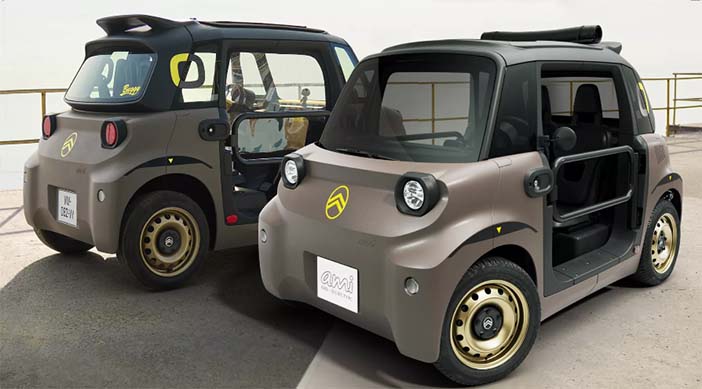
+++ Last year we saw the dinky CITROEN Ami get a redesign and now it’s the turn of the Ami Buggy – the electric quadricycle’s slightly more rugged off-road variant. The design of the revised Ami Buggy follows the update to the standard model, with Citroen’s new badge adorning the front and rear, while the headlights have been reshaped and moved higher up the body. As before, pairs of corresponding parts (including the front and rear body panels, the wings, plus the windscreen pillars and rear screen) are made from the same moulds to keep production costs low and give the Ami Buggy a unique symmetrical design. Further details to help the Buggy stand out include a convertible fabric roof, a roof spoiler, yellow badging, 14 inch steel wheels finished in gold, and metal side bars instead of doors for a more open, adventurous look. Despite the funky design carrying over to the interior, it’s still pretty barren, with a holder for your smartphone, which can then act as an infotainment screen thanks to Citroen’s MyConnect Box app, displaying things like battery charge level, mileage, charging time and entertainment. The technical layout of the Ami Buggy remains unchanged with a 5.5 kWh battery sending power to an 8 hp electric motor for a top speed of 45 kph and a maximum range of 73 km. Charging speeds stand at a rather laborious 4 hours with a 3 kW charger. +++
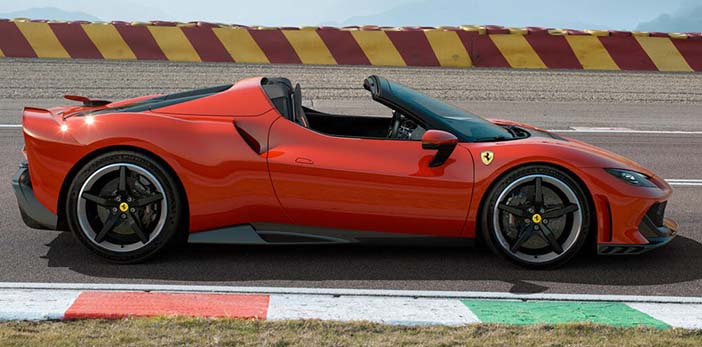
+++ The new FERRARI 296 Speciale is billed as the “most fun to drive, emotionally charged” car the marque has built yet, with its 880 hp claimed to be “very close” to the limit of what a rear-wheel-drive car can offer. Priced from €407,000 in Italy and offered in both coupé and spider forms, it packs 50 hp more than the 296 GTB, has 20 % more downforce and is 60 kg lighter. However, it is “not just an exercise where we put a few additional horsepower”, said Ferrari marketing chief Enrico Galliera. The Speciale instead represents a more comprehensive engineering effort. For instance, its twin-turbo V6 uses aluminium pistons and the titanium conrods from the new F80 hypercar, and the head is secured to the block with titanium bolts. This has allowed an increase in combustion chamber pressure of 7%, boosting the V6’s output from the previous 665 hp to 700 hp. Moreover, the crankcase has been shaved down to save 1.2 kg and the turbo design has been reworked to shed another 1.2 kg. Ferrari has also doubled the size of the ‘hot tube’ (the sound pipe linking the engine bay and cabin) to improve the sound quality and volume of the V6. Revised cooling for the hybrid system has unlocked a further 14 hp, independent of the V6. “We are very, very close to the limit of the maximum horsepower that we can manage for a rear-wheel-drive car”, said development chief Gianmaria Fulgenzi. With that in mind, an aerodynamic overhaul has resulted in a redesign of the 296’s rear end, inspired by the Challenge and GT3 racers. This has brought about the fitment of 2 winglets atop the car’s rear haunches and a small active spoiler that rises from the back end, from just above the Prancing Horse badge. The spoiler has 3 possible positions and adjusts based on the steering angle and throttle position. It plays a key role in boosting the car’s maximum downforce by 20 % compared with the 296 GTB, with 435 kg at 250 kph. The damper and spring set-up has been revised, bringing a 5 mm drop in ride height and a claimed 13 % reduction in maximum body lean when cornering. The cockpit has been reworked to minimise weight, with new seats that are said to be 5 kg lighter than those in the 296 GTB. There is more carbonfibre than before, including on a new single-piece door card, and the new steering wheel swaps the previous unit’s touch sensitive control pads for traditional buttons. Ferrari said the Speciale will not be strictly limited in number but by the time it spends in production, which will be significantly shorter than for the now-discontinued GTB. It will be “very exclusive”, said Galliera. Ferrari will offer the car only to what it calls “active” clients: those who have bought a new or approved-used car (or maintained an older car) through an official dealer within the past 5 years. +++
+++ PORSCHE has announced changes to its EV strategy, confirming it will no longer expand its in-house battery production business. The decision has been made because of a slower-than-expected take up of electric cars. Investment will be redirected into a broader product and software offensive. This marks a significant shift in Porsche’s product strategy and comes just months after it secured a majority stake in V4Smart, a joint venture with German battery specialist Varta. It also hints at a renewed focus on combustion-engined models as well as electrified derivatives of existing models, rather than an all-out expansion of dedicated EV models. +++
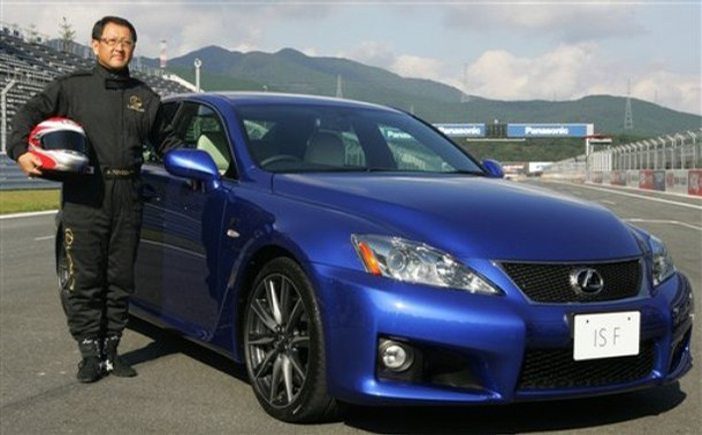
+++ As the former president and CEO and now chairman of TOYOTA ’s board, Akio Toyoda has long balanced his responsibilities with a passion for racing. Under the pseudonym Morizo Kinoshita, he created a second identity on the track, competing in major motorsport events such as the 24 Hours of Nürburgring in 2009, 2014 and 2019. Often behind the wheel of Toyota and Lexus branded race cars. In fact, his input behind the wheel at races and behind development, production, and race cars has been cemented so deeply into Toyota lore that cars like the Toyota GR Corolla Morizo Edition have been named after him. In a recent interview, Toyoda doubled down on his skepticism of battery-electric vehicles. However, when acknowledging that some Toyota engineers want an EV sports car, he said that the idea doesn’t exactly align with his values. “There will always be people inside Toyota passionate about developing electric sports cars”, Toyoda told. “But for me, as the master driver, my definition of a sports car is something with the smell of gasoline and a noisy engine”. In addition, he still believes that the company has a mountain to climb when it comes to building a selection of EVs that fit with Toyota’s mantra of providing affordable, high-quality cars to its customers. Currently, Toyota offers only 1 electric car: the BZ4x, a crossover co-developed with Subaru. “Toyota is a mass-production brand, so we also need to think about affordability, even with BEVs”, he said. “Once Toyota has the capacity to offer affordable BEVs, then maybe that’s a moment when I as a master driver will be introducing a BEV sports car”. In response to a question asking him if in his capacity as Toyota’s “Master Driver”, would he ever race an EV in a competitive race, the man known to enthusiasts simply as Morizo expressed that he wouldn’t want to race an EV because the kind of races he likes to do (endurance races) would be less about driving skill and more about the cars’ technical limitations. “No! It’s not exciting”, he said. “Because you won’t be able to go around the circuit for more than an hour. The kind of races I enter are mostly endurance races, so with the current BEVs, it’s not going to be a race of the cars. It’s a race of charging time or battery exchange or something. The next master driver will have to take on that challenge. That’s their job”. +++