
+++ The ALFA ROMEO Stelvio and Giulia have always lagged behind rivals when it comes to technology, but the fast-approaching next-generation models are set to make huge leaps forward in this department while retaining the sense of driver focus that customers expect from the Italian firm. Alfa Romeo’s head of marketing and communication, Cristiano Fiorio, acknowledges that with the current models (which were launched around a decade ago) “sometimes we might perceive that there was still a gap on technology, on ADAS and on some other things”. But he added: “These 2 new products fill any gap that there was with our competitors, so we are ready to play the game with all our weapons”. I asked him if these new Alfas would still be driver focused, to which he fired back: “I believe that the cars in general today have too much technology, too many buttons. Of course, the development of technology helps a lot, and when it helps to save lives and boost safety, I love it, it’s more than fine. Or there’s technology that is helpful for day-to-day living. But then the car has to be driven and I want the pleasure of driving, not the pleasure of playing video game games or watching movies on the infotainment”. He continued: “The purpose of Alfa is to offer cars that are nice to drive and which respond to your needs. If you have to understand the technology before driving, that cannot be an Alfa Romeo. I have a lot of friends who drive competitor cars (so they’re no longer my best friends!), and they tell me that they probably use 10 percent of the technology onboard because they are unable to use many things. Yes, maybe they are 50 like I am, but they are not 99, so they should be able to, and that’s another bit of the problem”. Fiorio didn’t reveal any exact details about how the new Stelvio and Giulia will tread the tightrope of balancing technology with driver focus, but pointed to how the team achieved just that with the 33 Stradale, which he refers to as the epitome of the brand. For example, the steering wheel features no buttons at all: “because we said, ‘guys, let’s not forget that for Alfa Romeo is about the pleasure of driving’. So, the more pure we can be to this, the better it is, without forgetting the need for technology for safety and for day-to-day life”. The all-new, second-generation Stelvio is due to be revealed later this year, and will be available with a choice of hybrid and pure-electric powertrains, while rivals will include the Audi Q5 and Q6 e-Tron, plus the new BMW X3 and iX3. Meanwhile, the next Giulia is slated to appear in 2026, at which point it’ll be able to resume its ongoing battle against the Audi A5 (formerly the A4) and BMW 3 Series. +++
+++ INEOS AUTOMOTIVE will launch the delayed Fusilier 4×4 “in 2028 or 2029”, confirming its commitment to becoming a multi-model, mass-market car maker. The follow-up to the Grenadier 4×4 was shown in concept form last year and planned to go on sale in 2027 as both a pure-electric car and a range-extender (REx). According to CEO Lynn Calder, the delay “is all driven by doubts about powertrain” and “from regulators in key markets, notably in the European Union and the United Kingdom”. Although the Fusilier REx’s engine would act as a generator for the battery, rather than directly driving the wheels, it “would be banned” under upcoming laws outlawing hybrids from 2035. “We’re too small to spend huge amounts on product development to then find that we can’t produce it, we can’t sell it, in key markets”, said Calder. When many other car makers are winding back their commitments to phase out combustion engines, “we’re quite small to be taking gambles on things like that”, said Calder, “at a time when consumers don’t know what to buy, aren’t super-clear on what’s being regulated. In our minds, we know the product line-up we want, but how they’re powered is to come. When we get some clarity from governments about what will be allowed to be sold, then we can do what I think automotive manufacturers should do, which is focus on what customers want to buy and then develop and sell that”, continued Calder, noting a disconnect between legislative requirements and how quickly consumers are adopting new tech. Calder spoke at the opening of a biomass energy plant at Ineos’s factory in Hambach, France (formerly Mercedes-Benz’s ‘Smartville’), which will reduce the factory’s CO2 emissions by around 20% (to “beyond net zero”) as well as its heating costs. Heating is around 70% of all energy use at the plant. Production of the Grenadier was suspended for 4 months late last year after seat supplier Recaro Automotive went into liquidation, having given Ineos only a few weeks’ notice, Calder said. The German firm has since been rescued by Italian supplier Proma Group and full Grenadier production speed will be achieved again in May. Despite the hiatus, Ineos grew Grenadier sales by 40% last year as it entered its 50th worldwide market. One of them is China, by far the world’s largest. Total capacity at Hambach could be up to 50.000 or so cars per year with all-shift working, but Ineos is currently considered a small-volume manufacturer, which “means we get certain derogations in terms of mandates for emissions reduction over time, which shelters us for the moment”, said Calder. Manufacturers selling fewer than 2.500 cars or vans a year are exempted from the UK’s ZEV mandate requirements, but Calder added that “we don’t want to be a small-volume manufacturer. That’s not the ambition and we’re not staying under a limit in order to achieve that. We will bust the limit of sales the very first second we can. And then we will have to have a different line-up of vehicles or, frankly, focus on different markets”. Calder said any heavy trade tariffs between the EU and US was a concern for Ineos, given the US is the firm’s biggest market “by a long way”, and US president Donald Trump has announced a 25% levy on cars and car parts imported into the country. Ineos said it was “outraged” by the development and, in response, Calder demanded “urgent and direct political intervention”. Speaking before the announcement, Calder said: “There is a disparity between automotive imports and exports (American-made cars incur a 10% levy in the EU) and I’m hoping there’s a deal to be done that doesn’t hurt really small brands like us, who are really trying to find our feet and get up and running”. Ineos won’t share production or financial figures for its auto division, but Calder said: “When I look around at comparable brands (I don’t mean in terms of vehicle types, but in terms of start-ups trying to build a name for themselves) and I look at the financials that come out of those companies, I think we’re doing really well. One of the things that we’re really good at, and there are lots of things we’re not, is cost control. We run businesses like a very tight ship, and not everybody likes that, and it’s not easy, it’s not fun, but we take care to run a business really well; we don’t throw lots of money at everything. There’s no doubt we’ve got a long way to go”. +++
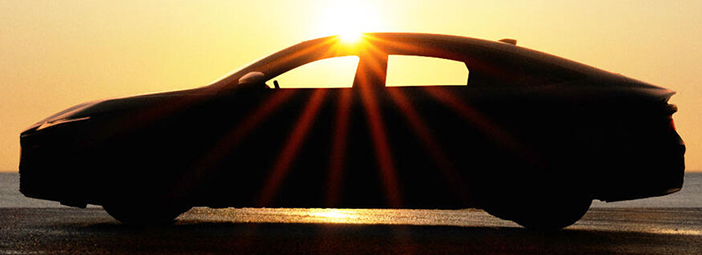
+++ LEXUS will go after the BMW i5 and Audi A6 E-tron with a bold new generation of the ES saloon, to be revealed at the Shanghai motor show next week. Expected to gain the option of electric power for the first time, the new Lexus ES is described as a “global flagship model”, confirming that it will be sold internationally but raising questions about the future of the larger LS saloon, which has been Lexus’s flagship since it launched in 1989. Lexus dropped the LS from its line-up earlier this year due to slow sales, leaving the ES as its only saloon offering in the market. The more fleet-focused ES has historically fared better, but remains a niche player in comparison to the likes of the similarly positioned BMW 5 Series, Mercedes-Benz E-Class and Audi A6. Lexus hasn’t confirmed whether or not it will bring the new 8th generation ES to Europe, but the addition of electric power will strengthen its appeal with fleet buyers and could play an important role in contributing to Lexus parent company Toyota’s EV sales mix. Lexus hasn’t yet released any details of the new car’s specifications ahead of the unveiling on 23 April but has trademarked the names ES 350e and ES 500e, hinting at the potential for a pair of EV options, as with the RZ. The RZ 350e is equipped with a single motor on the front axle producing 225 hp and a 77 kWh battery giving an official range of 580 km. The lower, sleeker ES would be likely to improve upon this if equipped with the same hardware. The RZ 500e meanwhile has a dual-motor powertrain with 384 hp and a 77 kWh battery giving a range of 500 km. Lexus has also trademarked the ES 350h name, suggesting the new saloon will maintain a hybrid option; likely the petrol-electric set-up from the NX 350h, which produces a combined 245 hp. An official preview image shows that the next ES will retain a low-slung and rakish-roofed silhouette, with efforts at improving aerodynamic efficiency in pursuit of range. The ES’s Shanghai debut is reflective of the model’s importance in China, where saloons continue to be far more popular than in Europe. It has been the number one car imported into China since 2017. Overall, Lexus imports into China grew by 4.1% last year, bucking a wider downward trend. +++
+++ MAZDA ’s rotary revival plans are one step closer to reality. The company is planning a 2-rotor engine for America and now engineers are confident it’ll be able to pass today’s strictest emissions regulations. “I decided to reopen the rotary engine development group and I gave a mission to them”, Mazda CEO Masahiro Moro told. “That was to comply with stringent emissions regulations like LEV IV in the U.S., and Euro 7”. Moro previously said a single-rotor engine wouldn’t be powerful enough for American audiences, hence the move to develop a dual-rotor powertrain. “Rotary is not good at complying with emissions. That was the reason we decided to discontinue it in 2012”, Moro told. “That is a very high hurdle they have to overcome, but in the last year the progress has been very encouraging”. The only thing holding back Mazda from selling a rotary-powered vehicle now? How to sell it. “The next challenge is making a good business case”, Moro says. “But technically, we are almost ready. If we see a good business case, we’re ready to go”. Mazda brought the rotary engine back into production in 2023, albeit as a range-extending generator for the MX-30 electric crossover sold overseas. This new two-rotor setup will likely be used in something sportier, though. The Japanese automaker revealed last year it was considering putting a sporty vehicle into production, a-la the Iconic SP concept shown above. Moro suggested such a car would likely not have a stick shift, but something quicker. “If, let’s say (and we haven’t decided anything yet) if we do go to the super sports category, then a gearbox should be faster”, he said, “then probably not a manual, but a more advanced transmission technology can be used”. It’s still unclear when we might see a real, actual production version, should the project be green-lit. +++
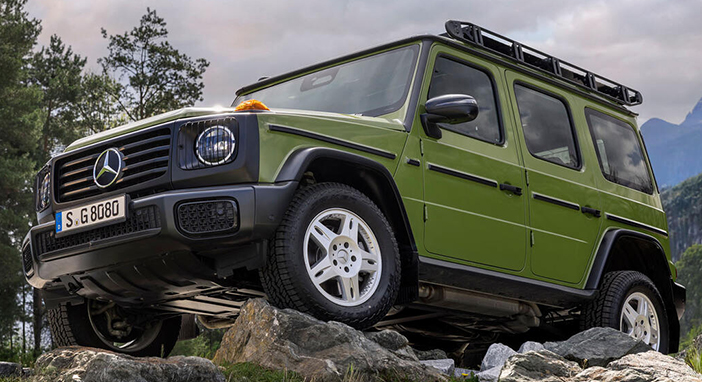
+++ MERCEDES-BENZ has unveiled a special version of the G-Class that harks back to the 1979 original with a series of historic styling cues. Called the G-Class ‘Stronger than the 1980s’, it swaps the modern car’s clear bonnet indicators for amber-tinted units like those of the original car and gains a set of classic-looking five-spoke alloy wheels. It is available in a choice of two two-tone liveries, with Agave Green or Colorado Beige paint contrasted against Night Black around the front fascia, skirting and grille, referencing the same scheme used on the original car. The ‘Schöckl Proved’ emblem mounted on the car’s B-pillar is updated to feature the original G-Class, and at the rear end, the Mercedes-Benz wordmark uses the same font as in the 1980s. The roof rack, mudflaps, rear ladder and headlight meshes are borrowed from the Professional catalogue of optional extras available on the standard G-Class. Inside, the seats are upholstered with Dove Grey chequered cloth and the ‘Stronger than the 1980s’ script is inscribed on the passenger grab handle. The puddle lights in the mirrors project the message “stronger than time” onto the ground when either of the front doors is opened. The special edition is otherwise based on the regular G450d, packing a 3.0-litre diesel-powered straight six that puts out 385 hp. This yields a 0-100 kph time of 5.8 seconds. +++
+++ POLESTAR has cut the emissions of the electric cars it produces by 25% since 2020, and it has done so without radical technologies or materials, instead targeting the “low-hanging fruit”. Polestar sustainability boss Fredrika Klarén explained that the substantial reduction in cradle-to-grave CO2 is in large part due to how Polestar now sources materials. Since the start of the production of the ‘2’ in 2020, it has swapped from aluminium and steel to metal that has either already been recycled or has been smelted using renewable electricity. These 2 materials are responsible for some 45% of the 2’s total greenhouse gas emissions, according to Polestar, so present significant opportunities to reduce its environmental impact. The Chinese / Swedish company also started using renewable energy at its factories; and it derives some reduction in emissions from the updated, now rear-wheel-drive 2’s greater efficiency. “A lot of voices want to talk about how it is technically unfeasible or financially unsound”, said Klarén, “but what we see is that there are so many low-hanging fruits you can absolutely go for”. She added that there is “still progress to be made”, even with these “low-hanging fruits”. For example, Polestar Zero (the company’s project to build a climate-neutral car by 2030) recently identified a potential 10-tonne reduction in CO2 emissions in steel and aluminium sourcing alone. Kláren continued: “Recycled content: it’s not rocket science, right? Hopefully we can really guarantee that these solutions can be utilised as quickly as possible. When we went into the Polestar Zero project, we had the 2020 version of the Polestar 2 as a base car. That car had a 26.1-tonne carbon footprint, and if we use the solutions that I just spoke about, we would be down to 16 tonnes”. Pursuing such endeavours means Polestar is now outperforming its previous forecast for decarbonising its cars entirely by 2040, according to Kláren. “An EV is not sustainable today, but it absolutely has the potential to become that, and it is better today than the [alternative], and to also create exciting stories around these cars”, she said. +++
+++ The rise in popularity of the coupé-SUV has been significant over the past decade or so, with many manufacturers dabbling in the sector, making it something of a surprise that RENAULT has pulled the plug on the Arkana. An official statement from the French firm reads: “With Symbioz and Rafale joining Captur and Austral last year, the decision has been taken to focus Renault’s SUV range around these 4 core models”. The Arkana will soon be removed from sale and it’s understood that the firm has no plans to replace it with a second-generation model. Instead, Renault’s growing electric vehicle range has seen the rebirth of old nameplates such as the 5 and the 4, which will occupy a similar crossover space to the outgoing model. Sitting on the same CMF-B platform as the Renault Captur, the Arkana was originally introduced in Russia ahead of its launch in Europe in 2021. 2 years later, the Arkana received a mid-life facelift in line with Renault’s own brand revamp. +++
+++ Tariffs, should in theory, help American automakers, but that’s not exactly the case. Quite the opposite as a number of them import vehicles and parts from other countries. This is hardly a shocking revelation, but Wall Street is worried and the stock market has been on a roller coaster ride as of late. The latest warning sign comes from UBS, which has downgraded STELLANTIS to neutral. This follows a similar downgrade for General Motors. Seeking Alpha reports that UBS analyst Patrick Hummel pointed to the 25% automotive tariff as hitting Stellantis harder than some of its rivals. This is due to the fact that roughly 35% of sales in the United States come from imported vehicles. Among them are the Chrysler Pacifica and Dodge Charger Daytona, which are made at Windsor Assembly in Canada. South of the boarder, there’s Toluca Assembly which builds the Jeep Compass and Wagoneer S. Mexico is also home to the Saltillo Truck Assembly Plant, which builds heavy duty Ram pickups. This presents a significant problem, but imports aren’t the only issue. U.S. sales have been falling and Hummel believes the company will have a hard time regaining market share, especially as demand softens. This could lead to losses and a negative free cash flow. +++