+++ ALFA ROMEO ’s next supercar has moved a step closer, with a new “very limited edition” top-end model set to be developed in conjunction with Italian sailing team Luna Rossa, following the announcement of a partnership between the 2 organisations. “We will do something bespoke and limited, and also something that touches a higher number of people”, said Alfa Romeo CEO Santo Ficili, opening up the possibility for a Luna Rossa series of special editions of existing models to sit alongside the halo small-volume performance car. “The DNA of Alfa is doing something hard and limited, and also something broader”. Alfa’s chief said the brand would be tapping into Luna Rossa’s experience of working with carbon fibre on its America’s Cup sailing boats.”We have seen what they can do with lightweight materials”, he said at the announcement of the tie-up, described by Alfa Romeo’s marketing boss Christiano Fiorio as “a true technological collaboration”. Alfa Romeo has previously stated that it would follow up the 33 Stradale supercar with another model that’s due to be seen in 2026 as part of ambitions to develop a series of halo models over the coming years, although details are still scarce. The 33 Stradale was developed in 16 months, and all 33 examples of the 630 hp supercar, estimated to cost around €3 million in the Netherlands, found homes. Ficili’s predecessor Jean-Philippe Imparato stated last year that Alfa Romeo would push forward with more low-volume Alfa Romeo halo models. “I don’t have the intention to go back to 500 or 1.000 cars, I want to stay below 100 cars and I want to put in all of the quality and performance features that I need”, he said. +++
+++ AUDI has revealed details of its fresh plug-in hybrid powertrain for the new Q5 and Q5 Sportback, which will be available to order in in July. Called the Q5 e-hybrid Quattro, the new system can travel up to 100 km on electric power, making it a compelling option for those who aren’t quite ready to switch to an electric car, or company-car drivers who can benefit from lower tax rates. Fundamentally, the hybrid system is the same as the one announced for Audi’s new A5 and A6, sharing their general powertrain layout and elements. It’s made up from a 250 hp 2.0-litre turbocharged 4-cylinder petrol engine paired to an electric motor and a 25.9 kWh battery pack. The 299 hp total system output powers Audi’s quattro all-wheel-drive system through a new dual-clutch automatic transmission. It accelerates from 0-100 kph in 6.2 seconds and tops out at 250 km/h. With a sizeable battery, Audi has increased the AC charging potential to 11 kW (which will top up the pack in around 2.5 hours from empty) but has stopped short of offering any DC fast-charging capabilities. This new powertrain’s other features include much higher levels of regenerative braking through both the brake pedal and when lifting off the throttle; the strength of this can be controlled via steering-wheel paddles. Audi says that around 90 percent of all braking can be handled by the electric motor’s regen braking, helping to top up those critical EV kilometres. As a result, the Q5 e-hybrid is capable of up to 100 km on battery power alone, which is 45 percent more than the previous generation, and smack bang in the middle of its two key rivals. BMW’s plug-in X3 is rated to around 80 km from its slightly smaller 20 kWh battery pack, but the Mercedes GLC has a 120 km WLTP range. There has been some compromise in terms of boot space in order to fit the battery pack. Audi quotes 438 litres (and 433 litres for the Sportback), which is a loss of around 80 litres compared with non-PHEV models. This can be expanded by flipping the second-row seats down, but as with all its key rivals, there’s little in the way of under-floor storage. Powertrain aside, the plug-in Q5 is otherwise identical to the existing models, featuring the same high-specification arrangement of displays up front and a restrained, familiar design outside. +++
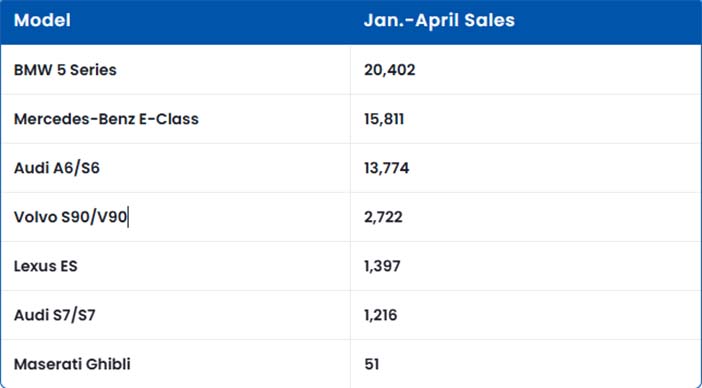
+++ Mercedes-Benz and BMW unveiled the current E-Class and 5 Series within a month of each other in 2023. Buyers are clearly favoring one over the other so far this year, and those in Stuttgart have to be a bit disappointed with the trend. The 5 Series is outselling the E-Class and its other rivals by a wide margin. Numbers published by Dataforce show BMW sold about 5.000 more cars than Mercedes through the first 4 months of the year. That’s despite both models seeing sizeable sales increases compared to the same period in 2024. Sales for the 5 Series and E-Class are up 56 percent and 19 percent, respectively, according to the data. The E-Class barely outsold the Audi A6/S6, which saw a 10 percent increase, but both crushed the Volvo S90/V90, Lexus ES and the Audi A6/A7. BMW’s i5 also outsold its other electrified rivals, squeaking past the Audi A6 e-Tron: 8.843 versus 7.460 units. Mercedes sold just 3.740 EQE sedans. Completely missing from the list is the Jaguar XF, which the automaker stopped building in the middle of 2024. The brand is undergoing a bold reimagining that will move the automaker upmarket to compete with Bentley, Maybach, and Porsche. The Ghibli, at the bottom of the list, is also a discontinued model. Maserati said the car’s production has ended in 2024, leaving buyers with fewer choices, which makes the current iterations of the 5 Series and E-Class even more important to their respective brands as they battle for customers. +++
+++ When it comes to products, CHRYSLER currently offers the least among the 14 brands under the Stellantis corporate umbrella. It’s now essentially a minivan brand, selling only the Pacifica/Voyager. Heck, even Lancia, another troubled carmaker within the conglomerate, has a second product scheduled for 2026. So, how does the struggling American brand, which turned 100 just last week, plan to get back in shape? By experimenting. In an interview, Stellantis design chief Ralph Gilles said Chrysler is “ripe for a new chapter”. The brand aims to revamp its current image and attract a new clientele by targeting the “brand-new conquest customer”. Although Stellantis has numerous products across its vast portfolio, there are still gaps that Chrysler will attempt to fill with its upcoming vehicles. “I think it’s time for us to pivot. We’re going to try. We’re going to experiment with the brand. There is an unserved part of our portfolio in our showroom that our dealers have identified that we can maybe serve with Chrysler, so we’re in the process of experimenting”. Although Chrysler had initially planned to go fully electric by 2028, that’s no longer the case. Gilles said the new line-up will be built on the STLA Medium and STLA Large platforms, both of which support combustion, hybrid, and electric drivetrains. The STLA Medium is already used in European products, such as the Peugeot 3008/5008, Opel Grandland, Citroën C5 Aircross, and the not-for-America Jeep Compass. The STLA Large underpins the Dodge Charger, Jeep Wagoneer S, as well as the upcoming Recon and Cherokee. Stellantis also has an STLA Small architecture, but Chrysler appears to be focusing on larger vehicles. STLA Medium is designed for cars measuring 4.3 to 4.9 meters, with wheelbases ranging from 2.7 to 2.9 meters. STLA Large supports vehicles ranging from 4.76 to 5.1 meters long and 1.89 to 2.03 meters wide. Chrysler finally has a new design studio to create its future vehicles, one of which could be a sedan inspired by the Halcyon concept. Although the concept won’t go into production as is, CEO Christine Feuell suggested it could influence a 300 replacement. An SUV inspired by the Halcyon is reportedly also in the pipeline. Both could debut as early as next year. The Pacifica turns 10 next year, and Chrysler has confirmed plans to update the minivan and introduce a fully electric version. Just weeks before his abrupt resignation, Stellantis CEO Carlos Tavares said the struggling brand would have only a few years to save itself. However, there’s now a sense that Chrysler is finally receiving the attention it deserves. With newly appointed Antonio Filosa leading the empire, a revival seems to be underway. Gilles mentioned that Stellantis has “been working very hard behind the scenes” on the STLA Medium and Large platforms. He described them as the “perfect foundations” for new vehicles bearing the winged emblem. These new products certainly can’t arrive soon enough, and Chrysler deserves the attention after years of neglect. +++
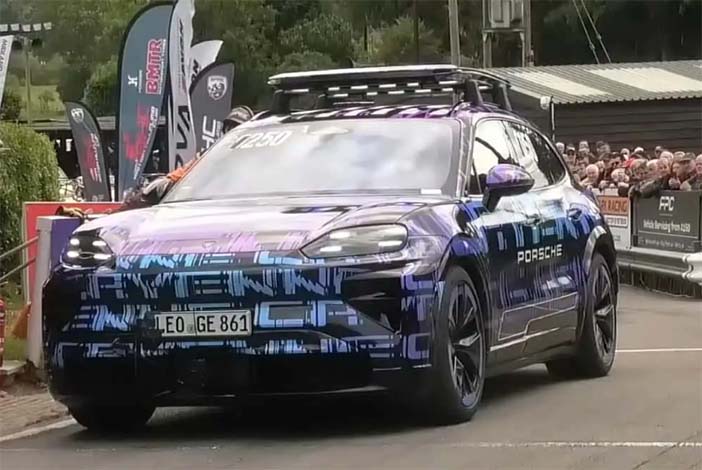
+++ The electric PORSCHE CAYENNE , which should be revealed sometime this year, just smashed a hill climb record. Despite it not being exactly finished and ready for prime time yet, a camouflaged Cayenne EV prototype showed up at the Shelsley Walsh Hill Climb in the United Kingdom this past weekend and swept the floor with the competition. The purple electric Cayenne was driven by Gabriela Jilkova, development driver at Porsche’s Formula E program, who gave it everything. In complete silence, Jilkova wrestled the battery-powered SUV along the 914 meter track in just 31.28 seconds. That’s 4 seconds faster than the previous record for SUVs at Shelsley Walsh, set by a Bentley Bentayga W12, and a hair faster than the fastest production electric car, a Porsche Taycan Turbo S, which did the climb in 31.43 seconds. “I’ll tell you what, for a big car, that is scuttering up the hill, something special”. Now, it’s worth noting that the Cayenne EV isn’t a production car just yet, but it’s still mighty impressive that an SUV was quicker than a sports sedan. In other words, if you were worried that the upcoming electric Cayenne would be boring or slow, this result should put your mind at ease. We still don’t know a lot about the upcoming electric Cayenne. Based on the same PPE platform as the new Macan EV, the battery-powered Cayenne will be sold alongside a heavily reworked version of the current gas-powered model well into the 2030s. Initially, the new Cayenne was supposed to be electric-only, just like the new Macan, but Porsche toned down its ambitions recently after disappointing sales. Besides the electric Cayenne and Macan, Porsche is planning on introducing yet another crossover that will supposedly become the new flagship for the German automaker. Codenamed K1, the SUV is expected to offer seating for seven people when it hits the market sometime toward the end of the decade. The Shelsley Walsh hill climb, where the Cayenne EV smashed the SUV record, is part of the British Hill Climb Championship. Located in Worcestershire, Shelsley Walsh is the oldest motorsport venue in the world to still use its original course, with the first recorded use going back to August 12, 1905. +++
+++ Akio Toyoda is a man who speaks his mind. He’s been saying for years that forcing everyone to buy electric cars isn’t the way forward. TOYOTA ’s chairman is adamant that the transition can’t be rushed and that going all-in on electric cars would have massive repercussions across the automotive industry. He believes millions of jobs throughout the supply chain could be at risk if the combustion engine is phased out too quickly. On the environmental front, Toyoda maintains that EVs are still much dirtier than hybrids. He claims the company has sold around 27 million hybrids since launching the first-generation Prius in 1997. According to him, those hybrids have had the same carbon footprint as 9 million fully electric vehicles when adding battery and vehicle production into the equation. Toyoda argues that a single EV is as dirty as 3 hybrids. However, while it’s true that producing EVs and their batteries creates more carbon emissions than building gas cars, over their life cycles, EVs are responsible for far fewer overall emissions. “But if we were to have made 9 million BEVs in Japan, it would have actually increased the carbon emissions, not reduced them. That is because Japan relies on thermal power plants for electricity”. Toyota’s reluctance to fully embrace EVs has sparked criticism, with some even questioning the company’s future. You’ve probably seen comments predicting Toyota’s downfall for lagging in the electric race, but that hasn’t happened. In fact, the opposite is true. In 2024, Toyota was the world’s largest automaker for the fifth year in a row. Sure, its EVs may trail the competition, but Toyota more than makes up for it with its hybrids and the remaining ICE models it still sells. The latest petrol-powered car to receive the hybrid treatment is the Aygo X, the firm’s smallest model outside of the kei cars, which are sold exclusively in Japan. Toyota claims the dinky hatchback has the lowest CO₂ footprint of any non-plug-in car on the market. Akio Toyoda once said EVs would never exceed a 30 percent market share and argued that the industry should focus on hybrids and synthetic fuels. Although it has admitted that the Mirai has been a commercial failure, Toyota remains committed to hydrogen and sees potential in combining it with combustion engines. At the same time, it’s helping BMW launch its first series-production hydrogen vehicle in 2028. As the automotive powerhouse it is, Toyota has the financial and industrial muscle to improve its hybrids while also developing better EVs. It has made the BZ4X more appealing and added the BZ Tourer and C-HR+ to its growing electric line-up. Its luxury brand Lexus recently launched the ES electric sedan and upgraded the RZ. While the spotlight is on hybrids and EVs, Toyota hasn’t forgotten the joy of driving. The company’s CEO, Koji Sato, was recently quoted as saying, “A car is not a car if it’s not fun”. In the coming years, expect a new Supra, a revived Celica and possibly a new MR2, judging by the mid-engine prototype shown earlier this year. Lexus, too, will launch a GT3-style road car, likely with a V8. All told, Toyota appears to have just about every base covered. The impending return of the FJ Cruiser would further cement Toyota’s reputation for offering one of the most comprehensive line-ups in the automotive industry. +++
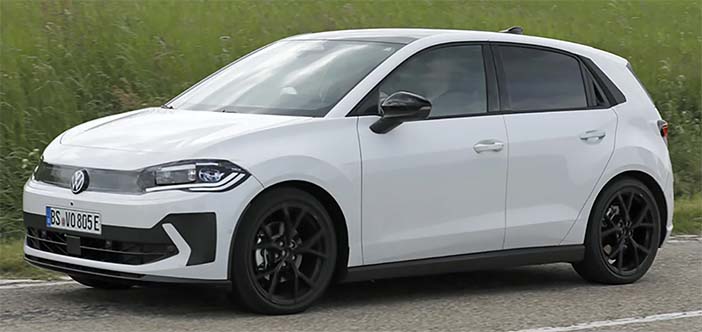
+++ New spy shots of the VOLKSWAGEN ID.2 or ID.Polo (VW hasn’t quite made its mind up on the name) have revealed that the production model will be very true to the original ID.2All concept when it’s revealed in September. There’s no getting away from just how important the new supermini-sized EV is for the German brand, because it doesn’t just downsize its electric models, it also represents the beginning of a new era of interior and exterior design, and fast-moving battery innovation. We’ve seen Volkswagen ID.2 prototypes before, but what’s new here is the fact this one is a full ‘body-on’ prototype that shares its external skin with the forthcoming production car. This tells us an awful lot about the ID.2 that you’ll be able to buy in 2026. There are a few changes to the front, such as a bonnet that now sits higher, and the end of the front lighting now turns downwards to help simplify manufacturing. The body itself looks exactly the same, except for the normal rear door handles rather than the concept’s hidden units, while the rear end also looks to be close, with a light bar, square-shaped lighting graphics and a clean, simple tailgate. But the big news is under the skin, because the ID.2 also heralds a heavily reformed electric architecture. As well as improving efficiency, it will also lower the price of building the cars for VW, something the German giant is relying on to re-establish its position as Europe’s biggest and most profitable mainstream manufacturer. There’s a lot at stake for VW, but the future ID.2 is promising big things, not least the €25.000 starting price. It’ll achieve this through a variety of means, not least a simplified platform called MEB Entry, but should also prove profitable; a crucial aspect for the survival of VW in the electrified age. The new platform’s development is being done in collaboration between Volkswagen and its sister brand Cupra, whose Spanish plants will build all MEB Entry models, including future Skoda and Volkswagen SUVs and the new Cupra Raval, which will be the first to reach production in mid-2025. Beyond just offering a low-cost supermini, the ID.2 will also be the first all-electric car to offer a GTI edition, which has already been previewed with another concept. But the future VW ID.2 will have a tough crowd to compete with, including a range of new rivals such as the Renault 5, Fiat Grande Panda and Citroën ë-C3. There’s also a brand-new set of Stellantis rivals on their way in the coming years. These include a new Peugeot e-208 and Opel Corsa Electric, which will sit on their own refreshed platform. +++