
+++ BENTLEY is readying pure-petrol successors to the Bentayga, Continental GT and Flying Spur in a reversal of its EV-only plan, brought on by drastic U-turn at Porsche late last week. Under its ‘Beyond100′ strategy, the British luxury car maker planned to phase out petrol engines entirely by 2035. But it’s now set for significant alterations as its Volkswagen Group sibling firm doubles down on renewed commitments to ICE development. Porsche confirmed on Friday that it will commit €3.1 billion to extend the life of its ICE models. This notably includes new “top” models of the next-generation 718 Boxster and Cayman and no longer selling the planned ‘K1’ flagship as an EV. Fellow Volkswagen Group firm Audi cancelled its plan to go electric-only by 2033 last year. Bentley CEO Frank-Steffen Walliser told that as the 3 brands share platforms, drivetrains and other key components, decisions and investments in Stuttgart and Ingolstadt have had direct consequences in Crewe. He confirmed that Bentley still plans to launch a new plug-in hybrid or electric model every year from 2026, beginning with its first EV, an “urban SUV”. But with Porsche and Audi continuing to invest heavily in ICE technology for their best-sellers, he said Bentley now has scope to balance its drivetrain mix more towards traditional petrol power further into the next decade than originally anticipated. As such, pure-petrol successors to the Bentayga, Continental GT and Flying Spur are set to remain part of the line-up, reflecting demand from key markets such as the Middle East and North America. They were originally expected to be offered only with PHEV or EV powertrains. Backing the decision, Walliser said: “There is a dip in demand for luxury electric vehicles, and customer demand is not yet strong enough to support an all-electric strategy. The luxury market is a lot different today than when we announced ‘Beyond100’. “Electrification is still our goal, but we need to take our customers with us”. Despite the change in tack, investment in Bentley’s Crewe facility is pressing ahead, with a new electric model assembly line, paint shop and design centre under construction. Bentley had already pushed back its target for becoming an all-electric brand from 2030 to 2035, citing slowing demand in the luxury EV market. The Volkswagen Group’s new direction and multi-billion-euro investments in ICE models are expected to reinforce that decision. +++
+++ SUVs have dominated the American market for well over a decade, with half of the 20 best-selling vehicles in the US last year being SUVs. While many automakers have abandoned sedans in favour of more profitable crossovers, BMW isn’t ready to give up on the traditional four-door just yet. In an interview, BMW emphasized that sedans remain a vital part of its line-up. Oliver Heilmer, the man leading BMW’s Neue Klasse design language and the former head of Mini design, stated that sedans are still “the core of the brand”. Heilmer said: “A couple of years ago, you might have thought the sedan is something that might disappear. But it’s quite stable, to be honest. Now it’s something where we are setting a statement. We have said BMW is standing for sedans. A small, sporty, elegant, mid-sized sedan is the core of the (BMW) brand”. BMW still has one of the most comprehensive sedan line-ups among luxury automakers. Models like the 3 Series, 4 Series Gran Coupe, 5 Series, and 7 Series remain top contenders in their respective segments, and more sedans are on the way. After the launch of the iX3 SUV, BMW plans to introduce the electric i3 sedan, followed by a new 3 Series with a traditional internal-combustion engine. The company has also confirmed that new performance variants are in development, along with upcoming updates to the 5 Series and 7 Series in the years ahead. In the same interview, Oliver Heilmer added that BMW’s design language will soon become “way more subtle.” While the signature kidney grille will remain, its size and shape will vary, suggesting the oversized grilles seen on current 3 and 4 Series models may soon be phased out. “Different markets are reacting differently to proportion. We always try out different kinds of shapes. BMW is always testing if the customer’s taste is changing”. +++
+++ The main thing that would stop LOTUS from building its radical, futuristic Theory 1 concept is its lack of a front wiper mechanism, the company’s chief designer has said. The 1.000 hp, Esprit-inspired 3-seater was revealed last year as a showcase of innovative new technology and next-generation design cues that Lotus was looking to bring to future cars. The company hasn’t confirmed plans to develop it into a production car, but Lotus Group vice-president of design Ben Payne said the concept is “deliberately” a realistic design proposition and its headline features and cues are “well within the realms of reality”.
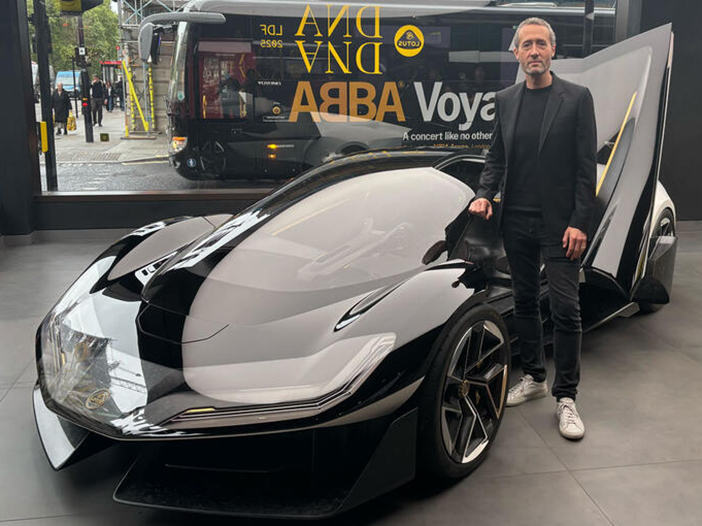
Speaking at a new exhibition celebrating Lotus’s design DNA at the brand’s flagship showroom in Mayfair, Payne described the Theory 1 as a “scalable timeline of innovation” featuring barely any elements that make it unviable for production. “There are things on this car which we are able to do now”, he said. “To actually put that car in its entirety into production is a bit of a stretch, but it informs the future”. He highlighted that the electric supercar’s dimensions are roughly on a par with the existing Evija hypercar, “so there’s nothing here that goes beyond the normal dimensions of a production vehicle”, and said many of its radical technologies are simply new interpretations or evolutions of systems that exist in production cars already. The ultra-lightweight AP Racing carbon-ceramic brake discs and cast aluminium calibers, for example, are simply “one generation on” from those that feature on the Evija; the super-sticky Pirelli P-Zero Elect tyres are now fitted to other production cars; and the recycled carbonfibre bodywork “can be done today; it’s just down to customer demand and whether people want to engage in it”. The highly advanced digital technology showcased in the Theory 1, meanwhile, is already in production elsewhere, “we’ve just never shown it on a sports car”. Examples include the projected head-up displays, which are “becoming more commonplace” and the electric rear-view mirrors, which are taken from the Emeya saloon, “so that’s not pushing it”. Even the 3-seat cabin and revolutionary ‘grasshopper’ dihedral door system have been conceived with an eye on real-world usability, Payne explained, and the outlandish wedge-shaped silhouette and air-channelling bodywork don’t come at the expense of practicality, with a small boot included behind the seats.
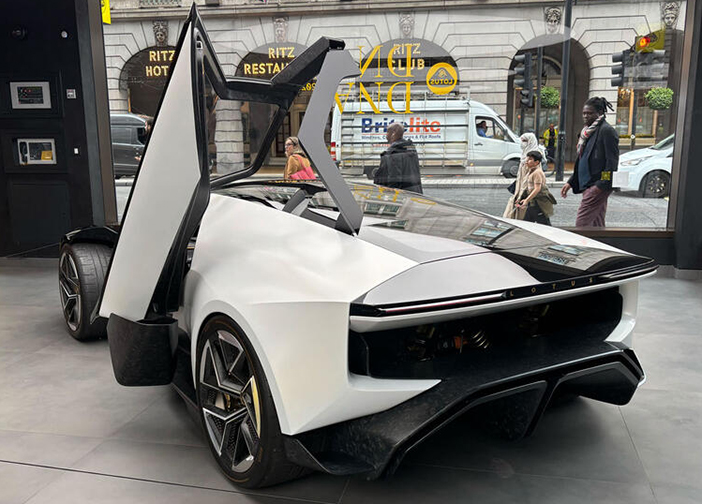
Asked if the Theory 1 was designed with real-world viability in mind, Payne said: “Deliberately. The wheel and tire package is directly taken from the Evija, so there’s nothing outlandish in terms of how that comes together. It’s a next-gen production braking system on it, but the tyre size and the wheel size is exactly what they have on the Evija. So nothing crazy”. There are only a few small obstacles in the way of Lotus being able homologate the Theory 1, Payne added. “To be quite open and honest about it, the major challenge with this is that there’s no wiper system on the car, so it would need a reconfiguration of the cowl area, move the screen back a little bit and fit a wiper for legal usage. “But the electronic rear view mirrors and lighting systems, it’s all It’s next-gen thinking, basically. We’ve deliberately given it tangibility and credibility”. Despite its relative viability, however, Lotus has no immediate plans to build a production version of the Theory 1, as its immediate focus is on driving sales of its ‘lifestyle’ Eletre and Emeya EVs and restoring the company to a position of financial stability. Payne said: “It’s a showcase at this point in time about what the future is, but a core focus for the company is to reassert the brand values and now look at our evolving situation, what we’re able to do, what we can do and what the market wants. The focus for us is to drive a bit more volume and provide a sustainable business in terms of financials. This type of car is possibly not the best way to do that. “We’re looking at how to lower the price points and to get more people into our products; that would be the next step. But this serves as a bit of a North Star in many, many ways”. In its conception as a technology and design showcase that will influence future production cars, the Theory 1 is similar to a long-forgotten Lotus prototype from the early 1990s known as the SID. Named for its focus on “structure, isolation and dynamics”, the Esprit-bodied, Metro 6R4-engined SID mule was developed by Lotus Engineering in 1992 to test chassis systems that were highly advanced for the time, including four-wheel-drive, four-wheel steering and active suspension. Engineers were able to program the SID’s dynamic characteristics using a laptop and its trick suspension meant it could allegedly corner with almost no body roll. It could even lean into corners like a motorbike. Payne said this lesser-known test mule played no small role in developing once-radical technology that would one day make it into production cars and suggested that, in this sense, the Theory 1 is its spiritual successor. “It allowed them to separate steering from suspension and dynamics and play with all the different systems on a vehicle. Cars today have an awful lot of active systems on them; it was done an awfully long time ago”. +++
+++ NISSAN is to to downsize its design studio in London as part of a major cost-saving plan that was announced earlier this year. Nissan is also scaling back its operations at its design headquarters in Japan and will close centres in California and São Paulo, Brazil. The Paddington studio, which celebrated its 20th anniversary in 2023, is expected to have its workforce reduced, although Nissan has yet to confirm this. +++
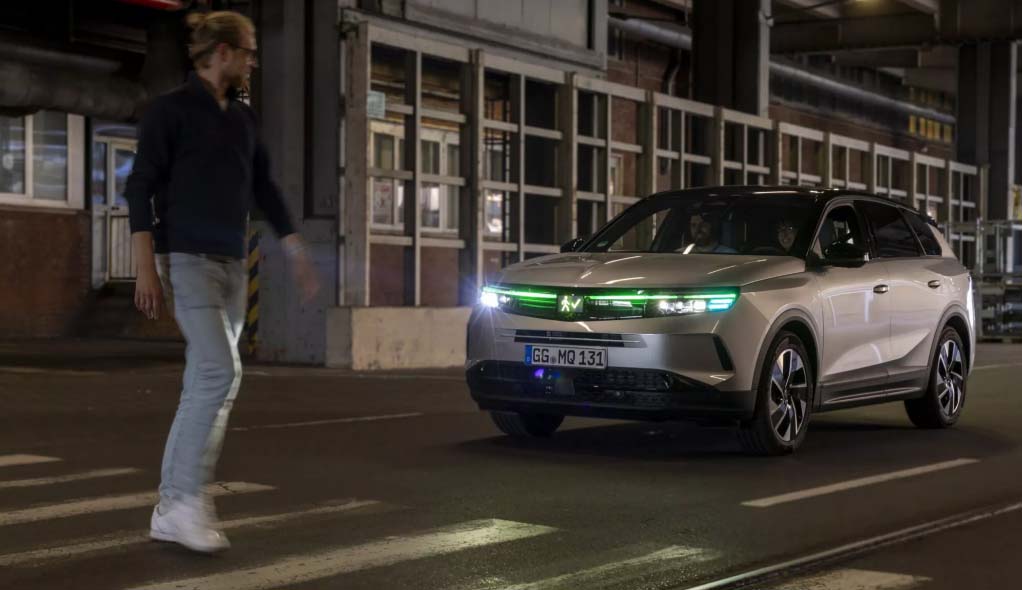
++ As cars edge closer to taking over more driving duties, the question of how they interact with the people around them becomes increasingly important. Technology may be ready to let drivers take their hands and eyes off the task, but it also raises a new challenge: how does a car signal its intentions to those outside it? In that spirit, OPEL has built a Grandland prototype with a lighting system designed to speak directly to pedestrians. The test model is equipped with Level 3 driver assistance, which allows the person behind the wheel to disengage under certain conditions. Once the vehicle is in charge, though, a fresh layer of communication is needed to make sure people on the street understand what the car is about to do. The Opel Grandland prototype has been fitted with a new camera system that can detect objects and gestures, combined with an AI-backed “intention prediction” function. This allows it to better recognize real world scenarios like when a pedestrian emerges from parked vehicles or a child steps on the road when chasing a ball. When operating in Level 3 autonomy (or higher), the SUV’s front and rear indicators shine in cyan. This colour was chosen as it is not associated with any other vehicle function. When a pedestrian is detected in the path of the vehicle, it starts braking and the LED headlights change from white to magenta. Furthermore, a small screen that normally displays Opel’s Blitz emblem shows a warning sign or a pedestrian alongside a halt gesture. When the car has come to standstill, the LEDs turns green and the display shows a walking figure. In more complex situations when the AI algorithm can’t figure out what to do, the driver is prompted to take control of the vehicle. Philipp Röckl, Global Lead Lighting at Stellantis, explains the thinking behind the project: “Headlights clearly play an important part in increasing road safety, but modern lighting systems are capable of so much more. For example, lighting signatures can easily be animated and used for animations. And the illuminated Blitz on the Grandland can be substituted by a display that can both show the illuminated emblem and be used to communicate with other road users and pedestrians. By using existing lighting elements, it makes it easy to add communication features once we will introduce autonomous driving features in our cars”. The Grandland with the unique equipment and lighting features follows a number of prototypes and production vehicles from other brands that examine the same issue. The model was created in-house in Opel’s Russelsheim headquarters in Germany and was showcased at the International Symposium on Automotive Lighting (ISAL) in Darmstadt. It is the result of a collaboration between the Opel Concept Workshop and students from the TU Darmstadt university. Stellantis and TU Darmstadt have formed a strategic partnership for joint research into new lighting technologies since 2022. As part of this, the automaker is currently funding three doctoral students at the university’s Department of Electrical Engineering and Information Technology. On her part, Julisa Le, Stellantis’ Lead Innovation Engineer, said: “We specifically chose colors that are not already associated with other vehicle functions to avoid misunderstandings. For example, red is intuitively understandable, but it is already used for stop lights or the rear lights of cars. Cyan and magenta have been thoroughly evaluated for perception purposes and are currently not present in any traffic situations. Both ensure clear, unambiguous communication with other road users”. +++
+++ PORSCHE will include a combustion engine option for “top” versions of the next-generation 718 Boxster and Cayman as part of a significant shift in the company’s electric strategy that also kills the planned large ‘K1’ electric SUV above the Cayenne. The new ‘strategic realignment’ also confirms major overhauls for the Cayenne and Panamera combustion engine and plug-in hybrid models to keep them running “well into the 2030s’, CEO Oliver Blume said on a call to investors. Porsche will take a €1.8 billion hit on a decision to halt development of the SSP 61 ‘Sport’ version of the Volkswagen Group platform that was going to underpin the K1 large SUV as well as an electric replacements for the Panamera and the Taycan. The SSP Sport platform (derived from the platform underneath mainstream Volkswagen Group models including the next Volkswagen Golf and Skoda Octavia, has now been postponed until “well into the 2030s”, Blume said. The K1 model (dubbed a ‘D-SUV’ by Porsche) will now be launched with combustion-engine and plug-in hybrid variants, Porsche said, without giving a precise date. The K1 was first announced in 2022, along with plans for the third-generation Porsche Panamera and second-generation Porsche Taycan. “We have seen a clear drop in demand for exclusive battery-electric cars, and we are taking that into account”, Blume said. Porsche has also been roiled by “dramatically decreasing” demand for luxury goods in China, Blume said. Also hitting profits was the US decision to increase tariffs on imported cars. The company said the combination of circumstances will cut its predicted net profit margin to around 2% this year but predicted a return to growth in the ‘medium-term’ when it planned to grow margins back above 10% with the new products rolling out. “This flexibility gives us a strong position with a compelling mix of combustion engines, plug-in hybrids, and battery electric vehicles”, Blume said. The CEO said the company was still committed to electrification. “They excite a specific and growing customer group”, Blume added. Porsche is about to launch the new Cayenne Electric based on the Volkswagen Group’s 800V Premium Platform Electric (PPE) architecture, and already sells the Macan Electric. Porsche had originally intended the electric Macan to replace the combustion-engine version, back when its plan was to push for 80% of its global sales to be electric by 2030. However Porsche will now add an equivalent SUV model with both combustion engine and plug-in hybrid variants to sell alongside the Macan electric, the company said. This new ‘M1’ SUV will be its first production car with drive biased towards the front wheels, after the company decided to based it on the third-generation Audi Q5 which sits on the VW Group’s Premium Platform Combustion (PPC) architecture. In July Blume said the M1’s short, 3-year development was “speeding up the process” of bringing it to market. A new Porsche typically takes 5 years from concept to road. No more information was given the ‘top’ versions of the new 718 with the combustion engine, but it could mean the continuation of the hardore RS and GT4 RS models, with entry versions covered by the electric drivetrain. +++
+++ The VOLVO EX90 has been moved to the company’s new 800-volt electrical architecture, despite having been on sale for less than 18 months. The changes, applicable to the 2026 model-year cars, apparently enable owners to add 250 km of range in 10 minutes. The news comes around 6 months after the then-Volvo CEO Jim Rowan told me: “We started off with 400 volts on the SPA2 architecture, and then we wanted to upgrade that, partly because of range and faster charging speeds”. Volvo says the 800 volt technology “delivers more power for faster acceleration, while using energy more efficiently”, although it hasn’t disclosed specifics on performance gains, battery size or additional range, as hinted by Rowan back in March. “If you look at China and you look at the Chinese competitors, nearly all the new models coming out are 800 volts and above”, he said at the time. “And because a lot of the electronic components are done in China, the price of the components is coming down. As we go forward, we’ll move everything to 800 volts. We’ll upgrade the EX90, and of course, the ES90 starts at 800 volts and the EX60 on SPA3 will come out on 800 volts as well. That helps us standardise across the platform”. In addition to the electrical hardware changes, the new model year adds the electrochromic panoramic roof first introduced on the ES90. Volvo says the glass panel lets occupants “adjust the glass transparency” apparently helping to “reduce glare or boost privacy at the touch of a button”. An upgraded dual Nvidia Drive AGX Orin-based core computer will also feature, capable of 500 trillion operations per second. Volvo says this enables new connected safety alerts for slippery roads, hazards ahead, and accidents ahead, along with the integration of automatic e-call functionality with Emergency Stop Assist (ESA). Alwin Bakkenes, Volvo’s head of global software engineering, told us previously that the new core computer would give the cars “eight times the computing power; we’re going to be able to enhance the performance of the ADAS systems quite dramatically, and we want it to be available to all customers. Other new features include improved automatic emergency steering functionality in darkness, along with Park Pilot assist for parallel parking. Existing customers can upgrade their cars to the new chip for free, although the work needed requires a visit to a Volvo workshop. While unconfirmed at this stage, we expect the EX90 to still be offered in Plus and Ultra trims, with a choice of Single Motor, Twin Motor and Twin Motor Performance powertrains – the latter having upwards of 500 hp, as well as almost 650 km of range. +++