
+++ The BENTLEY CONTINENTAL SUPERSPORTS has returned as a 666 hp V8-powered, 2-seat, rear-wheel drive tourer that is said to be the most dynamic car Crewe has produced to date. The new limited-run flagship will go on sale in March priced at around 500.000 euro in the Netherlands; a significant increase from the current range-topping GT Speed’s 298.856 euro starting point. Bentley will build 500 examples. Codenamed Project Mildred, after 1929 endurance racer Mildred Mary Petre, the new Supersports also marks the start of a push by Bentley to create “more extreme cars”, said CEO Frank Walliser. It is based on the current Continental GT but it is “so different” from that car, said Walliser, and has set a number of firsts for road-going Bentleys. For example, it is the first rear-wheel-drive Continental, it is fitted with the largest front splitter of any production Bentley in history, and it offers the most downforce of any road car to leave Crewe. A rival (in specification rather than price) to the Aston Martin DB12 S, the new Supersports has been revealed 100 years after the 3 Litre Super Sports was launched; the first Bentley to wear the nameplate. It has since adorned the 2009 first-generation and the 2017 second-generation Conti GT, which each drew power from a 6.0-litre W12. But while the badge has previously been used to denote the most powerful member of Crewe’s stable, in an age of electrification and 1.000 hp EVs, the new Supersports has instead been created to be what Walliser calls “the most driver-focused Bentley yet”. Key to this positioning is its comparative lightness. At just under 2.000 kg, the new Supersports is half a tonne lighter than the GT Speed and the lightest Bentley since the Mark V of 1940. This has been made possible most notably by the powertrain, which deletes any hybrid assistance and swaps 4-wheel drive for 2-wheel drive. The roof, which is usually made from aluminium, is now carbonfibre; something that also lowers the car’s centre of gravity. Inside, the rear seats have been removed, sound insulation pulled out, speaker numbers cut, and an array of driver assists deleted. Power comes from what started out as the same twin-turbocharged 4.0-litre petrol V8 used in the Continental GT Speed’s 780 hp hybrid set-up. However, Bentley has fitted it with a stronger crankcase, uprated cylinder heads and larger turbos to increase its output to 666 hp and 800 Nm. This has also helped create the highest power density of any Bentley engine to date at 166,5 hp per litre. The ZF 8-speed dual-clutch gearbox (which is used across all current Bentley models) has been upgraded and now features new clutches and software. The result is sharper and more responsive shifts, says Bentley, especially when downshifting under braking. With this output and low weight, the Supersports can dispatch 0-100 kph in 3.7 seconds. While quick, it is around half a second slower than the hybrid-assisted and four-wheel-drive GT Speed and 0.3 seconds slower than the DB12 S. Top speed is estimated to be 310 kph. However, Bentley says that outright power wasn’t the aim. Instead, the brief for the Supersports was to create the most driver-focused Bentley to date. Key to this, compared with the standard car, is where the power is sent. This is the first Continental (apart from GT3 race cars) to feature a rear-wheel drive configuration.
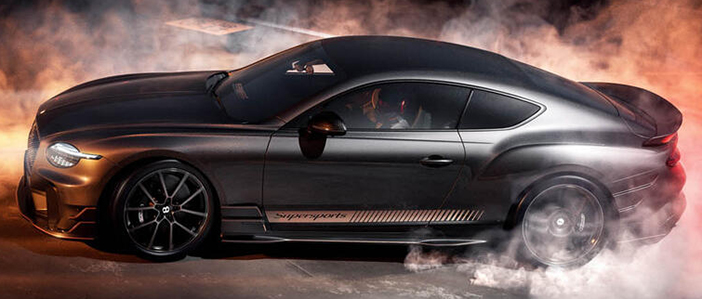
The set-up meant that engineers had to widen the rear track by 16 mm so the power normally put on the road by 4 wheels could be handled by 2. Software also plays a major part. For example, a torque vectoring system combines with an eLSD to enable sharper turn-in and maximise traction under braking. The Supersports also gets its own bespoke steering and suspension tuning, as well as traction management systems. As with the standard Conti, the Supersports has double wishbones at the front, a multi-link axle at the rear, air springs and rear-wheel steering. Twin-chamber dampers are new. The Supersports is one of the most aggressive-looking Bentleys to date and engineers claim that no elements have been included “just for aesthetic purposes”. The most notable is the new front bumper. Lower and wider than the GT Speed’s, it features the largest splitter yet seen on a road-going Bentley. On the nose sits a new lightweight mesh grille. Elsewhere, the Bentley features two pairs of stacked dive planes, chunky side sills, large wing blades, a new rear diffuser and, strikingly, a boot spoiler. In total, the Supersports generates over 300 kg more downforce than the GT Speed (Bentley has not given a specific figure for either car) while maintaining a 54:46 front- to-rear weight distribution. Bentley claims that with the optional Pirelli P Zero Trofeo RS tyres (which are fitted to 22 inch aluminium wheels), the chassis changes and weight-saving mean the Supersports can corner around 30% quicker than the GT Speed, with up to 1.3g of peak lateral force.
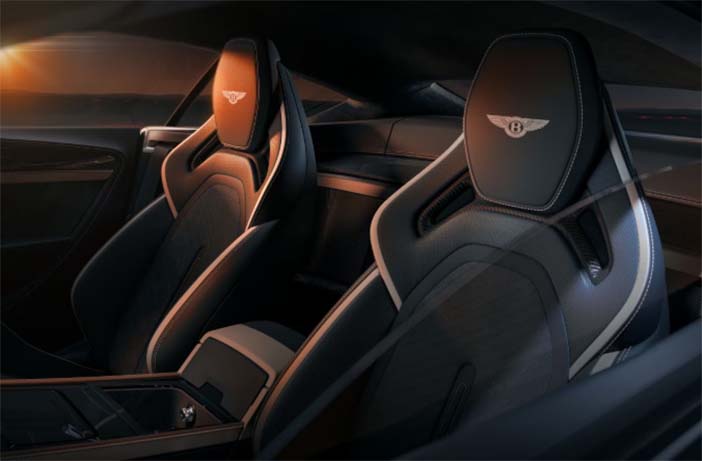
Like the exterior, the interior is also purposeful, albeit with Bentley touches, such as carbonfibre panels and lashings of leather. The car is fitted with more bolstered, lightweight, carbon buckets that sit lower than the seats in the GT Speed. Like the standard car, it gets a 12.3 inch touchscreen and digital driver’s panel. In place of the rear seats is a leather-wrapped carbon tub. Production will begin in September and most cars are expected to head to the US, Bentley’s main market. +++
+++ Volkswagen may cancel its plan to move GOLF production to Mexico. The news comes as the company reviews key elements of its global production strategy announced last year. This is down to delays in the development its Scalable Systems Platform (SSP) for EVs, growing financial pressure and employee unrest. A decision to transfer production of the Golf from its traditional home in Wolfsburg, Germany, to Puebla, Mexico, in 2027 was announced in December last year as part of a job security deal made with Volkswagen’s works council. +++
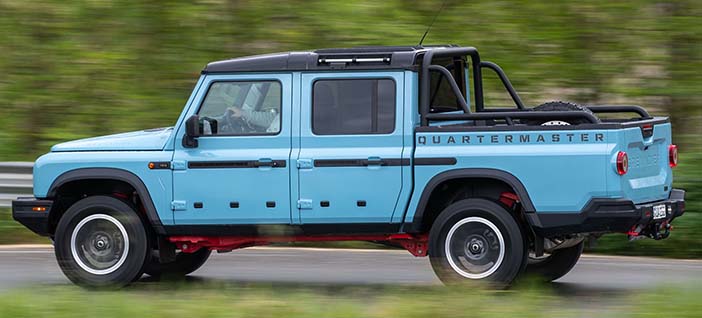
+++ INEOS AUTOMOTIVE has announced that it will axe “several hundred” jobs amid continued high losses. The cuts will affect a large percentage of its circa-1.850 global staff, based at sites including its London HQ, its engineering center in Böblingen, Germany, and its factory in Hambach, France. The company didn’t give an exact figure, saying the process was still in the consultation phase. Staff members employed in building the Grenadier off-roader and Grenadier Quartermaster pick-up in the former Smart factory in France will be unaffected by the cuts, a spokesperson said. +++
+++ JLR lost more than half a billion pounds in the 3 months to 30 September, as the devastating effects of a cyber attack weighed heavily on its financial performance. The attack halted production across JLR’s plants for 5 weeks from 2 September, and the resulting loss of revenue ended a run of 11 straight profitable quarters for the company. JLR posted a loss of 620 million euro for the quarter, of which 225 million was a direct result of the hack. JLR didn’t say whether any of that amount was paid as a ransom to the hackers. +++
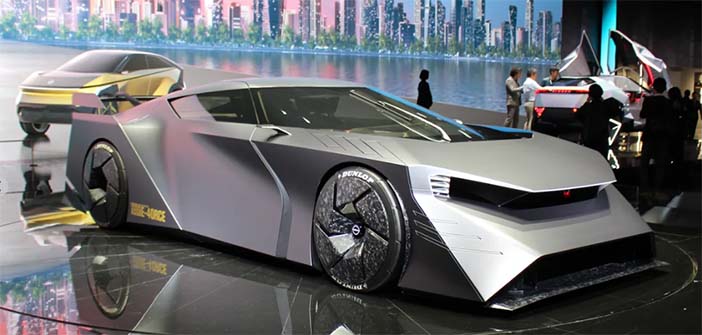
+++ NISSAN is reconsidering plans to launch an electric successor to the GT-R supercar based on 2023’s outlandish Hyper Force concept. Previously described by the firm as a “tangible lucid dream”, the Hyper Force is a brutalist, futuristic vision of what an R36-generation GT-R could look like, featuring a solid-state battery and a 1.360 hp 4-wheel-drive powertrain .Upon its unveiling, bosses said the concept was feasible for production by 2030 as an EV successor to the V6-powered R35 GT-R, which went out of production earlier in 2025 after a 17-year stint. But now product boss Guillaume Cartier has said the Japanese firm is “exploring different routes” to a next-generation GT-R. He said “it’s something I believe in, as I was in charge of launching GT-R in Europe” but there remains “no clear plan” to launch a new supercar. The rethink comes as manufacturers of premium and sports cars confront weak global demand for EVs in those segments. Maserati cancelled plans to offer an electric version of the MCPura supercar this year, for example; Lotus has delayed plans to launch an electric equivalent of the Emira; Porsche has extended the life of the petrol-powered 718; and Polestar has put its 6 electric super-roadster on the back burner. Cartier didn’t say whether this was a factor in the uncertainty around the next GT-R but did say the decision isn’t a priority, as such a model wouldn’t be a high-volume proposition globally. “You have 3 major sports car markets in Europe (United Kingdom, Switzerland and Germany) and the rest like it but don’t have a real market”, he explained. Nevertheless, he added that “the impact and consideration of the brand is important, so that’s something we are considering”, suggesting Nissan could consider the GT-R viable as a halo product rather than a meaningful revenue generator. +++
+++ The second-generation VOLKSWAGEN T ROC R will arrive in 2027 using the same drivetrain as the latest Golf R, updated with the addition of mild hybridisation. The electrical element will not boost the engine’s outputs beyond the current 333 hp and 400 Nm but instead ensures its compliance with the forthcoming Euro 7 emissions regulations. The upgraded engine is combined with a standard 7-speed dual-clutch gearbox and the latest version of Volkswagen’s multi-plate-clutch 4-wheel drive system. As with the Golf R, buyers will be offered the option of a titanium Akrapovic exhaust system with 4 tailpipes. Key changes for the new T-Roc R include a move onto the MQB Evo platform, which also underpins the current Passat, Tiguan and Golf. This brings a significantly wider track than on the outgoing T-Roc, promising more lateral grip. It will also use components from the Golf GTI Edition 50, including stiffer springs. The new T-Roc R will ride on 20 inch wheels shod with 245 mm-wide performance tyres; 30 mm broader than previously. Although the interior of the new model remains under wraps, Volkswagen said the R will receive its own digital instrument graphics along with other sporting touches, including a new steering wheel and new front seats. The new T-Roc R will enter production in October 2027, with Dutch sales planned to begin shortly after. +++
+++ The VOLKSWAGEN GROUP has become the latest Exhibit A in how U.S. tariffs, sluggish markets worldwide, rising competition from China and slowing EV adoption rates have undermined finances and planning across the auto industry. The company’s supervisory board has delayed until next year the approval and release of spending plans for new and updated products, factory investments and other outlays, including a new Audi assembly plant in the U.S. The company’s spending program typically looks out 5 years. The VW Group, the world’s second-largest automaker after Toyota, has a financing gap of about €11 billion for investments earmarked for 2026 alone. The company has already delayed several key product programs across various brands. +++