
+++ Chinese automaker BYD said its annual sales rose to a record $116 billion, outpacing Tesla’s, but its profit fell for the first time since 2021 under pressure from cutthroat competition. BYD, the largest electric vehicle maker, has been expanding into global markets including Latin America and Europe, where auto analysts say profit margins are typically higher than in China. It’s also banking on cutting-edge technology upgrades to grow appeal, announcing a new powerful fast-charging battery days ahead of its earnings report. With competition inside China at punishingly high levels, analysts foresee a tough road ahead this year. But in a boost for EV makers, higher oil and gasoline prices due to the Iran war are starting to recharge interest in renewable energy. Domestic sales have been declining recently for Shenzhen-based BYD, which overtook Tesla in 2025 as the world’s biggest EV maker, selling 2.26 million electric vehicles last year, up 28% from a year earlier. Tesla said it delivered 1.64 million vehicles, down 9%. The Chinese company’s revenue grew 3.5% to 804 billion yuan ($116 billion) in 2025, another record, eclipsing rival Tesla’s full year revenue of $94.8 billion. However, BYD said its annual profit was 32.6 billion yuan ($4.7 billion) last year, down 19% from 2024. The company last booked a profit decline in 2021. The Chinese auto group has reported 6 straight months of declining sales. Total sales in January-February fell 36% year-on-year to 400.241 units, as higher overseas sales didn’t offset persistent weakness in domestic demand. “They cannot rely on mass market EVs to help them keep the same volume that they were selling”, said Chris Liu, a Shanghai-based senior analyst at advisory group Omdia. A fierce price war in China, the world’s biggest auto market, has hurt BYD’s profitability, and rivals such as Geely Auto were gaining ground in early 2026. “We also recognize that competition in the NEV (New Energy Vehicle) industry has reached a fever pitch, and is undergoing a brutal ‘knockout stage’ ”, chairman Wang Chuan-fu wrote in its earnings report Friday. Wide-reaching government subsidies meant to encourage Chinese drivers to switch to EVs have been extended but are scaled back this year, putting pressure on carmakers. Expectations are that the Iran war and the global energy shock would push more people to switch to EVs, with the likes of BYD standing to gain at home and overseas. BYD shares traded in Hong Kong have fallen more than 20% over the past year but have been rising in March. Meaningful technology upgrades may be the key to regain markets, analysts say. BYD in early March launched a new generation of the powerful “blade” EV battery that can achieve a nearly full charge in 9 minutes. It also introduced new car models such as the new Datang SUV installed with its latest technologies, which auto analysts at HSBC said in a research note could “help BYD to regain domestic market share through technology leadership”. Overseas, BYD plans to keep growing its global market share to hone its profits. It has made inroads in the United Kingdom, Brazil and Argentina and is aiming to sell around 1.3 million vehicles overseas in 2026, up from about 1.05 million last year. Its strategy in building and expanding factories overseas will also help boost its international market growth, said Claire Yuan at S&P Global Ratings. +++
+++ GEELY AUTO has launched Geely Technology Europe, a R&D hub that consolidates its engineering operations in Sweden and Germany to streamline global vehicle development and reduce the time gap between Chinese and international market launches. The new European R&D powerhouse, announced on March 26, 2026, builds upon Geely’s long-established presence in Europe, which began in 2013 when the Chinese automaker partnered with Volvo to establish a Research and Development Centre in Gothenburg, Sweden. According to Geely, the institute will work in coordination with the Geely Research Institute in China to develop vehicle platforms designed for global markets from inception. The organization aims to cut the delay between domestic Chinese and overseas product launches to under 6 months. “Europe is more than a key market, it is a global benchmark for automotive excellence”, said Giovanni Lanfranchi, CEO of Geely Technology Europe. “Establishing Geely Technology Europe creates a genuinely borderless R&D setup; a strategic edge that allows us to not only meet global standards, but help set them”. The European hub represents the latest evolution in Geely’s strategic approach to global research and development, positioning Europe as a crucial center for vehicle architecture, software development, and regulatory compliance across multiple brands, including Zeekr, Lynk & Co and Geely. A few days ago, European testing authorities granted regulatory certification to Geely Auto Group’s advanced driver assistance system; the company revealed on March 13 that its “G-ASD” system secured UN R171 certification, an essential regulatory milestone for operating within the European Union, clearing the path for vehicles featuring this technology to enter European markets. This announcement follows Geely’s December 2025 unveiling of the world’s largest automotive safety testing facility in Hangzhou Bay, China. That facility, which benefited significantly from Volvo’s renowned safety expertise, represents another milestone in Geely’s global technological advancement strategy. With plans to double its European-led vehicle projects by 2027, Geely Technology Europe will focus on three core areas: co-development of global architectures, market-specific product optimization, and AI-powered digital experiences, including advanced driver assistance systems and smart cockpit technologies. +++
+++ The HYUNDAI MOTOR GROUP will expand its annual production capacity by 1.2 million vehicles by 2030 by accelerating its localization strategy tailored for each region, the firm’s CEO Jose Munoz told investors during its regular shareholders’ meeting Thursday. The renewed vision comes as the global auto industry undergoes a major paradigm shift into electrification. The global trade uncertainty (triggered mostly by the imposition of auto tariffs from the United States) also comes as a lingering risk factor to the Korean carmaker. However, Hyundai said it identifies the industrial transition and trade risk as major opportunities to widen its global sales. “With Hyundai Motor Group Metaplant America ramping to full capacity, hybrid production being added to our U.S. manufacturing footprint, and new production bases planned in India, Saudi Arabia and Vietnam, we will produce more vehicles closer to where our customers live”, Munoz said. “We will expand our global annual production capacity by 1.2 million units by 2030, and this is how we turn trade challenges into structural advantages”. The carmaker placed its strategic focus on executing specific localization strategies for each market. Starting from 2027, Hyundai Motor said it will introduce its extended range electric vehicles (EREVs) with more than 965 kilometers of driving range in North America. EREVs are cars with a petrol engine which is used only for charging batteries. North America is the most strategically important market for the carmaker, as the region accounts for the largest portion of its total global exports. The company also shared its plans to launch its first body-on-frame midsized pickup truck before 2030 in the region where demand for commercial vehicles remains strong. Hyundai Motor has also identified China and India as the carmaker’s 2 major revenue areas. In China, the carmaker plans to launch 20 new models for the next 5 years. “We have already introduced the Elexio electric SUV, with a C-segment electric sedan to follow”, he said. “Our goal is 500,000 annual sales there; more than double our current volume”. For the Indian market, the carmaker will launch a total of 26 new models by 2030 by investing $5 billion. “We will launch India’s first locally designed, engineered and manufactured electric SUV by 2027”, Munoz said. “The Hyundai Motor Group will also bring Genesis to India in the same year”. On the software front, the carmaker promised to continue deepening ties with globally renowned tech firms in areas such as artificial intelligence (AI) and autonomous driving. “Our collaboration with Nvidia, our investments in 42dot and Motional, our partnership with Waymo and our commitment to building an AI data center in Korea are all part of our efforts to secure this technological competitiveness”, he said. “We are pursuing multifaceted collaborations to lead in the most consequential technology race of our era”. +++
+++ LEAPMOTOR has Leapmotor officially launched its new A10 (international name: B03X) pure electric compact SUV. The A10 is available in 4 variants. Autointernationaal.nl expects prices will range from 18.995 euro to 24.495 euro in the Netherlands. This car was first unveiled at the Guangzhou Auto Show last year. Positioned as a pure electric compact SUV, the Leapmotor A10’s key highlights include the availability of lidar, Qualcomm 8295 and 8650 chips, and a maximum pure electric driving range of almost 400 km. The A10 adopts Leapmotor’s “Tech Natural Aesthetics 2.0” design language. The front fascia features “Smiling headlights”. A trapezoidal lower bumper intake is complemented by ventilation openings in the fog light areas. The A10 offers a palette of 6 vibrant exterior colours: Seaweed Green, Acorn Brown, Berry Blue, Tundra Gray, Galaxy Silver and Morgan Pink.
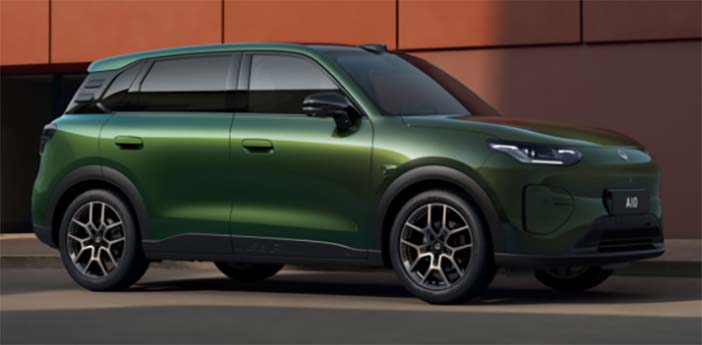
The vehicle measures 4.270 mm in length, 1.810 mm in width and 1.635 mm in height, with a wheelbase of 2.605 mm. It rides on 18 inch wheels. The rear design is highlighted by its “Haha taillights”. Inside, the A10 features a dual-spoke multi-function steering wheel, an 8.9 inch full LCD instrument cluster and a 14.6 inch 2.5K floating central control screen. The infotainment system is powered by a Qualcomm SA8295 cockpit chip and integrates Qwen’s AI assistant. A floating IP BAR located below the central screen offers customizable options such as ambient lighting, a fragrance dispenser, a safety hammer, or a humidifier. Comfort features include heated front seats and a heated steering wheel. The A10 offers a 106 liter sunken storage compartment in the trunk, and the rear seat cushions can be flipped up 60 degrees to create additional storage space. The A10 is equipped with lidar and a Qualcomm SA8650 chip, enabling “parking space to parking space” full-scenario assisted driving. This suite includes City NAP (Navigation Assisted Pilot), Highway Navigation, and Memory Parking functionalities. The A10 utilises 2000MPa aerospace-grade hot-formed steel in critical areas to ensure occupant protection. The Leapmotor A10 is powered by a single electric motor, available in 2 output options: 95 hp or 122 hp, both delivering a peak torque of 150 Nm. Customers can choose between 2 battery capacities: 39.8 kWh or 53 kWh. These battery options provide CLTC pure electric driving ranges of 320 km and 400 km, respectively. The A10 also supports fast charging, capable of replenishing the battery from 30% to 80% in 16 minutes. +++
+++ It has been confirmed that an all-new combustion-powered PORSCHE Cayenne is in the works and that it will build the upcoming model with petrol and hybrid engines. Ralf Keller, Porsche’s director of SUV model lines, told: “We plan to have these combustion engines and hybrids available far into the next decade”. This will include an all-new model, replacing the current petrol Cayenne that has been on sale since 2018. This represents a sizeable investment into the future models, but Porsche will continue to share a development partnership with Audi, as the 2 firms do on SUVs with a combustion engine now. Keller told: “We can use the MLB-Evo platform, and we can use the PPC platform. It was always successful to share these things”. This suggests that Porsche will run a version of Audi’s new PPC platform, with the new Cayenne sharing key technologies with the new Audi Q7 that’ll arrive later this year. This set-up is a heavily updated version of the MLB-Evo platform used before, but with a few key differences. Fundamental upgrades to the car’s electronic architecture, and the flexibility of its integration of hybrid technologies should make it more powerful, more efficient and more dynamic than what has gone before. Keller suggested to us that this will include the latest technologies found in its other models, saying: “We have the chance to integrate Active Ride into the petrol car; the Cayenne doesn’t have that. That could be one thing. And then maybe you know the technique of the 911, of electrification, maybe this is something that would also work with a new Cayenne. It’s not a clear plan now, but there are many technical things that we can put into the petrol Cayenne”. In terms of size, the new Cayenne will exist in a Porsche line-up that also includes the future petrol-powered Macan and K1 flagship. These models will book-end the SUV range in terms of size, keeping the general footprint of the future ICE Cayenne similar to that of the current model. Keller confirmed this, saying: “The Cayenne was always best as a compact car, and the next one will stay consistent with that”. What will change over the current ICE model, however, is the design inside and out. The program has already been initiated, but there should still be time for Porsche’s new head of design, Tobias Sühlmann, to have an influence. However, the company could decide to go down the route of offering 2 distinct models on different platforms, covered by the same ‘top hat’, similar to what Mini has done with petrol and electric versions of its Cooper. Inside the new petrol Cayenne, expect the integration of the new electric model’s ‘waterfall’ display, plus extensive personalisation within the colour, trim and wheel options. No firm date has been set for the new Cayenne’s launch, but we expect that it’ll arrive in 2028 or perhaps 2029, leaving a few years for the recently updated version to mature in the market. A sloping-roof Coupe will also no doubt be part of the plan, considering that it makes up 60 percent of European sales, and around 40 percent of total global sales. +++
+++ Ouyang Minggao said SOLID STATE BATTERIES may require 5 to 10 years to reach a 1% market share, adding a longer-term adoption estimate to his earlier comments on the technology’s rollout. The estimate adds a market adoption timeline to earlier disclosures from the same event, which focused on vehicle-level deployment and technical development stages. Ouyang Minggao, a Chinese Academy of Sciences academician and Tsinghua University professor, has led research on battery systems and new-energy vehicle powertrains. Ouyang said all-solid-state batteries are expected to begin vehicle installation around 2027. He presents this as an initial deployment phase, distinct from broader market adoption. He notes that entering vehicles does not equate to large-scale commercialisation, which depends on further development and scaling. He also states that test vehicles equipped with solid-state batteries are expected to appear between late 2026 and 2027. Chery announced that its solid-state battery has reached an energy density of 400 Wh/kg, with a target of 600 Wh/kg and plans for vehicle testing in 2027. Geely said it aims to complete its first in-house solid-state battery pack in 2026 and begin vehicle validation. Battery supplier Eve Energy also released solid-state battery products, including a 60 Ah automotive cell and a consumer-focused design optimised for lower-pressure conditions. Japanese automakers continue parallel development programs. Toyota plans small-scale production around 2026 and larger-scale output after 2030, while Nissan aims to launch a production vehicle equipped with solid-state batteries in 2028. Ouyang Minggao explains that conventional lithium-ion batteries consist of a cathode, an anode, an electrolyte, and a separator, with liquid electrolytes enabling ion transport. All-solid-state batteries replace the liquid electrolyte and separator with solid-state materials, forming a “liquid-free” structure. This design is associated with a higher theoretical energy density compared with current commercial lithium-ion batteries, which are around 300 Wh/kg. Large-scale adoption depends on resolving multiple technical challenges, including high interfacial resistance at solid-solid interfaces, lithium dendrite formation, and limitations in cycle-life performance. The report adds that cost reduction requires scaling production volumes, as manufacturing capacity expansion is linked to lower unit costs. It also notes that safety characteristics are still under evaluation. Ouyang said solid-state batteries are not “absolutely safe,” and that the technology remains at an early stage with multiple issues yet to be addressed. Despite ongoing development and announcements, solid-state batteries are unlikely to reach meaningful market scale in the near term. Ouyang’s estimate that reaching 1% market share could take 5 to 10 years suggests that large-scale adoption lies beyond the initial phase of vehicle integration. +++
+++ SMART , a brand known for its compact city cars, is facing challenges with its strategy to “grow bigger”. Despite confidently dismissing criticisms about increasing vehicle sizes in February, market data suggest consumers aren’t embracing this direction, with unsold inventory now being liquidated through used car channels at steep discounts. According to data from the China Association of Automobile Manufacturers and the Passenger Car Association, Smart sold 29.986 new vehicles in the past year (March 2025 to February 2026). The smallest and longest-available model, the #1, accounted for approximately 64% of sales, while the larger #3 and #5 models represented just 14% and 22% respectively. The #5, Smart’s largest and flagship model, heavily promoted in 2025 (particularly the plug-in hybrid version launched in China in October 2025), has notably underperformed. Yuan Auto reported that brand-new, unregistered Smart #5 vehicles are being sold through a used car platform in Chongqing at prices 13.000 euro below the official recommended price. “These are all Smart #5 long-range luxury versions. They’re from late 2024”, a platform employee told, adding that prices could be negotiated even lower for trade-ins or financing customers. This liquidation isn’t surprising for a model whose monthly sales have consistently remained in the 3-digit range in China. What’s concerning is Smart’s persistence with increasingly larger vehicles despite the #1 consistently outperforming its larger siblings. Even more worrying, Smart’s next major release is the #6, an even larger vehicle than the #5. According to regulatory filings, this plug-in hybrid sedan approaches 5 meters in length with a wheelbase of 2.926 mm, the longest in Smart’s line-up. The #6 will compete directly with the Xiaomi SU7 and Tesla Model 3, where no manufacturer has yet successfully challenged these 2 dominant models.
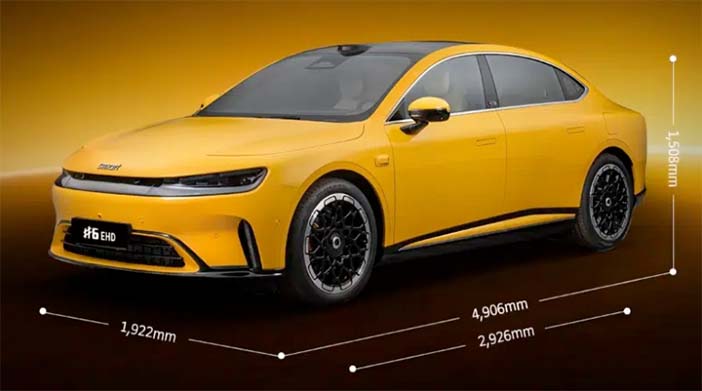
Meanwhile, the #1, Smart’s bestseller, has seen 4 iterative updates since its June 2022 launch, but these have primarily involved price reductions and minor configuration adjustments rather than significant improvements to design, battery technology, or driving assistance features. The current #1 model still offers the same 150 kW maximum fast-charging capability as the 2022 version, while comparable competitors like the Lynk & Co Z20 (also built on Geely’s Sustainable Experience Architecture) now support up to 300 kW fast charging. After the #6, Smart appears to be returning to its roots. According to Smart Global CEO Tong Xiangbei, the upcoming #2 will feature a 2-seat design built on a new all-electric platform and is expected to debut at the Beijing Auto Show in April, with both hardtop and convertible versions to be released starting in late 2026. +++
+++ VOLKSWAGEN will stick to plug-in hybrids for Europe, with brand CEO Thomas Schäfer ruling that range-extender technology “makes no sense” here. Volkswagen’s Chinese joint-venture with SAIC has revealed the ID.Era, a 7-seat SUV concept heading for production. Its battery offers a 300 km range, extended by another 700 km thanks to an efficient on-board engine acting as a generator. But what works in flowing Chinese traffic doesn’t work with the cut and thrust of European roads, and that’s before you get into the sheer expense of offering a big battery, electric motor and combustion engine, argues VW. “We have the technology in China”, Schäfer told. “There you swim with the traffic, but for driving in Europe, I’m not so sure. The only evidence of it is the Nissan Qashqai e-Power”. The updated Qashqai isn’t a plug-in so relies on its 1.5-litre engine to summon its range of up to 1.200 km. The downside is CO2 emissions of 102 g/km; more than twice that of many plug-in hybrids, which benefit from running mostly on battery power for the WLTP test cycle, although economy slumps when the battery is drained. “The European CO2 rules don’t give you any benefit for range extenders”, continued Schäfer. “And it’s expensive technology. We could bring it but it’s nothing that makes sense”. VW showed its range-extender (REx) tech in the ID.Era, an SUV with a large footprint which can easily fit the tech. The only European VWs that could conceivably accommodate such a drivetrain are the Tiguan and 7-seat Tayron SUVs. “But we have plug-in hybrids with a 150 km range on most of our major cars. That’s okay”, said Schäfer. VW R&D chief Kai Grünitz also waded into the debate, arguing that an electric car with a 640 km range and 15-minute charging time would make the need for REx tech academic. “Why should you combine that with an engine? It’s the worst of both worlds: an expensive, big battery with an expensive engine. And a range extender is always heavy, so it’s definitely not an efficient vehicle”. So the battle lines are being drawn. On one side there’s Leapmotor with its C10 range-extender, a technology Renault has also promised to develop for midsize cars on a new electric vehicle platform after 2028. But Volkswagen won’t be extending the range of hybrid vehicles on sale any time soon. +++
+++ XPENG officially reported that its net loss shrank by 80.3% in 2025, compared to the previous year. At the same time, the company’s revenue surged by 87.7% year-over-year due to the strong sales growth. On March 20, the Guangzhou-based new energy vehicle maker Xpeng released its operating and financial summary for 2025. The company solidified its position last year with new models. Xpeng delivered 429.445 units globally, up 125.9% Y-O-Y. According to China EV DataTracker, this NEV maker sold 383.873 units domestically, representing a 119.4% increase. The Xpeng’s total revenue surged by 87.7%, reaching 76.72 billion yuan (11.12 billion USD). The automobile sales revenue was 68.38 billion yuan (9.91 billion USD), representing a 90.8% increase compared to 2024. At the same time, the company’s gross profit margin reached 18.9%, compared to 14.3% in 2024. Most notably, Xpeng’s net loss shrank by 80.3% to 1.14 billion yuan (170 million USD). For clarity, the company’s net loss was 5.79 billion yuan (840 million USD) in 2024. The non-GAAP net loss was just 460 million yuan (66.6 million USD). This number excludes share-based compensation expenses and fair value losses. It is worth noting that Xpeng recorded the first-ever net profit in Q4 2025. It reached 55 million dollar, marking a turnaround from a net loss of 190 million dollar in the same period of 2024. The company’s growth is linked to new car launches, including the Xpeng X9 minivan with an EREV powertrain, the new Xpeng P7 sedan and the Xpeng G7 crossover. At the same time, the company also has other high-volume models, including the Mona M03 and the P7+. The company also provides some of its tech to Volkswagen. Despite positive financial results reached in 2025, China EV DataTracker data shows that Xpeng delivered 28.415 units from January to February 2026, down 49.5% Y-O-Y. This drop correlates with the overall drawdown caused by phased-out subsidies for new energy vehicles in China. This year, Xpeng will launch a few more models, including the full-size flagship SUV called the Xpeng GX. It has recently begun mass production in China. +++