
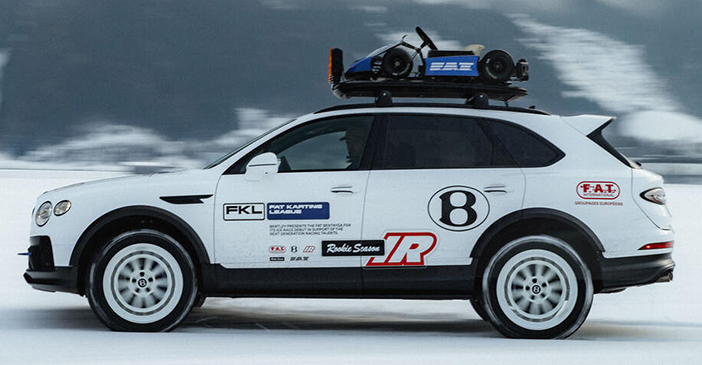
+++ Earlier this year, BENTLEY unveiled the Bentayga X Concept, an off-road-focused version of the luxury SUV. The automaker was clear about its intentions, admitting that it designed the concept to gauge interest in an “enhanced off-road capable Bentayga” and there is at least one group interested in a production version: Bentley’s dealers. Bentley has been showing the concept to dealers since early January, and according to Mike Rocco, Bentley’s North America CEO, the dealer response has been, “’Yes, we want that car, bring it to market”. He added that such a model would be a “supreme offering”, limited in production like Bentley’s Supersports. When asked if Bentley could possibly launch such an SUV in the next few years, Rocco said, “I would say sooner than that, on the off-road Bentayga”. And then after that, the automaker will develop something new. The Bentayga X Concept debuted at the end of January, featuring significant off-road upgrades. The SUV had a raised suspension, giving it 12.2 inches of ground clearance and nearly two feet of wading depth. Bentley also widened the track by 5 inches. The Bentayga also had extended wheel arches that accommodate the 22-inch white wheels, a color we hope Bentley keeps for the potential production version. Powering the concept was the brand’s twin-turbocharged 4.0-liter V8 engine producing 650 hp. It sounds like Bentley is seriously considering putting the X Concept, or a version of it, into production. It wouldn’t be alone in wanting an off-road luxury SUV. BMW and Audi are considering similar models to compete with the legendary Mercedes-Benz G-Class, which just had its best sales year ever. +++
+++ FORD needs an influx of fresh models in Europe and it needs it fast. Its share of the new passenger car market on the continent continues to shrink, falling to just 2.8 percent in the first 2 months of the year. Registration numbers published by the European Automobile Manufacturers’ Association show a 20.3 percent drop to 55,025 units. You could argue that the first 2 months of the year don’t tell the whole story. That’s true, but the outlook for the rest of 2026 isn’t encouraging either. Focus production ended last November, meaning the once hugely popular compact model now sits in the car graveyard alongside the Ka, Fiesta and Mondeo. The Puma and Kuga can only do so much, so there’s a clear need for more products. While the Volkswagen-based Explorer and Capri EVs haven’t really moved the needle, Ford is now turning to Renault. Another pair of electric vehicles is on the way, but the first model won’t go on sale until early 2028. In the meantime, the Blue Oval will have to make do without any non-SUV models. Well, there’s the Mustang, but it’s hardly a volume seller. Despite the 2-year gap in its European lineup, Ford’s CEO is optimistic about the future. In an interview, Jim Farley said the company is now developing “passion products” while pledging: “no more generic vehicles”. The 2 electric vehicles currently in development will sit on Renault’s Ampere platform, meaning they’ll be related to small cars like the Twingo, 4 E-Tech Electric and the 5 E-Tech Electric. “Whether they’re based on a VW or Renault platform, we’re going to execute those cars with a swagger that’s specific to Ford of Europe”. In the meantime, Ford of Europe continues to lose market share, and it’s not just to long-running companies. While the likes of Volkswagen Group, Stellantis and the Hyundai Group continue to pull ahead thanks to their vast lineups, newcomers from China are breathing down Ford’s neck. In the first 2 months of the year, BYD’s market share hit 1.9 percent with 36,069 registrations. SAIC is even closer to Ford, with 41.454 registrations, representing 2.1 percent of the market. Chinese carmakers are bringing more and more models to Europe, and if they maintain this pace, it’s only a matter of time before they overtake Ford. I wouldn’t be surprised if it happens by the end of the year, especially now that the Focus is no more. +++
+++ HYUNDAI plans to launch 46 new vehicles in China and India over the next 5 years, as it ramps up efforts to diversify its global footprint beyond the tariff-hit US and sluggish European markets. CEO Jose Munoz stated in a recent shareholder letter that the company will roll out 20 car models in China and 26 in India by 2030. This marks a 2.6-fold increase from the 18 models launched in the 2 markets over the past 5 years. With the new targets, Hyundai aims to raise combined sales in China (444.000 units) and India (832.500 units) to 1.28 million units in the same period. Compared to the 2 markets’ total sales of about 702.000 vehicles last year, the average annual growth rate would be roughly set at 12.7 percent. If achieved, China and India would account for 23 percent of Hyundai’s global sales, up from 17 percent last year. On the other hand, sources say the share of North America and Europe (the carmaker’s key markets) is expected to decline from 43.7 percent in 2025 to approximately 41 percent. Munoz said Hyundai will further accelerate its “In China, for China, to the world” localization strategy. As part of this effort, the company last year unveiled Elexio, an electric SUV developed primarily by its China-based R&D center as its first market-specific model. Built on Hyundai’s E-GMP electric vehicle platform, Elexio has boosted price competitiveness through a localized supply chain, including lithium iron phosphate batteries. However, the model has gained little traction, selling just 569 vehicles in the four months after its launch in October last year. For the Indian market, the automaker aims to introduce an electric SUV developed and manufactured entirely within the country as early as next year, while also considering the debut of its premium brand Genesis. At the group level, Hyundai and Kia have already built an annual production capacity of 1.5 million vehicles in the country, supported by x plants in Chennai, Anantapur and Pune. Industry watchers say Hyundai’s strategic pivot reflects mounting uncertainty in its key markets. In the US, high auto tariffs (currently set at 15 percent) have eroded profitability, costing about 4.1 trillion won ($2.7 billion) last year and contributing to a 19.5 percent drop in operating profit. The elimination of EV consumer tax credits under the Inflation Reduction Act has further dampened demand. In Europe, Hyundai faces intensifying competition from Chinese automakers such as BYD, SAIC Motor and Geely. The combined market share of Hyundai and Kia decreased to 7.9 percent last year, while sales fell 2 percent to 1.04 million units, marking a second consecutive annual decline. +++
+++ There’s a real sense of momentum in Gaydon. I felt it the moment I walked through the doors at JLR’s headquarters. You can see it in the faces of everyone you pass as you move through the bright, minimalist corridors. But more than anything, that spark of energy (mixed with a bit of nerves, but also confidence) was unmistakable in the eyes of Rawdon Glover, JAGUAR ’s managing director and the person steering one of the biggest revolutions in the history of the iconic British brand. And during an early test drive of the Type 00 prototype, I also had the chance to ask him a few questions to better understand what’s really going on. Q: We’re at the start of a new era for Jaguar. What should we expect? A: First of all, in the best tradition of the brand, expect a break from convention. We won’t follow the same rules everyone else follows, especially in the EV world. Expect a decisive shift away from our previous design language. It’s something Jaguar has done several times over its 90-year history. But also expect it to drive like a Jaguar. Q: The Type 00 is ambitious, both technically and in terms of positioning. How did you decide on its attributes? What makes it different? A: Some of this is subjective, so I’ll give you my take. What makes it special is its ability to reconcile things that are often at odds with each other. On one hand, we’re an electric brand, so range is fundamental. On the other, proportions and overall height matter a lot to us. This four-door GT stands just about 135 cm tall. Traditionally, a project like this forces a choice: either increase battery pack thickness to get more range (raising the car in the process) or accept a compromise on driving distance. We looked for different solutions. In this case, unlike almost everyone else, we’re positioning part of the battery pack ahead of the lower structures. To do that, we had to completely rethink energy management and impact behavior. That lets us keep the car low, preserve the proportions, and at the same time avoid sacrificing either range or performance. It’s an example of the approach we’ve taken. I remember when I saw the model for the first time, I wondered how it would stand up to aerodynamic requirements and active and passive safety demands. And yet we managed to maintain the purity of the design while also achieving the most aerodynamic Jaguar ever, with a 0.23 drag coefficient. That’s a notable result for a car with these proportions, especially because we didn’t follow the typical EV route of similarly shaped, rounded designs with small wheels. Q: What have you learned during development? A: That it isn’t easy. Creating a new vehicle while also rebuilding a brand is complex. The biggest lesson is that without teamwork, you don’t achieve anything. For example, on aerodynamics we started at a drag coefficient of about 0.30 and brought it down to 0.23, with clear benefits for range. That was only possible thanks to ongoing collaboration between designers, modelers and engineers, with about 15.000 tests and changes. Q: Based on your market research, who are the buyers for a car this unusual? A: Well, it certainly won’t be inexpensive: the average price in Europe will be over €130.000, so spending power is the first factor. We’re likely talking about customers who are more urban than rural and who are open to EVs, even if they aren’t necessarily current EV owners. But what truly connects them is a mindset: they value design and quality, they’re interested in technology, and above all they’re independent and self-assured. They choose brands that represent them. This is a car with a strong design statement that speaks to people who want to stand out. Every use should feel meaningful, whether it’s a highway trip or simply arriving somewhere. Q: How will the Jaguar lineup evolve from here? A: Future Jaguars will share some key elements already seen on the four-door GT. They’ll have very pronounced proportions and a strong identity. They’ll all be fairly low. We won’t move into tall SUV territory, because that’s already very well covered by Range Rover. There will be strong stylistic consistency across the range, but each vehicle will have a distinct personality. Q: Stepping back, you halted production of the previous models and cancelled future programs. How did you arrive at such a drastic decision? A: Looking back 5 or 6 years, Jaguar’s business model wasn’t working: it wasn’t profitable, it wasn’t growing, and the customer base was aging. Culturally, the brand was also losing relevance. And competing in the premium volume segment dominated by German automakers was extremely difficult, especially for reasons of industrial scale. Our model works better at the high end, where it’s possible to support higher prices with more distinctive products. That’s why an update wasn’t enough: we needed a clean break. That led to the decision to stop existing programs and restart. Q: The communication around the first prototype reveal was heavily criticized. Some accused you of trying to erase the past (like deleting Instagram posts) while others accused you of being “woke,” with colourful ads and androgynous characters. Was that reaction intentional, or did you get something wrong? A: I think it depends a lot on how you look at the brand launch experience and what we did in Miami. Jaguar was becoming more and more of a forgotten brand. Yes, people still had a strong emotional connection with it, but what they loved wasn’t what we’d been doing in recent years. It was what we’d done 30, 40, 50 years ago. For us, that was a real challenge. The purpose of the initial campaign was simply to send a signal. What we wanted to say was: “Look, Jaguar is doing something truly radical. It’s not what you expect from Jaguar. It’s something about originality, difference, standing out.” Now, if you asked me: did you expect Jaguar to become the most talked-about brand on social media globally for three straight days? I would have thought you were crazy: of course not. So in a sense, we achieved far more than we expected: much more attention, many more people looking at what we were doing. From a big-picture perspective, that’s positive. People were interested and started talking about Jaguar again. What we lost in that moment, though, was control of the narrative. Social media is a very binary, divisive platform. Everything becomes: I like it, I don’t like it. It’s this, it’s that. Black or white—about anything. We had a much more nuanced story, about renewal and connecting to the past. Those details are very hard to communicate on social platforms. That’s why we’ve now “unpacked” the message to explain it to people: to journalists, to customers, to potential customers. And when you explain it properly, people understand. But I think it’s fair to say that for a period we lost control of the narrative. Now that we’re starting to talk about vehicle dynamics, we’re no longer talking only about design, but also about engineering. That gives us far more opportunity to go into detail: how does it drive? What are the benchmarks? And that’s why we’re coming back to some of Jaguar’s iconic models from the past. Because if you think about it, until recently (until December) we were only talking about design. Now we have the ability, consistently, to talk about dynamic capability. And that’s exactly what car enthusiasts and Jaguar fans wanted to hear. I always try to see the glass half full: we created interest, we created anticipation. People now want to know: what will you do next? What’s the production car like? How does it drive? What’s it like inside? And that’s a very positive thing, because we’ve built a base of interest that didn’t exist 14 or 15 months ago. Now it does, and we have to manage it carefully. Q: Looking back, would you still have presented it in pink? A: You know, we were in Miami. You know what the local football team colour is there? Pink. It’s a typical colour for the city and its sunsets. The real question I’d ask is: did the car look good? Did you like it? I don’t have the option of going back and starting over, so I look forward and say, “OK, what did we learn?” And what we learned is that we need to pause and spend more time controlling our messaging. Q: Rolls-Royce, another British luxury brand, has said its gas-powered models will live beyond 2030, stepping back from the goal of being fully electric by then. Would you ever consider hybrids? Is it technically possible on this platform? A: No. Jaguar will be exclusively electric. We’re not working on anything else. Compared to other models on the market, we’re talking about ranges of around 700 kms. At that kind of range, charging anxiety becomes much less of a concern. Q: Last question. What comes after this Type 00, and do you also have a plan B? A: What’s next? We’re working on the entire line-up. A four-door GT is essentially finished. We’re in the final stages. Now we’re moving into the technical development phase (that’s the next step) and we’re excited about that new model just as much as we are about the first. We believe in what we’re doing. We’re taking risks, sure, but nothing is risk-free. And I think if you look at our past, Jaguar has often taken an approach that didn’t necessarily follow the path everyone else was taking. We think this is the right moment to continue in that direction. +++
+++ American electric car maker LUCID will finally come to Europe in 2027 with the Cosmos, a rival to the BMW iX3 and Volvo EX60. The premium SUV will be unveiled later this year ahead of production starting at the company’s recently completed plant in Jeddah, Saudi Arabia. Lucid will then follow up in 2028 with the more off-road-and adventure-focused Earth and a bigger, more practical derivative of the Cosmos after that. The Cosmos is the first of Lucid’s new range of ‘mid-size’ models. It is built on an entirely new platform that uses a bespoke 800V architecture, but it is powered by even more compact and efficient electric motors than those offered today. European president Lawrence Hamilton sees strong market appeal for both the mainstream Cosmos and off-road-flavoured Earth, pointing to the continuing success of adventure-themed premium cars like Land Rovers and the Mercedes G-Class. “So the more utilitarian direction, we definitely see appeal for that in Europe”, he said. “It’s a statement piece about the way people want to spend their time. And there’s obviously huge market demand for the sleeker, sportier crossovers”. Sales in Europe so far have been slow, but Hamilton mostly puts this down to Lucid’s gradual start with direct-sales stores. “The strategy was always quite clear, which is to start relatively small and modestly”, he said. “Arguably, the Air and the Gravity are proofs of concept and brand-building: they show the world what we’re capable of doing. Midsize cars, like the Cosmos, will provide that capability to a bigger mass market”. There are no plans for European production, though. Lucid has weathered some profitability storms. in its short existence, but Hamilton said the company has the liquidity to carry on with the development of the mid-size cars, and it is on track with the production ramp-up of the Gravity. The company is confident about sticking with EVs and won’t be developing range-extenders. Hamilton added: “We are not interested in having anything to do with fossil fuel-burning technologies. We are pure BEV, because we believe it makes a better product”. +++
+++ Godzilla is never really gone, only sleeping. The next-generation of the NISSAN GT-R is apparently in the very early stages of product development. Nissan North America’s Chief Planning Officer, Ponz Pandikuthira, says we’re likely to hear more news about the R36 GT-R around 2028. And we should see the actual car before 2030. Pandikuthira says that the next-generation GT-R would likely retain some form of its V38 engine. This makes some sense considering the twin-turbocharged V6 engine is capable of delivering prodigious power. But the engine won’t work on its own because the current V38 wouldn’t meet various global emissions requirements. And Nissan wants it to be a global car. This means hybridization will be a must. In an era of increasing use of electric motors and battery packs to deliver wild amounts of horsepower, it seems a no-brainer that the future GT-R will follow this path. The R35 was never really a lightweight car by sports car standards, but when it first appeared, it was a bit of a technological wonder. You had a very cool center stack with various witches paired with a display designed by Polyphony Digital from Gran Turismo. The AWD system enabled wicked launches, while the twin-turbo engine and dual-clutch gearbox delivered incredible on-track performance. A future R36 GT-R would only elevate the same basic concepts through enhanced torque vectoring, next-gen displays, and the potential for truly wild power output. The GT-R punched well above its weight for a long time. As sports cars and supercars evolved, the Nissan GT-R stuck to its formula and somehow managed to remain wildly quick throughout. Still, the pace of performance has eventually outgrown what the GT-R could offer. It’s time for Godzilla to rest a bit and return in an evolved form in the future. +++
+++ OPEL is working on a hot new electric Astra as the next model in its recently relaunched GSE sub-brand. It will be the first Astra hot hatch since the OPC bowed out in 2017 and the third Opel to wear the new GSE badge after the Mokka and upcoming Corsa, with which it is tipped to share its 280 hp FWD powertrain, including an electronic limited-slip differential. There is an opportunity for a fast Astra to benefit from the retirement of the Ford Focus ST and Honda Civic Type R petrol hot hatches. It will also enter a growing segment of EV performance hotches that includes the Alpine A290, Cupra Born and Mini Aceman JCW, as well as the Abarth 600e and Alfa Romeo Junior Elettrica Veloce with which it is expected to share key components. Improving brand perception with cars like its GSE models is key in Opel’s plan to fend off competitors from China, with newcorners such as Omoda, Jaecoo and BYD posing a significant threat. “When we look at surveys, Opel scores highly for rational appeal but not so much the emotional”, the brand’s new commercial director, Michael Auliar, told. Insiders suggest there is “momentum” in the GSE sub-brand’s development, with the Corsa arriving later this year and the German brand fielding an entry in the ADAC GSE Rally Cup with an extensively modified Mokka. Although the Astra was the first car to use the GSE name when it was revealed in 2023, it was not the focused performance machine that it was initially billed as. The arrival of the hot Mokka last year effectively relaunched GSE, bringing much more power: 280 hp compared with the Astra GSE Ppug-in Hybrid’s 225 hp, and a bespoke suspension set-up. The new Astra GSE is likely to employ a similar range of upgrades, but it could gain more power to match combustion rivals such as the Volkswagen Golf GTI and ensure it is not outperformed by the smaller, lighter and cheaper Mokka GSE and Corsa GSE. +++