
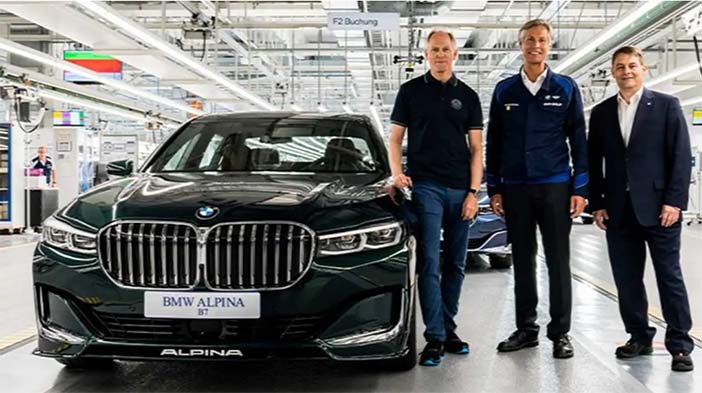
+++ It’s the end of the road for one of the finest performance saloons in the world: ALPINA says goodbye to the BMW 7 Series-based B7 as the Bavarian company makes the switch from the G11/12 series to the all-new G70 generation. It seems that Alpina, now fully owned by BMW, doesn’t plan a successor for the go-fast luxury cruiser. In an official post on Facebook, Alpina Belgium announces the final B7 has been assembled, and “the era of the BMW Alpina B7 is coming to an end in the Alpina automobile manufactory”. The German automaker doesn’t say it directly, but from the announcement, I get the impression that no replacement is currently being developed. Alpina even takes a retrospective look at the high-end sedan by saying it now looks “back at the fascinating automobiles which came about in Buchloe on the basis of the BMW 7 Series”. With the new G70 generation of the 7 Series, it seems that the Buchloe-based company won’t be given access to the platform for performance and luxury modifications. The new Bavarian flagship in combustion and electric forms went into production in July this year and the sales are about to start later this autumn. BMW now even produces the i7’s electric drive components in-house at its Dingolfing plant, where up to 500.000 electric vehicles can be assembled annually. As for Alpina, the high-performance automaker is switching its focus towards SUVs with one of the firm’s latest products being the heavily revised XB7. With a new face and more power than before, first deliveries are scheduled for the first months of next year. The Alpina B7 is now history and, at least for now, there’s no direct replacement planned. At the end of 2025, Alpina will switch to a new deal with BMW probably changing the strategy of the company regarding the models it will modify with the 7 Series being the first to get axed. Recent statements made by BMW officials also put the B3 in trouble, though there’s nothing confirmed for the 3 Series-based vehicle. +++
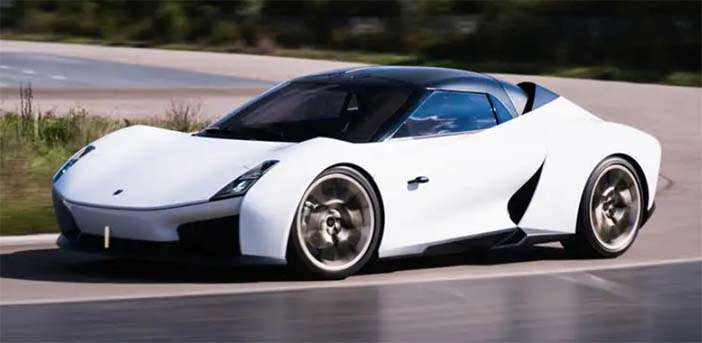
+++ German supercar maker APOLLO has revealed an electric sports car prototype, previewing technology that will underpin its future EVs. The Bavaria-based firm, which in its original guise produced the Gumpert Apollo from 2005 and in 2017 unveiled the Apollo Intensa Emozione, has been developing the G2J for more than 2 years. The rolling prototype is constructed of lightweight composite materials, including carbonfibre, and takes the form of a sleek, aerodynamic sports car with a space-age design. No powertrain or performance details have been revealed, but Apollo claims the prototype is currently being used to test and refine its powertrain, connectivity and digital-ecosystem technology. While it previews the firm’s future electric cars, the design of the G2J isn’t indicative of Apollo’s upcoming electric sports car concept. That car will be revealed later this year, with design inspiration drawn from the Intensa Emozione and its planned successor, the Apollo Project Evo. “Today Apollo Future Mobility Group signals its intent to define the performance-EV mobility experience by revealing the advanced engineering prototype codenamed G2J”, said chairman Eric Ho. “This will underpin a highly exciting and anticipated suite of new electric performance vehicles. The beautiful form of this test car is just a hint of the future design of a series of performance cars that will take the Apollo hypercar DNA and apply it to create the most exciting sporting-focused EVs on the planet. This is just the beginning, and we’re delighted that customers and fans of the brand from around the world will be kept informed throughout the exhaustive testing, proving and refining programme that will serve as the foundation for Apollo’s ambitions to become the globe’s defining performance EV brand”. Apollo revealed 2 electric concept cars at the China International Import Expo last year: the EVision S luxury saloon and the EVision X luxury SUV. +++
+++ The new, second-generation BMW M2 is important for a number of reasons: it’s the M division’s cheapest car on sale, it’s the final M car to use a pure-combustion powertrain, it’s one of the last sports cars to be offered with a manual gearbox and it promises drastically improved pace over its forebear. And, as BMW M boss Frank van Meel attests, it’s the modern-era M car that adheres most rigidly to the purist principles on which the performance brand was originally established. He took Autointernationaal.nl around the new M2 to highlight the most important areas of improvement over the previous car, and to explain exactly what role it plays in the line-up. Question: What about the previous M2 needed changing? Answer: “I think with the old car, we were a little bit more playful with the rear axle, allowing more drift angles but also not being the fastest on the track. And that’s something we changed: it’s very light-footed still, that’s typical, but it has even more speed on the track. It’s less loose on the rear axle. “If you change the settings, you can drift as always, but if you’re in serious race mode on the track, it’s more precise. The previous M2 also was precise, but this is less, let’s say, spectacular, in a way, because spectacular makes you slower”. Q: You fought to offer the M2 with a manual gearbox; do you have to have these discussions a lot? A: “No, because also within BMW, M has a very high and good reputation, and a very high degree of trust. So we have a very high degree of freedom in what we do. But, of course, if you add something which is not only an adaption to a platform but more or less a gearbox that isn’t there at all in the whole platform, then it’s a little bit longer of a discussion”. Q: Do you think M can always offer a car at this price point? A: “I would say it’s the other way around there. If you look at potential customers, they have some limits. So there are, let’s say, organic price limits that people have. Of course, you can go up and up and up. But then you lose just a lot of customers and fans. So of course we will try to also offer in the future cars in this price range”. Q: Does M still have a lot of customers who care about lap times? A: “Well, I think the character is why you buy a car. So I think 100% of our customers value the character of the car. Of course, if you ask how many of them really go to a track, I’d say it’s it’s quite a high number. I can’t tell you how high but in the United States, we know that there’s a big number of of customers who go to tracks with their own vehicles. But also in Europe, there are fan groups that meet each other and then they go to a track, or they come to our M driving-experience days. But I think the thing is that you know that you can do that with a car. And the other thing is that with an M, this precision and agility is not something you only feel on the track. If you start the engine and put on the seatbelt, it’s like getting in a race car. You have this feeling: ‘Okay, this is serious business, I’m one with the machine.’ And even if you drive at only 30mph, you will feel this precision. If you’re just in inner-city driving and turning in to a traffic light… it’s a little bit difficult to describe. A lot of cars you turn and you just corner. With this, it’s precision work; you’re having fun just driving through the city”. Q: Do you still take a lot from motorsport programs when you’re developing a road car? A: “Yes, because motorsport teaches you how to make a car precise. In motorsports, if you’re not precise, you can’t win. So that’s also something you want to have here, and that’s something we take from the race cars into the series-production cars. And that’s also the story behind what we did when we started with the M3 and M5 a long time ago. We said: ‘You don’t need to decide if you’re driving a race car or a sedan, you can have both in one’ ”. +++
+++ Earlier this year, BMW revealed the latest generation of its smallest SUV: the X1. There are now spy shots which reveal that the German firm is working on a successor to its X2, which is set to receive plenty of inspiration from the X1. Unlike other coupe SUVs in BMW’s stable, the current X2 isn’t really pitched as a coupe variant of its similarly sized SUV sibling. Although it shared the same platform, engines and interior as the old X1, the X2 featured very different styling on the outside, rather than merely adding a sleeker roofline at the rear. The new spy images show that the next X2 will be brought closer into line with the new X1, acting as a more conventional coupe SUV alternative, in a similar fashion to how the X4 and X6 relate to their respective X3 and X5 relatives. At the front we can see a similar headlight and signature design to the X1’s. The kidney grille shape is also squared off and while there’s camouflage covering the side air intakes in the pictures we expect it to follow the X1’s style here too. The overall shape of this test car is immediately recognizable as a coupe SUV from the sloping rear roofline, but the ride height looks higher than the current X2’s, giving it a proportion more akin to the larger X4. The rear of the car shows a different light shape to the new X1’s and while there’s no exhaust protruding from the bumper, we can just make out a back-box for an exhaust system. Underpinning the next-generation X2 will be the same UKL2 architecture as used by the new X1. This means the X2 should use the same internal combustion engine lineup, starting with a front-wheel drive diesel version and ranging up to a 322bhp four-wheel drive plug-in hybrid petrol. The platform will allow for a pure-electric X2 (most likely named iX2). Given BMW revealed both the X1 and iX1 side by side we should expect the same for the X2 and iX2. Power will come from a 64.7 kWh battery, which should allow for 313 hp and 494 Nm of torque. BMW says the iX1 delivers 357 km of range but the coupe SUV body of the iX2 will affect this figure. The interior of the X2 should look and feel fairly similar to the X1’s. Up front we’ll see a 10.25-inch infotainment screen and a 10.7-inch digital dash featuring BMW’s latest OS 8 software. The X2 will have a smaller boot than the X1’s 540-litre capacity thanks to that sloping roofline. +++
+++ If you’ve never driven a car made by LOTUS , you’re not alone: they’ve always been a small manufacturer, and even spotting one in public is a rarity — but you’re missing out. Their exotic good looks are far surpassed by their dedication to connecting man to machine to pavement above all else. But like every other automaker these days, big changes are afoot. Yes, Lotus is going electric. But it’s also going big, and in more ways than one. I recently sat down with Lotus Group vice president & managing director Matt Windle and chief brand officer James Andrew to talk about how the storied brand will pay service to its past as it aims its headlights toward the future. We’ve already seen the Evija (formerly referred to by internal codename Type 132), a low-volume, all-electric hypercar that represents the small automaker’s first big step into electrification. With about 2.000 hp coming from 4 electric motors, you can forget 0-100; it’ll do 0-300 kph in 9.1 seconds. It starts at over $2 million and production will be capped at 130 units. Flashy numbers to make a big splash, before going bigger in both size and production volume. Next will come the Lotus Eletre (formerly Type 133), an electric SUV that represents the (currently) small automaker’s desire to cater to every lifestyle rather than to be pigeonholed by purists and luddites. To reach big volumes, Lotus needs to be a truly global company, and it needs to create cars that more customers can use, and at prices they can afford. And even though an SUV isn’t what we’re used to seeing from Lotus, perhaps we shouldn’t be surprised, and not just because seemingly every other exclusive, top-shelf brand is now offering an SUV or will be soon. James Andrew reminded us that the appreciation has always been there, and that Lotus founder Colin Chapman had 2 parking spots at the office: one for his Lotus Esprit, and the other for a Range Rover he’d often drive to work. Don’t expect a rock-crawling luxury off-roader to wear the Lotus badge, though. The gents assured us that the brand’s focus remains on performance. And a crucial part of that performance is in driving dynamics that connect the driver to the car. Certain EV advantages (like flexibility in powertrain packaging or the lack of an exhaust system and the heat protection that requires) mean that its electric cars can retain that cab-forward, mid-engine-style layout. Ride and handling remain a focus, along with a balanced weight distribution. Aerodynamics continue to be an important part of the formula, it wouldn’t be Lotus, otherwise. The Evija uses Venturi tunnels to reduce drag (“air going through a car is easier than air going over a car”, Windle told me) and the Eletre has a grille that opens and closes “like a piece of art”. Finally, a familiar design element Lotus calls “Becker corners” (named after longtime Lotus Director of Vehicle Engineering Roger Becker) allow drivers to see the exterior corners to aid in precision car placement. Eco-friendly materials work with the brand’s focus on performance, luxury and sustainability. Recyclable materials and natural materials like wool blends not only help lend credence to the brand’s environmental pursuits, but save weight by about 50% compared to traditional leather interiors. Like a lot of brands, Lotus is also going to offer many animal-free interiors as well. Another feather in Lotus’ green cap is simply the number of its cars that are still on the road: 75%. Lotus notes that that will undoubtedly change as its scale increases, but it’s also researching second-life uses for when the batteries in its new stable of offerings are retired from the road. Lotus is also making advancements in technology to go along with its new focus on electrification. For instance, the Eletre will be equipped with lidar, and will be hardware-ready for Level 4 autonomous driving. Windle says it’s a bit of “balancing act” to provide such high-level driver assistance alongside a driver-focused dynamic experience. But even the new kit will tip its hat to the old. For instance, the Eletre’s lidar will pop out from and retract into the fenders, not unlike how the Lotus Esprit’s headlights emerged from its hood. As a traditionally small brand, Lotus intends to maintain that personal relationship with its customers and fans. Lotus prides itself on the fact that their people “always man our stand” at car shows and events. When I spoke to them just before the Detroit Auto Show, Windle and Andrew were preparing to head to West Virginia for a Lotus Owners Gathering. Lotus will continue forward with small-venue tours to personally connect with the public. You’ll also find them at events like Goodwood, and Lotus promises big things for next year’s Monterey and Quail events. The Lotus Emira will be the last of the series-production internal-combustion cars for the brand, but that doesn’t mean Lotus is done with gas-powered cars altogether, as its Lotus Advanced Performance (LAP) division will develop and offer ICE cars in limited quantities. In addition to bespoke and racing vehicles, it will also create high-spec limited editions and “ultra-exclusive” halo cars, both electric and gasoline-powered. Don’t expect any hydrogen fuel cell vehicles from Lotus in the future, though. Lotus is “fully committed to battery-electric”, Windle told me. Moving beyond the Emira in 2023 and Evija and Eletre in 2024, some Lotus machines will be even more affordable. The Eletre starts in the $100.000 range. The Type 134 (which is the internal designation for the D-segment SUV coming in 2025 or 2026) will be even lower, but we’re told not to expect Lotus prices to dive too deep. The Type 135 sports car will arrive in ’26 or 27, and, through what’s sure to be some fantastical exercise in design and engineering, will be about the same height and weight as the Emira. It’s being called “a spiritual successor of the Elise”. We can’t wait to see that one. Lotus aims to produce 100.000 cars a year from 2027 on, a far cry from the 1.700 cars it sold last year. Of those future vehicles, Lotus expects about 10% to be sports cars, while lifestyle vehicles will make up the vast remainder. Of course, transforming into a much larger carmaker requires some global moves. That includes manufacturing in China, the home country of Lotus’ majority owner as of 2017, Geely. That’s where lifestyle vehicles like the Eletre will be assembled, while Lotus’ British manufacturing will be responsible for its sports cars. Lotus will also grow its dealer presence throughout the world, including adding about 10 dealers a year in North America, while also placing a greater focus on Latin America. Indeed, Lotus will soon look like a much different brand than before. But, not entirely unfamiliar. Sure, a lot’s changing, with growth in size and scale, and the adoption of new technologies, powertrain and otherwise. Still, Lotus cares enough about its own rich history and hard-earned reputation that it will still cater to its current owners and loyal fans. They’ll just have many thousands of new ones, too. +++
+++ RENAULT plans to build a network of charging stations for electric cars along motorways across Europe, the French carmaker’s e-mobility services unit said on Monday. The first charging station will open in a few months in southern France, with 200 more planned to follow by mid-2024 in France, Belgium, Italy and Spain, Mobilize said, adding it was in advanced talks with potential partners to finance the network. Rolling out an adequate charging infrastructure and offering motorists convenient solutions when traveling is one of the main challenges faced by producers of electric vehicles, as batteries generally offer less driving radius than fuel tanks and take much longer to recharge. Renault, whose share price value has declined almost 70% since early 2018, is far from being a leader in the European electric vehicles market. But the company is pushing ahead with plans to split its EV and combustion engine businesses in a bid to compete with rivals such as newcomer Tesla and German giant Volkswagen in the race to electric driving. The new charging stations will be installed at Renault dealerships located close to motorway exits, with dedicated spaces where drivers can rest during the average half-hour charging period. They will be accessible around the clock and offer a lounge, playing corners for children and refreshments. To avoid the need to install new power grid infrastructure, Mobilize said it would use a stationary storage system the size of a small container which is capable of charging up to 6 regular cars of any make at the same time. “This will allow us to charge these containers very gently, without disrupting the power grid”, said Nicolas Schottey, head of Mobilize Power Solutions. Tesla has been rolling out high-performance superchargers for years and has a global network of about 30.000 fast-chargers that it says can give a 200 km boost in 15 minutes. Volkswagen expects its network of fast-chargers to nearly quadruple to about 45.000 by 2025, with 18.000 EV pumps in Europe, 17.000 in China and 10.000 in North America. +++
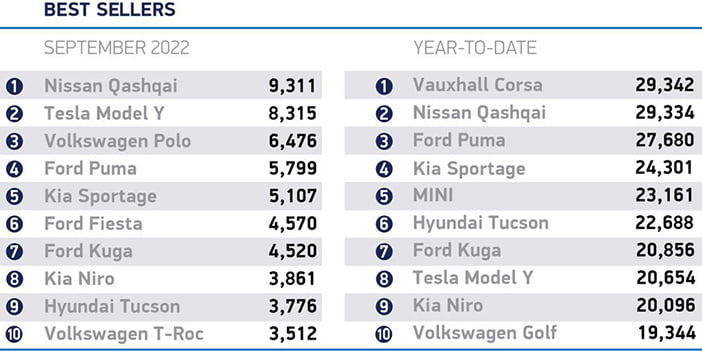
+++ In September, new passenger car registrations in the UNITED KINGDOM increased by 4.6% year-over-year to 225.269, but remains 34% below pre-pandemic levels. Despite this strong result (September is typically the second biggest month of the year, because of the plate change), year-to-date sales (1.208.368) are 8.2% lower than in 2021 at this point. The Society of Motor Manufacturers and Traders (SMMT) explains that the industry continues to battle issues constraining supply to fulfil a backlog of orders. Last month, some 50.397 electric cars were registered, which is 16% more than a year ago and 16.9% of the total market. It’s also the second-highest month ever. All-electric car sales continue to grow relentlessly (in September by 16%) while plug-in hybrids remain in the red for the seventh consecutive month. However, at least the rate of PHEV decline is smaller. In september, 12.281 units of such cars were sold; down 12% year-over-year with a market share of 5.5%). So far this year, 249.575 new passenger plug-in cars (PHEV + electric) were registered in the UK (up 18% year-over-year), reaching an average market share of 20.7%. BEVs did 175.614 (up 40% year-over-year) at a market share of 14.5% and PHEVs sold 73.961 (down 15% year-over-year at market share of 6.1%). For reference, in 2021, some 305.281 plug-in electric cars were registered (up 74% year-over-year) at 18.5% market share. The big news for the UK is that the cumulative new registrations of plug-in electric cars reached 1 million units in September: 1.002.157 to be precise (since January 2010). “September has seen Britain’s millionth electric car reach the road: an important milestone in the shift to zero emission mobility. Battery electric vehicles make up but a small fraction of cars on the road, so we need to ensure every lever is pulled to encourage motorists to make the shift if our green goals are to be met”. According to the official data, the Tesla Model Y noted 8.315 first registrations in September, which is the second-best result overall. This allowed it to also become #8 year-to-date with 20.654 units. The Model Y remains the top-selling electric model in the country with a potential for even higher results in the near future. The Tesla was also #2 in June (10th YTD) and #1 in March (#6 YTD). The brief report does not list other plug-ins, although Kia reports that its Kia Niro EV (e-Niro) model is the third best-selling BEV year-to-date with 9.366 units. I assume that the second best must be the Tesla Model 3, which had 7.773 in the first quarter of 2022 alone. +++
+++ VOLKSWAGEN ’s announcement that the Scout brand was returning kicked the rumor mills into high gear. We’ve seen drawings and heard endless speculation, and now we’re getting into rumors about how the vehicles will actually come to life. A report states that Volkswagen is in talks with Magna International to build the new line of off-road EVs. Rumors have flared since Volkswagen noted that the Scout would ride on a new platform. Neither the MEB platform nor VW’s new platforms can underpin a hardcore off-roader. The Scout pickup should be around the same size as an F-150, so there are differences between the new vehicles and existing models in VW’s catalog. The costs, time, and effort required to develop and implement a new platform are immense, leading many to wonder if Volkswagen will call in outside help. Magna makes sense because the Canadian giant offers contract manufacturing and could develop a new electric platform for Volkswagen. The automaker may take advantage of the design and other capabilities but may want to keep manufacturing in-house. Company CEO Herbert Diess confirmed that the company is assessing various sites in the U.S., so it’s not a stretch to guess that one could house Scout production. The vehicles themselves are shaping up to be robust and rugged. A prominent member of the vintage Scout community, Jeff Bade, posted on Facebook last week, saying that his look at early Scout prototypes showed him that Volkswagen cares about the community and the brand’s history, meaning they will be capable in the dirt. +++