
+++ The government of Alberta, Canada, will hit ELECTRIC VEHICLE owners with a new $200 annual tax in a bid to help raise funds for road improvements. In the government’s fiscal 2024-25 budget, it says the tax has been designed to compensate for the added wear and tear on provincial roads caused by EVs and their added weight. The fee of $200 also roughly equates to what the government says the average ICE vehicle owner pays in fuel taxes each year. The levy will raise approximately $1 million in revenue in fiscal 2024-25. This will increase to $5 million in 2025-26 and $8 million in 2026-27. These figures are tiny compared to the $1.4 billion expected to be raised in 2024-25 through fuel taxes alone. “While fuel tax revenue is not dedicated to funding construction and maintenance of provincial roads, there are nevertheless fairness concerns with drivers of other vehicles and longer-term challenges associated with declining fuel tax revenue”, the government said in its budget. “Government will continue to review the sustainability of the fuel tax, including the increasing use of alternative fuels, and consider changes to protect tax revenue. “I’m interested in fixing the roads”, added Alberta finance minister Nate Horner. “We need everyone to help”. Further details about the EV tax will be announced in the fall before it is implemented by January 1, 2025. The head of the Canadian Vehicle Manufacturers’ Association that represents the Detroit Three locally, Brian Kingston, does not support the tax and believes it will make zero-emissions sales mandates more difficult to achieve. “Taxing electric vehicles will cost Albertan’s and make Canada’s ambitious EV sales targets even more difficult to achieve”, Kingston said. “Helping Albertans switch to electric depends on efforts from all levels of government to address the key barriers to EV adoption, including affordability and a lack of charging infrastructure”. +++
+++ Stellantis just dropped 3 new recalls, two for JEEP and a third one for Ram vehicles. Combined, they affect over 350.000 vehicles across numerous model years. In the largest recall of the three, the issue lies with a steering knuckle that could come apart and allow the wheel to fall outward from the car. It includes 338.238 Jeep Grand Cherokees from between 2021 and 2023. According to Jeep, the pinch bolt that attaches the upper control arm to the steering knuckle could be suspect. Some were damaged during production and in those cases, the upper control arm could separate from the knuckle. In that sort of situation, steering would be greatly diminished if not nearly impossible. As such, Jeep is recalling all of these Grand Cherokees (including the L version) to mend the issue. It says that it expects to find the problem in just one percent of the SUVs in the population. Jeep technicians will replace the pinch bolts for free to ensure the problem doesn’t occur. According to the recall filing, the company has been informed about 18 warranty claims and one field report related to the issue. Jeep also cautioned that owners might hear an “abnormal noise” when driving over bumps so be on the lookout for that if you drive one of these SUVs. In a separate recall, it says that 9,433 Jeep Grand Cherokees from the 2023 and 2024 model years have an issue with the auto high beam headlamp controller. If the lighting switch is set to Auto, the vehicle might not illuminate the high beams when the driver requests it. Jeep will have a technician update software in the vehicle to fix the problem. +++
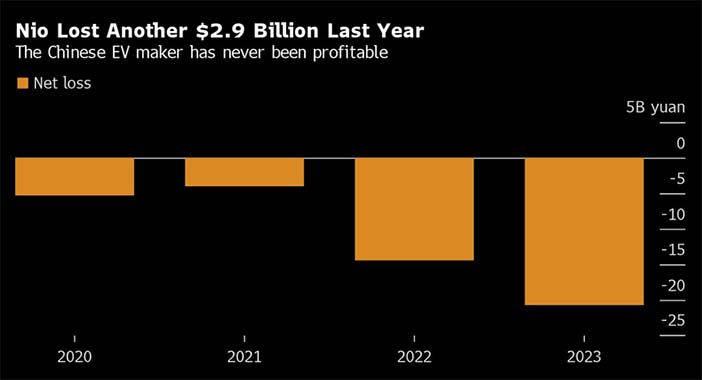
+++ NIO ’s annual loss widened last year as the Chinese electric-vehicle maker faced fierce competition in the world’s biggest EV market. The Shanghai-based company’s net loss of 5.4 billion yuan in the 4th quarter brought its annual deficit to 20.7 billion yuan ($2.9 billion), according to a statement Tuesday. Nio posted better-than-expected sales for the final 3 months of 2023. “Moving into 2024, we will prioritize our business objectives, improve system capabilities and optimize cost management”, Nio’s chief financial officer Steven Feng said. While vehicle margins improved to 11.9 percent in the 4th quarter, that was still below analyst expectations. Unlike rivals Xpeng and Li Auto, which is now making money, Nio hasn’t announced any major product launch plans for 2024. The automaker, which has a lineup of mainly premium crossovers and sedans, is however expected to unveil a mass-market brand that would compete with Tesla’s locally built models; a move analysts say may help stem losses. Nio now expects to ship as many as 33.000 cars in the first quarter, down from 50.045 vehicles in the previous 3-month period. The company’s deliveries last year weren’t even two-thirds of its original sales target. Gross margins for the 4th quarter came in at 7.5 percent compared to the 10.2 percent the market was looking for. Nio now sees revenue of as much as 11.1 billion yuan for the current quarter, significantly below analyst expectations. Once considered one of the brightest rising stars in China’s EV market, Nio has struggled of late, last year receiving a capital injection in the form of a just-in-time share sale to Cyvn Holdings, an investment entity controlled by the government of Abu Dhabi. The June $738.5 million cash infusion may only last a short while at current burn rates. Nio’s mass market brand Alps will start deliveries in the 4th quarter, CEO William Li said during an earnings call Tuesday. Its first model will come with a swappable battery and compete with Tesla’s Model Y, while the second model has been developed for larger families. With an output of around 10.000 units per month, Alps’ first product will have a 10 percent lower manufacturing cost than the Model Y, the CEO said. The main Nio brand will maintain its focus on premium cars and only offer models with priced above its 298.000 yuan ET5, Li said, adding that Alps will prioritize volume. The company also plans to launch an even cheaper sub-brand in 2025, with vehicles priced below 200.000 yuan. Nio is also expanding in the United Arab Emirates. In November, Nio trimmed around 10 percent of its workforce and the carmaker has considered spinning off some non-core businesses to reduce costs. In December, it signed a deal for a $2.2 billion cash injection again from Cyvn Holdings. Upon completion, Cyvn will own a 20.1 percent stake in Nio and can nominate 2 board directors. The automaker also entered into a technology license agreement last month with a subsidiary of Cyvn to grant a non-exclusive and non-transferrable worldwide license to Nio’s existing and future technical information, technical solutions, software and intellectual property rights, it said in the statement. Nio is aggressively promoting its battery-swap technologies, partnering with a handful of Chinese automakers including Geely and local authorities in Anhui province, where Nio’s factory is based. EVs using battery-swap technology can be driven into a booth where the depleted cell is replaced with a charged one in a matter of minutes, reducing driver concern about range and charging times. +++
+++ POLESTAR has taken a bruising in recent months, as its performance disappointed investors, and its parent company, Volvo Cars, announcing it would cease financial support. Geely, the parent company of both Volvo Cars and Polestar, has stepped in to provide support. However, Thomas Ingenlath, the startup’s CEO, recently claimed that his company is actually in a better position than it may look like from the outside. Although EV sales globally increased between 2022 and 2023, the growth was not as significant as in previous years, nor did it meet the expectations of automakers worldwide. Consequently, companies that had committed to transitioning entirely to electric vehicles have recently reversed their stance, opting to rely more (or at least for longer) on internal combustion and hybrid models while awaiting a rebound in the EV market. Ingenlath contends that these automakers are falling into a “trap”. “There’s an incredible threat and danger if you don’t embrace future innovation and believe in that technology: the electric drivetrains, the innovation in battery, the innovation in modern electronics and software”, he told. “If you don’t participate in that and think you can wait, and customers are ready for it, it’s an incredible trap”. However, Ingenlath wasn’t upset that traditional carmakers are falling into it. He claimed that since his company his fully committed to EVs, the vacuum left by traditional automakers who have been spooked by slowing growth can be filled by the Swedish startup. “It’s an incredible opportunity for Polestar that, in that sector of premium performance cars, there is indeed not that much competition coming”, said Ingenlath. “I definitely think that is where you have customers who very much embrace the innovation and the greatness of the electric drivetrain, especially in this very high-end premium, exclusive sector”. Ingenlath pointed out that those customers will support it through difficult times, adding that unlike Tesla, whose Model 3 and Y are targeting mainstream customers, Polestar’s wealthy clientele are less susceptible to economic factors than less affluent buyers. However, those customers haven’t given Polestar the same success that Tesla’s mainstream buyers have. While the American automaker made one of the most popular vehicles on earth in 2023, the Model Y, Polestar was forced to downgrade its forecasts last year, as it struggled to meet its sales targets. Also of concern for Polestar is its manufacturing. While initially building its vehicles at plants in China enabled it to expedite getting vehicles on the road, this decision also exposes it to vulnerability, as Europe and the U.S. contemplate regulations that could disadvantage vehicles manufactured within the Asian superpower’s borders. With production coming to Korea and already rolling in the U.S., as well as its opportunity to double down where traditional automakers have chosen to hesitate, the company is not without hope, though. That may explain why it recently secured a $1 billion funding package from a group of banks, which may allow Polestar to stick around long enough to find out if Ingenlath’s optimism is justified. +++
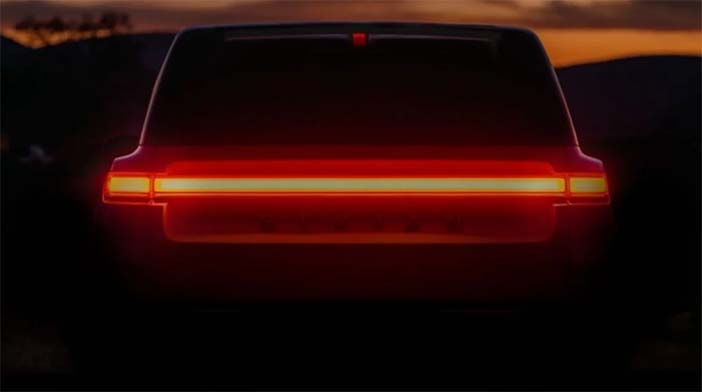
+++ The RIVIAN R2 reveal is but a day away, with a few teasers and a smattering of the debut thunder escaping from the Laguna Beach extravaganza before the appointed time. First, the official stuff: Rivian posted a shot of the R2’s rear left corner on X not long ago, the R1 Junior looking exactly like dad. A shot of the entire rear aspect taken at night proves the similarity, a from the black roof to the full-width light bar, although the R2 gets a sharper, squarer swell from the greenhouse to the shoulder line making room for the light bar. The unofficial information comes courtesy of Rivian owner Chris Hilbert, who got the wise idea to use a browser’s ability to pull up the source code of a web site. When he did this on the R2 page at Rivian’s site, he found a range of key specs for the electric SUV. Starting with price, Rivian boss R. J. Scaringe has long spoken of a price between $40,000 and $60,000. According to the site code, the R2 will start at $47.500 before destination costs, options and the rest. The least expensive R1S starts at $74.900. Remember, though, Rivian doesn’t expect to begin deliveries until 2026, a long way off in these capricious times to lock in prices. Battery capacity wasn’t listed among the numbers, but 530 km of range was; 110 km short of the maximum range available with the R1S. A 3.2 seconds 0-100 km/h was in there as well. I’m guessing that sprint represents an upper spec that doesn’t sell for $47,500. Compared to the Jeep Wrangler, the R2 is about 30 centimeters longer, 2.5 centimeters wider and its roof height is 10 centimeter lower. The R2’s 25 centimeter of ground clearance is exactly 2.5 centimeter short of the clear air beneath the 2024 Jeep Wrangler Rubicon. As Rivian is being all about adventure, the R2 gets off-road specs, too: 25-degree approach angle, 27-degree departure angle. I look forward to finding out what’s going on with the overhangs on the new ride; the R2 10.6 degrees worse on approach than the R1S and 7.3 degrees worse on departure. Minimum approach and departure angles for the Jeep Wrangler are 41.4 degrees and 35.9 degrees, respectively. +++
+++ TOYOTA ’s joint venture battery company with Panasonic will become a wholly owned subsidiary of the Japanese automaker later this month. The company, Primearth EV Energy, is currently 51% owned by Toyota and 49% owned by Panasonic. It mass produces batteries for hybrid electric vehicles but plans to also begin producing batteries for BEVs and PHEVs, and play an important role in Toyota’s growing electrification plans. Toyota says that “more competitive batteries will enhance the appeal of Toyota’s electric vehicle offerings and contribute to achieving carbon neutrality through a multi-pathway approach”. Primearth EV Energy was formed as Panasonic EV Energy in December 1996 with Toyota holding a 40% stake and Panasonic having the remaining 60% stake. The company was renamed Primearth EV Energy in June 2010 and at the time was 80.5% owned by Toyota. It currently employs 4.700 people. The car manufacturer notes that the acquisition of Primearth EV Energy will allow it to flexibly respond to growing battery demand and boost its competitiveness. It is not just traditional batteries that Toyota is working on though. Late last year, Toyota joined forces with Japanese oil producer Idemitsu Kosan to develop and produce solid-state batteries for future electric vehicles. Idemitsu has been conducting research and development on solid-state batteries since 2001 while Toyota has been doing the same since 2006. They hope to begin mass production of solid-state batteries by 2027-2028 but Toyota recently announced it will release its first EV with a solid-state battery in a “couple of years”, complete with a driving range of 1.200 km and the ability to charge in just 10 minutes. In the more immediate future, forthcoming EVs from the Toyota and Lexus brands will hit the market with prismatic battery cells aimed at increasing range and reducing weight. +++
+++ In the UNITED KINGDOM , the new car market boomed in February with record registrations. As a result, Britain’s auto industry had the best February in 20 years. The UK’s automotive industry witnessed a remarkable surge in February, marking its strongest performance for the month in two decades, according to the latest data released by the Society of Motor Manufacturers and Traders (SMMT). New car registrations soared by 14.0 percent to reach a total of 84.886 units, marking the 19th consecutive month of expansion. This impressive upturn has been primarily propelled by increased investment from fleet operators, who have been driving demand for the new cars. Fleet registrations spearheaded the growth trajectory with a notable surge of 25.2 percent, while businesses also contributed significantly with a 15.5 percent increase. However, the private sector continued to face challenges, witnessing a modest decline of 2.6 percent and recording a 33.7 percent market share. This disparity is often attributed to the traditional volatility of February, being the lowest volume month of the year, as buyers often defer purchases to March with the arrival of the new number plate. The Ford Puma, which was recently refreshed, was again Britain’s best-selling model in February with 2.535 cars delivered to customers, followed by the Volkswagen Golf (2.203 units) and Volkswagen T-Roc (1.986). The Kia Sportage, currently the country’s second best-selling model since the start of the year, came fourth with 1.948 sales and the Audi A3 was fifth with 1.835 sales. Next came the Mini Hatch (1.828), the BMW 1-Series (1.815), the Tesla Model Y (1.777), the Nissan Qashqai (1.616) and the Vauxhall Mokka (1.513). The spotlight on electrified vehicles remained prominent, with hybrids registering a robust growth of 12.1 percent, although experiencing a marginal decrease in market share compared to the previous year. Plug-in hybrids witnessed the most significant proportional surge, escalating by 29.1 percent and capturing 7.2 percent of the market. Battery electric vehicles showcased a commendable uptick of 21.8 percent, constituting 17.7 percent of total registrations. +++
+++ 2 years ago, the Felicity Ace cargo ship sank in the Atlantic Ocean following a massive fire, leading to the loss of more than 3.900 vehicles. The VOLKSWAGEN GROUP is now facing 2 lawsuits that claim the fire was triggered by a Porsche Taycan that was onboard. One of the suits has been filed in Stuttgart and was brought by half a dozen plaintiffs. These include ship operator Mitsui OSK Lines and Allianz, which was one of the insurers of the vessel. This case was filed more than a year ago but paused due to mediation talks planned for the second lawsuit currently before a court in the German city of Brunswick. The 2 lawsuits will resume if no settlement is reached. While the Volkswagen Group has confirmed the 2 lawsuits, it has not commented on them. The suits claim that the lithium-ion battery of the Porsche Taycan caused the fire and that the Volkswagen Group had not informed them of the danger and necessary precautions required for transporting electric vehicles. The judges have not yet looked into the merits of the 2 lawsuits as the parties involved have yet to agree on the amount of collateral that must be posted. Estimates suggest that the fire cost the Volkswagen Group approximately 140 million euro. Fortunately for most customers who had vehicles on board the Felicity Ace, their vehicles were replaced. These included the 15 Lamborghini Aventador Ultimae models that were destroyed as well as 1.800 Audi vehicles that were also on the ship. Some of the non-VW Group used vehicles were not replaced. These included a 1996 Honda Prelude SiR that was on the ship and being imported to the U.S. The Felicity Ace was also carrying a 1977 Land Rover Santana, a 2007 BMW 750i, a 2015 Ford Mustang and a 2019 Mini Countryman. +++