
+++ With the European Union poised to implement taxes of up to 38 percent on the import of vehicles from CHINA , a new study revealed that 2 in 5 of Europe’s best-selling EVs are of Chinese origin. Looking at data for May 2024, the results show that Chinese cars accounted for 19 percent of EV sales in May 2024; a 6 percent increase from the same month last year. Overall, European new car registrations dropped by 2.5 percent in May 2024 versus the year before but remain higher than they were following years riddled by post-pandemic production turmoil in 2021 and 2022. A total of 1.09 million units were registered last month. Felipe Munoz, Global Analyst at JATO Dynamics, commented: “Since the global pandemic, the European car market has only recovered to 75%-80% of its original size. As a result, many factories across Europe are not operating at full capacity, giving Chinese OEMs a unique opportunity to sell across Europe”. But now the tariffs are coming. MG, owned by SAIC, will be on the receiving end of the most punitive levy of 38.1 percent applied to its EVs when the duties come into effect. The move, which will also effect BYD and Tesla to name a few, comes following a European Commission investigation into Chinese government subsidies. However, it is worth noting that MG’s overall business unit managed to outperform Tesla in Europe. The company focusing its attention on ICE options, likely in anticipation of the incoming duties, while MG’s BEV arm saw a reduction in the number of new cars it registered in May, Volvo, BYD and Smart all made significant increases.
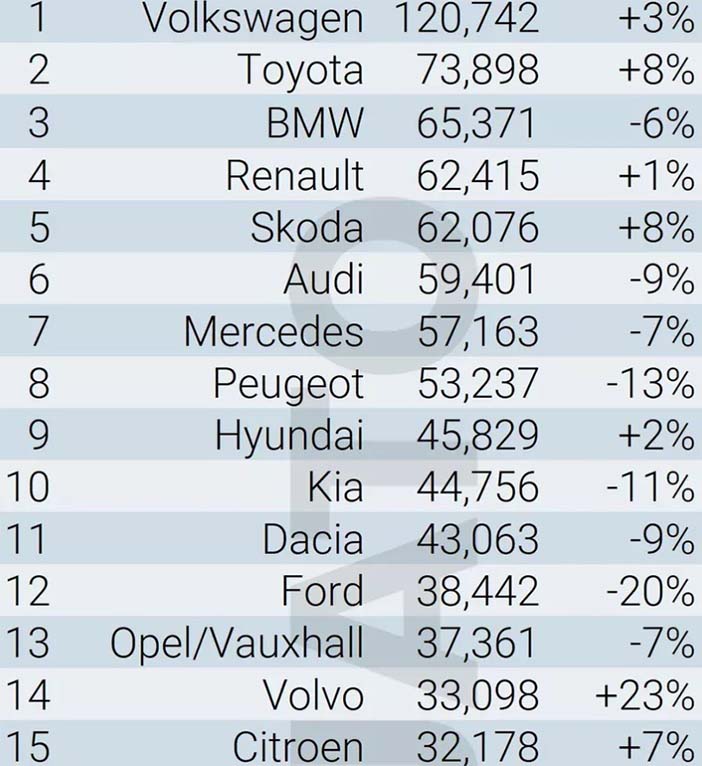
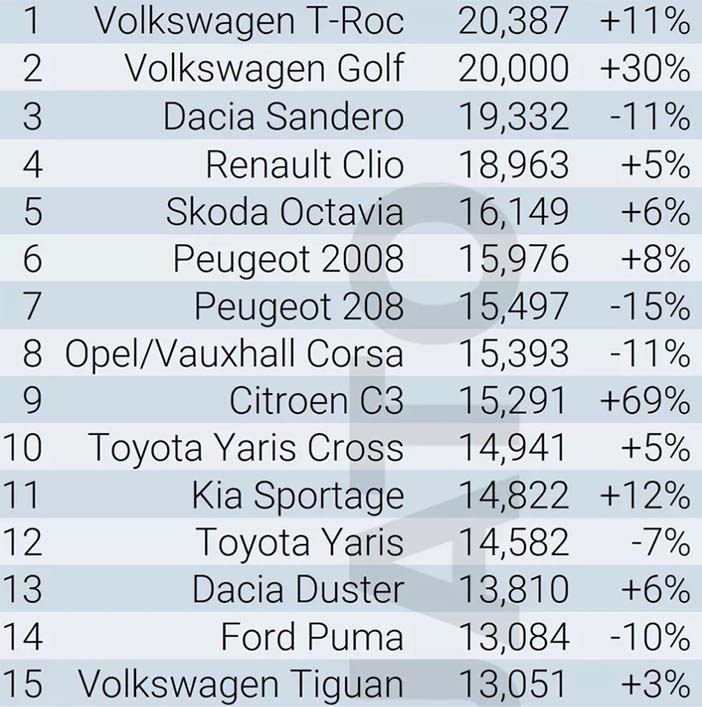
Meanwhile, Volkswagen dominated the best-selling brand and model standings in May, with the T-Cross proving most popular with new car buyers, while the new Volkswagen Golf managed to record a 30 percent increase in numbers since the same time last year:
+++
+++ The CITROEN C4 is tipped to be radically reinvented, taking heavy influence from the genre-bending Oli concept and prioritising affordability and utility. “We will put a car very much like Oli on the road”, Citroën design chief Pierre Leclercq told when asked about the miniature electric car’s role in the French company’s future. He explained that the new C3 and C3 Aircross have been designed in parallel with the Oli and that it “is going to influence another car coming afterwards, and it will be quite exceptional. When we developed that concept, there wasn’t one idea that we didn’t want to push into production”, said Leclercq. He conceded that some elements of the Oli were “not good ideas”, suggesting that some of its more conceptual elements would remain on the motor show stand, although he wouldn’t go into specifics. “I can tell you that the intention with Oli and the car that will come to the road is functionality, innovation and price: mobility for all”, summarised Leclercq. Citroën product chief Laurence Hansen suggested that the concept’s ideas (and therefore any faithful recreation of it) might not fully materialise across the brand’s line-up until 2026 or 2027, because a typical product development cycle is around 5 years. The C4 will be up for replacement around that time, following a mid-life facelift later this year, making it the most logical candidate for an Oli-flavoured reinvention. That facelift, due to be unveiled at the Paris motor show in October, will bring more squared-off bumpers and lighting signatures inspired by the Oli, but is not anticipated to introduce radical technical changes. Given the new C4’s affordable, utilitarian billing, it’s likely use Citroën parent company Stellantis’s value-focused Smart Car platform. Design work recently started on a broadened portfolio of models based on the platform, following the initial tranche that comprises the C3, C3 Aircross, Fiat Grande Panda and Opel Frontera. Citroën CEO Thierry Koskas hailed the platform’s flexibility and confirmed that Citroën would use it to launch larger cars, hinting at plans for a new model between the C3 Aircross and the next-generation C5 Aircross. “We aren’t at all at the end of the developments that we have on the Smart Car platform”, said Koskas. “There will be more cars based on this”. +++
+++ LUCID has recalled 5.251 Air luxury sedans due to a software error that could cause a loss of power. Air EVs labeled as 2024 models are not included in the recall. According to documents posted by the National Highway Traffic Safety Administration, Lucid’s High Voltage Interlock (HVIL) safety mechanism, which is designed to be used during vehicle assembly, inspection, maintenance, or repair and not while the vehicle is in motion, could be triggered while the vehicle is in Drive or Reverse. If that happens, the vehicle will experience an unexpected loss of power. Other vehicle functions that don’t run directly off the high-voltage battery pack, such as the steering, brakes and displays, would continue to function. The issue has been remedied via modified software, according to Lucid. “The Remedy Software, transmitted to all customers via over-the-air update starting on June 24, modifies the HVIL logic to prevent removal of HV from the HV bus while in Drive or Reverse gear. Instead, a Drive System Warning with direction to contact customer care is displayed while in Drive or Reverse, and a Drive System Fault will occur once the vehicle is placed in Park or Neutral”. The NHTSA also reported a second recall from Lucid, this time covering 7.506 Air sedans built between 2022 and 2024 due to an issue with a coolant heater that could fail to defrost the windshield. Although Lucid has calculated a failure rate of just 1.2%, the EV maker has included new programming via a software update “to provide a warning to drivers upon HVCH failure, even if the driver has not tried to enable cabin heat or defrost”. Vehicles with failures will get a new High Voltage Coolant Heater free of charge. Vehicles manufactured after February of 2023 have a newer version of the coolant heater and are therefore not included in this latest recall. Lucid further notes that only 255 customer vehicles have yet to accept the new software, meaning this is a very limited issue despite the relatively high number of vehicles included in the official recall. The windshield defroster issue was first addressed in January of this year. This new announcement expands the number of models affected. +++
+++ MERCEDES has set a target of reducing the costs of its EV batteries by as much as 30% by increasing their energy density. The German firm aims to increase the energy density of its batteries to 0.9 kWh per litre. The 120 kWh battery in its most efficient current EV, the EQS saloon, has an energy density of 0.55 kWh per litre. This new target also goes beyond the 0.8 kWh per litre that Mercedes claims to be achieving from lithium ion batteries with a silicon composite anode, developed with American company Sila Nano Technologies and earmarked for future versions of the electric G-Class. +++
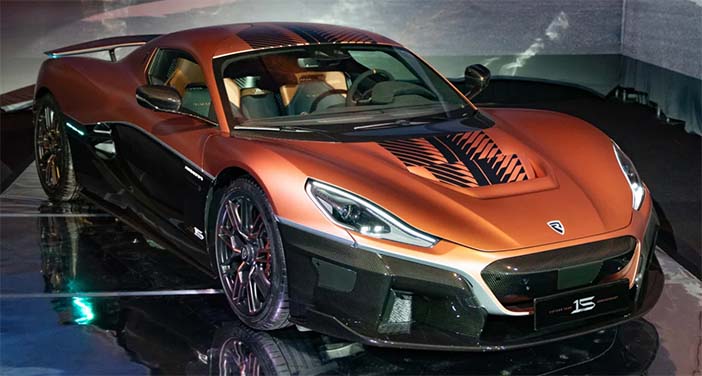
+++ RIMAC is celebrating 15 years of “achieving the impossible” with nine specially made examples of its record-breaking electric hyper car that’s been unimaginatively named the Nevera 15th Anniversary Edition. Every one of them will be finished in a new shade of copper, which is not only very on-trend, but marks the first use of matte paint on the Nevera. It’s contrasted by fully exposed gloss carbon fibre on the lower half of the car, and the complex circuit board-inspired pattern that runs along the bonnet, roof and massive rear spoiler. The same copper hue is found on the dual-tone alloy wheels, which are exclusive to the anniversary edition. Meanwhile, the interior features unique anodised copper switchgear and copper-painted surfaces, plus special ‘2009-2024’ and 1-of-9 badging just behind the driver. The lucky few who get to order one of these nine cars will be offered a choice of bold black or pristine white upholstery, with the seats also sporting contrasting copper leather and ‘15’ embossed on the headrests. Like the ‘regular’ Nevera, power comes from 4 electric motors (2 at each end) which produce a combined 1.920 hp and 2.340 Nm of torque. 0-100 kph takes a simply bewildering 1.9 seconds, and top speed is 410 kph; the highest of any EV. Range stands at 486 km, thanks to a 120 kWh battery. The Rimac Nevera 15th Anniversary Edition costs precisely €2.350.000. That price includes all the options, and a bespoke luggage set that matches the interior of the customer’s car. The first of the nine ultra-exclusive cars will make its public debut at the 2024 Goodwood Festival of Speed, and despite it being a customer’s own car, Rimac will be sending it up the famous hill climb during the event. Last year, the Nevera Time Attack edition set the production car record on the same course, completing it in 49.32 seconds. Rimac’s founder and CEO, Mate Rimac (who is also the boss of Bugatti now) said of the milestone for his namesake brand: “Honestly, when I started to tinker with my first car in a garage, I couldn’t have even dreamt of being where we are 15 years later. There were so many times in the early years that we really thought the company wouldn’t make it, so reaching the 15-year milestone felt like it was worthy of a celebration. The 15th Anniversary Edition Nevera is the car that marks our progress, revealing just how far we’ve come”. +++
+++ China has comprehensively taken over the car market of RUSSIA after stepping in to replace Western car makers following Russia’s invasion of Ukraine. Chinese companies such as Great Wall Motor, Geely and Chery are importing models to the country as well as co-operating with the Russian government to restart the country’s once-thriving car manufacturing industry. As a result, Russian car sales are booming again, with sales up 75% so far this year, at just over 700.000, according to the Association of European Businesses (AEB) in Russia. Of the 130.715 new cars sold in June, 69.400 were imported from China, the AEB said. Xi Jinping has sought to portray China as neutral in Russia’s war on Ukraine even as western officials say it’s provided components and other support for Vladimir Putin’s forces. Now it seems Chinese and Russian companies are developing an attack drone similar to an Iranian model Russia is using in Ukraine, a sign Beijing may be edging closer to providing the sort of lethal aid that western officials have warned against. +++
+++ STELLANTIS has recalled 332,000 Alfa Romeo, Jeep, and Fiat vehicles due to faulty seat belt sensors. Included in the recall are certain 2017-2024 Alfa Romeo Giulia and 2018-2025 Stelvio models along with 2019-2023 Fiat 500X, Jeep Renegade and 2024 Fiat 500e models. According to documents posted by the National Highway Traffic Safety Administration, “A disrupted connector on the buckle switch hall effect may affect the conduction on the connectors of the seat wiring and buckle which may cause the front seat air bag to not perform as expected during a crash”. In more simple terms, the sensor that tells the vehicle’s onboard computer if an occupant’s seat belt is buckled may fail. If this happens, an airbag may not inflate in the event of a crash as intended. As of June 26, Stellantis says it has identified 578 field reports in North America potentially related to this issue. “The remedy will be to replace the connector by directly wiring the sensor to the harness with a solder tube”, according to documentation provided by Stellantis. All repairs will be made free of charge. +++
+++ TESLA shareholders will appear in court to argue that an unprecedented request for more than $7 billion in attorneys’ fees to be paid by the company is “outlandish”, the latest twist in a legal showdown over Musk’s $56 billion pay package. +++