+++ With its 800 volt technology, 95 kWh battery, over 1.000 Nm of torque and 2.9 seconds sprint, the new AUDI E-TRON GT PERFORMANCE is the sporty top model among Audi’s electric cars. How does it compare with its rivals? The e-Tron GT’s most important competitors in the top version include sporty 5-metre saloons such as the Tesla Model S Plaid, the Lucid Air Grand Touring and its sister model, the Porsche Taycan Turbo. Models such as the Mercedes EQE/EQS or the BMW i7, on the other hand, cannot keep up, even in the sports versions. In comparison, the Tesla is the strongest while the Audi takes second place. The Tesla also has the shortest sprint time (0-100 km/h) and the Porsche can claim second place thanks to its relatively low weight. The Tesla also has the highest topspeed. The Audi, Porsche and Tesla have more or less the same electric consumption. The Lucid has by far the biggest battery capacity and therefore also the biggest range. The Tesla comes second in this respect, but has by far the lowest charging power. Therefore, the Tesla also has the longest charging time. Winners in this respect are the Audi and Porsche (due to their 800 volt architecture). But both cars have a small luggage compartment (490 litres / 491 litres) versus 793 litres for the Tesla and 910 litres for the Lucid. The Tesla is by far the cheapest car, while the Lucid takes second place. Compared to the Porsche, the Audi is slightly inferior, but it is also slightly cheaper. The Tesla’s driving performance is better, its range is greater and the boot is bigger than the Audi’s, and yet the price is significantly lower. The Lucid virtually outclasses the Audi with its enormous range. Overall, the Audi RS e-tron GT Performance is only convincing when it comes to fast charging; here it and its sister model, the Porsche Taycan Turbo, are clearly better than the competition, even compared to the Lucid Air with its 900 volt architecture. +++
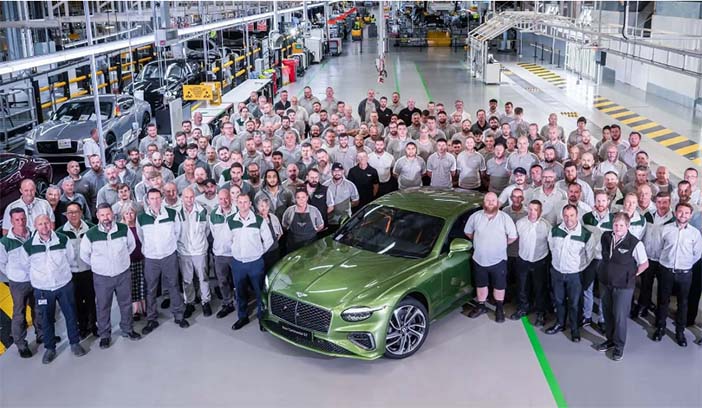
+++ The first 4th generation BENTLEY CONTINENTAL GT rolled off the assembly line at the Crewe factory on the same day as founder Walter Owen Bentley’s 136th birthday. With the same specifications as the car used for the model launch, the first of the new series was painted in Tourmaline Green, with Gravity Grey and Mandarin interiors. The car will begin life as a press fleet car, before becoming part of Bentley’s Heritage Collection. The first next-generation Bentley Continental GT will become part of the company’s Heritage Collection, a collection of 45 cars, including some of the most extraordinary Bentleys ever made, representing each decade of the company’s 105-year history. The car will follow in the production line from the first examples made for private customers. The Bentley Continental GT for this 2024 model year has been completely revamped and has become hybrid in a Speed version. The coupe in the sportiest trim has ditched the iconic W12 in favour of a new electrified powertrain with an impressive 800 hp and 1.000 Nm of torque comprising a twin-turbo V8 combined with a zero-emission electric motor and a 25.9 kWh battery. The result is a sprint time from 0 to 100 kph covered in just 3.2 seconds, with the advantage of a range of 80 km in pure electric mode (according to the EU driving cycle). +++
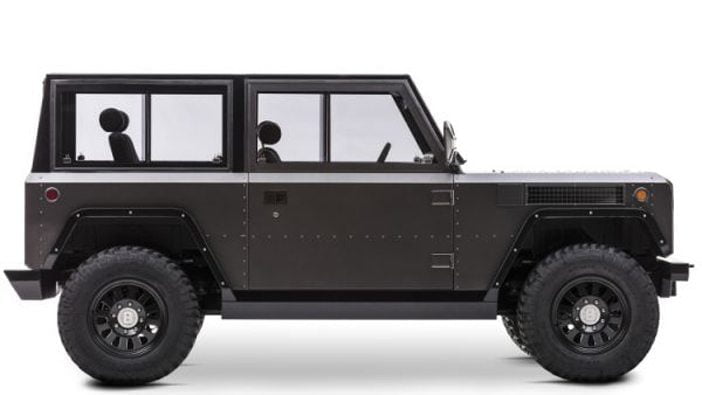
+++ Remember electric vehicle maker BOLLINGER ’s big, brawny off-road vehicles? The ones that launched the brand almost 8 years ago? Well, the first Bollinger trucks rolling out of a suburban Detroit plant this week look nothing like those. Bollinger Motors’ pivot, and the launch of its first saleable Class 4 electric trucks for fleet customers, is nearly as remarkable as the Bollinger B4’s tight turning radius. It will be interesting to see whether Bollinger’s move to commercial fleet vehicles pays off. +++
+++ The year 2025 is marked in red in the calendars of car manufacturers operating in Europe. From 1 January next year, the average CO2 EMISSIONS of their model ranges will have to be reduced from 116 to 94 g/km. Failure to do so will result in fines in the millions, 1 euro for every g/km in excess, to be multiplied by the number of cars sold. Solution? Sell more and more electric cars, so as to cut emissions as much as possible. A mission deemed practically impossible by ACEA, the association of European car manufacturers, who in a press release ask Europe for a postponement of the limits “A substantial and holistic review of the CO2 regulation will be essential to assess real-world progress against the level of ambition and to take appropriate measures”. So far, no response has come from Europe, while Carlos Tavares, CEO of Stellantis, harshly criticised the association’s demands: “It would be surreal to change European rules now. Everyone has known the rules for a long time, everyone has had time to prepare and so now we run”, said the Portuguese manager to the France Press agency, lashing out at ACEA, of which he has not been a member since 2022 and which counts giants such as the Renault Group and Volkswagen within its ranks. The Stellantis boss then points out that the rules have been known for a long time and that rushing to make amends today, just a few months after they came into force. From the point of view of the competition so dear to the EU, it would be surreal to change the rules now”. Naturally, there is also no shortage of criticism at Europe and its regulations, also because of the imposition of all-electric and the 2035-end for combustion cars. “Now we have the cars, we have organised ourselves to make the necessary sales, we are breathing down Tesla’s neck, and we are told there will be disasters. But we should have thought of that before, right?”, Tavares said. In his criticism of ACEA, Tavares also responds indirectly to Luca De Meo, CEO of the Renault Group and president of ACEA who, just a few days ago, had stressed the urgency of revising the rules: “European car manufacturers could face fines of 15 billion euros if they fail to comply with CO2 emission standards. To comply with the rules, manufacturers would have to reduce their production by ‘more than 2.5 million vehicles. The low emissions of electric models can compensate for the share of as many as four combustion cars, but the sector is still too weak at the moment”. A critical situation in many respects, with Volkswagen, for example, suffering also from the low demand for its electric cars. +++
+++ For several weeks now, we have often heard talk of changes in strategy or reversals of direction on the ELECTRIC TRANSITION ; Sweden’s Volvo is just the latest, in chronological order, to make statements on the subject. But is this really the case? Are manufacturers, who have invested billions and concentrated enormous efforts in a few years to convert to electric or start the process, really ready to backtrack? Not exactly: let us therefore shed some light by analysing the new plans brand by brand. The biggest wake-up call comes, as always, from the market: sales of electric cars in most countries are growing less than expected, even where they seemed to be off to a good start. Even China, the scene of the latest boom, is recording more modest increases than expected. The defect is not so much in the vision, which even the world’s leading manufacturers have shared (some more, some less), but in the timing. The goal of completely or almost completely wiping out traditional engines from the ranges and the market between 2030 and 2035 is perhaps proving to be hasty, because the sales trend is not progressing as expected. Contributing to this is the generalised crisis in sales, which is being driven by rising prices and a reduction in the purchasing power of households, especially in low-income brackets. A scenario in which electric vehicles, which are still proportionately more expensive than conventional ones, are not advantaged, despite incentives and concessions. The problem lies in the fact that manufacturers have not yet succeeded in bringing truly affordable products onto the market. The need to recoup huge investments and safeguard profit margins, together with the initial cost of the technologies, have prompted manufacturers to start with vehicles in the medium-high segment and positioning, which are, however, also those in which electric propulsion shows its limits the most, given that the yardstick for comparison is traditional cars suitable for long distances. To put it simply, there is a lack of small and cheap electric cars, or at least more affordable ones, which to all intents and purposes are only just beginning to arrive with models such as the Renault 5 E-Tech, Citroën ë-C3, Fiat Grande Panda Elettrica, Volkswagen ID.2 and so on. Having said that, manufacturers are not contemplating a real about-face, but are revising their statements of 3 years ago, when most had announced a total switch to electric in their ranges by the end of this decade or the middle of next. Today, however, many are beginning to retract by talking about a more gradual transition, with an increase in the hybrid offering and a lengthening of the timeframe, which, however, will still have to lead to the target. The first to become more tepid about the conversion to electric are the American giants. General Motors has revised both its production plans, scaling back its estimates for 2024 from 300.000 to 250.000 vehicles, and delayed the launches of some new cars. The CEO Mary Barra recently spoke of the intention to focus on plug-in hybrids for the North American market as well. Specifically, the Cadillac brand was planning to electrify the majority or almost the majority of its range by 2030, while today, vice=president John Roth announced that combustion engines could remain available beyond that date. Even Ford, after having played an early lead in the prolific pick-up sector with its F-150 Lightning, now seems to want to focus its attention on expanding its hybrid engine offering and, in the meantime, postpones the launch of other full-size electrics, which should have been imminent, to 2026-2027. Even those who seem to have embraced electric power with a convincing formula like Volvo are not safe from second thoughts. The goal of a ‘full electric’ range from 2030 is now under discussion, as the company makes it known that its market mix will no longer include 100 percent BEVs (battery electric vehicles), but at least 90 percent, so that the remaining 10 percent can allow ’the sale of a limited number of mild hybrid models, if necessary’. The Volkswagen Group and brand are investing in plug-in hybrids, which seem to have become the most popular in North America and China. According to market estimates for the USA and Canada, the Wolfsburg company is expected to make 55% of the sales mix electric by the end of the decade, and for Europe as much as 80%, but these estimates could now be scaled back considerably. Even Porsche, which recently introduced the historic first electrified engine in the 911, is not getting all the satisfaction it expected from its electric range. The plan to move 80% of sales to zero emissions remains, but the 2030 deadline falls. As for Mercedes, it had made one of the most shocking statements in 2021, announcing its intention to introduce only electric models from 2026 and to end production of all non-electric models by 2030. However, Stuttgart itself was quick to point out that this plan would be implemented ‘if the market allowed it’, and today we know that the EQ family, especially in the upper range, is suffering from a sales crisis. For Jaguar Land Rover, the electrification plan is still partly shrouded in mystery. The brand from Solihull is more “open” and linear, having started with the Range Rover EV and plans a second model for 2025, while Jaguar, which has announced a radical switch to electric from 2026, has not yet clearly confirmed which models it intends to launch and from when. Staying on the subject of luxury brands, even Bentley, despite having the Volkswagen Group behind it, has still taken some time. The first EV, initially planned for 2025, will instead only arrive 2 years later. In the meantime, rivals Rolls-Royce’s have already introduced the Spectre, but they are not yet talking about ending the reign of 8- and 12-cylinder engines. Even those who, like Renault, are writing the history of the electric car are showing some hesitation, despite the fact that the long-awaited 5 E-Tech is finally on its way, which will be followed by two other models (R4 and Twingo) in the more affordable segments of the market. CEO Luca De Meo admits that full electrification may not arrive by 2030 as announced, and perhaps not even by 2035 (barring European regulations). +++
+++ In EUROPE , the battery industry is going through a difficult period. Many manufacturers are reviewing their plans to go electric, both in terms of car production and cell and battery production. The cause is the general drop in demand for non-polluting cars that characterises the market. Volkswagen, Stellantis and Mercedes have already scaled back their green transition strategies, and the associated companies PowerCo and ACC have put the brakes on the construction of new Gigafactories around the world. Even Volvo, one of the brands most convinced that pure electric is the best choice for the future, recently declared that it would only sell battery-powered cars in 2030, but with the caveat: “provided we have the commercial conditions to do so”. Against this backdrop, one of the companies in difficulty is Northvolt, Europe’s largest battery manufacturer, which needs to find a way to control its costs and turn around its financial situation. Northvolt, which has numerous partnerships with the European manufacturers mentioned above (Volvo and Volkswagen in particular), began saying a few weeks ago that it was obliged to carry out a major internal reorganisation to put its accounts in order. Today it announced that it would be suspending production at its largest plant, Northvolt Ett Upstream 1 in Skelleftea (Sweden), and making redundancies (the number of redundancies was not specified). In addition, it will be looking for new partners to manage the factories in Poland and will be selling a site in Sweden for the production of cathode material. However, Northvolt has announced that the Swedish plants belonging to NOVO (the joint venture with Volvo) and those of Northvolt 3 in Germany and Northvolt 6 in Canada will continue to operate normally for the time being. It had been clear for some time that Northvolt was sailing in troubled waters. The company had already decided to postpone any future decision on the IPO until a more favourable time had come. Then there was the announcement of the closure of the R&D centre in California. But that’s not all. The Swedish company also faced difficulties in increasing production volumes, which posed a number of problems. It was precisely the inability to meet delivery deadlines that led BMW to cancel an order for cells worth €2 billion. The agreement between the Swedish company and the Munich-based manufacturer had been signed in July 2020 and was intended to guarantee components for the construction of batteries for the iX and i4. +++
+++ Along with Geely, STELLANTIS is the car group with the largest number of brands in its range. Created in 2021 following the merger between PSA (5 brands at the time) and FCA (9 brands), it has retained all the brands, and the new CEO has decided to give each of them a 10-year period to determine their viability. 3 years after the merger, however, the situation is complicated. Managing so many brands that often overlap can be difficult. Add to this the growing pressure from Chinese manufacturers and the targets for electrification, and the problem is considerable. Which are the most promising brands? A brand’s potential today is measured by its ability to attract numerous markets and customers around the world. It is not enough to be competitive in a single market or region. Increasing competition from China is making life difficult for everyone, especially for brands with strong exposure to a single market. That’s why I think Jeep has been and remains Stellantis’ most interesting brand. Despite the difficulties it faces today, it is widely known, operates in the right segment and has a good history. This iconic brand accounted for 17% of the Group’s worldwide sales in 2023, with 1.04 million units. The total fell by 6% in 2022 due to some demand issues in the US and Canada and the cessation of local production in China. However, Jeep has found a good position in Brazil and Europe and could improve its presence in the Middle East, Africa and South-East Asia. The challenge is to offer more products on a more regular basis. Ram also has potential. It is an American brand with no presence in Europe or Asia. However, it operates in the pick-up and light commercial vehicle segments, which are highly strategic in developing economies, where growth is on the cards. Latin America, Africa, the Middle East and Turkey, Central Asia, India and South-East Asia will account for 22% of global light vehicle sales in 2023 (excluding Russia and Iran). Add Australia and New Zealand, where pick-ups are very popular, and you have almost a quarter of global car sales. Sales of pick-up trucks, commercial vans and light commercial vehicles in these markets totalled 3.8 million units. This total rises to 7.5 million units if the United States and Canada, where Ram is already present, are included. The third brand which, in my opinion, is still shining is Maserati. It is currently one of Stellantis’ most troubled brands, but it has a number of strengths which, if properly exploited, could end up giving it some satisfaction. Firstly, it is still considered to be a luxury brand, which is very important because it is not exposed to Chinese competition in the same way as mainstream and high-end brands (luxury is still a European affair). Secondly, it is a global brand in the sense that it is known everywhere, even if it is not available in all markets. Although it lags behind Porsche in terms of sales and product range, it remains a popular brand with a strong association with Italian craftsmanship and design. These values are crucial in the higher segments where competition is fierce, but there is room for a bigger Italian luxury car maker, given that Ferrari and Lamborghini are concentrating on sports cars and supercars. +++
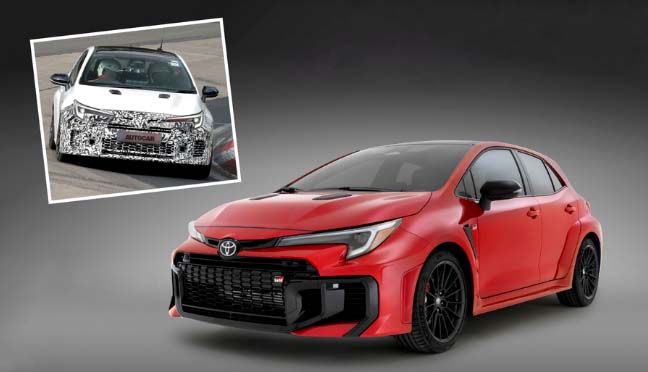
+++ TOYOTA looks to be readying its GR Corolla hot hatchback for a European launch as prototypes begin testing at the Nürburgring. Hot hatch fans have long called for Toyota to bring the Gazoo Racing variant of the Corolla to Europe. The standard car is the Japanese brand’s third biggest seller in the region, behind the Yaris and Yaris Cross. Toyota’s performance division performs strongly already in the region with its three current models, the GR Yaris, GR Supra and GR 86. However, the latter is being killed off soon by the EU’s new GSR2 safety regulations, which could make space for the Corolla to finally go on sale in Europe. The standard Corolla is built in Bernaston, Derbyshire, but the all-wheel-drive hot version is built at the same Motomachi facility in Japan as the GR Yaris. It has already been engineered in both left-hand drive (for North America) and right-hand drive (for Japan). The latest version, unveiled this summer and spotted testing at the Nürburgring in right-hand drive guise, is powered by a turbocharged 1.6-litre engine that makes 300 hp. That’s 42 hp more than the GR Yaris, which uses the same three-pot powertrain and four-wheel drive system. It can, like the Yaris, also be optioned with either a 8-speed automatic or 6-speed manual gearbox. With those power figures it is a natural rival for the likes of the BMW M135i (300 hp), Honda Civic Type R (320 hp), and Volkswagen Golf R (333 hp). A more powerful GRMN (Gazoo Racing Meisters of the Nürburgring) variant has also been spotted lapping the Nordschleife (pictured below). Not yet revealed, the track-honed GR Corolla sits lower to the road and sports a chunkier rear wing. Toyota already sells a special-edition GRMN Yaris in its home market in very limited numbers, which is a stiffer, lighter and more powerful version of the GR Yaris. Asked about the prototypes, a Toyota spokesperson told that “all major car manufacturers test their biggest global products at the Nürburgring”, but did not deny the possibility of the car being destined for European dealerships. Even if it is confirmed to be sold on this side of the Atlantic, the GR Corolla would no doubt be a highly exclusive proposition. It’s currently sold in North America from $36,500, but if it follows a similar costing structure to its sibling in Europe (which commands a high premium over the standard Yaris), it would cost north of €80.000. +++
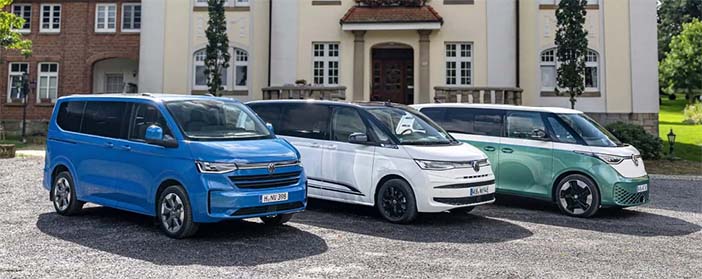
+++ The most important new product from VOLKSWAGEN Commercial Vehicles at the IAA Transportation 2024 is undoubtedly the new Transporter and Caravelle. However, there are also innovations in other model series, such as the Multivan and ID.Buzz. For the first time, Volkswagen Commercial Vehicles is showing the Multivan as a version with a combined plug-in hybrid and all-wheel drive. The new Multivan eHybrid 4Motion is the first Volkswagen Group model series based on the modular transverse matrix to feature this system. The 245 hp plug-in hybrid drive temporarily turns the Multivan eHybrid 4Motion into an electric car for everyday use, as the van can cover long distances purely electrically thanks to a 19.7 kWh battery. The second-generation plug-in hybrid drive is extremely efficient and will therefore enable long journeys between refuelling stops. The drive consists of a combination of an electric motor and a turbocharged high-tech petrol engine (1.5 TSI evo2) with a VTG charger (turbocharger with variable turbine geometry). At the same time, the ID.Buzz programme has been expanded upwards and downwards. In addition to the 286 PS Pro models with normal wheelbase (NWB) and 79 kWh battery, the 286 hp strong ID.Buzz with a long wheelbase (LWB) including a large 86 kWh battery and a range of up to 485 km as well as the 2 GTX models with 340 hp, all-wheeldrive (NWB: 79 kWh, up to 420 km range ; LWB: 86 kWh, up to 475 km range) can now be ordered in Germany. +++